
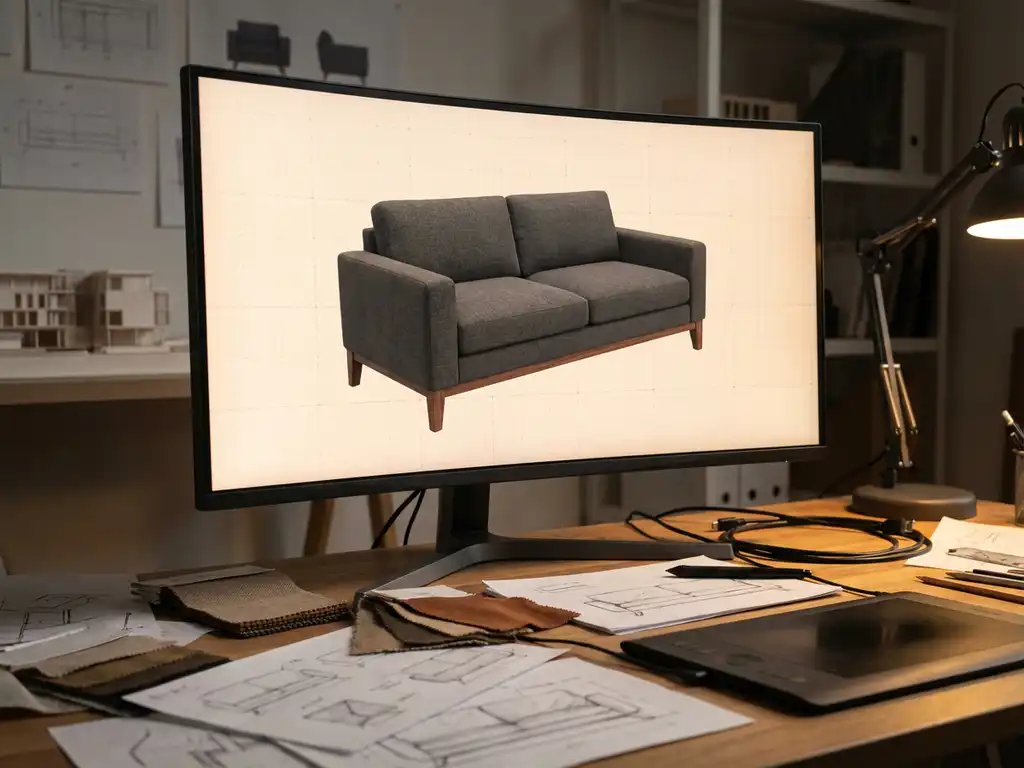
Retailers are increasingly turning to 3D product rendering to compete online by creating photorealistic digital product images without the costs of traditional photography. This technology enables unlimited product variations, interactive customer experiences, and faster time to market while reducing operational expenses. Modern consumers expect immersive shopping experiences, and 3D rendering delivers the visual quality and customization options that drive conversions and reduce returns in competitive online marketplaces.
What is 3D product rendering, and why are retailers adopting it?
3D product rendering is a digital technology that creates photorealistic images and interactive experiences from three-dimensional product models. Instead of photographing physical products, retailers use computer-generated imagery to showcase items with precise lighting, textures, and environments that often match or exceed the quality of traditional photography.
The core capabilities extend far beyond simple product images. Modern 3D rendering enables real-time customization, allowing customers to modify colors, materials, configurations, and components instantly. This creates an interactive shopping experience in which buyers can visualize exactly what they’re purchasing before making a decision.
Retailers are adopting this technology for three primary business reasons. Cost reduction is the most immediate benefit, as a single 3D model can generate thousands of product variations without additional photography sessions. Scalability becomes achievable when launching new product lines or entering new markets, as digital assets can be modified and deployed rapidly across multiple channels.
An enhanced customer experience drives long-term competitive advantage. Today’s consumers expect interactive, personalized shopping experiences that traditional e-commerce cannot deliver. 3D rendering bridges the gap between online and in-store shopping by providing the visual detail and interactivity that builds purchase confidence.
How does 3D rendering help retailers reduce costs and increase efficiency?
3D rendering eliminates the recurring costs of traditional product photography while dramatically improving content production efficiency. A single 3D model replaces hundreds of individual photoshoots, reducing both direct photography expenses and the logistical complexity of coordinating shoots for every product variation.
Physical prototypes and sample libraries become unnecessary when customers can interact with photorealistic digital versions. This particularly benefits furniture and interior design retailers, who have traditionally maintained expensive showrooms and sample collections. The elimination of physical samples reduces storage costs, shipping expenses, and the risk of damage or obsolescence.
Visual Commerce Solutions
Talk to our team about your project.
Content production workflows scale efficiently with product catalogs. When launching new colors, materials, or configurations, retailers can generate complete visual content libraries in days rather than months. This speed-to-market advantage becomes crucial in competitive industries where product cycles are accelerating.
Operational efficiency extends beyond content creation. Customer service teams can use interactive 3D models to demonstrate products and answer questions more effectively. Sales processes become more streamlined when customers can visualize and customize products independently, reducing the need for extensive sales support while improving conversion rates.
What competitive advantages do retailers gain from 3D product visualization?
3D product visualization enables mass customization at scale, allowing retailers to offer personalized products that competitors using traditional photography cannot match. Customers can modify colors, materials, sizes, and configurations in real time, creating a sense of ownership before purchase that significantly improves conversion rates.
The immersive shopping experience addresses the primary weakness of online retail: the inability to physically examine products. Interactive 3D models allow customers to rotate, zoom, and examine products from every angle, building the confidence typically associated with in-store shopping. This enhanced engagement translates directly into higher conversion rates and lower return rates.
Product categories that were previously difficult to sell online become accessible through 3D visualization. Complex, configurable products, furniture, and customizable items can be presented with a clarity that static images cannot achieve. This opens new market opportunities and allows retailers to compete in segments previously dominated by physical showrooms.
Brand differentiation becomes achievable through superior visual presentation. When competitors rely on traditional photography, retailers using high-quality 3D rendering create a premium brand perception that justifies higher prices and builds customer loyalty. The technology itself becomes a competitive moat that is difficult for competitors to replicate quickly.
How are customers responding to 3D product experiences in online retail?
Customer engagement metrics consistently show higher interaction rates with 3D product content than with traditional images. Users spend significantly more time exploring products when interactive 3D models are available, indicating increased interest and purchase consideration. The ability to customize and visualize products creates an engaging experience that customers actively seek out.
Purchase confidence increases substantially when customers can interact with realistic 3D representations. The uncertainty that typically accompanies online shopping diminishes when buyers can examine products from multiple angles, test different configurations, and see realistic material representations. This confidence translates into higher conversion rates and fewer abandoned shopping carts.
Return rates decrease when customers’ expectations are set accurately through detailed 3D visualization. The common disconnect between product images and reality becomes less problematic when customers can examine products thoroughly before purchase. This particularly benefits categories such as furniture and fashion, where fit, scale, and appearance are crucial factors.
Customer behavior patterns reveal a preference for personalized shopping experiences that 3D technology enables. Buyers appreciate the ability to customize products to their preferences and see immediate visual feedback. This interactive element transforms passive browsing into active engagement, creating stronger emotional connections with products and brands.
What challenges do retailers face when implementing 3D product rendering?
Technical integration complexity is the primary implementation hurdle for retailers adopting 3D product rendering. Existing e-commerce platforms may require significant modifications to support interactive 3D content, and ensuring consistent performance across devices and browsers demands careful technical planning and testing.
Content creation workflows must be restructured to accommodate 3D asset production. Teams accustomed to traditional photography need training in 3D modeling, rendering, and asset management. The initial learning curve can slow implementation, particularly for organizations without existing 3D expertise or well-defined workflow processes.
Initial investment considerations include both technology costs and resource allocation for content creation. While 3D rendering reduces long-term expenses, the upfront investment in software, training, and initial asset creation can be substantial. Retailers must plan carefully to ensure adequate budget allocation and realistic timeline expectations.
Staff training requirements extend beyond technical teams to include customer service, marketing, and sales personnel who will work with the new technology. Everyone involved in the customer experience needs to understand how 3D features work and how to communicate their benefits effectively to customers.
Quality standards must be established to ensure 3D content meets brand expectations. Unlike traditional photography, where quality is immediately apparent, 3D rendering quality depends on technical specifications, rendering settings, and optimization choices that require expertise to evaluate and maintain consistently.
How 3dimerce helps retailers compete with 3D product rendering
We provide a comprehensive platform that addresses every challenge retailers face when implementing 3D product rendering technology. Our experienced team combines high-quality visual output with seamless integration capabilities, enabling retailers to compete effectively without the typical implementation complexity.
Key benefits of our approach include:
- Seamless integration with existing e-commerce platforms and retail systems
- Scalable content production workflows that grow with your product catalog
- Comprehensive training and support throughout implementation and beyond
- Blazing-fast performance optimized for all devices and browsers
- Stunning visual quality that exceeds traditional photography standards
- Flexible customization options tailored to your specific industry needs
Our platform eliminates the technical barriers that prevent retailers from adopting 3D rendering technology effectively. With over 20 years of experience in the European market, we understand the specific challenges facing premium brands and provide solutions that deliver immediate competitive advantages.
Ready to transform your online product presentation and compete more effectively? Contact us today to discuss how our 3D product rendering platform can elevate your retail strategy and drive measurable results.