
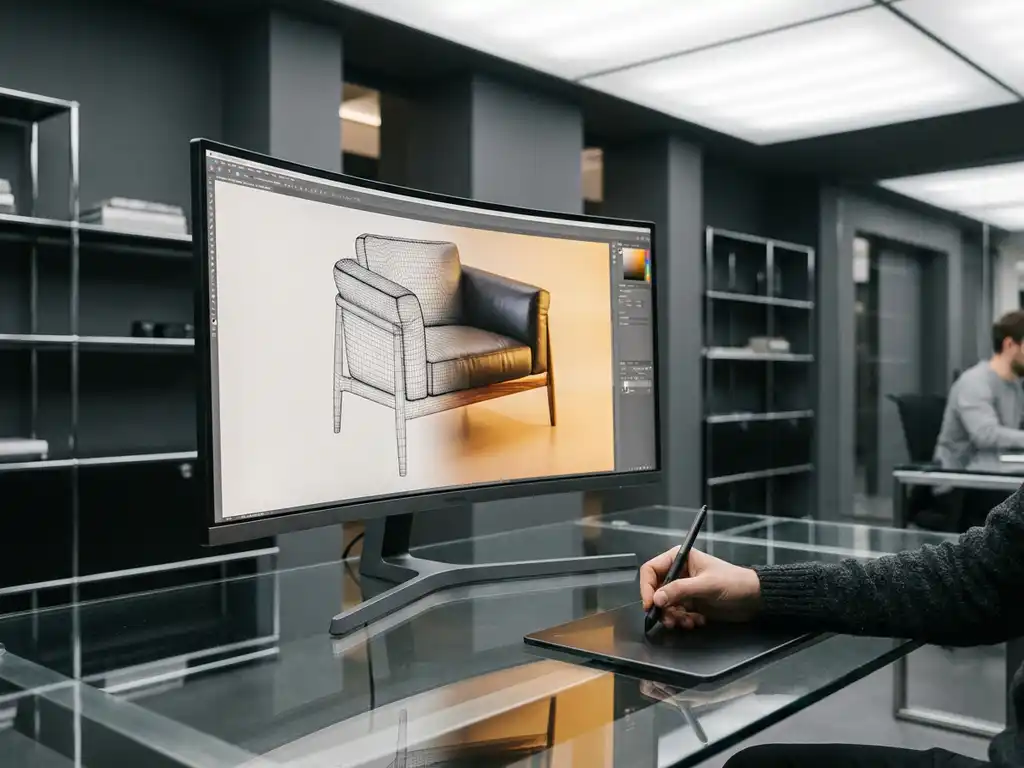
3D rendering software is a computer program that transforms three-dimensional digital models into photorealistic images or animations by simulating how light interacts with virtual objects, materials, and environments. This technology has become essential for industries ranging from architecture and product design to entertainment and marketing, enabling creators to visualize concepts before they exist in the physical world.
Why are outdated visualization methods limiting your product sales potential?
Traditional product photography creates a bottleneck that costs businesses thousands in missed opportunities and operational inefficiencies. When you rely on physical photoshoots for every product variant, color option, or configuration, you’re locked into a cycle where new products take weeks to reach the market, seasonal updates require expensive reshoot schedules, and customization options remain limited to what you can physically produce and photograph. This approach particularly hurts premium brands where visual quality directly impacts customer perception and purchase decisions. The solution lies in adopting 3D rendering workflows that generate unlimited product variations instantly, allowing you to respond to market demands in real-time while maintaining consistent visual excellence across all channels.
What does inconsistent product imagery signal about your brand positioning?
When your product visuals vary in lighting, angle, or quality across different platforms, customers unconsciously question your attention to detail and professional standards. This inconsistency becomes especially damaging for luxury and design-focused brands where visual perfection is expected. Mixed lighting conditions between your website, social media, and retail displays create a fragmented brand experience that erodes trust and reduces conversion rates. The path forward involves implementing a unified 3D rendering system that ensures every product image maintains identical lighting, perspective, and quality standards, regardless of where customers encounter your brand.
Visual Commerce Solutions
Talk to our team about your project.
What is 3D rendering software and why is it important?
3D rendering software converts mathematical descriptions of three-dimensional objects into two-dimensional images that appear realistic to human eyes. The process involves complex calculations that simulate how light rays bounce off surfaces, creating shadows, reflections, and material properties that make virtual objects appear tangible and authentic.
This technology has become crucial for modern businesses because it eliminates the limitations of traditional photography while offering unprecedented creative control. Companies can visualize products before manufacturing, create marketing materials for items that don’t yet exist, and generate thousands of product variations without the time and cost constraints of physical photoshoots. Industries like automotive, furniture, fashion, and architecture rely heavily on 3D rendering to communicate design concepts, test market reception, and streamline production workflows.
How does 3D rendering software actually work?
The 3D rendering process begins with a digital model created using specialized modeling software. This model contains geometric data that defines the shape, size, and structure of objects in three-dimensional space. Artists then apply materials and textures to these models, defining how surfaces should appear in terms of color, roughness, transparency, and reflectivity.
The rendering engine performs ray tracing calculations to simulate how light travels through the virtual scene. It calculates how light rays interact with each surface, determining which rays reach the virtual camera and at what intensity. The software considers factors like light source positions, material properties, atmospheric effects, and camera settings to generate the final image. Advanced algorithms handle complex phenomena like subsurface scattering in skin or fabric, caustics from glass or water, and global illumination that creates realistic ambient lighting.
Modern rendering engines use sophisticated mathematical models to achieve photorealistic results. They calculate millions of light ray interactions per second, determining how light bounces between surfaces, gets absorbed by materials, or passes through transparent objects. The final output depends on render settings that balance quality against processing time.
What’s the difference between real-time and offline rendering?
Real-time rendering prioritizes speed over absolute visual fidelity, generating images fast enough to create smooth interactive experiences. This approach uses simplified lighting calculations and optimized algorithms to achieve frame rates of 30-60 images per second or higher. Real-time rendering powers video games, virtual reality applications, and interactive product configurators where users need immediate visual feedback.
Offline rendering focuses on maximum visual quality regardless of processing time. These systems can spend minutes or hours calculating a single image, using complex algorithms that simulate light behavior with scientific accuracy. Offline rendering produces the photorealistic imagery used in films, architectural visualizations, and high-end product marketing where visual perfection is paramount.
The choice between approaches depends on application requirements. Interactive product configurators benefit from real-time rendering that responds instantly to customer customization choices, while marketing campaigns might use offline rendering to create stunning hero images that showcase products in their best light.
What types of 3D rendering software are available?
Professional 3D rendering software spans several categories designed for different use cases and skill levels. High-end packages like Autodesk Maya, 3ds Max, and Cinema 4D offer comprehensive toolsets for modeling, animation, and rendering, typically used by film studios and design agencies. These applications provide maximum creative control but require significant training and powerful hardware.
Specialized rendering engines like V-Ray, Corona, and Octane focus purely on image generation, integrating with modeling software to provide advanced lighting and material capabilities. These tools excel at producing photorealistic results for architectural visualization and product rendering.
Cloud-based and SaaS rendering platforms have emerged to democratize access to professional-quality 3D visualization. These solutions handle the technical complexity behind user-friendly interfaces, allowing businesses to generate high-quality product imagery without extensive 3D expertise. Real-time web-based configurators enable customers to customize products and see changes instantly, bridging the gap between professional rendering quality and consumer accessibility.
How can businesses use 3D rendering for product visualization?
Product visualization through 3D rendering transforms how companies present their offerings across sales and marketing channels. Manufacturers can create complete product catalogs before physical production, enabling early market testing and pre-order campaigns. This approach particularly benefits companies with configurable products, where traditional photography would require shooting every possible combination.
E-commerce applications leverage 3D rendering to provide interactive shopping experiences. Customers can rotate products, change colors and materials, and see customizations in real-time. This level of engagement increases confidence in purchase decisions and reduces return rates. Advanced configurator solutions integrate directly with e-commerce platforms, allowing seamless transitions from customization to purchase.
Retail environments use 3D visualization to overcome physical space limitations. Digital showrooms can display entire product ranges without inventory requirements, while interactive displays let customers explore options that might not be available for immediate purchase. This technology proves especially valuable for furniture and interior design retailers where space constraints limit what can be physically displayed.
How 3Dimerce helps with 3D rendering and product visualization
We specialize in delivering enterprise-grade 3D rendering solutions that combine photorealistic quality with blazing-fast performance. Our visual product experience platform transforms how luxury and design-focused brands showcase their products, offering:
- Stunning visual quality: Our rendering technology produces images that match or exceed traditional photography standards, with perfect lighting, shadows, and material representation.
- Real-time configurators: Customers can customize products instantly, seeing changes in photorealistic quality without waiting for page reloads.
- Omnichannel consistency: The same high-quality visuals work seamlessly across websites, mobile apps, and in-store displays.
- Scalable content generation: Create unlimited product variations without additional photoshoot costs or production delays.
- Seamless integration: Our headless architecture connects with existing e-commerce platforms and sales systems.
Ready to transform your product visualization strategy? Contact our team to discover how our 3D rendering platform can elevate your brand’s digital presence and drive measurable improvements in customer engagement and sales conversion.
Frequently Asked Questions
How long does it typically take to implement a 3D rendering solution for an existing product catalog?
Implementation timelines vary based on catalog size and complexity, but most businesses see their first rendered products within 2-4 weeks. The process involves creating 3D models from existing product data, setting up materials and lighting, and integrating with your current systems. Large catalogs with hundreds of products may take 2-3 months for complete conversion, but you can launch with priority products while the rest are being processed.
What's the typical return on investment for switching from photography to 3D rendering?
Most companies see ROI within 6-12 months through reduced photography costs, faster time-to-market, and improved conversion rates. The cost savings become particularly significant when you factor in eliminated reshoot expenses, reduced inventory needs for photography, and the ability to create unlimited product variations instantly. Many businesses report 15-30% increases in conversion rates due to better product visualization and interactive experiences.
Do I need to hire 3D specialists or can my existing marketing team manage rendered content?
Modern 3D rendering platforms are designed for marketing teams without technical 3D expertise. User-friendly interfaces allow you to change colors, materials, and configurations with simple point-and-click controls. While initial setup may require 3D specialists, day-to-day content management can typically be handled by existing marketing staff with minimal training.
How do I ensure 3D rendered images match the actual product quality customers receive?
Accurate 3D rendering requires precise material scanning and color calibration to match real-world products. Professional 3D rendering services use spectrophotometers and material scanners to capture exact surface properties. Regular quality checks comparing rendered images to physical samples ensure consistency. Many platforms also offer color-managed workflows that maintain accuracy across different displays and devices.
Can 3D rendering handle complex materials like fabric textures, wood grain, or metal finishes?
Advanced 3D rendering excels at reproducing complex materials through sophisticated material modeling and texture mapping. Modern rendering engines can accurately simulate fabric weaves, wood grain patterns, brushed metal finishes, and even subtle effects like leather aging or fabric pilling. The key is using high-quality material scans and proper shader setup during the initial modeling phase.
What happens if I need to update product designs or add new variants after the 3D models are created?
Well-structured 3D workflows make updates straightforward and cost-effective. Parametric modeling techniques allow quick modifications to dimensions, proportions, or features without rebuilding entire models. Adding new color or material variants typically takes minutes rather than scheduling new photoshoots. Most professional 3D rendering services include revision cycles in their packages to accommodate design changes.
How do customers typically respond to interactive 3D product configurators compared to static images?
Interactive 3D configurators consistently outperform static imagery in engagement metrics and conversion rates. Customers spend 2-3x longer on product pages with 3D configurators and show 40-60% higher purchase intent. The ability to customize and immediately visualize changes creates a sense of ownership that traditional product photography cannot match. This engagement translates directly into reduced return rates and higher customer satisfaction.