
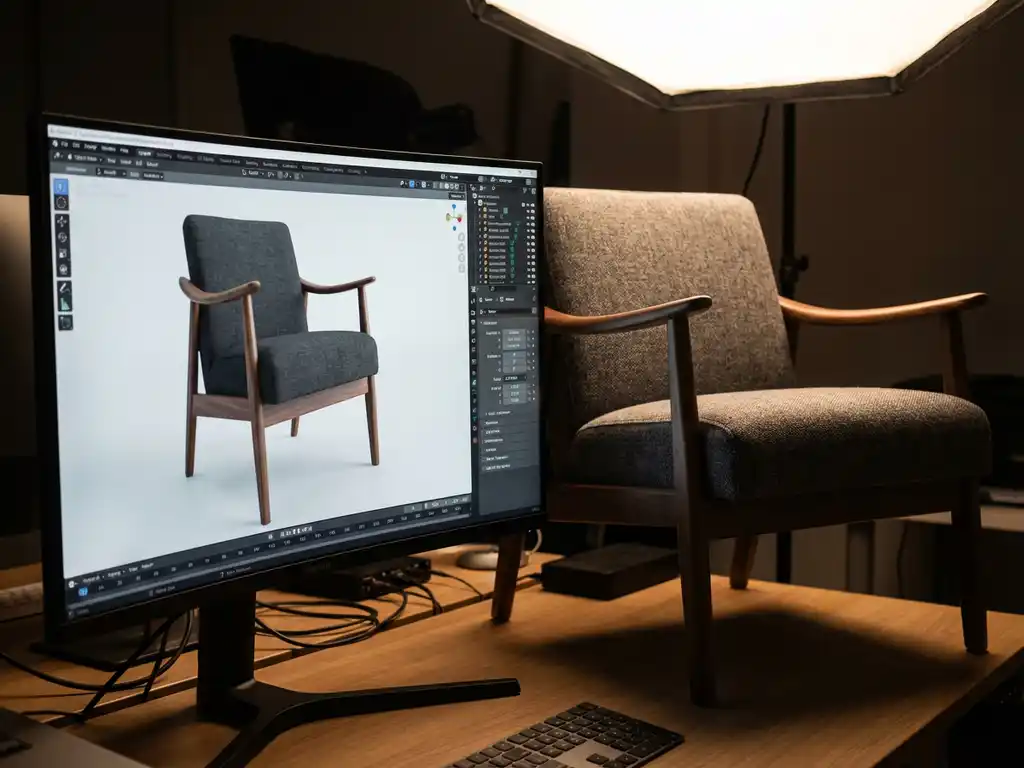
A 3D CGI render and a CGI image are not the same thing — even though both are produced entirely by computer software. Understanding the CGI render meaning, and how it differs from broader CGI imagery, is the first step toward choosing the right visualisation strategy for your products. 3D product rendering focuses specifically on creating photorealistic images of individual products for commercial use, while CGI imagery encompasses a broader range of computer-generated visuals, including environments, characters, and complex scenes. Both methods create compelling visuals without traditional photography, but understanding their distinctions helps businesses choose the right approach for their specific needs.
What Does CGI Render Mean? Key Terms Explained
Before comparing the two approaches, it helps to understand what these terms actually mean. CGI — short for Computer-Generated Imagery — refers to any visual content produced using computer software rather than a camera. A CGI render is the final image output of that process: the moment the software calculates light, shadow, and material properties to produce a photorealistic frame. Whether you are looking at a 3D CGI render of a luxury kitchen cabinet or a visual effects shot in a film, the underlying principle is the same — a computer has constructed every pixel.
The following key terms appear throughout this guide and across the industry:
- CGI (Computer-Generated Imagery): The broad category of all visual content created digitally using computer software, spanning product images, architectural visualisations, film effects, and game environments.
- 3D Rendering: The computational process of converting a 3D scene — geometry, materials, lights, and camera — into a flat 2D image. CG rendering is the engine behind every photorealistic product image you see online.
- PBR (Physically Based Rendering): A rendering methodology that simulates how light interacts with real-world surfaces. PBR ensures that materials such as brushed steel, matte lacquer, or polished marble behave exactly as they would under physical lighting conditions.
- Ray Tracing: A rendering technique that traces the path of light rays as they bounce between surfaces, producing highly accurate reflections, refractions, and shadows. It is the gold standard for photorealistic CG renders in the design and luxury segment.
- Real-Time Rendering: Rendering that produces images fast enough to respond to user input instantly — the technology behind interactive product configurators and augmented reality viewers.
3D Product Rendering vs. CGI Imagery: What Is the Real Difference?
3D product rendering is a specialised subset of CGI (computer-generated imagery) that focuses exclusively on creating photorealistic images of products for commercial purposes. CGI imagery is the broader umbrella term covering all computer-generated visual content, including films, games, architectural visualisations, and product imagery. CGI renders — whether used for product visualisation, architectural walkthroughs, or brand storytelling — all originate from the same core CG rendering pipeline, but their goals and workflows diverge significantly.
The primary distinction lies in their scope and application. 3D product rendering concentrates on accurately representing physical products with precise materials, textures, and lighting to showcase items for sales and marketing. This technique prioritises product accuracy, configurability, and commercial viability.
CGI imagery, conversely, encompasses creative and artistic applications beyond product visualisation. It includes character animation, environmental scenes, special effects, and conceptual artwork, where artistic interpretation often takes precedence over commercial accuracy.
Product rendering typically requires detailed product specifications, material properties, and brand guidelines to ensure the digital representation matches the physical item exactly. CGI projects may prioritise visual impact, storytelling, or creative expression over technical precision.
The workflow differences are significant as well. Product rendering follows standardised processes to ensure consistency across product ranges, while CGI projects often involve unique creative pipelines tailored to specific artistic visions.
Which Delivers Better Marketing Results: 3D CGI Renders or General CGI Imagery?
3D product rendering delivers superior results for most product marketing campaigns because it is specifically designed for commercial applications. It produces consistent, accurate product representations that customers can trust when making purchasing decisions — something broader CGI work is not optimised to do.
Product rendering excels in e-commerce environments where customers need to examine products closely. The technique produces multiple angles, configurations, and contextual settings from a single 3D model, providing comprehensive product views that traditional photography cannot match cost-effectively. The CG renders produced through a dedicated product rendering workflow are optimised for commercial use, ensuring that every CGI asset meets the resolution, colour-accuracy, and format requirements of modern e-commerce and marketing platforms.
For marketing campaigns, product rendering offers unmatched flexibility. Marketers can adjust colours, materials, and configurations instantly without new photoshoots. This agility enables rapid campaign iterations and personalised content creation.
CGI imagery works better for brand storytelling and emotional marketing, where creative interpretation adds value. However, for direct product promotion, the accuracy and consistency of product rendering typically convert better because customers see exactly what they will receive.
The scalability factor strongly favours product rendering for businesses with extensive product catalogues. Once the initial 3D models are created, generating variations becomes efficient and cost-effective. Real-world applications demonstrate how product rendering streamlines marketing workflows while maintaining visual quality.
Why Choose 3D Product Rendering Over Traditional Photography?
For B2B decision-makers weighing their options, the comparison between 3D product rendering and traditional photography is just as important as understanding how rendering differs from general CGI. The advantages of rendering become especially clear when evaluated against the real operational costs and constraints of a conventional photoshoot.
- Cost at scale: A traditional photoshoot requires physical samples, a studio, a photographer, and reshoots for every new variant or colour. With 3D rendering, a single approved model generates unlimited colour, material, and configuration variants at a fraction of the per-image cost — making large catalogues dramatically more affordable.
- Speed to market: Booking studios, shipping samples, and processing RAW files takes weeks. A 3D CGI render can be produced and approved within days, enabling faster campaign launches and more responsive seasonal updates.
- Pre-production availability: Photography requires a finished physical product. 3D rendering can produce market-ready imagery from CAD files alone — meaning product listings, trade show materials, and retailer catalogues can go live before the first unit is manufactured.
- Variant flexibility: Every colour, finish, configuration, and size can be visualised from a single base model. Changing a fabric from charcoal to ivory or swapping a handle finish from brushed brass to matte black takes minutes, not another photoshoot.
- Sustainability: Eliminating physical prototypes, studio logistics, and international sample shipping reduces material waste and carbon footprint — a growing factor in B2B procurement decisions and brand responsibility reporting.
We deliver all of these advantages within a single, integrated platform built specifically for the design and luxury segment — combining the visual quality that premium brands demand with the operational efficiency that modern marketing teams require.
Visual Commerce Solutions
Talk to our team about your project.
Cost and Timeline Comparison: 3D Product Rendering vs. CGI Imagery
3D product rendering generally offers better long-term cost efficiency for businesses with multiple product variants, while CGI imagery costs vary dramatically based on project complexity and creative requirements.
Initial setup costs for product rendering are higher because creating accurate 3D models requires detailed product specifications and technical precision. However, once established, the cost per additional image drops significantly — businesses can generate unlimited angles, colours, and configurations from existing models without commissioning new assets.
CGI imagery costs depend heavily on creative complexity. Simple scenes may cost less initially, but elaborate environments, character animation, or special effects can become extremely expensive. Each project often requires unique assets and workflows that cannot be reused across a product catalogue.
Timeline considerations favour product rendering for ongoing marketing needs. Initial 3D model creation typically takes one to three weeks, depending on product complexity, but subsequent images can be generated within days. This speed supports rapid campaign deployment and seasonal updates.
CGI projects typically require longer creative development phases, including concept approval, asset creation, and iterative refinement. Complex scenes may take months to complete, making them less suitable for time-sensitive marketing campaigns.
The revision process also differs significantly. Product rendering allows precise adjustments to materials, lighting, and configurations efficiently. CGI projects may require substantial rework if the creative direction changes, affecting both cost and timeline.
How the 3D CGI Rendering Process Works: From Brief to Final Image
For B2B decision-makers unfamiliar with the technology, understanding what actually happens between submitting a project brief and receiving a finished CGI render removes uncertainty and makes it far easier to plan budgets, timelines, and internal approvals. The process is more structured — and more collaborative — than many expect.
- Product brief and asset collection: We begin by gathering your product specifications — CAD files, material swatches, brand guidelines, and reference photography. The more detail provided at this stage, the more accurate the final render. A thorough brief eliminates costly revisions later and ensures the finished CGI asset reflects your product exactly.
- 3D modelling and geometry build: Our team constructs a precise digital model of your product based on the supplied specifications. Every dimension, edge, and surface detail is built to match the physical item — or, in the case of pre-production renders, the design intent. This is where the foundation of a photorealistic result is established.
- Material and texture application (PBR workflow): Using a physically based rendering workflow, we apply materials that simulate real-world surface behaviour. Whether the finish is polished marble, brushed aluminium, or hand-stitched leather, the material responds to light exactly as it would in a physical environment — a critical quality standard for the design and luxury segment.
- Lighting setup and camera positioning: Lighting defines the mood, depth, and perceived quality of a render. We configure lighting rigs and camera angles to match your brand’s visual language — whether that means clean studio lighting for e-commerce or atmospheric scene lighting for aspirational lifestyle imagery.
- Render engine processing: The scene is submitted to our advanced render farm infrastructure, which compresses processing time without compromising the photorealistic quality your brand demands. What might take hours on a single workstation is completed in a fraction of the time — enabling the blazing-fast turnaround that time-sensitive campaigns require.
- Post-production and delivery: Final images are refined in post-production — colour grading, background compositing, and format preparation — before being delivered in the exact file formats your channels require. Assets are ready for immediate upload, with no additional conversion steps needed.
Types of CGI Renders: Stills, Animation, and Real-Time Visualisation
CGI rendering is not a single output — it is a spectrum of visual formats, each suited to different marketing channels and customer touchpoints. Understanding which format serves which purpose helps businesses invest in the right output types for their specific goals.
Static still renders
Static CGI renders are the most widely used format for product marketing: hero shots, lifestyle images, and close-up detail renders that showcase a product’s form, finish, and craftsmanship. These images are the backbone of e-commerce listings, printed catalogues, trade show materials, and digital advertising. A single approved 3D model can generate dozens of still renders — every angle, every colour variant, every configuration — without a single additional photoshoot.
CGI animation
Product animations extend the power of 3D CGI renders into motion. Turntable animations allow customers to see a product from every angle in a single viewing experience. Exploded-view animations reveal internal components and construction quality — particularly valuable for technical marketing in appliances, electronics, and engineered products. Lifestyle video sequences place products in aspirational environments with cinematic production values, reinforcing premium brand positioning across social media and digital advertising channels.
Real-time and interactive visualisation
Real-time rendering is where the technology becomes genuinely transformative for e-commerce and retail. Interactive product configurators allow customers to explore every variant — colour, material, size, and finish — live on a product page, reducing purchase hesitation and increasing conversion rates. Our platform supports blazing-fast interactive configurators that deliver this experience without compromise. AR-ready file formats (USDZ for Apple devices, GLB for web and Android) enable shoppers to place a product in their own space before committing to a purchase — a capability that is increasingly expected in the design and luxury segment.
The future of CGI rendering: AI, real-time, and immersive experiences
The CGI rendering landscape is evolving rapidly. AI-assisted rendering tools now dramatically reduce the processing time required to produce clean, noise-free images — meaning faster turnaround without any compromise in visual quality. Machine learning is also accelerating material generation, allowing complex surface properties to be created and applied with far greater speed than traditional manual workflows allow.
Real-time rendering via game-engine technology is enabling a new generation of interactive product experiences — from live configurators on product pages to fully immersive virtual showrooms. Augmented reality integrations allow shoppers to visualise a sofa in their living room or a kitchen cabinet in their actual space before committing to a purchase — a capability that is increasingly expected in the design and luxury segment. We are already positioned to deliver all of these capabilities, ensuring that our clients remain at the forefront of visual commerce as the technology continues to advance.
What technical requirements do businesses need for 3D product rendering vs. CGI imagery?
3D product rendering and CGI imagery share some infrastructure requirements but differ in the expertise and tooling they demand. Understanding these differences helps businesses assess whether to build internal capabilities or partner with a specialist provider.
Technical requirements for 3D product rendering
3D product rendering requires specialised software, high-performance hardware, and technical expertise in product modelling and photorealistic rendering. Businesses typically need dedicated workstations with powerful graphics cards and substantial RAM for complex product visualisations.
The software stack includes professional 3D modelling applications, rendering engines, and often specialised product configuration tools. These platforms require ongoing licences and regular updates to maintain compatibility and access to the latest features.
Team expertise for product rendering centres on technical skills in CAD integration, material science, and commercial photography principles. Team members must understand product manufacturing processes and brand guidelines to ensure accuracy across every output.
Technical requirements for CGI imagery
CGI imagery requires a broader range of creative and technical skills, including animation, compositing, and artistic direction. The team structure often includes artists, technical directors, and creative supervisors with diverse specialisations — a significantly different profile from a product rendering team.
Shared infrastructure considerations for both approaches include render farm capabilities for high-volume production, asset management systems for version control, and integration with existing business systems such as PLM or e-commerce platforms.
Many businesses find that partnering with specialised providers delivers better results than building internal capabilities, particularly for product rendering, where consistency and technical precision are paramount.
Frequently Asked Questions
What is the difference between a CGI render and a photograph?
A photograph captures light reflected from a physical object using a camera sensor. A CGI render simulates that same process entirely within software — the lighting, the surface materials, the shadows, and the camera perspective are all mathematically calculated rather than physically captured. The practical result can be visually indistinguishable from photography, but a CGI render offers complete control over every element of the image: nothing is left to chance, and every detail can be adjusted without reshooting.
How long does it take to produce a 3D CGI render?
The timeline depends on the complexity of the product and the scope of the brief. Building a new 3D model from scratch typically takes one to three weeks for a detailed product. Once the base model is approved, however, additional renders — new angles, colour variants, lifestyle scenes — can be produced within days. Our render farm infrastructure is specifically designed to compress processing time, so clients in the design and luxury segment receive finished CGI assets at a pace that supports real marketing deadlines.
What file formats are typically delivered?
The formats delivered depend on how the assets will be used. For e-commerce and digital marketing, high-resolution JPEGs and PNGs with transparent backgrounds are standard. For augmented reality, USDZ files are required for Apple AR Quick Look and GLB files for web-based and Android AR viewers. For downstream 3D use — animation, further rendering, or integration into configurators — FBX and OBJ formats are commonly delivered. We provide assets in the exact formats your channels require, ensuring immediate usability without additional conversion steps.
How can I tell a CGI render from a real photo?
As CGI rendering quality has advanced, the distinction has become increasingly difficult to spot — which is precisely the goal for commercial product imagery. That said, there are a few visual cues that can reveal a computer-generated image: perfect surface uniformity with no fingerprints, dust, or micro-scratches; impossibly clean, even lighting with no stray reflections or hotspots; the complete absence of lens distortion or depth-of-field imperfections; and flawless, mathematically precise shadow gradients. In high-quality CG renders produced for the luxury segment, even experienced photographers often struggle to identify the image as computer-generated.
Are CGI renders suitable for Amazon and e-commerce listings?
Yes — CGI renders meet and frequently exceed the image-quality standards required by Amazon, Shopify, and other major e-commerce platforms. High-resolution renders on white or transparent backgrounds satisfy technical specifications, while lifestyle renders comply with supplementary image requirements. A significant commercial advantage is that CGI renders can be produced before physical stock is available, enabling pre-production listings, pre-order campaigns, and retailer onboarding to begin months ahead of launch.
What does a 3D product rendering workflow look like from brief to delivery?
The workflow begins with a detailed brief and the collection of product assets — CAD files, material references, and brand guidelines. From there, a 3D model is built, materials are applied using a PBR workflow, and lighting and camera angles are configured to match the intended use. The scene is then processed through a render engine, and the resulting images are refined in post-production before being delivered in the required formats. The entire process is structured around client review and approval at key stages, ensuring the final CGI assets align precisely with brand expectations.
CGI Rendering in Practice: Use Cases by Industry
3D CGI rendering is not a one-size-fits-all solution — its value is most clearly demonstrated when applied to the specific challenges of a given industry. The following verticals represent areas where the technology delivers measurable commercial impact, and where we have built deep expertise.
Kitchen and bathroom manufacturers
Kitchen and bathroom manufacturers face a common challenge: catalogues must go live before production samples are available. With 3D CGI rendering, every cabinet finish, worktop material, and hardware option can be visualised in photorealistic detail months before the first unit ships — enabling pre-order campaigns, trade show materials, and retailer listings without a single physical prototype. For brands offering extensive configuration options across door styles, colours, and finishes, a single approved 3D model generates the full visual library required for both print and digital channels. We are the specialist partner for kitchen and bathroom brands operating in the design and luxury segment who need this level of quality and scale.
Furniture and interior design brands
Furniture brands contend with an enormous matrix of variants: every sofa comes in multiple fabrics, every dining table in multiple timber finishes and leg configurations. Producing photography for every combination is financially prohibitive. CGI rendering solves this by generating every variant from a single base model — with material accuracy that satisfies even the most discerning luxury buyer. Lifestyle scenes place pieces in aspirational interior environments that reinforce brand positioning and inspire purchase intent far more effectively than plain studio shots.
Consumer electronics and appliances
For consumer electronics and appliance brands, detail renders that reveal product quality, build precision, and feature differentiation are essential for both retail listings and technical marketing materials. CGI allows extreme close-up renders that highlight surface textures, port placements, and design details with a level of control that physical macro photography rarely achieves. Exploded-view animations can communicate engineering quality and internal architecture — building confidence in a purchase that customers cannot physically inspect before buying.
Luxury goods and design brands
In the luxury segment, the image is the product experience. Aspirational lifestyle scenes — a watch on a polished marble surface, a handbag in a sunlit atelier, a lighting fixture in a curated interior — communicate brand values as powerfully as the product itself. 3D CGI rendering gives luxury brands complete creative control over every element of that scene: the light quality, the surface reflections, the environmental context. The result is imagery that is consistently on-brand, endlessly adaptable, and produced at a pace that keeps up with collection cycles and campaign schedules.
How 3Dimerce delivers product visualisation for design and luxury brands
We specialise in delivering comprehensive product visualisation solutions that combine the precision of 3D product rendering with advanced CGI capabilities. Our platform is built for the design, luxury, and high-end market — brands where visual quality is non-negotiable and configurability is essential to the customer experience.
Our approach delivers:
- Hero shots and lifestyle scenes — photorealistic renders placing your product in aspirational environments tailored to the design and luxury segment
- Close-up detail renders — extreme macro imagery that communicates craftsmanship, material quality, and product precision for both e-commerce and technical marketing
- 360-degree spin sets — fully navigable product views that replicate the in-store handling experience online and reduce purchase hesitation
- Real-time interactive configurators — blazing-fast tools that allow customers to explore every colour, material, and configuration variant live on your product page
- AR-ready USDZ and GLB file exports — assets prepared for Apple AR Quick Look and web-based 3D viewers, enabling shoppers to place products in their own space before buying
- FBX and OBJ files for downstream use — production-ready 3D assets that integrate seamlessly into your existing pipeline, whether for animation, further rendering, or platform configuration
All assets are delivered in the formats your channels require — whether that is high-resolution JPEGs for print, USDZ for Apple AR Quick Look, or GLB for web-based 3D viewers — ensuring immediate usability without additional conversion steps. Our platform integrates with Shopify, WooCommerce, and major marketplace environments, so assets are ready for upload the moment they are approved.
With over 20 years of experience in virtual product experiences, we understand the technical and commercial requirements that drive successful product visualisation campaigns. Our SaaS solution eliminates the complexity of managing internal 3D capabilities while delivering consistently exceptional results — at the quality level that design and luxury brands demand.
Ready to transform your product visualisation strategy? Contact our team to discuss how our advanced rendering and CGI capabilities can enhance your product marketing effectiveness and streamline your visual content production.