
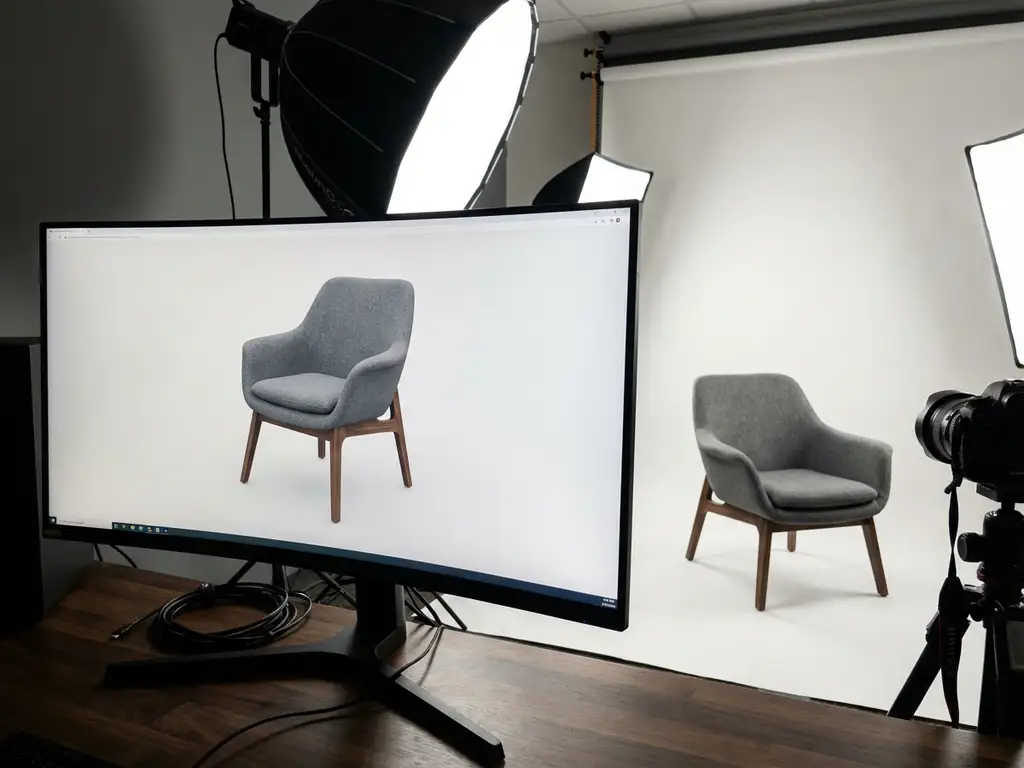
3D product rendering transforms product launches by enabling companies to create photorealistic visuals before physical prototypes exist. This technology accelerates time to market, reduces costs, and enhances customer engagement through interactive experiences. Modern brands use 3D rendering to streamline launch processes while maintaining premium visual quality across all channels.
What is 3D product rendering, and why does it matter for product launches?
3D product rendering is the process of creating photorealistic digital images from three-dimensional models using computer graphics technology. It can replace traditional photography by generating high-quality visuals that showcase products from any angle, with perfect lighting and detail.
For product launches, this technology is essential because it eliminates the need to rely on physical prototypes for marketing materials. Companies can begin creating promotional content, website imagery, and sales materials while products are still in development. This flexibility allows for unlimited variations, angles, and configurations without additional photography costs.
The technology enables brands to present products consistently across multiple channels. Whether for e-commerce platforms, print catalogues, or in-store displays, the same high-quality visuals maintain brand integrity throughout the launch campaign. This consistency becomes particularly valuable for companies launching products in multiple markets simultaneously.
Additionally, 3D rendering supports interactive experiences that traditional photography cannot match. Customers can explore products from every angle, customise configurations, and visualise options in real time, creating more engaging launch experiences that drive conversion rates.
How does 3D rendering accelerate product launch timelines?
3D rendering accelerates product launches by enabling parallel development workflows, in which marketing teams create visuals while engineering teams finalise product designs. This approach can reduce launch timelines by several weeks or months compared to traditional sequential processes.
Traditional photography requires finished prototypes, studio bookings, professional photographers, and post-production editing. Each product variation needs a separate shoot, and any design changes require complete reshoots. This creates bottlenecks that delay launch schedules and increase pressure on development teams.
With 3D rendering, marketing materials can be produced as soon as initial product designs are available. Teams can create comprehensive visual libraries covering all product variations, colours, and configurations simultaneously. Design changes can be implemented quickly, without rescheduling shoots or incurring additional costs.
The technology also enables faster market testing and feedback collection. Companies can present realistic product visuals to focus groups, stakeholders, and potential customers early in the development process. This early feedback helps refine products before manufacturing begins, reducing the risk of costly post-launch modifications.
Furthermore, global launches become more manageable when visual assets are available digitally. International teams can access and deploy marketing materials immediately, without waiting for physical samples or coordinating photography sessions across different time zones.
What are the cost benefits of using 3D rendering for product launches?
3D rendering typically costs significantly less than traditional photography campaigns, particularly for products with multiple variations or configurations. The technology eliminates expenses for studio rental, professional photography, model fees, and extensive post-production work.
Physical prototype costs represent another major area of savings. Traditional launches require multiple prototypes for photography, trade shows, and stakeholder presentations. These prototypes often cost thousands of pounds each and require shipping worldwide. 3D rendering reduces prototype needs to essential testing and validation units only.
Eliminating reshoot costs provides substantial ongoing savings. When design changes occur during development, traditional photography requires new shoots with associated studio, photographer, and production costs. 3D rendering accommodates changes through digital modifications that cost a fraction of a new photography session.
Scalability offers long-term cost advantages. Once 3D models are created, generating additional images, angles, or variations requires minimal incremental cost. Companies can create extensive visual libraries covering every product option without proportional increases in budget.
The technology also reduces time-to-market costs. Faster launches mean earlier revenue generation and competitive advantages. Companies can capitalise on market opportunities more quickly while competitors struggle with traditional photography bottlenecks. Advanced 3D solutions provide comprehensive cost benefits that extend throughout the product lifecycle.
How does 3D product visualisation enhance customer engagement during launches?
3D product visualisation creates interactive experiences that allow customers to explore products in ways that are impossible with traditional photography. Customers can rotate products, zoom in on details, and examine features from every angle, creating deeper engagement than static images.
Product configuration capabilities enable customers to customise options in real time. They can change colours, materials, sizes, and features while immediately seeing the results. This interactivity helps customers understand product possibilities and builds confidence in purchase decisions.
The technology supports omnichannel launch strategies by providing consistent experiences across all touchpoints. Whether customers encounter products online, in-store, or through mobile applications, the same high-quality 3D experiences maintain engagement and brand perception.
Virtual showrooms and product demonstrations become possible without physical inventory. Companies can showcase entire product ranges in immersive environments that highlight features and benefits effectively. This capability is particularly valuable for complex or technical products that require detailed explanation.
The visual quality of modern 3D rendering often exceeds traditional photography in terms of consistency and control over detail. Perfect lighting, shadows, and reflections create aspirational product presentations that enhance perceived value and desirability during launch campaigns.
What challenges should companies expect when implementing 3D rendering for product launches?
Initial setup requirements represent the primary challenge for companies adopting 3D rendering. Creating accurate 3D models requires detailed product specifications, material properties, and technical drawings. This process demands close collaboration between design, engineering, and marketing teams.
Team training needs vary depending on existing capabilities. Marketing teams may require education on 3D workflows, file formats, and quality standards. Technical teams need an understanding of rendering software, lighting principles, and output optimisation for different channels.
Integration considerations affect workflow efficiency. Companies must ensure 3D rendering processes integrate smoothly with existing product development, marketing automation, and content management systems. Poor integration can create bottlenecks that negate time-saving benefits.
Quality control becomes more complex with 3D rendering. Teams must establish standards for visual accuracy, brand consistency, and technical specifications across all rendered outputs. Regular reviews and approval processes help maintain quality while avoiding delays.
File management and version control require careful planning. 3D projects generate large files that need organised storage, backup systems, and access controls. Clear naming conventions and workflow documentation prevent confusion and ensure team efficiency.
Budget allocation may need adjustment as costs shift from photography to technology and training. Companies should plan for software licensing, hardware requirements, and potential external expertise during the transition period. Successful implementation examples demonstrate how proper planning overcomes these initial challenges.
How 3dimerce helps with product launches
Our visual product experience platform transforms product launches through advanced 3D configurators and seamless integration capabilities. We provide comprehensive solutions that eliminate traditional photography bottlenecks while delivering stunning visual quality that aligns with premium brand positioning.
Key benefits for product launches include:
- Accelerated timelines through parallel development workflows and instant visual generation
- Scalable visual content covering unlimited product variations without additional photography costs
- Interactive customer experiences that increase engagement and conversion rates during launches
- Omnichannel consistency across webshops, in-store displays, and marketing materials
- Real-time customisation enabling customers to configure products and see immediate results
Our platform integrates seamlessly with existing e-commerce systems and sales environments, ensuring smooth implementation without disrupting current workflows. The technology delivers photorealistic quality that enhances brand perception while reducing reliance on physical prototypes and traditional photography.
Ready to transform your next product launch? Contact our team to discover how our 3D product rendering solutions can accelerate your launch timeline while delivering exceptional customer experiences that drive sales success.
Related Articles
- What is the difference between 3D product rendering and a product configurator?
- Why are furniture brands switching from photography to 3D product rendering?
- What is the connection between 3D product rendering and brand trust?
- What industries benefit from 3D product rendering?
- Why is 3D product rendering growing fast in the home furnishings industry?