
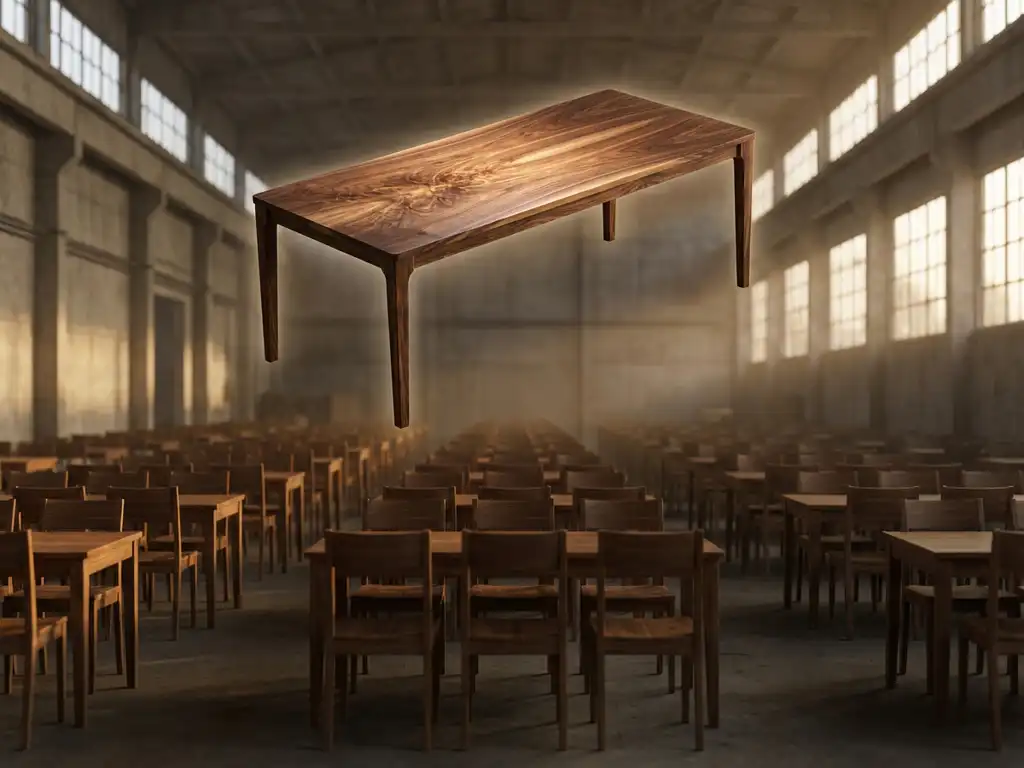
3D product rendering is highly scalable for large product catalogues through automated workflows, parametric modelling, and cloud-based processing capabilities. Unlike traditional photography, 3D rendering can generate thousands of catalog-ready product variations through mass product render pipelines from a single digital model without additional photoshoots, making it particularly effective for brands with extensive product lines. Our clients regularly achieve cost reductions of up to 70% versus traditional photography, with bulk product rendering pipelines delivering hundreds of catalog-ready images overnight. The technology delivers consistent quality across all variations whilst significantly reducing the time and costs associated with visual content production.
How Our Bulk Product Rendering Workflow Scales to Thousands of SKUs
Understanding exactly how a large catalog moves through our rendering pipeline is the fastest way to evaluate whether bulk product rendering is right for your operation. Rather than describing scalability in abstract terms, here is the precise sequence we follow, from the moment you share your product data to the moment catalog-ready images land in your e-commerce platform, PIM, or DAM.
Our rendering for catalogs follows five clearly defined steps:
- Asset Ingestion: Upload existing 3D models or product data via PIM integration or direct file import (CSV, Excel, or native CAD formats). Our team handles format conversion and asset preparation so your existing data works immediately.
- Master Template Setup: We configure a parametric master model with all material, color, size, and configuration parameters mapped to your product data fields. This one-time setup is the foundation that makes every subsequent batch run near-instant.
- Automated Variant Generation: The rendering engine reads your product specifications and automatically queues every required variant combination for batch processing, with no manual file creation needed for individual SKUs.
- Cloud Rendering at Scale: Our cloud infrastructure processes all variants simultaneously, delivering consistent, studio-quality outputs regardless of whether the queue contains 50 or 50,000 SKUs. Elastic compute resources scale dynamically to match your batch size.
- Quality Check and Export: Automated quality assurance flags any anomalies before final images are exported directly to your e-commerce platform, PIM, or DAM, in the exact file formats and resolutions each channel requires.
This end-to-end pipeline is what separates a genuine catalog product rendering solution from a standard 3D visualisation service. Every step is designed to remove manual bottlenecks so your team spends time on strategy, not file management.
What Makes Bulk Product Rendering Scalable for Large Catalogs?
Parametric modelling and automated workflows form the foundation of scalable 3D product rendering. These systems create master templates that automatically generate variations based on predefined parameters such as colour, material, size, and configuration options. Cloud-based processing handles the computational demands of rendering thousands of images simultaneously, without manual intervention for each output.
Scalability in 3D product rendering comes from several technical factors working together:
- Template-based modelling: A single master 3D model produces unlimited variations without rebuilding geometry for each one.
- Automated rendering pipelines: Multiple product configurations are processed in batches, often overnight or during off-peak hours.
- Elastic cloud infrastructure: Computing resources scale up or down based on demand, ensuring consistent performance regardless of catalogue size.
- PIM integration: Modern 3D rendering platforms connect directly with product information management (PIM) systems, automatically pulling specifications and generating visuals when new products are added.
This combination eliminates manual intervention for routine catalogue updates and ensures visual consistency across all sales channels.
AI-Assisted Automation in Our Rendering Pipeline
Our rendering pipeline integrates AI-assisted automation at every stage of bulk processing, which is what makes it uniquely suited to high-end and luxury catalog production at scale. Three capabilities set our approach apart from conventional rendering services.
First, automated quality control: AI scans every rendered output for lighting inconsistencies, geometry errors, or color deviations before delivery, eliminating manual review bottlenecks that would otherwise make large batches impractical. Second, intelligent environment matching: the system selects or generates background environments suited to the product category and brand positioning, ensuring lifestyle imagery feels considered rather than generic. Third, material and finish optimization: AI adjusts material rendering parameters, including reflectivity, texture grain, and shadow depth, to ensure every fabric, finish, and surface looks photorealistic across all output formats. Together, these capabilities mean that a batch of 5,000 SKUs receives the same level of visual care that a manual studio session would give to five.
Catalog Product Rendering vs. Traditional Photography: Speed, Cost, and Scale
Automated 3D rendering reduces both time and costs substantially compared to traditional photography for extensive catalogues. Photography requires individual shoots for each product variation, whereas 3D rendering systems generate unlimited variations from a single digital model. Quality remains consistent across all outputs, eliminating the lighting and setup variations common in studio photography.
| Traditional Photography | AI-Generated Imagery | 3Dimerce 3D Rendering | |
|---|---|---|---|
| Cost per 100 SKUs | High (studio, crew, post-production, reshoots per variant) | Lower upfront, but inconsistent outputs require corrections | Low marginal cost after one-time master model setup |
| Time to deliver 100 variants | 2 to 5 days minimum | Fast, but quality review adds time at scale | Overnight batch delivery for established pipelines |
| Consistency across outputs | Variable (lighting, setup drift between sessions) | Inconsistent, especially across material types | Pixel-perfect consistency enforced by automated QA |
| Flexibility for product updates | Low (requires full reshoot) | Moderate (prompt adjustment, but limited configurability) | High (update master model, regenerate all variants instantly) |
| Scalability to 10,000+ SKUs | Not practical | Possible, but quality degrades at luxury level | Native capability, no throughput ceiling |
| Suitability for luxury and high-end brands | High for hero shots, not scalable for full ranges | Limited photorealism for premium materials and finishes | Photorealistic quality optimised for high-end and luxury brands |
For brands managing large catalogs where visual quality and variant depth both matter, mass product rendering with 3Dimerce delivers the only solution that scales without compromising on premium output.
Flexibility is another structural advantage. Product changes require new photoshoots with traditional methods, but 3D models can be updated instantly and propagated across all variations. Advanced 3D solutions also enable camera angles and environmental settings that would be impossible, impractical, or prohibitively expensive to achieve physically.
Visual Commerce Solutions
Talk to our team about your project.
What are the key challenges when scaling 3D rendering for enterprise catalogues?
Data management and quality control are the primary challenges when implementing 3D product rendering at enterprise scale. Large catalogues require systematic organisation of 3D assets, textures, and product specifications. Maintaining consistent visual standards across thousands of rendered images demands robust review processes and, where possible, automated quality checks.
Integration complexity increases with catalogue size and the number of connected systems. Enterprise deployments typically require seamless connections with existing e-commerce platforms, product information management (PIM) tools, and content management systems (CMS). Technical teams must ensure rendering workflows don’t disrupt live operations whilst maintaining data accuracy across all touchpoints.
Resource planning is equally important for both initial setup and ongoing maintenance. Large catalogues require significant computational resources during peak rendering periods. Staff training also becomes a critical factor as teams transition from traditional photography workflows to 3D-based processes. New skills in digital asset management and briefing 3D artists replace older ones rather than adding to an already full workload.
Which industries benefit most from scalable 3D product visualisation?
Furniture, automotive, and fashion are the industries that see the greatest returns from scalable 3D product visualisation, due to their high volume of product variations and customisation options. These sectors typically offer multiple colours, materials, sizes, and configurations, combinations that would be cost-prohibitive to photograph comprehensively at scale.
Furniture and interior design brands face the most complex rendering challenge: every sofa may come in dozens of fabrics, every bed frame in multiple finishes, and every lifestyle image must feel aspirational enough for a luxury catalog. Our parametric material libraries allow teams to swap upholstery, wood finishes, and paint colors across an entire range in one batch. Room-staging generation then places the same product into multiple curated interior environments, and a single rendering session delivers web-optimised JPEGs, high-resolution print files, and 360-degree spin assets simultaneously. Automotive companies use 3D visualisation to present every vehicle configuration, colour, and optional feature, a scope that would be impractical to cover through conventional photography.
Manufacturing industries with technical products also gain measurable advantages. Complex machinery, industrial equipment, and technical components often require detailed views, cutaway illustrations, and exploded diagrams that are faster to produce and easier to update using 3D models than with traditional photography.
Multi-Channel Export for Luxury and Design Brands
One rendering session should serve every channel your brand operates across, and that is precisely how we have built our export workflow. When a batch of catalog product rendering completes, our platform simultaneously packages outputs to the required specification for each destination: compressed web assets for your e-commerce platform, high-resolution files for print catalogs, and optimised imagery for digital lookbooks and social channels.
This eliminates the need for separate post-production runs for each format, which is a hidden cost that makes traditional photography even less competitive at scale. For luxury and design brands where brand consistency across print and digital is non-negotiable, a single source of truth for every image, at every resolution, for every channel, is a material operational advantage.
Batch-Creating Catalog Images for Sofas, Beds, and Casegoods at Scale
For furniture brands, bulk product rendering means generating every fabric, finish, and room-setting combination from a single master model, without a single reshooting day. A sofa range that comes in 30 fabrics across 5 frame configurations produces 150 distinct SKUs. With traditional photography, that is 150 separate shoots. With our platform, it is one master model and one overnight batch run.
The same logic applies across the full furniture range. Beds, casegoods, dining tables, and storage units all carry finish and configuration variants that multiply SKU counts rapidly. Our catalog product rendering pipeline handles that complexity natively, reading variant data directly from your PIM and generating every combination without manual queuing. The result is a complete, catalog-ready image set delivered to your team before the working day begins.
Fabric and Material Swaps Across Entire Ranges
Parametric material libraries are what make fabric-and-material swaps genuinely instant at scale. Each fabric, whether a boucle, a performance velvet, or a woven linen, is mapped as a material parameter in the master sofa model. When the batch runs, the rendering engine applies every fabric in the library to every frame configuration and outputs all combinations as catalog-ready images. There is no manual file duplication, no per-variant setup, and no quality variation between the first image and the last.
This capability is particularly valuable for furniture brands that refresh fabric ranges seasonally. Adding ten new upholstery options to a sofa line of five frames produces fifty new images from a single material library update. The master model never changes; only the parameters do.
Color and Finish Variants for Beds and Casegoods
Finish variant generation for beds and casegoods follows the same parametric logic, applied to wood tones, lacquer colors, and metal hardware options. Finish parameters such as oak, walnut, painted white, and smoked ash are defined once in the master model and applied in batch across all casegoods SKUs simultaneously. A wardrobe range available in six finishes and three sizes produces eighteen SKUs from a single rendering session.
Because every output is generated from the same master geometry under the same lighting setup, color accuracy and surface detail are identical across all variants. For luxury furniture brands where material authenticity is a brand promise, this consistency is as important as the speed.
Lifestyle Scene and Room-Staging Generation
A single 3D model placed into multiple pre-built room environments produces the lifestyle imagery that converts browsers into buyers, and our platform does this at catalog scale. Each master furniture model is compatible with a library of curated interior environments, from Scandinavian minimal to warm Mediterranean, that can be assigned to products in bulk. The rendering engine places the product into each selected environment and outputs a lifestyle image alongside the standard white-background catalog shot.
This means a furniture brand can launch a new sofa with both clean product imagery and aspirational room-staging imagery ready on day one, generated in the same overnight batch. Competitors who rely on physical set builds or manual 3D compositing cannot match that turnaround at any price point we have seen in the market.
How do you implement scalable 3D rendering without overwhelming your team?
A phased implementation approach is the most effective way to build 3D rendering capabilities without disrupting existing operations. Starting with a single product line or category allows teams to establish workflows, develop expertise, and surface potential issues at a manageable scale before expanding to the full catalogue.
Training focuses on building new skills rather than replacing existing knowledge. Marketing teams learn to brief 3D artists instead of photographers; technical staff shift from managing physical inventory to managing digital assets. Pairing experienced team members with 3D specialists during the transition period accelerates knowledge transfer and reduces friction.
Workflow integration works best when it complements existing processes rather than replacing them abruptly. Successful implementations typically run parallel systems initially, gradually shifting responsibilities as confidence and capability develop. Clear communication about timelines, expectations, and available support resources is essential to maintaining team confidence throughout the change.
Frequently Asked Questions About Bulk Product Rendering
How many SKUs can bulk product rendering handle in a single batch?
Our cloud infrastructure scales dynamically, handling batches from dozens to tens of thousands of SKUs within a single processing run. Throughput speed depends on variant complexity, specifically the number of material parameters, environment combinations, and output formats requested, rather than raw SKU volume. For most furniture and design brand catalogs, a full overnight batch is sufficient to deliver a complete image set by morning, regardless of whether the queue contains 500 or 15,000 variants.
What file formats do you accept for catalog product rendering?
We accept the most common product data and 3D file formats used in e-commerce and manufacturing environments, including CSV and Excel for product specification data, and native CAD formats alongside standard 3D interchange formats for geometry. PIM integration handles automated data ingestion for teams that manage product information centrally. If your existing assets are in a format you are unsure about, our team will assess compatibility during the initial consultation at no cost.
How long does it take to go from product data to catalog-ready images?
The initial setup phase, which covers master model creation, material library configuration, and pipeline integration, typically takes one to three weeks depending on catalog complexity. Once the pipeline is established, ongoing batch runs for new variants or updated products are delivered overnight. For established clients adding seasonal variants or new SKUs to an existing range, turnaround from data submission to catalog-ready images is measured in hours rather than days.
Can mass product rendering maintain consistent quality across thousands of images?
Consistency is one of the structural advantages of mass product rendering over traditional photography. Because every image is generated from the same master model under the same lighting parameters, color accuracy, shadow depth, and surface detail are identical across the entire output set. Our automated QA process scans every rendered image before delivery, flagging any anomalies, such as geometry errors, lighting deviations, or color drift, for review before the batch is released. Brand-standard guardrails are configured during setup and enforced automatically on every subsequent run.
Is 3D rendering for catalogs suitable for luxury and high-end product lines?
Our platform is specifically optimised for the design and luxury segment, which is the market we built it for. Photorealistic material rendering, bespoke lighting setups calibrated to premium brand aesthetics, and fine-grain control over surface properties such as reflectivity, texture grain, and shadow softness ensure that every output meets the visual standards luxury brands require. We work with brands for whom visual quality is a non-negotiable part of the product experience, and our rendering for catalogs reflects that standard in every image we deliver.
How 3Dimerce supports scalable 3D product visualisation
We built our platform specifically to address the scalability challenges that e-commerce managers and product teams face with large catalogues. Our comprehensive SaaS solution combines automated workflows, seamless system integrations, and dedicated implementation support, handling the technical complexity so your team can focus on business outcomes rather than infrastructure.
3Dimerce is purpose-built for the design, luxury, and high-end market, where visual quality is non-negotiable and production speed is a competitive advantage. Whether you need bulk product rendering for a furniture range or rendering for catalogs spanning multiple product categories, our platform is built to handle the full scope. Our scalable 3D product rendering solution includes:
- Automated batch processing for thousands of product variations
- Direct integration with existing e-commerce and PIM systems
- Cloud-based infrastructure that scales with your catalogue size
- Comprehensive training and ongoing technical support
- Quality assurance processes ensuring consistent, premium visual standards
A mid-market European furniture manufacturer managing over 2,000 SKUs across sofas, beds, and casegoods reduced their visual content production timeline from six weeks to three days after implementing our bulk product rendering pipeline. Fabric swaps, finish variants, and room-staging imagery for their full range were delivered in a single overnight batch, ready for their seasonal catalog launch. The result was a 70% reduction in visual production costs and a catalog that went live on schedule for the first time in three years.
Managing a large product catalog should not mean choosing between speed and quality. Our bulk product rendering platform delivers both, processing thousands of SKUs overnight while maintaining the photorealistic, luxury-grade visuals your brand demands. To see exactly how it works for your catalog, contact our team and we will render one of your products live during our first conversation, so you can evaluate the quality and workflow fit before making any commitment. Book a Live Rendering Demo and let us show you what your products look like at their best.