
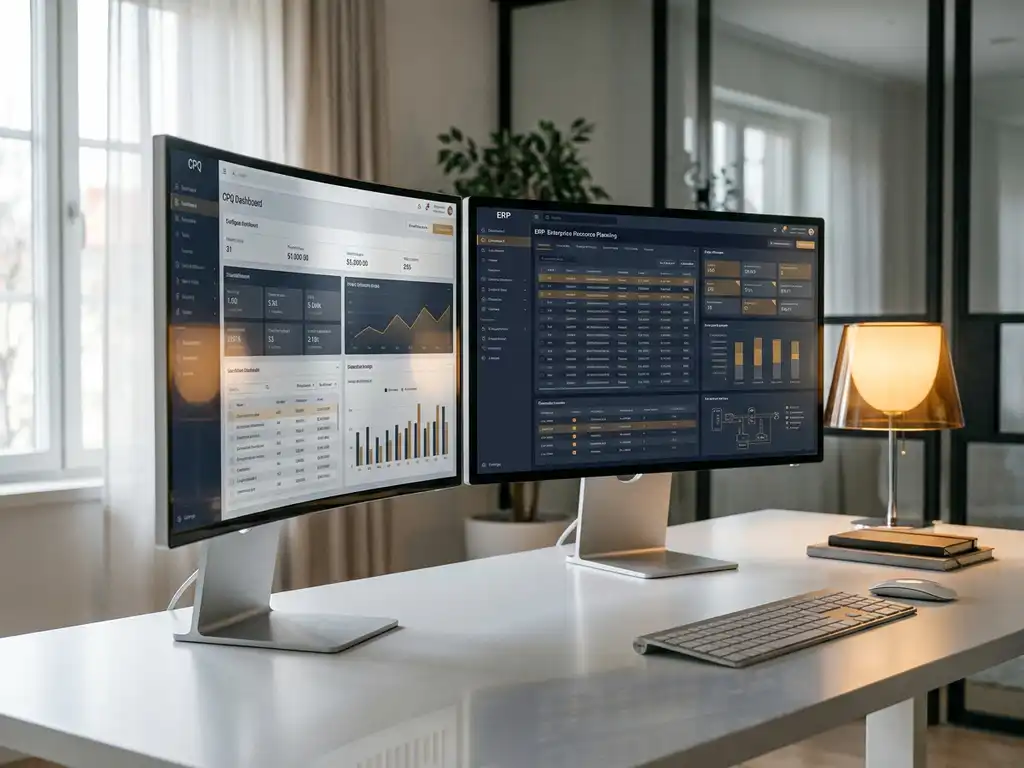
No, CPQ is not an ERP system. CPQ (Configure, Price, Quote) software is a specialized sales tool designed to help businesses configure complex products, calculate accurate pricing, and generate quotes quickly. ERP (Enterprise Resource Planning) is a broader business management platform that handles operations like inventory, finance, HR, and production. They serve very different purposes.
That said, CPQ and ERP are often used together, and understanding how they complement each other can help you make smarter decisions about your sales and operations tech stack. Below, we break down what each system does, where they differ, and how they work best in combination.
What does CPQ software actually do?
CPQ software automates the process of configuring products, calculating prices, and generating quotes for customers. It is built specifically for businesses that sell complex, configurable products with many variants, options, or pricing rules. The goal is to make the sales process faster, more accurate, and more consistent.
At its core, a CPQ solution handles three interconnected tasks:
- Configure: It guides sales teams or customers through product options, ensuring only valid combinations are selected. No more manual errors or impossible configurations reaching the customer.
- Price: It applies the correct pricing rules automatically, including discounts, volume tiers, and custom pricing agreements, so every quote reflects accurate costs.
- Quote: It produces a professional, branded quote document that can be sent to the customer quickly, often within minutes rather than days.
For brands selling high-end, design-led products with many customization options, CPQ is particularly powerful. It removes the bottleneck of manually calculating prices for every possible product variant and gives sales teams the confidence to quote accurately on the spot.
What is an ERP system used for?
An ERP system is a centralized business management platform that integrates and automates core operational functions across an entire organization. It typically covers finance and accounting, inventory management, procurement, production planning, HR, and order fulfillment. ERP is the operational backbone of a business.
Where CPQ focuses narrowly on the sales configuration and quoting process, ERP takes a much wider view. It tracks what stock you have, what it costs to produce, how orders flow through your supply chain, and how the business performs financially. Think of ERP as the system of record for everything that happens once a sale is made and needs to be delivered.
Common ERP platforms include SAP, Microsoft Dynamics, Oracle, and similar enterprise-grade systems. These platforms are powerful but broad. They are not designed to handle the nuanced, customer-facing complexity of configuring a premium product with dozens of finishes, materials, and dimension options.
Visual Commerce Solutions
Talk to our team about your project.
What’s the difference between CPQ and ERP?
The key difference between CPQ and ERP is their focus: CPQ is a front-end sales tool, while ERP is a back-end operations platform. CPQ accelerates and improves the process of selling configurable products. ERP manages the operational and financial processes that run the business after the sale.
Here is a clear side-by-side comparison of how the two systems differ:
- Primary purpose: CPQ handles product configuration, pricing, and quoting. ERP handles operations, finance, inventory, and production.
- Who uses it: CPQ is used primarily by sales teams, account managers, and sometimes customers directly. ERP is used across finance, operations, logistics, and management.
- Point in the journey: CPQ operates at the start of the sales cycle. ERP takes over once an order is placed and needs to be fulfilled.
- Complexity it handles: CPQ manages product and pricing complexity. ERP manages operational and organizational complexity.
- Customer-facing: CPQ often has a customer-facing or sales-facing interface. ERP is almost entirely internal.
Confusing the two is easy because both deal with products and pricing data. But they operate at fundamentally different layers of the business.
Can CPQ and ERP work together?
Yes, CPQ and ERP work very well together and are frequently integrated in mature sales and operations environments. When connected, CPQ feeds confirmed, accurate order data directly into the ERP system, eliminating manual re-entry and reducing errors between the quote stage and order fulfillment.
A well-designed integration between CPQ and ERP creates a seamless flow from customer inquiry to delivery. The CPQ system handles the complexity of configuration and pricing at the point of sale, then passes the finalized order to ERP, which triggers inventory checks, production scheduling, and invoicing automatically.
This kind of integration is especially valuable for manufacturers and retailers of complex, configurable products. When a customer configures a bespoke piece of furniture with specific dimensions, materials, and finishes, the CPQ system ensures the quote is accurate and the configuration is valid. The ERP system then ensures the right materials are ordered, production is scheduled, and the order is tracked through to delivery.
Modern CPQ platforms are built with integration in mind. Our solutions are designed to connect smoothly with existing business systems, so the data flows where it needs to go without friction.
Do you need both CPQ and ERP, or just one?
Whether you need both CPQ and ERP depends on the complexity of your products and the scale of your operations. If you sell simple, fixed products with straightforward pricing, ERP alone may be sufficient. But if your products are configurable, have many variants, or require complex pricing logic, CPQ becomes essential alongside your ERP.
For design-led manufacturers and premium product brands, the case for CPQ is strong even if ERP is already in place. ERP systems are not built to handle the front-end complexity of guiding a customer or sales rep through dozens of configuration choices while calculating accurate prices in real time. That is exactly what CPQ does best.
A practical way to think about it: ERP keeps your business running. CPQ helps your business sell more effectively. Both have distinct roles, and in most mid-to-large product businesses, both earn their place.
How 3Dimerce helps with CPQ
We built our CPQ capabilities specifically for brands that sell premium, configurable products where accuracy and visual quality matter equally. Our Ensemble Suite goes beyond standard quoting tools by combining advanced pricing logic with stunning product visualization, so your sales team and customers can configure, price, and quote with complete confidence.
Here is what sets our approach apart:
- Accurate pricing every time: Our advanced pricing and quotation engine ensures every configuration is priced correctly, no matter how many variables are involved.
- Visual configuration included: Quotes are backed by photorealistic 3D visuals, so customers see exactly what they are buying before they commit.
- Flexible deployment: Our CPQ solution works as a standalone tool or as part of a broader visual product experience platform, with or without the full visual configuration layer.
- Seamless integration: We connect smoothly with your existing webshop, ERP, or other business systems through headless integration, keeping your tech stack clean and efficient.
- Built for premium brands: We understand the high-end market. Our platform is designed for brands where quality, design, and customer experience are non-negotiable.
If you are ready to streamline your sales process and give your team the tools to quote complex products accurately and confidently, we would love to show you what is possible. Get in touch with us and let’s talk about how our CPQ solution fits your business.
Frequently Asked Questions
How long does it typically take to implement a CPQ system?
Implementation timelines vary depending on the complexity of your product catalog and how many systems need to be integrated. A straightforward CPQ deployment can take as little as a few weeks, while a more complex rollout involving deep ERP integration, custom pricing rules, and 3D visual configuration may take several months. The key is to work with a CPQ provider that has a structured onboarding process and experience integrating with your existing tech stack.
What happens if my CPQ and ERP systems fall out of sync?
When CPQ and ERP data become misaligned — for example, if pricing updates in ERP are not reflected in CPQ — it can lead to inaccurate quotes, margin errors, and fulfillment issues. To prevent this, look for CPQ solutions that support real-time or scheduled data sync with your ERP. Establishing clear data ownership rules (i.e., which system is the source of truth for pricing, inventory, and product data) is equally important to maintaining consistency across both platforms.
Can CPQ software handle customer-specific pricing agreements and discounts?
Yes, and this is actually one of CPQ’s strongest capabilities. A well-built CPQ system can store and apply customer-specific pricing tiers, contract-based discounts, volume pricing, and promotional rules automatically at the point of configuration. This means sales reps no longer need to manually calculate or remember individual deal terms — the system applies the right price for the right customer every time, reducing both errors and approval bottlenecks.
Is CPQ only suitable for large enterprises, or can smaller businesses benefit too?
CPQ is valuable for any business where product complexity, pricing variability, or quote volume creates friction in the sales process — regardless of company size. While large enterprises were early adopters, modern CPQ platforms are increasingly accessible to mid-sized and growing businesses. If your sales team is spending significant time manually building quotes, chasing approvals, or correcting configuration errors, CPQ will likely deliver a strong return on investment even at a smaller scale.
What's the biggest mistake businesses make when adopting CPQ?
The most common mistake is treating CPQ as a purely technical project rather than a sales enablement initiative. Businesses that focus only on the software setup without involving sales teams in the process often end up with a system that doesn’t reflect how deals are actually structured or how reps work in the field. Successful CPQ adoption requires input from sales, product, and operations teams from the start, clear documentation of your pricing logic and product rules, and proper training so the team actually uses the tool confidently.
Does CPQ replace the need for a CRM system?
No, CPQ does not replace CRM — the two systems serve complementary roles. CRM (Customer Relationship Management) manages the broader customer relationship, including contact records, deal pipelines, communication history, and sales forecasting. CPQ plugs into the quoting stage of that pipeline, handling the product configuration and pricing complexity that CRM tools are not built for. In most sales environments, CPQ sits between CRM and ERP: CRM manages the opportunity, CPQ produces the quote, and ERP fulfills the order.
How important is 3D visual configuration as part of a CPQ solution for premium product brands?
For brands selling high-end, design-led, or highly customizable products, visual configuration is not just a nice-to-have — it is a key part of the buying experience and a direct driver of conversion and customer confidence. When customers can see a photorealistic representation of their exact configuration before committing, it reduces hesitation, minimizes post-sale returns or change requests, and elevates the perceived quality of your brand. A CPQ solution that combines accurate pricing logic with real-time 3D visualization addresses both the commercial and experiential needs of premium product sales.
Related Articles
- What is PBR rendering and how does it improve product visualization?
- What are the different types of architectural renderings?
- Should you choose 3D product rendering or product videos?
- How does 3D product rendering support dealer and retail networks?
- How does 3D product rendering reduce dependency on physical showrooms?