
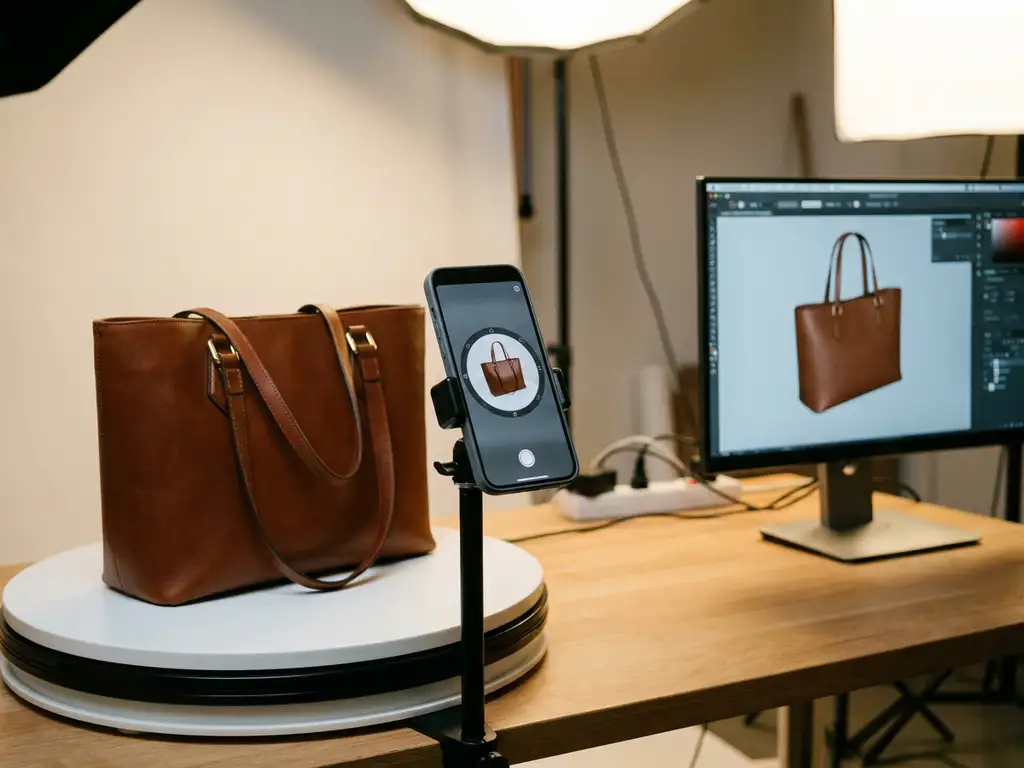
No — 3D photography and 3D rendering are not the same thing, though the terms are often confused. 3D product photography typically refers to 360-degree photography: a technique that captures a real physical product from multiple angles to create an interactive spinning view. 3D rendering, by contrast, creates a product image entirely from a digital model — no physical object required. When comparing photo vs rendering, the distinction matters enormously for production workflows, scalability, and cost. The right choice between 3D product rendering and 360-degree photography depends on your product complexity, variant count, and brand positioning — and understanding the difference is the first step toward making that decision confidently.
Why limited product visualization is costing you sales: the case for 3D rendering
When customers can’t properly visualize your products online, you lose conversions at the most critical moment of the buying journey. Static product images leave too much to the imagination, especially for complex or configurable products where customers need to understand dimensions, textures, and how different options work together. This visualization gap creates hesitation, increases return rates, and drives potential buyers to competitors who offer more comprehensive visual experiences.
The solution lies in choosing the right visualization technology that matches your product complexity and customer expectations — whether that’s interactive 3D rendering for highly customizable items or 360-degree photography for products where authentic material representation is paramount. For brands in the design, luxury, and high-end segment, the stakes are especially high: your visuals must do justice to the craftsmanship and quality your products represent.
How traditional photography workflows limit your product range expansion
Traditional photography workflows become exponentially more expensive and time-consuming as product variations multiply. Every new color, material, or configuration option requires additional photo shoots, storage space, and ongoing maintenance of your visual library. This creates a bottleneck that discourages product innovation and limits how quickly you can respond to market demands.
Modern visualization technologies — particularly 3D product rendering — break this constraint by generating unlimited variations from a single base asset. This enables brands to expand their offerings without proportional increases in visual content costs or production timelines.
How 3D rendering scales across your entire sales ecosystem
One of the most compelling advantages of 3D product rendering over traditional photography is its ability to supply every sales channel from a single production run. Once a base 3D model exists, it can generate all required visual assets with pixel-perfect consistency — eliminating the lighting and color variation that inevitably occurs between separate photography sessions. For European manufacturers and retailers managing multi-channel distribution, this represents a fundamental shift in how visual content is produced and maintained.
From one 3D model, you can generate:
- Silo product images on white for marketplace listings (Amazon, Bol.com, and similar platforms)
- Lifestyle renders with virtual environments for brand website product detail pages
- Detail and close-up renders for zoom functionality and technical specifications
- Color and material variant images without commissioning new shoots
- Campaign creatives for paid advertising, email marketing, and print catalogs
Because all assets derive from the same digital model, visual consistency across every output is guaranteed — something no photography workflow can reliably replicate at scale.
Visual Commerce Solutions
Talk to our team about your project.
What is 3D product rendering and how does it work for product visualization?
3D product rendering is the process of creating photorealistic images and interactive experiences from digital three-dimensional models of physical products. The process begins with building accurate 3D models that capture every detail of a product’s geometry, materials, and textures. These models are then placed in virtual environments where lighting, shadows, and reflections are calculated to produce images that are often indistinguishable from traditional photography.
For product visualization, 3D rendering excels because it enables real-time customization and configuration. Customers can change colors, materials, sizes, and components instantly, seeing exactly how their choices affect the final product. The technology supports everything from simple color swaps to complex multi-part assemblies, making it particularly valuable for furniture, automotive, luxury goods, and other industries where customer personalization drives sales. Modern rendering engines simulate how light behaves in the real world, producing convincing textures, reflections, and shadows in real time — keeping customers engaged throughout the entire configuration process.
The 3D rendering production process
Understanding how 3D rendering is produced helps set realistic expectations and supports internal business case planning. The key phases are:
- Briefing and reference collection — product specifications, technical drawings, material samples, and brand guidelines are gathered to inform the model
- 3D modeling and geometry — a precise digital model of the product is built, typically taking 1–3 weeks depending on complexity
- Material and texture mapping — surface materials, finishes, and textures are applied to the model to match real-world product specifications
- Lighting and environment setup — virtual lighting rigs and environments are configured to match your brand’s visual style
- Rendering and quality review — final images and interactive outputs are rendered and reviewed against quality benchmarks
- Variant generation — once the base model is approved, all color, material, and configuration variants are generated in hours rather than weeks
What is 360-degree product photography and when is it used?
360-degree product photography is a technique that captures a series of images of a real product from multiple angles around a complete rotation, then stitches those images together to create an interactive spinning view. The process typically involves placing products on a motorized turntable and photographing them at regular intervals — usually every 10–15 degrees — resulting in 24–36 individual images per rotation.
This technique works best for products where material authenticity and craftsmanship details are crucial selling points. Luxury goods, jewelry, electronics, and artisanal products benefit from 360-degree photography because customers can examine real textures, surface finishes, and build quality that can be difficult to replicate convincingly through 3D rendering alone. 360-degree photography is particularly effective for products with limited customization options, where the goal is to showcase the actual item rather than demonstrate configurability.
The 360-degree photography production process
The photography workflow involves a sequential dependency chain that directly affects time-to-market. Each phase must be completed before the next can begin:
- Pre-production planning and sample preparation — physical product samples must be sourced, prepared, and shipped to the studio before any work begins
- Studio booking and equipment setup — turntable rigs, lighting, and camera systems must be configured for each product category
- Product shoot on motorized turntable — each product variant is photographed individually at precise angular intervals
- Post-production retouching and stitching — individual frames are retouched and assembled into the final interactive spin sequence, adding days to the timeline
- File delivery and platform integration — optimized files are delivered and integrated into your e-commerce platform or product detail pages
Unlike 3D rendering, every new product variant restarts this entire process from the beginning — a meaningful constraint as your catalog grows.
3D rendering vs. 360-degree photography by industry: which works best?
The right choice between 3D product rendering and 360-degree photography often depends on the specific characteristics of your industry and product category. Below are four sectors where the decision is particularly consequential.
Furniture and interior design
3D rendering is the clear primary method for furniture brands. A single sofa model might be available in 8 fabric options, 4 leg finishes, and 3 size configurations — that’s 96 combinations. Photography every variant is cost-prohibitive and operationally impractical. With 3D rendering, all 96 variants are generated from one base model, with consistent lighting and perfect material representation. For premium furniture brands, a high-quality 3D configurator also elevates the customer experience, letting buyers compose their ideal piece in real time before committing to purchase.
Jewelry and luxury goods
For jewelry, 360-degree photography remains the preferred primary method for hero and detail imagery, because the micro-textures of hand-finished surfaces, the brilliance of gemstones, and the warmth of precious metals are best captured authentically. However, for brands managing extensive standard lines — multiple colorways of the same design, for example — 3D rendering provides catalog scalability that photography cannot match economically. A hybrid approach is often optimal: photography for flagship pieces, rendering for variant and catalog imagery.
Automotive and mobility
Automotive is one of the strongest use cases for 3D rendering. A single vehicle model can carry hundreds of exterior color, interior trim, and wheel combination options. Photographing every combination is simply not feasible. 3D rendering powers the configurators that allow customers to build their ideal vehicle online — a standard expectation in the automotive buying journey. Color and trim selectors, interior views, and detail close-ups all flow from a single master 3D model, making the 360 rendering approach both economically and experientially superior for this sector.
Consumer electronics
Electronics benefit from a hybrid strategy. Photography excels for hero and lifestyle imagery — a laptop on a desk, earphones worn by a person — where human context and emotional resonance matter. 3D rendering takes over for technical detail views, color variant images, and marketplace-compliant packshots. This combination ensures brand-quality storytelling at the top of the funnel while maintaining scalable, consistent variant imagery across every sales channel.
What’s the difference between 3D rendering and 360-degree photography?
The fundamental difference between 3D product rendering and 360-degree photography lies in their source material and capabilities. 3D rendering works with digital models that can be modified infinitely, while 360-degree photography captures existing physical products that cannot be altered after the shoot. The table below summarizes the key differences at a glance.
| Criteria | 3D Product Rendering | 360-Degree Photography |
|---|---|---|
| Source material | Digital 3D model | Physical product required |
| Customization flexibility | Unlimited in real time | None after shoot |
| Upfront cost | Higher initial investment | Lower per product |
| Cost per additional variant | Near zero | Full new shoot required |
| Time to first visual | Available before physical product exists | Physical sample must exist first |
| Visual consistency across catalog | Pixel-perfect consistency | Varies per shoot |
| Authenticity of materials | Simulated — highly accurate | Genuine — captured from real item |
| Scalability | Scales to thousands of variants from one model | Limited — each variant needs a shoot |
| Pre-launch use | Yes — sell before production | No |
| Best suited for | Configurable, multi-variant products | Small catalogs, artisanal or luxury goods |
Customization and configurability
3D rendering offers unlimited customization potential. Any aspect of the product — materials, colors, dimensions, components — can be changed in real time. The technology also enables features like cutaway views, exploded diagrams, and camera angles that showcase internal components or construction details that would be impossible to photograph conventionally.
360-degree photography provides authentic material representation and surface details captured directly from real products. Textures, reflections, and natural imperfections are genuine because they originate from actual items. However, each product variation requires a separate photo session, making the approach impractical for highly configurable products.
Cost and production timeline
3D rendering requires higher upfront investment for model creation but offers greater long-term flexibility. Once a base model exists, generating new variations costs a fraction of the original production effort. 360-degree photography has lower initial costs per product but becomes expensive as variation count grows. Rendering also eliminates ongoing costs for physical sample storage, shipping, and inventory management.
Visual quality
Modern 3D rendering can achieve photorealistic quality that rivals traditional photography, particularly for manufactured products with consistent materials and finishes. 360-degree photography guarantees authenticity for products with unique natural textures or handcrafted details, but limits interactive possibilities compared to a fully rendered configurator.
Can you use 3D rendering to sell products before they exist?
Yes — and this is one of the most strategically valuable advantages of 3D product rendering over photography. Because rendering works from digital files rather than physical samples, visuals can be ready weeks or months before a single unit has been manufactured. This fundamentally changes what’s possible in product launches, pre-order campaigns, and trade fair presentations.
Consider a furniture manufacturer preparing for a major trade fair: with 3D rendering, the entire new collection can be presented with photorealistic visuals and an interactive configurator — before a single prototype has been built. Retailers can begin collecting pre-orders through a fully interactive product page while production is still underway. Stakeholders and buyers can review and approve designs digitally, reducing costly late-stage changes. The benefits of 3D product rendering vs photos are particularly clear here: photography is simply not an option when no physical product yet exists. For brands navigating long production cycles and high investment risk, this capability alone can justify the switch to 3D rendering.
Which is better for showcasing configurable products: 3D rendering or 360-degree photography?
When comparing 3D product rendering vs photography for configurable products, rendering is the clear winner for one core reason: real-time variant visualization. It enables customers to see exactly what they are configuring without requiring separate photography for every possible combination.
Consider a modular furniture system with five fabric options, three wood finishes, and four size configurations. 360-degree photography would require 60 separate photo sessions to cover all combinations, while 3D rendering creates all variations from a single base model. Changes appear instantly, keeping customers engaged rather than waiting for pre-shot image sets to load.
3D rendering also supports advanced configuration features like real-time pricing updates, compatibility checking, and guided selling tools that help customers navigate complex product options. You can explore various use cases where interactive configuration transforms the buying experience from overwhelming to intuitive.
360-degree photography may still be preferred for luxury or artisanal products where material authenticity is the primary selling point, even where some configurability is sacrificed. The choice ultimately depends on whether your customers prioritize customization flexibility or authentic material representation.
How do costs compare between 3D rendering and 360-degree photography?
The cost comparison between 3D rendering and 360-degree photography depends on product range complexity and variation count. 360-degree photography typically has lower upfront costs per individual product, with sessions ranging from hundreds to low thousands of euros depending on product complexity and studio requirements. For products with minimal variations, this can be the more cost-effective option in the short term.
3D rendering requires higher initial investment for model creation and setup, but the cost per additional variation approaches zero once the base model exists. As variation count increases, 3D rendering becomes dramatically more economical. For brands managing 10 or more product variants, the break-even point between 3D rendering and repeat photography sessions typically occurs within the first catalog update cycle — a general pattern consistently observed across the industry. Long-term costs also favor 3D rendering: photography requires reshoots for any product updates, seasonal campaigns, or new marketing angles, whereas 3D models can be updated, relit, and reposed without additional sessions.
Production speed is another cost factor. 360-degree photography requires scheduling, shipping products to studios, and post-production time. 3D rendering generates new variations immediately once models exist, enabling faster time-to-market for new products and seasonal campaigns — a competitive advantage that frequently justifies the initial technology investment.
When should you choose 3D rendering vs. product photography?
The comparison between 3D rendering vs product photography ultimately comes down to your specific product situation, catalog scale, and strategic goals. Rather than treating this as a binary choice, use the criteria below to identify where each method delivers the most value for your business.
Choose 3D rendering when…
- Your product has more than 5 configurable variants (colors, materials, sizes, components)
- You need to market or sell a product before physical production is complete
- Your catalog is growing rapidly and photography costs are scaling out of control
- You need pixel-perfect visual consistency across multiple sales channels and markets
- You want to offer customers a real-time interactive configurator on your product detail pages
- You are in a sector — furniture, automotive, luxury goods, electronics — where variant depth is a core commercial requirement
Choose 360-degree photography when…
- Your product has unique handcrafted textures, natural materials, or surface details that are central to its appeal
- Your catalog is small and stable — fewer than 20 SKUs with no significant expansion planned
- Emotional storytelling through authentic material feel is the primary driver of purchase decisions
- Your product category relies on the genuine, unmediated appearance of the physical item (bespoke jewelry, artisanal goods)
- Budget constraints make the lower upfront cost of photography more appropriate for your current stage
Use both when…
- Your brand requires hero and lifestyle imagery with emotional depth — handled by photography — alongside scalable variant visuals powered by 3D rendering
- You sell flagship or limited-edition pieces that deserve dedicated photography, plus a broad standard range that benefits from rendering
- You want photography to anchor your brand identity while 3D rendering powers your configurator and catalog distribution
- Your product line includes both artisanal hero products and configurable standard lines that serve different customer needs
Do you have to choose? How leading brands combine 3D rendering and photography
The most sophisticated brands in the premium and luxury segment don’t treat 3D rendering and photography as competing alternatives — they treat them as complementary tools, each deployed where it delivers the greatest impact. Framing this as a binary choice underestimates the strategic flexibility available to modern product teams.
Where photography still leads
Professional photography remains the gold standard for hero images, editorial campaigns, and lifestyle storytelling. When a product needs to be shown in a human context — worn, used, experienced — photography delivers emotional resonance that rendering cannot fully replicate. Limited-edition launches, seasonal campaign imagery, and brand lookbooks all benefit from the authenticity and narrative weight of real photography. For these applications, the investment in a high-quality shoot is fully justified.
Where 3D rendering takes over
3D rendering excels everywhere that scale, consistency, and interactivity are required. Product detail page variant imagery, real-time configurators, marketplace-compliant packshots, seasonal recolors, and omnichannel catalog assets are all better served by rendering — faster, cheaper, and with guaranteed visual consistency across every output. We have extensive experience integrating 3D rendering workflows into existing visual strategies, ensuring that your photography investment is amplified rather than replaced. Contact us to explore how a combined approach could work for your brand.
How 3Dimerce delivers high-end 3D product rendering and configuration
We specialize in creating sophisticated 3D product configurators that transform how premium brands in the design, luxury, and high-end market showcase their products online and in retail environments. Our platform combines photorealistic rendering with real-time configuration capabilities, enabling customers to visualize unlimited product variations instantly — with stunning visual quality and blazing-fast performance. For decision-makers evaluating the business case: for brands with 10 or more product variants, the return on a 3D rendering investment typically materializes within the first catalog update cycle, as the cost of repeat photography sessions is eliminated and time-to-market accelerates significantly.
Our comprehensive solutions include:
- High-quality 3D product configurators with photorealistic visual output tailored to premium brand positioning
- Seamless integration into existing e-commerce platforms and in-store sales environments
- Real-time pricing and compatibility checking for complex product configurations
- Virtual showroom capabilities that eliminate dependency on physical sample libraries
- Blazing-fast performance across all devices, with touchable textures and natural lighting that reflect your product’s true quality
With over 20 years of experience serving European manufacturers and retailers across furniture, luxury goods, electronics, and automotive, we understand the unique challenges of scaling visual content production without compromising quality. Contact us to discuss how our platform can enhance your customer experience and drive measurable improvements in conversion and engagement.
Frequently Asked Questions
How long does it typically take to create a 3D model for product rendering?
The timeline for 3D model creation varies based on product complexity, but typically ranges from 1-3 weeks for standard products to 4-6 weeks for highly detailed or multi-component items. Simple products like basic furniture pieces can be modeled in a few days, while complex machinery or intricate jewelry may require several weeks. Once the initial model is complete, creating variations for different colors, materials, or configurations takes only hours rather than weeks.
Can 3D rendering really match the quality of professional product photography?
Modern 3D rendering can achieve photorealistic quality that is virtually indistinguishable from traditional photography, especially for manufactured products with consistent materials and finishes. However, for products with unique textures, natural materials, or handcrafted details, 360-degree photography may still have an edge in capturing authentic surface characteristics. The key is choosing the right approach based on your specific product type and quality requirements.
What happens if I need to update my product design after creating 3D models?
One of the major advantages of 3D rendering is the ease of updates. Minor changes like color adjustments, material swaps, or small dimensional modifications can be implemented within hours. More significant design changes may require model reconstruction, but this is still typically faster and more cost-effective than organizing new photography sessions for multiple product variations. The digital nature of 3D models makes iteration much more flexible than traditional photography workflows.
How do customers typically respond to interactive 3D configurators versus traditional product images?
Interactive 3D configurators consistently drive significant improvements in customer engagement and conversion rates. Customers spend 2-3 times longer exploring products with 3D configurators, and businesses typically see 20-40% increases in conversion rates. The mechanism behind these results is straightforward: customers who can configure a product in real time develop a stronger sense of ownership and certainty before purchase, which reduces cart abandonment and post-purchase returns. Lower return rates represent a meaningful secondary cost saving — return logistics in e-commerce can account for a significant percentage of revenue, making the reduction in returns a financially material benefit beyond the conversion uplift itself.
Is 360-degree photography worth considering for small product catalogs?
For small catalogs with limited product variations, 360-degree photography can be a cost-effective solution, especially if your products have distinctive textures or craftsmanship that benefits from authentic representation. If you have fewer than 20 product variations and don’t plan significant expansion, 360-degree photography might offer better immediate ROI. However, consider your growth plans – if you anticipate adding variations or expanding your catalog, 3D rendering provides better scalability.
What technical requirements do I need to implement 3D product configurators on my website?
Most modern 3D configurator platforms are designed to integrate seamlessly with existing e-commerce systems without requiring extensive technical expertise. The configurators typically run in web browsers using WebGL technology, so customers don’t need special software or plugins. Your main requirements are stable web hosting, integration with your product database for pricing and inventory, and ensuring your website can handle the additional interactive elements without performance issues.