
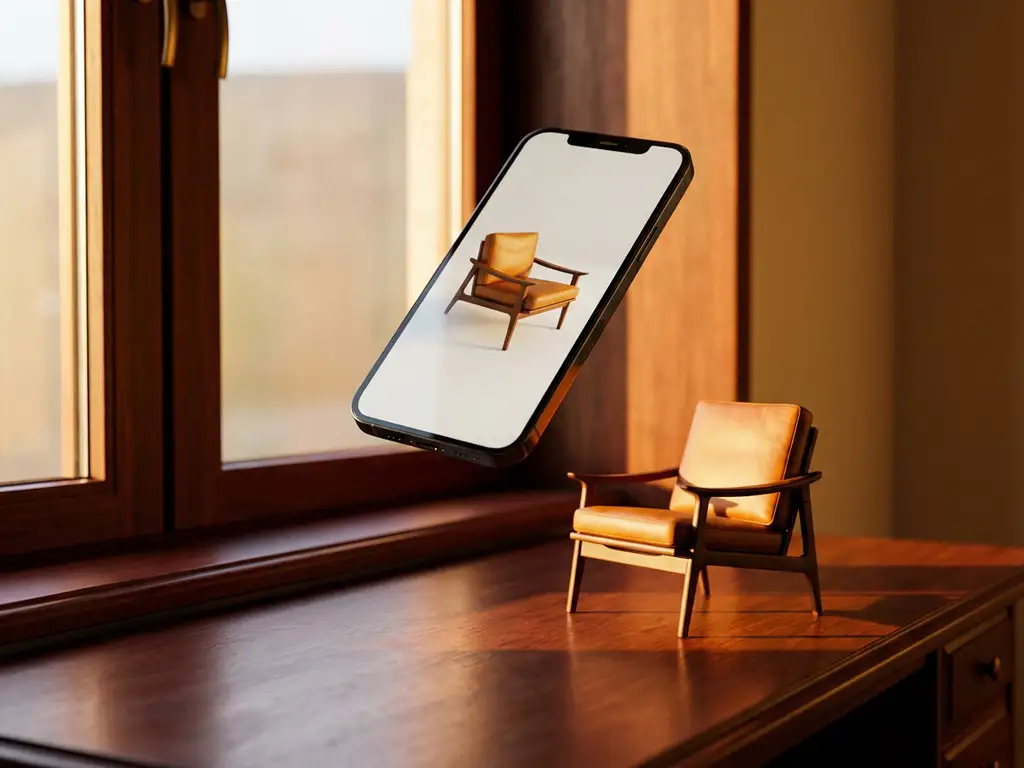
3D product rendering and AR visualization are both powerful technologies that create immersive visual experiences, but they serve different purposes and work in fundamentally different ways. While 3D rendering generates photorealistic images of products in controlled digital environments, AR visualization overlays digital content onto the real world through devices like smartphones or tablets, allowing customers to see how products would look in their actual space.
Why are outdated product visuals costing you customer conversions?
Traditional product photography simply cannot keep pace with today’s demand for interactive, customizable experiences. When customers encounter static images or basic product galleries, they struggle to visualize how items will look in their specific environment or with their preferred configurations. This disconnect leads to hesitation, abandoned carts, and ultimately lost sales. Research consistently shows that customers who cannot properly visualize products are significantly less likely to complete purchases, especially for higher-value items like furniture or luxury goods.
The solution lies in adopting advanced visualization technologies that bridge this gap between imagination and reality. By implementing either 3D rendering or AR visualization, brands can provide the rich, interactive experiences customers now expect, dramatically improving engagement and conversion rates.
What does customer uncertainty signal about your product presentation strategy?
When customers repeatedly ask detailed questions about product dimensions, colors, or how items will fit in their space, it reveals a critical weakness in your visual presentation strategy. This uncertainty creates friction in the buying process and often pushes customers toward competitors who offer more comprehensive visualization tools. The cost extends beyond immediate lost sales to include increased customer service overhead and reduced brand confidence.
Forward-thinking brands are addressing this by implementing visualization technologies that anticipate and answer these questions before they arise. Whether through detailed 3D rendering or interactive AR experiences, the goal is to eliminate uncertainty and empower customers to make confident purchasing decisions.
Visual Commerce Solutions
Talk to our team about your project.
What is 3D rendering and how does it work?
3D rendering is the process of creating photorealistic images or animations from three-dimensional digital models using specialized computer software. The technology works by calculating how light interacts with virtual objects, surfaces, and materials to produce images that are often indistinguishable from traditional photography. Modern 3D rendering engines simulate complex lighting conditions, material properties like reflectivity and texture, and even environmental factors to create stunning visual representations.
The process begins with creating detailed 3D models of products, complete with accurate dimensions, materials, and surface properties. Artists and designers then set up virtual scenes with appropriate lighting, backgrounds, and camera angles before the rendering engine calculates millions of light rays to produce the final image. Advanced rendering techniques can generate multiple product variations, configurations, and environmental settings from a single 3D model, making it incredibly efficient for brands with extensive product catalogs.
What is AR visualization and what makes it different?
AR visualization, or augmented reality visualization, overlays computer-generated content onto the real world through devices like smartphones, tablets, or specialized AR headsets. Unlike 3D rendering, which creates images in isolation, AR technology uses device cameras to capture the real environment and then seamlessly integrates digital objects into that live view. This creates the illusion that virtual products exist in the user’s actual physical space.
The technology relies on sophisticated tracking systems that understand the user’s environment, including surfaces, lighting conditions, and spatial relationships. Modern AR visualization can detect floors, walls, and furniture, allowing virtual products to be placed accurately and realistically within real rooms. The digital objects respond to the environment’s lighting and shadows, creating convincing interactions between virtual and physical elements. This real-time integration makes AR particularly powerful for products where spatial context matters, such as furniture, home decor, or architectural elements.
What’s the main difference between 3D rendering and AR visualization?
The fundamental difference lies in context and interaction. 3D rendering creates controlled, polished images or videos that showcase products in idealized environments, while AR visualization places those same products directly into the customer’s real-world space. Think of 3D rendering as creating the perfect product photography studio digitally, whereas AR visualization brings the showroom to the customer’s living room.
3D rendering excels at creating marketing materials, product catalogs, and detailed configurators where image quality and visual perfection are paramount. It allows for precise control over every aspect of the scene, from lighting to background elements. AR visualization, on the other hand, prioritizes contextual relevance and spatial understanding, helping customers answer the crucial question of how a product will actually look and fit in their specific environment. While 3D rendering can show a sofa in a beautiful virtual room, AR visualization shows that same sofa in the customer’s actual living room, complete with their existing furniture and lighting conditions.
Which technology is better for product marketing?
The choice between 3D rendering and AR visualization depends entirely on your marketing objectives and customer journey stage. 3D rendering proves superior for creating high-impact marketing materials, detailed product catalogs, and sophisticated configurators where visual quality and brand presentation are critical. It’s particularly effective for initial product discovery, social media content, and situations where you need to showcase products in aspirational or branded environments.
AR visualization becomes more valuable during the consideration and decision-making phases, especially for products where spatial fit and contextual appearance matter. It’s particularly powerful for furniture, home decor, appliances, and other items where customers need to understand how products will integrate with their existing space. Many successful brands now use both technologies strategically: 3D rendering for marketing and brand building, and AR visualization for final purchase decision support. Real-world case studies demonstrate that this combined approach often delivers the strongest results.
How do these technologies impact customer buying decisions?
Both technologies significantly reduce purchase anxiety and increase customer confidence, but through different mechanisms. 3D rendering builds trust through detailed, high-quality visuals that allow customers to examine products from multiple angles and in various configurations. This comprehensive view helps customers understand exactly what they’re purchasing, reducing the likelihood of returns and increasing satisfaction with the final product.
AR visualization takes this confidence-building a step further by eliminating spatial uncertainty. When customers can see how a dining table fits in their actual dining room or how a piece of artwork looks on their wall, they move from wondering “will this work?” to knowing “this will work perfectly.” Studies consistently show that customers who use AR visualization tools are significantly more likely to complete purchases and report higher satisfaction levels. The technology also tends to increase average order values, as customers become more confident in purchasing larger or more expensive items when they can visualize them accurately in context.
How 3Dimerce helps with advanced product visualization
We specialize in creating sophisticated 3D product configurators that combine the best aspects of both rendering and visualization technologies. Our platform delivers stunning, photorealistic visuals with blazing-fast performance, enabling brands to showcase their products with the quality and precision that luxury and design-focused markets demand.
Our comprehensive visual product experience platform offers:
- High-quality 3D rendering that matches or exceeds traditional photography standards
- Interactive configurators that allow real-time customization and visualization
- Seamless integration across webshops, in-store displays, and mobile applications
- Scalable solutions that grow with your product range without proportional cost increases
- Virtual showroom capabilities that reduce dependency on physical samples
Ready to transform your product visualization strategy and boost customer confidence? Contact our team to discover how our tailored 3D solutions can enhance your brand’s digital presence and drive measurable improvements in engagement and conversions.
Frequently Asked Questions
How long does it typically take to implement 3D rendering or AR visualization for my product catalog?
Implementation timelines vary based on your product complexity and catalog size. For 3D rendering, expect 2-4 weeks for initial setup and 1-3 days per product for high-quality models. AR visualization typically requires an additional 1-2 weeks for platform integration and testing. Most brands see their first products live within 4-6 weeks, with full catalog rollouts completed over 2-3 months depending on scope.
What are the ongoing costs compared to traditional product photography?
While initial setup costs for 3D rendering are higher than traditional photography, the long-term economics are significantly more favorable. Once 3D models are created, generating new images, angles, or configurations costs virtually nothing, whereas traditional photography requires new shoots for each variation. Most brands achieve cost parity within 6-12 months and realize substantial savings thereafter, especially for products with multiple variants or seasonal updates.
Do customers actually use AR features, or is it just a novelty?
Recent data shows that 71% of customers who interact with AR visualization tools complete their purchases, compared to 40% conversion rates for traditional product pages. The key is making AR easily accessible—customers are more likely to engage when the feature is prominently displayed and requires minimal steps to activate. Success depends heavily on implementation quality and ensuring the AR experience works smoothly across different devices.
Can I start with just 3D rendering and add AR capabilities later?
Absolutely, and this is often the most strategic approach. Starting with 3D rendering allows you to create high-quality product models that serve as the foundation for future AR implementation. The 3D assets you develop initially can be optimized and repurposed for AR without starting from scratch, making it a cost-effective way to gradually build your visualization capabilities while seeing immediate benefits from enhanced product imagery.
What technical requirements do my customers need to use AR visualization?
Most modern smartphones and tablets support AR visualization through web browsers, eliminating the need for customers to download special apps. iOS devices from iPhone 6S onwards and Android devices with ARCore support (most phones from 2018+) can handle web-based AR experiences. For the best results, ensure your AR implementation is optimized for mobile performance and provides clear instructions for first-time users.
How do I measure the ROI of investing in advanced product visualization?
Track key metrics including conversion rate improvements, reduction in product returns, decreased customer service inquiries about product details, and increased average order values. Most brands see 20-40% improvements in conversion rates and 15-25% reductions in returns within the first quarter. Additionally, measure engagement metrics like time spent on product pages and the percentage of customers who interact with visualization features to understand adoption and impact.
What happens if my products change frequently or I launch new items regularly?
3D rendering systems are designed to handle dynamic product catalogs efficiently. Once your initial models and templates are established, adding new products or updating existing ones becomes much faster and more cost-effective than traditional photography workflows. Many platforms offer bulk upload capabilities and automated processes that can integrate with your existing product information management systems, ensuring your visualization stays current with minimal manual effort.