
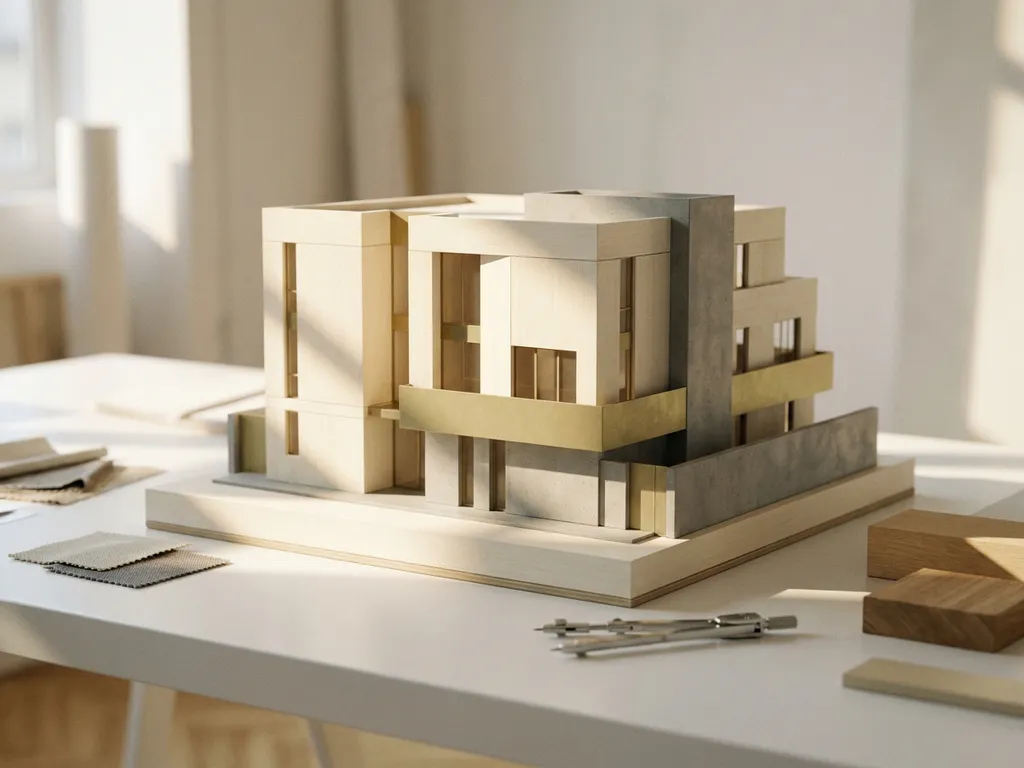
For most architectural projects in 2026, no single AI tool is universally best for architectural rendering. The right choice depends on your use case: generative AI tools like Midjourney or Stable Diffusion are strong for concept exploration and mood boarding, while dedicated platforms like Lumion AI or Enscape suit real-time walkthrough rendering. For high-end product and interior visualization where photorealism and brand precision matter, professional CGI platforms remain the gold standard.
Architects and brands working on design-led projects increasingly find that AI rendering tools serve different stages of the workflow rather than replacing each other. This article unpacks the key questions around AI rendering so you can make an informed decision about where each tool fits.
How does AI actually generate architectural renderings?
AI generates architectural renderings by using machine learning models trained on large datasets of images, 3D geometry, and lighting conditions. When you provide an input, such as a sketch, a text prompt, or a 3D model, the AI interprets that input and produces a photorealistic or stylized image by predicting what the scene should look like based on patterns it has learned.
Most AI rendering tools work through one of two core mechanisms:
- Diffusion models start from noise and progressively refine an image based on your prompt or reference input
- Neural rendering engines take existing 3D geometry and apply AI-driven lighting, material simulation, and denoising to speed up traditional render pipelines
- Style transfer and upscaling use AI to enhance or reinterpret renders produced by conventional software
- Real-time AI denoising (used in NVIDIA DLSS and similar tech) accelerates rendering without sacrificing visual quality
The practical result is that what once took hours of manual rendering and post-processing can now be produced in minutes. However, the trade-off is control: AI models make assumptions about materials, lighting, and spatial relationships that may not align with a specific design intent.
What are the most widely used AI rendering tools for architects?
The most widely used AI rendering tools for architects in 2026 include Lumion, Enscape, D5 Render, Chaos Vantage, and generative tools like Midjourney and Adobe Firefly. Each serves a different stage of the architectural workflow, from early concept visualization to final presentation.
Here is a practical overview of where each tool tends to excel:
- Lumion — Real-time rendering tightly integrated with ArchiCAD, Revit, and SketchUp. Best for quick exterior and landscape visualizations
- Enscape — Live rendering plugin for Revit and Rhino, popular for walkthroughs and client presentations during the design phase
- D5 Render — GPU-based real-time rendering with strong material libraries, gaining traction for interior architectural work
- Chaos Vantage / V-Ray — Industry standard for high-fidelity still renders and animations where photorealism is non-negotiable
- Midjourney / Stable Diffusion — Generative AI tools used for concept mood boards and design exploration, not final deliverables
- Adobe Firefly — Increasingly used for post-processing, material exploration, and marketing imagery
The choice between these tools is rarely about which is objectively best. It comes down to pipeline fit, team familiarity, and the quality bar required for the final output.
Visual Commerce Solutions
Talk to our team about your project.
What’s the difference between AI rendering and traditional CGI rendering?
The key difference between AI rendering and traditional CGI rendering is how the image is produced. Traditional CGI rendering uses physically based simulation, calculating how light bounces, refracts, and absorbs across every surface in a scene. AI rendering uses pattern recognition and learned approximations to produce visually similar results far more quickly, but without the same physical accuracy.
Traditional CGI rendering gives artists precise control over every variable: material properties, light temperature, shadow softness, and surface texture. This level of control is what allows professional CGI studios to produce images that are indistinguishable from photography. The trade-off is time and expertise. A high-quality CGI render can take hours to produce and requires skilled artists to set up correctly.
AI rendering sacrifices some of that precision in exchange for speed. It is excellent for iterating quickly, exploring design directions, and producing good-enough visuals for early-stage client communication. However, when a brand’s reputation depends on the visual quality of its product imagery, the approximations made by AI models often fall short of what professionally produced CGI delivers.
Can AI rendering match the quality of professional CGI studios?
For most high-end applications, AI rendering cannot yet fully match the quality of professional CGI studios. Professional CGI studios produce renders with precise material accuracy, controlled lighting, and brand-consistent styling that AI tools currently struggle to replicate with the same level of repeatability and detail.
AI rendering has made remarkable progress and can produce impressive results, particularly for architectural mood boards and concept images. But there are specific quality dimensions where professional CGI still leads:
- Material fidelity — The exact behavior of fabric weave, lacquered wood grain, or brushed metal requires physically accurate simulation that AI approximates rather than calculates
- Brand consistency — Professional CGI can be set up to reproduce a brand’s exact color standards, finish specifications, and visual language across hundreds of product variants
- Spatial accuracy — For interior visualization, proportions and perspective must be architecturally precise, which AI tools can distort
- Repeatability — A professional CGI pipeline produces consistent results across an entire product range; generative AI introduces variation that is difficult to control
For brands in the furniture, interior design, or premium product space, the difference between good-enough and genuinely stunning visuals has a direct impact on conversion and brand perception. That gap is where professional CGI earns its value.
Which AI rendering tool is best for product and interior visualization?
For product and interior visualization, D5 Render and Chaos V-Ray are the strongest AI-assisted options when working within a structured 3D pipeline. However, for brands that need scalable, photorealistic product imagery across multiple configurations and channels, a dedicated 3D product configuration platform delivers results that standalone AI rendering tools cannot replicate at scale.
The challenge with AI rendering tools for product visualization is that they are designed for single-scene output. If you need to visualize a sofa in 40 fabric options, 6 leg finishes, and 3 sizes, each rendered consistently and ready for your webshop, AI rendering tools require significant manual effort for each variant. A purpose-built visual configuration platform automates that process, generating every combination from a single 3D model setup.
For interior and architectural visualization where the goal is a single hero image or a walkthrough animation, tools like Enscape or Lumion remain practical and efficient choices. For product-led businesses that need visual content at scale, the calculus is different.
When should architects use AI rendering versus a CGI platform?
Architects should use AI rendering tools during early design phases for rapid concept exploration, client communication, and design iteration. A dedicated CGI platform is the better choice when the output needs to meet a high photorealism standard, be reproduced consistently, or be integrated into a sales or marketing workflow.
A practical way to think about it:
- Use AI rendering when you need speed over precision, are exploring design directions, or producing internal presentations
- Use a CGI platform when the render is a final deliverable, will be used in marketing materials, or needs to represent a product or space with complete accuracy
- Combine both when AI tools are used to prototype and a CGI pipeline is used to finalize and scale
For manufacturers and brands working with configurable products, the question shifts further. The goal is not just one great render but a scalable visual content system that covers every product variant, every channel, and every market. That is where architectural rendering services and product visualization platforms diverge significantly in purpose and capability.
How 3Dimerce Helps With Architectural and Product Rendering
We work at the intersection of photorealistic CGI and scalable product visualization, specifically for brands in the furniture, interior design, and premium product space. Where AI rendering tools offer speed at the cost of control, we offer both: stunning visuals produced with precision, delivered at the scale your product range demands.
Here is what working with us looks like in practice:
- Photorealistic 3D product configuration — Every material, finish, and dimension rendered accurately from a single 3D model setup, eliminating the need for individual photo shoots per variant
- Seamless integration — Our platform connects directly with your webshop, in-store tools, and sales environments through headless integration, so visuals are always live and always consistent
- Virtual photo studio — Generate CGI imagery on demand without scheduling, logistics, or reshoots, at a fraction of traditional photography costs
- Omnichannel consistency — The same visual quality whether your customer is browsing online, using an in-store configurator, or reviewing a digital catalogue
- Scalable by design — Adding new products, variants, or markets does not require starting over; the platform grows with your range
If your brand depends on visual quality to communicate its value, and you need that quality to scale across every product and every channel, we would love to show you what is possible. Get in touch with our team to explore how we can transform your product visualization.
Frequently Asked Questions
How do I get started with AI rendering tools if I have no prior experience?
The easiest entry point is a real-time rendering plugin like Enscape or Lumion, which integrate directly with tools architects already use, such as Revit or SketchUp. Start by importing an existing 3D model, experimenting with lighting presets, and gradually adjusting materials to understand how the tool responds. Most platforms offer free trials and extensive tutorial libraries, making the learning curve manageable even without a CGI background.
Can I use AI-generated renderings for client presentations and official project submissions?
AI-generated renderings are well-suited for early-stage client presentations, design reviews, and concept approvals, where communicating spatial intent matters more than pixel-perfect accuracy. However, for planning submissions, permit applications, or marketing materials where technical precision and brand representation are critical, you should rely on professionally produced CGI or a validated CGI pipeline. Always disclose to clients when imagery is AI-generated, particularly if proportions or material finishes have not been verified against the actual design specifications.
What are the most common mistakes architects make when adopting AI rendering tools?
The most common mistake is treating AI rendering as a direct replacement for a structured CGI workflow rather than a complementary tool for specific stages. Architects often over-rely on AI-generated outputs for final deliverables, only to find that material accuracy, spatial proportions, or lighting consistency fall short of client expectations. Another frequent pitfall is skipping prompt refinement or input quality control — the output of any AI rendering tool is only as good as the 3D model, reference image, or text prompt you feed into it.
How does AI rendering handle complex materials like fabric, glass, or brushed metal?
AI rendering tools approximate complex materials using learned patterns rather than physically simulating how light actually interacts with each surface. For common materials like painted walls or wood flooring, the results are often convincing. However, highly specular or translucent materials, such as brushed metal, sheer fabric, or backlit glass, are where AI approximations tend to break down, producing results that look plausible but not physically accurate. For product categories where material fidelity is a key part of the brand promise, physically based CGI rendering remains the more reliable choice.
Is it possible to maintain brand consistency across a large product range using AI rendering tools?
Maintaining strict brand consistency across a large product range is one of the most significant limitations of current AI rendering tools. Generative AI introduces natural variation between outputs, meaning that rendering the same product twice can yield subtly different results in lighting, shadow, or material tone. For brands managing dozens or hundreds of SKUs, this inconsistency creates visual noise across catalogues and webshops. A purpose-built 3D product configuration platform, built on a controlled CGI pipeline, is specifically designed to solve this problem by generating every variant from a single, standardized model and scene setup.
How much does AI rendering typically cost compared to professional CGI services?
AI rendering tools are generally available on subscription models ranging from free tiers to a few hundred dollars per month for professional plans, making them accessible for individual architects and small studios. Professional CGI services are priced per project or per image and typically reflect the complexity, quality level, and turnaround time required. The cost comparison shifts significantly at scale: for a brand needing hundreds of product images across multiple configurations, a scalable CGI platform often delivers a lower cost-per-image than either AI tools requiring manual effort per variant or traditional photography workflows.
What should I look for when evaluating whether an AI rendering tool fits my workflow?
Start by assessing three things: software compatibility, output quality requirements, and the volume of renders you need to produce. Check whether the tool integrates natively with your existing 3D modeling software, since plugins like Enscape or Lumion eliminate the need to export and re-import geometry. Then evaluate the tool’s output against your quality bar by rendering a representative scene from your actual work, not a demo asset. Finally, consider scalability — if your workflow involves producing visual content across multiple product variants or project phases, prioritize tools or platforms that support batch rendering, scene reuse, and consistent output rather than single-image generation.