
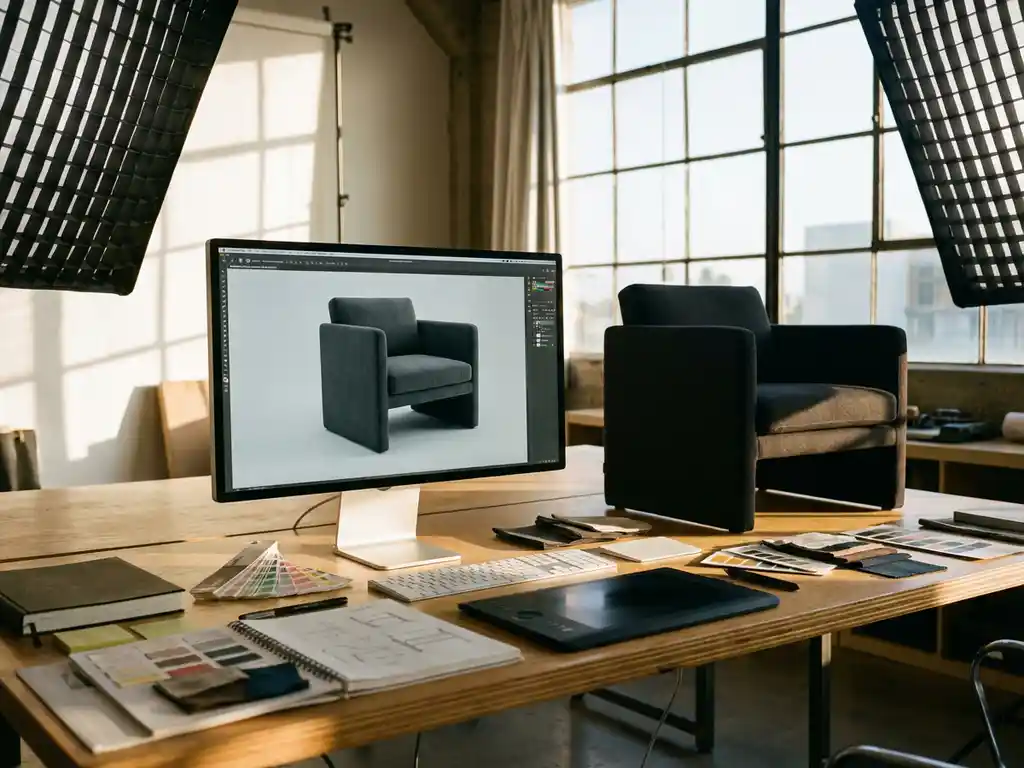
Furniture brands are making a significant shift from traditional photography to 3D product rendering due to mounting challenges related to cost, flexibility, and speed. Traditional photography struggles to keep pace with extensive product catalogues and customisation options, while 3D rendering offers unlimited variations, faster production times, and consistent quality across all channels. This transformation addresses critical business needs around scalability, cost efficiency, and enhancing the customer experience.
What’s driving furniture brands away from traditional photography?
Traditional photography creates substantial bottlenecks for furniture brands through high costs, lengthy production schedules, and limited flexibility for product variations. A single photoshoot can cost thousands of pounds and take weeks to organise, yet it captures only a fraction of the available configurations.
The logistical challenges multiply exponentially with product complexity. Furniture brands offering multiple finishes, fabrics, and configurations face impractical photography demands. Each new material or colour option requires additional shoots, studio time, and coordination.
Storage and management costs add another layer of complexity. Physical samples must be transported, stored, and maintained for photography sessions. Seasonal collections and discontinued items create ongoing warehouse expenses while limiting creative flexibility.
Maintaining consistent quality across different photoshoots, lighting conditions, and photographers becomes increasingly difficult. This inconsistency weakens brand perception, particularly for premium furniture brands, where visual excellence directly impacts customer confidence and purchasing decisions.
How does 3D product rendering actually work for furniture brands?
3D product rendering begins with creating detailed digital models of furniture pieces using specialised software. These models capture every surface texture, material property, and structural detail to ensure photorealistic output that matches physical products precisely.
The rendering process involves applying realistic materials, lighting, and environmental settings to the 3D models. Advanced rendering engines simulate how light interacts with different surfaces, creating natural shadows, reflections, and textures that rival traditional photography.
Configuration systems allow brands to modify colours, materials, and finishes instantly without rebuilding the entire model. This flexibility enables comprehensive product visualisation solutions that showcase thousands of variations from a single base model.
The final output produces high-resolution images suitable for websites, catalogues, and marketing materials. Rendering quality now achieves photorealistic standards that customers cannot distinguish from traditional photography, while offering superior consistency and control over lighting and presentation.
What are the real cost differences between photography and 3D rendering?
The initial investment in 3D rendering requires higher upfront costs for model creation and software setup, typically ranging from several thousand to tens of thousands of pounds, depending on product complexity. However, ongoing costs decrease dramatically compared to traditional photography workflows.
Traditional photography costs accumulate with every product variation, new collection, or marketing campaign. Studio rental, photographer fees, styling, and post-production editing create recurring expenses that scale linearly with content needs.
Scalability economics strongly favour 3D rendering. Once digital models exist, generating new images costs a fraction of equivalent photography. Brands can produce hundreds of product variations, lifestyle scenes, and marketing visuals without additional physical setup or coordination.
Long-term return-on-investment calculations show that 3D rendering typically breaks even within 12–18 months for active furniture brands. The cost advantages become more pronounced for brands with extensive customisation options, frequent product launches, or international market requirements.
Which furniture brands benefit most from switching to 3D rendering?
Brands offering extensive customisation options gain the most immediate value from 3D rendering technology. Companies with multiple fabric choices, finish options, or modular components can showcase every possible combination without exponential photography costs.
Premium and luxury furniture brands particularly benefit from rendering’s quality consistency and creative control. These brands require flawless visual presentation across all channels—something traditional photography struggles to deliver consistently.
Omnichannel retailers operating both online and physical showrooms find 3D rendering essential for maintaining visual consistency. The technology enables seamless integration between digital catalogues, in-store displays, and customer configuration tools.
Fast-growing brands with frequent product launches appreciate rendering’s speed advantages. New collections can be visualised and marketed before physical production is complete, accelerating time to market and enabling pre-order campaigns that improve cash flow.
What challenges do furniture brands face when implementing 3D rendering?
Technical integration requirements pose the primary implementation challenge for furniture brands. Existing e-commerce platforms, product information management systems, and workflow processes often need modification to accommodate 3D rendering outputs and configuration tools.
Quality control processes require adjustment to ensure rendered images accurately represent physical products. Brands must establish protocols for material accuracy, colour matching, and dimensional precision to maintain customer trust and reduce returns.
Staff training needs extend beyond technical teams to include marketing, sales, and customer service personnel. Change management becomes crucial as teams transition from photography-based workflows to digital rendering processes.
Timeline considerations for successful adoption typically span 3–6 months, depending on product complexity and integration requirements. Brands must plan for this transition period while maintaining current marketing and sales activities using existing visual content.
How 3dimerce helps with furniture brand digital transformation
We specialise in creating sophisticated 3D product configurators specifically designed for furniture brands seeking premium visual quality and seamless integration. Our visual product experience platform supports the entire journey, from initial product modelling through customer interaction and sales conversion.
Our comprehensive solution includes:
- High-quality 3D product configurators with photorealistic rendering capabilities
- CGI imagery production that matches your brand’s premium positioning
- Seamless integration with existing e-commerce platforms and sales systems
- Omnichannel compatibility for consistent experiences across digital and physical touchpoints
- Scalable SaaS architecture that grows with your product range and business needs
With over 20 years of experience serving European furniture and design brands, we understand the unique challenges of premium product visualisation. Our platform delivers stunning visuals with blazing-fast performance, ensuring your customers experience the quality and craftsmanship your furniture represents.
Ready to transform your furniture brand’s visual content strategy? Contact our team to discuss how our 3D rendering solutions can enhance your customer experience while reducing your content production costs. Explore our successful implementations to see how leading furniture brands have revolutionised their digital presence through advanced product configuration technology.