
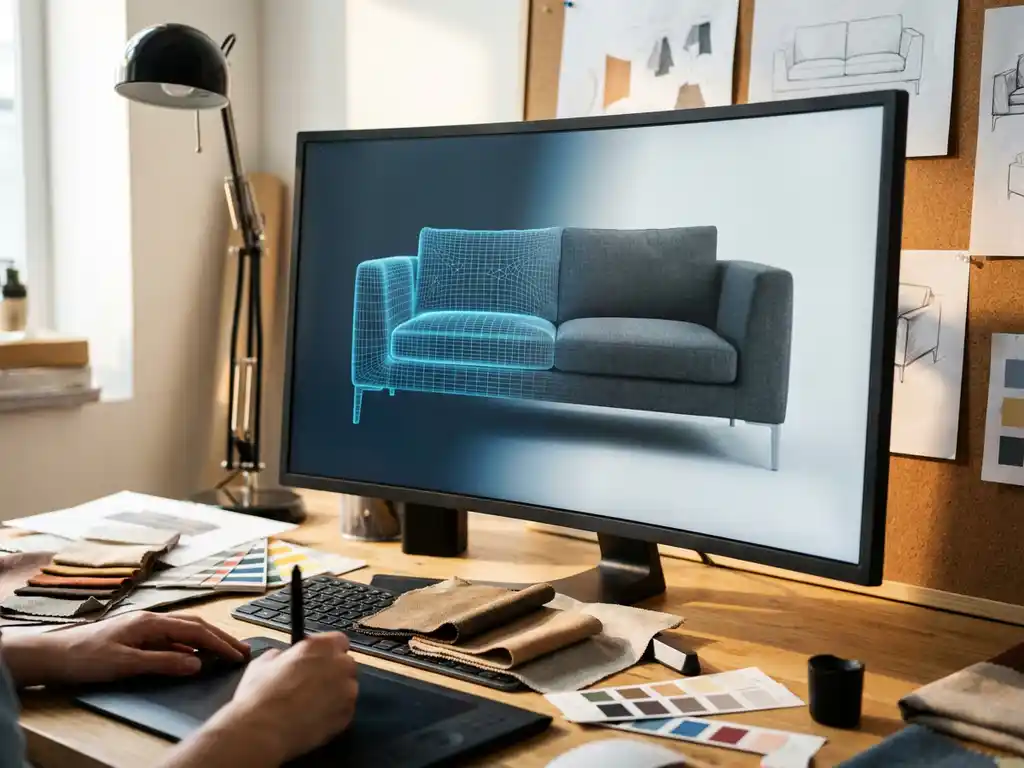
The home furnishings industry is experiencing unprecedented growth in 3D product rendering adoption, driven by consumer demand for personalised shopping experiences and the need to reduce the high costs of traditional photography. This technology is transforming how furniture brands showcase products, enabling unlimited customisation options while maintaining consistent visual quality across all sales channels. These developments address key challenges in furniture marketing and the customer experience.
What is driving the rapid adoption of 3D rendering in home furnishings?
Consumer expectations for personalised products and interactive shopping experiences are the primary drivers behind the widespread adoption of 3D rendering in home furnishings. Modern customers want to visualise furniture in different colours, materials, and configurations before purchasing, particularly for high-value items where buying decisions require confidence.
The shift towards omnichannel retail has created pressure for furniture brands to maintain visual consistency across websites, showrooms, and marketing materials. Traditional photography cannot keep pace with the volume of product variations that customers now expect to see, making 3D product rendering an essential solution for comprehensive product visualisation.
Cost pressures from conventional photography are also accelerating adoption. Furniture brands face mounting expenses for photoshoots covering every possible product combination, colour option, and seasonal variation. Digital rendering eliminates these recurring costs while providing unlimited flexibility in product presentation.
The need for competitive differentiation further drives adoption, as brands recognise that superior product visualisation directly impacts conversion rates. Companies offering interactive 3D experiences gain significant advantages over competitors relying solely on static photography.
How does 3D product rendering solve traditional furniture marketing challenges?
3D product rendering eliminates the high costs and logistical complexity of traditional furniture photography by creating unlimited product variations digitally. Instead of organising expensive photoshoots for every colour, material, and configuration option, brands can generate comprehensive visual libraries from a single 3D model.
The technology addresses slow time-to-market by enabling instant visual content creation for new products. Marketing teams can generate product imagery before physical prototypes exist, allowing earlier campaign launches and a faster response to market trends.
Inconsistent visual quality across different channels becomes manageable through standardised 3D product rendering workflows. Every product image maintains consistent lighting, angles, and quality standards, whether used online, in print catalogues, or in retail environments.
The inability to showcase all product variants disappears when digital rendering replaces the limitations of physical photography. Customers can explore every available option through interactive configurators, reducing uncertainty and increasing purchase confidence.
Visual Commerce Solutions
Talk to our team about your project.
What are the key benefits of 3D configurators for furniture customers?
Real-time customisation allows furniture customers to modify products instantly and see changes immediately. This interactive experience builds confidence by showing exactly how different materials, colours, and configurations will look before committing to a purchase.
Accurate product visualisation reduces the gap between customer expectations and delivered products. High-quality 3D rendering shows realistic textures, lighting, and proportions, helping customers make informed decisions about furniture that will fit their spaces and preferences.
The ability to view products in different environments significantly enhances the shopping experience. Customers can see how furniture pieces look in various room settings, lighting conditions, and alongside other items, creating a more complete understanding of their potential purchase.
Reduced purchase uncertainty comes from the comprehensive product exploration that 3D configurators enable. When customers can examine every detail and variation of furniture pieces, they feel more confident about their investment—particularly important for high-value home furnishing purchases.
Why are furniture brands choosing 3D rendering over traditional photography?
Unlimited product variations without additional photoshoots are the most compelling advantage of 3D rendering over traditional photography. Once a 3D model exists, brands can generate infinite combinations of colours, materials, and configurations instantly, eliminating ongoing photography costs.
Consistent lighting and quality control become achievable through digital rendering workflows. Every product image maintains the same professional standards, whereas traditional photography can vary with location, equipment, and environmental conditions.
Faster production timelines enable more responsive marketing campaigns. 3D product rendering can generate new imagery within hours rather than the weeks required for traditional photoshoot planning, execution, and post-production.
Lower long-term costs make rendering financially attractive despite the initial investment. While creating 3D models requires upfront resources, the ongoing savings from eliminated photoshoots, studio rentals, and logistics quickly offset the initial expense.
Greater flexibility for marketing campaigns allows brands to adapt quickly to seasonal trends, promotional needs, and market opportunities without scheduling complex photography sessions.
How do furniture companies successfully implement 3D product visualisation?
Technology selection should prioritise platforms that integrate seamlessly with existing e-commerce systems while providing high-quality rendering capabilities. Companies need solutions that handle complex furniture configurations without compromising performance or the user experience.
Integration with existing e-commerce platforms requires careful planning to ensure smooth data flow between product configurators and shopping cart systems. Successful implementations maintain consistent pricing, inventory, and the customer experience across all touchpoints.
Staff training requirements include both the technical skills needed to manage 3D content and the customer service knowledge required to support interactive shopping experiences. Teams need to understand how configurators work and how to assist customers effectively.
Content creation workflows must establish clear processes for developing, updating, and maintaining 3D product libraries. Successful companies create systematic approaches for adding new products and variations while ensuring consistent quality.
Measuring success through conversion rates and customer engagement metrics helps companies optimise their 3D visualisation investments. Key indicators include time spent using configurators, customisation completion rates, and improvements in purchase conversion. Regular analysis of these metrics, supported by detailed implementation examples, guides ongoing refinement efforts.
How 3dimerce helps furniture brands with advanced 3D product rendering
We specialise in creating sophisticated visual product experience platforms that transform how furniture brands present their products online and in retail environments. Our SaaS solution combines photorealistic rendering with seamless e-commerce integration, enabling brands to offer comprehensive customisation experiences that drive conversions.
Our advanced 3D product rendering capabilities deliver:
- Photorealistic visualisation with accurate textures, lighting, and materials that showcase furniture quality
- Real-time configuration tools that handle complex product variations smoothly
- Seamless integration with existing e-commerce platforms and point-of-sale systems
- Omnichannel consistency across web, mobile, and retail environments
- Scalable solutions that grow with your product catalogue and business needs
With over 20 years of experience serving European furniture brands, we understand the unique challenges of the home furnishings market. Our experienced team’s expertise enables brands to reduce photography costs while improving customer engagement and conversion rates through superior product visualisation.
Ready to transform your furniture marketing with advanced 3D product rendering? Contact our team to discuss how our visual product experience platform can enhance your customer experience and drive growth.