
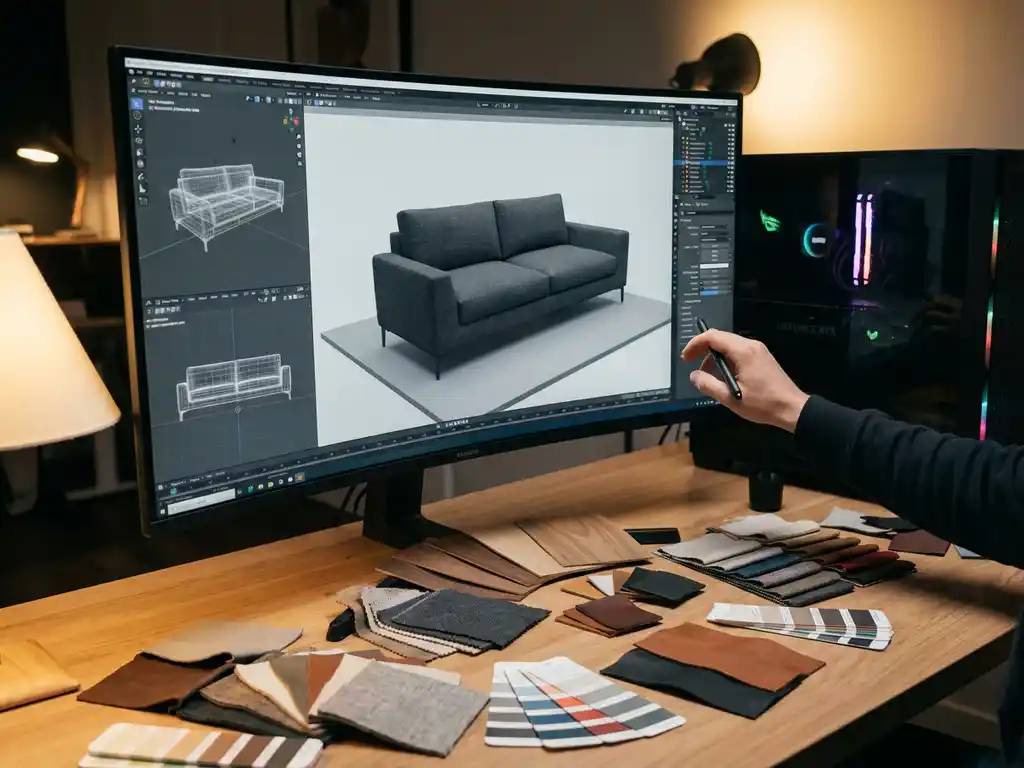
Leading luxury interior brands are transforming their product presentation through 3D product rendering, a technology that creates photorealistic digital images of furniture and décor without traditional photography. This approach offers unlimited customisation options, significantly reduces costs, and enables interactive shopping experiences that boost customer engagement and conversion rates. Leading luxury interior brands are using 3D product rendering not only to reduce costs but to create unforgettable digital experiences that mirror the allure and exclusivity of their physical showrooms.
How do luxury interior brands create interactive 3D product experiences?
Premium and luxury interior brands face a unique challenge online: replicating the tactile, curated in-store experience digitally. A discerning shopper who visits a flagship showroom expects to run their fingers across hand-stitched upholstery, examine the grain of a hand-polished walnut tabletop, and sense the weight of a solid brass fitting. Recreating that level of sensory richness on a product page demands far more than a static photograph. Interactive 3D product experiences are the technology that makes it possible.
Online luxury commerce is growing rapidly, and younger affluent consumers — millennials and Gen Z — treat immersive digital experiences as a baseline expectation, not a premium feature. Brands that meet this expectation earn trust and purchase commitment from their most valuable customers. We work exclusively in the higher segment of the market, and we have built our platform around the visual precision and performance standards that luxury interior brands require.
The premium buyer mindset and why luxury shoppers demand richer digital experiences
Discerning shoppers approach high-value furniture and décor purchases with a level of scrutiny that static imagery simply cannot satisfy. They want to examine every detail: the texture of a fabric, the reflectivity of a metal finish, the exact proportions of a piece in relation to a room. When a brand fails to provide this depth of information online, premium buyers default to visiting a physical showroom or, worse, choosing a competitor who does provide it.
Interactive 3D experiences close this gap. They give luxury shoppers the visual confidence to make high-consideration purchases online by putting genuine product depth at their fingertips. For brands operating in the luxury interior market, this is not a nice-to-have feature. It is the digital equivalent of a well-trained sales associate who knows every detail of every piece in the collection.
How high-end brands use 3D configurators to reflect in-store exclusivity online
The finest interior brands have spent decades building showroom environments that communicate exclusivity through curation, lighting, and tactile richness. A great 3D configurator translates that exclusivity into a digital format. Customers can explore hand-stitched upholstery details, select from rare material finishes, and adjust bespoke dimensions, all within a photorealistic environment that reflects the brand’s aesthetic standards.
Rather than browsing a static catalogue, a luxury buyer interacts with the product itself. They change the leg finish from brushed gold to matte black, swap a velvet fabric for a bouclé, and see the result rendered instantly at a quality that rivals a professional photoshoot. This level of engagement creates a sense of ownership before the order is even placed, which is a powerful driver of purchase commitment at the premium end of the market.
The role of photorealistic quality and bespoke customisation in luxury brand positioning
For luxury interior brands, the quality of the visual experience is itself a brand signal. A render that captures the subtle sheen of a hand-polished surface or the precise drape of a premium linen communicates craftsmanship and attention to detail before a customer has touched the product. This is why photorealistic quality is non-negotiable in the luxury segment: a mediocre render does not just fail to impress, it actively undermines brand credibility.
Bespoke customisation reinforces this positioning further. When a brand offers a genuine range of high-quality options, configured and visualised in real time, it signals confidence in its own product and respect for its customer’s individuality. We deliver exactly this: stunning visuals and blazing-fast performance, tailored to the standards of the luxury interior market, so that every interaction reflects the brand’s commitment to excellence.
What is 3D product rendering, and why are luxury interior brands adopting it?
3D product rendering is the process of creating photorealistic digital images using computer graphics software instead of traditional photography. Interior brands use specialised rendering tools to generate detailed visuals of furniture, lighting, textiles, and accessories, simulating real-world materials, lighting conditions, and surface textures with high accuracy.
Interior brands are rapidly adopting 3D rendering because it solves fundamental challenges in product marketing. Traditional photography requires physical samples, expensive studio setups, and lengthy production schedules. When brands offer customisable products with multiple fabric options, finishes, or configurations, photographing every possible combination becomes prohibitively expensive and logistically complex.
The cost advantages are substantial. Rather than organising photoshoots for hundreds of product variations, brands create a single 3D model that can generate unlimited visual combinations. This approach reduces photography costs significantly whilst providing greater creative control over lighting, angles, and styling.
Flexibility is another key driver. Brands can modify colours, materials, or design elements instantly without new photoshoots. Product launches happen faster, seasonal campaigns adapt quickly, and marketing teams can respond to trends without waiting weeks for new imagery.
How do interactive 3D experiences transform the luxury furniture shopping journey?
3D product rendering enables interactive shopping experiences that traditional photography cannot match. Customers can view products from multiple angles, customise materials and colours in real time, and visualise items in different room settings through sophisticated product configurator tools, reducing purchase uncertainty and increasing confidence in high-value buying decisions.
Interactive configurators represent the most significant transformation. Customers select fabric types, wood finishes, hardware options, and dimensions whilst seeing changes instantly. This hands-on approach reduces purchase uncertainty and increases confidence in buying decisions, particularly for high-value furniture investments.
Turning shoppers into co-creators: the strategic value of personalisation
Today’s premium furniture buyers, particularly millennials and Gen Z affluent consumers, do not want to choose from a catalogue. They want to design their own piece. 3D configurators transform the purchase journey from passive browsing to active co-creation: the customer becomes the designer, and the brand becomes the enabler of a genuinely personal outcome.
The emotional result is powerful. A sofa that a customer has configured in their chosen fabric, leg finish, and dimensions feels uniquely theirs before it is even ordered. That sense of ownership dramatically increases purchase commitment and reduces the likelihood of returns. Brands that offer this level of co-creation command both higher price points and stronger customer loyalty, because the product is no longer just furniture. It is an expression of the customer’s own taste and vision.
Interactive product details: annotations, hotspots, and dimension overlays
Beyond basic configuration, advanced 3D viewers offer a layer of interactive detail that is particularly valuable for luxury interior brands. Clickable annotation hotspots are small interactive markers placed on the 3D model that expand to reveal material specifications, care instructions, or craftsmanship details when clicked. For luxury products, these hotspots are an elegant way to communicate quality cues that would otherwise require a lengthy written description.
Real-time dimension overlays display exact product measurements, including height, depth, and seat height, directly on the model as the customer rotates it. This eliminates the need to cross-reference specification sheets and gives buyers immediate spatial confidence. Material close-up zoom allows customers to click on any surface and see a macro-level render of the fabric weave, wood grain, or metal finish, replicating the tactile inspection that happens naturally in a showroom. Each of these features reduces purchase hesitation and supports the premium pricing that luxury interior brands depend on.
Visual Commerce Solutions
Talk to our team about your project.
The technology effectively bridges online and in-store experiences. Retail locations use digital configurators on tablets or large displays, allowing customers to explore options without requiring extensive physical inventory. Sales staff guide customers through configurations efficiently, creating personalised experiences that traditional showrooms struggle to provide.
Virtual room visualisation adds another dimension. Customers can place configured products into realistic room settings, adjusting lighting, wall colours, and complementary furniture. This contextual viewing helps customers understand scale, proportion, and aesthetic compatibility before purchasing.
3D rendering also supports augmented reality (AR) applications. Using a smartphone or tablet, customers place a virtual version of a configured product into their actual room, providing direct visual confirmation of size, style, and fit before committing to a purchase.
What types of interactive 3D experiences can interior brands offer?
Not all interactive 3D experiences serve the same purpose, and understanding the distinct formats available helps marketing and e-commerce managers choose the right tool for each stage of the customer journey. There are three primary experience types that luxury interior brands deploy, each with a specific use case and an ideal channel.
Interactive 3D product configurators
A 3D product configurator allows a customer to build a personalised version of a product in real time, selecting materials, colours, dimensions, and finishes and seeing the result rendered instantly at photorealistic quality. For luxury interior brands, this is the most powerful format: it puts creative control directly in the hands of the buyer and transforms a passive browsing session into an active design experience.
Configurators perform best on product detail pages (PDP), where a customer is already in a high-intent mindset and evaluating a specific piece. They are equally effective in a showroom environment, where a sales associate uses a tablet to walk a client through 47 fabric options for a bespoke dining chair, with live price updates at each selection. The result is a personalised, consultative experience that commands both attention and premium pricing.
3D product videos and animated lifestyle content
Animated 3D renders simulate realistic light, shadow, and material movement to create cinematic product videos without a single physical photoshoot. A floor lamp can be shown illuminating a room at dusk. A dining table can rotate slowly to reveal its joinery and finish from every angle. These videos carry the same photorealistic quality as a configurator render but are packaged for passive consumption.
This format is ideal for Instagram Reels, Pinterest, and email campaigns, where the goal is emotional brand storytelling rather than deep configuration. A well-crafted animated lifestyle render communicates the atmosphere and craftsmanship of a luxury piece in seconds, reaching audiences who are not yet in a purchase mindset but are building brand affinity. Because the assets are generated digitally, seasonal creative can be refreshed within hours rather than weeks.
Augmented reality and virtual room placement
Augmented reality (AR) allows a customer to use their smartphone camera to place a 1:1 scale render of a sofa, dining table, or floor lamp into their actual room. They can walk around the virtual piece, check how it fits between existing furniture, and assess whether the proportions feel right in their specific space. For high-consideration purchases, this is one of the most powerful tools available for reducing purchase hesitation.
AR performs best as a feature on the product detail page, triggered after a customer has already engaged with the configurator and selected their preferred options. The combination of configuration and AR placement creates a complete decision-making journey: the customer designs their piece, then places it in their home, and arrives at the checkout with genuine visual confidence in their choice.
How do interior brands integrate 3D across the entire customer journey?
The most effective use of 3D visualisation is not limited to the product detail page. Interior brands that integrate 3D assets across every stage of the customer journey, from first discovery to final purchase, create a seamless 3D integration across the customer journey that reinforces brand quality at every touchpoint and drives measurably stronger outcomes.
Product listing pages: standing out in the grid
On product listing pages (PLP), brands can use 360-degree thumbnail spins or animated grid cards that rotate when a user hovers over them. In a category full of flat photographs, a product that moves immediately draws the eye and signals a higher level of brand investment. This visual differentiation increases click-through rates to the product detail page, giving the configurator and AR experiences more opportunities to convert.
For luxury interior brands, the PLP is also a brand statement. A grid of photorealistic, dynamically rendered thumbnails communicates the same attention to detail as a beautifully produced print catalogue, without the print run costs or the logistical constraints of keeping imagery current across a large and frequently updated product range.
Product detail pages: configuration and purchase confidence
The product detail page is where interactive 3D experiences deliver their highest return. Configurators, annotation hotspots, dimension overlays, material close-up zoom, and AR placement all converge on the PDP to give a discerning buyer every piece of information they need to commit to a high-value purchase. This depth of information is what separates a luxury e-commerce experience from a standard one.
Brands that invest in PDP-level 3D experiences also benefit from richer customer data. Every configuration choice a buyer makes is a signal of preference, which can inform product development, inventory planning, and personalised follow-up communications.
Brand landing pages and campaign storytelling
At the top of the funnel, 3D animated hero visuals and lifestyle renders replace expensive location shoots and allow seasonal creative to be updated within hours. A new collection launch that would previously have required a multi-day photoshoot in a rented location can now be executed entirely in 3D, with the creative team adjusting lighting, styling, and composition digitally until the result is exactly right.
This flexibility is particularly valuable for luxury interior brands, whose seasonal campaigns must communicate a precise aesthetic mood. A 3D-generated hero image or short film can be refined to a degree of perfection that a physical shoot rarely achieves, and the asset library created in the process can be repurposed across web, social, print, and retail display without any additional production cost.
What business benefits do premium interior brands gain from 3D product visualisation?
3D product visualisation, the use of computer-generated imagery to represent physical products, delivers measurable advantages across cost, speed, customisation, and brand consistency for interior and furniture brands.
Cost efficiency
Cost efficiency is the primary advantage. Brands eliminate studio rental fees, photographer costs, model expenses, and the logistics of coordinating physical samples. Once a 3D model is created, it can generate thousands of images at minimal additional cost, making extensive product customisation economically viable for the first time.
Faster time to market
New product launches can happen within days rather than weeks. Marketing campaigns adapt quickly to seasonal trends, promotional requirements, or inventory changes without scheduling new photography sessions.
Expanded product variation
Brands can offer extensive customisation options, including hundreds of fabric choices, finish combinations, and configuration possibilities, without inventory risk or additional photography costs. Physical showrooms cannot economically accommodate this range.
Brand consistency across channels
Digital imagery maintains identical lighting, styling, and quality standards whether used on websites, catalogues, social media, or retail displays. This consistency strengthens brand recognition and professional presentation across every customer touchpoint.
Higher conversion rates
Conversion rates increase because customers engage more deeply with interactive product experiences. The ability to customise and visualise products reduces purchase hesitation and returns, whilst increasing average order values through premium customisation options. Industry research indicates that interactive 3D product experiences can multiply conversion rates significantly compared to static imagery, with studies pointing to uplifts of 2.5x or more for high-consideration purchases. A substantial majority of online shoppers prefer interactive 3D representations over product video when evaluating premium products, and research from Deloitte on personalisation shows that one in five consumers is willing to pay a 20% price premium for a product they have personalised themselves. For luxury furniture brands, where average order values are high and purchase decisions are deliberate, these numbers translate directly into meaningful revenue growth. We deliver the platform and the visual quality that produce these outcomes for our clients.
Brand prestige and emotional differentiation
For premium interior brands, the quality of the visual experience is itself a brand signal. A photorealistic 3D render that captures the sheen of a hand-polished walnut surface or the drape of a premium linen fabric communicates craftsmanship and exclusivity before a customer has touched the product. This emotional resonance, the feeling that a brand truly understands quality, is what converts a browser into a buyer at the luxury end of the market. Brands that invest in exceptional visual experiences do not just sell products; they build the kind of emotional connection that generates repeat purchases and genuine brand advocacy.
How do leading luxury furniture brands implement interactive 3D configurators?
A 3D product configurator is a tool that lets customers build and visualise a personalised version of a product, selecting materials, colours, dimensions, and finishes, with changes rendered in real time. Successful implementation depends on three core areas: platform integration, staff training, and user interface design.
Platform integration requires a seamless connection with existing e-commerce systems, inventory management, and pricing engines. Leading brands ensure configurators work flawlessly across desktop, mobile, and tablet devices whilst maintaining fast loading speeds and responsive performance.
Staff training is crucial in retail environments. Sales teams learn to guide customers through digital configuration processes, explain options clearly, and demonstrate product possibilities. Training programmes cover technical operation, customer engagement techniques, and troubleshooting common issues.
User interface design focuses on simplicity and logical progression. Customers navigate material selection, colour choices, and sizing options in intuitive sequences. Clear visual feedback shows changes immediately, whilst pricing updates transparently throughout the configuration process.
Integration with existing business systems ensures accurate pricing, availability checks, and order processing. Successful implementations connect configurators with inventory databases, manufacturing systems, and customer relationship management (CRM) platforms.
Customer support systems adapt to handle configuration-related enquiries. Support teams understand the technology’s capabilities and limitations, helping customers achieve their desired outcomes whilst managing expectations appropriately.
What challenges do interior brands face when adopting interactive 3D rendering technology?
Interior brands adopting 3D rendering technology typically encounter three categories of challenge: upfront investment costs, technical integration complexity, and internal workflow adjustment. Each is manageable with phased planning, but understanding them in advance helps brands set realistic expectations and timelines.
Initial investment concerns many brands, particularly smaller businesses. 3D model creation, software licensing, and staff training require upfront expenditure before cost savings are realised. That said, the technology typically pays for itself within 12-18 months through reduced photography expenses.
Technical integration challenges arise when connecting new rendering or configurator systems with existing e-commerce platforms, inventory management tools, and customer databases. Legacy systems may require updates or custom development work to support advanced configurator functionality.
Content creation workflows need restructuring. Teams shift from photography-based processes to 3D modelling approaches, requiring new skills and different timelines. Product development cycles adapt to include 3D asset creation alongside physical design work.
Quality standards require careful management. 3D renders must match or exceed the quality of traditional photography whilst maintaining brand aesthetic standards. This requires skilled 3D artists and robust quality control processes to ensure consistent output, particularly important for premium and luxury interior brands where visual precision is non-negotiable.
Customer education is sometimes necessary. Whilst younger consumers adapt quickly to interactive technologies, some customers need guidance to fully utilise configurator capabilities. Clear on-screen instructions and intuitive design help minimise this challenge.
Change management within organisations also requires attention. Teams must adjust to new workflows, different software tools, and updated processes for product marketing and sales support.
Is 3D product visualisation becoming the new standard for luxury interior brands?
For premium and luxury interior brands, 3D product visualisation is rapidly shifting from competitive advantage to competitive necessity. As online luxury commerce continues to grow and consumer expectations, shaped by immersive digital experiences across industries, rise year on year, brands that rely solely on static photography risk appearing outdated to their most valuable customers. The discerning shoppers who define the luxury interior market have come to expect the kind of rich, interactive digital experience that 3D visualisation delivers. Brands that cannot provide it are not just missing a feature. They are sending a signal about their level of investment in the customer experience.
Early adopters in the interior sector are already compounding the benefits. Richer customer data from configurator interactions informs smarter product development. Lower return rates improve operational margins. Stronger visual differentiation builds the kind of brand equity that sustains premium pricing over the long term. The question for most brands is no longer whether to adopt interactive 3D visualisation, but when. And the brands that move first in their segment are the ones that establish the visual benchmark their competitors will have to match.
We make this transition seamless for high-end interior brands. Our platform is built from the ground up for the luxury and premium segment, combining stunning photorealistic quality with blazing-fast performance and a depth of tailored options that generic solutions cannot match. The next section explains exactly how we do it.
How 3Dimerce helps with 3D product rendering for interior brands
3Dimerce is a Netherlands-based visual commerce specialist with over 20 years of experience in 3D product visualisation for the design, luxury, and high-end interior market. We provide tailored rendering and configurator solutions built specifically for furniture and décor brands that demand both stunning visual quality and blazing-fast performance across every platform.
Our platform enables interior brands to present their full product range, across all materials, finishes, and configurations, through photorealistic imagery and interactive experiences that drive customer engagement and sales growth.
Our key features include:
- Photorealistic rendering quality that meets the standards of premium and luxury interior brands
- Interactive configurators that support unlimited product variations in real time
- Seamless integration with existing e-commerce, inventory, and CRM systems
- Blazing-fast loading speeds optimised for desktop, mobile, and tablet
- Comprehensive onboarding, staff training, and ongoing technical support
- Scalable solutions that grow with your product range and business needs
Our Netherlands-based team handles everything from initial 3D model creation to platform integration and staff training, ensuring smooth implementation without disrupting your existing operations. We work closely with European interior brands, including those operating at the premium and luxury end of the market, to deliver visual solutions tailored to their specific product ranges and customer expectations.
Ready to transform your product presentation with professional 3D rendering technology? Contact our team today to discuss how our visual product configuration platform can enhance your customer experience and drive business growth.