
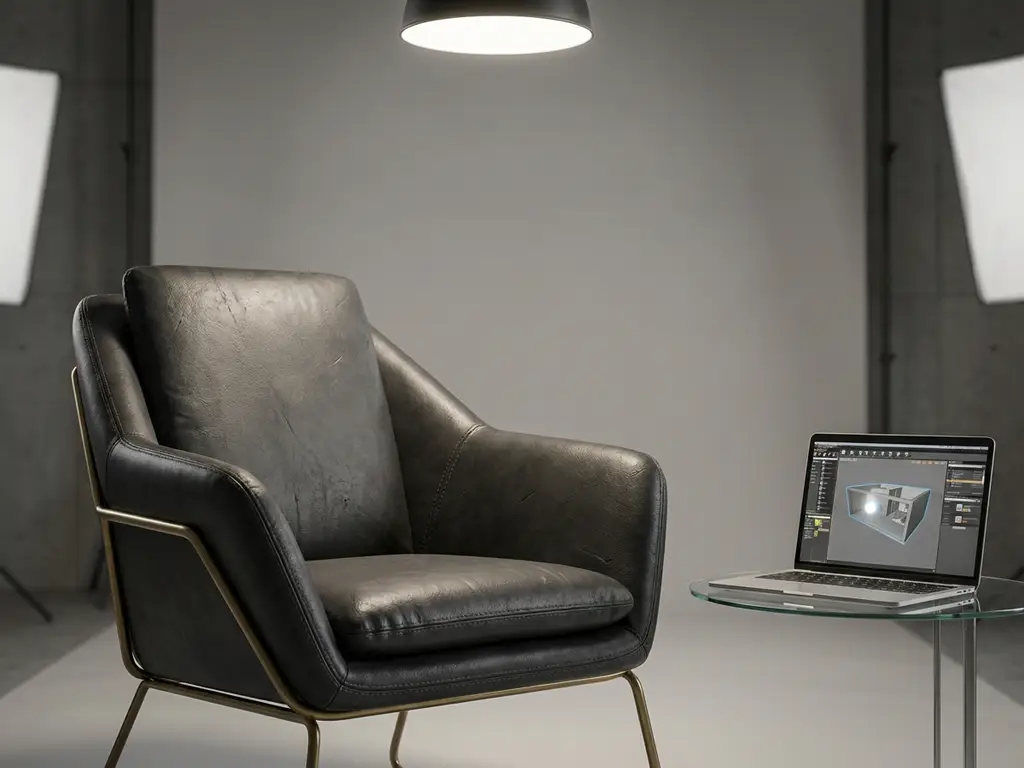
Three qualities make 3D product rendering exceptionally effective for marketing: its ability to produce photorealistic visuals without physical photoshoots, its unlimited configurability across product variants, and its consistency across every marketing channel. 3D product rendering for marketing campaigns works by building products digitally using computer-generated imagery (CGI), then placing them in virtual environments where lighting, materials, and compositions can be controlled with absolute precision. Modern rendering quality is routinely indistinguishable from studio photography, while offering capabilities that photography simply cannot match. In this guide, we cover what 3D product rendering is, how it improves engagement and conversion, which products benefit most, and how to measure its marketing impact.
What exactly is 3D product rendering, and why does it matter for marketing?
3D product rendering is a digital process that creates realistic images of products using computer-generated imagery (CGI). Unlike traditional photography, which captures physical products in real environments, 3D rendering builds products digitally using specialised software to simulate lighting, textures, and materials with precision that physical shoots cannot always guarantee.
The technology differs fundamentally from photography because it creates products virtually before they exist physically. This means brands can visualise products in any colour, material, or configuration without manufacturing samples or setting up costly photoshoots. The rendering process involves three core steps: creating a digital 3D model of the product, applying realistic materials and textures, and placing it in a virtual environment with controlled lighting.
Marketing benefits include significant cost efficiency compared to traditional photography. Once a 3D model is created, unlimited variations can be generated without additional photoshoot expenses, making it practical to respond rapidly to market demands and seasonal campaigns. Visual consistency across all marketing channels becomes achievable because every image originates from the same digital source, ensuring brand coherence whether customers encounter products online, in catalogues, or in-store displays.
The technology behind 3D product rendering has evolved dramatically over the past two decades. In its early years, rendering was a niche, cost-prohibitive tool used almost exclusively by large automotive manufacturers and consumer electronics companies for pre-production visualisation. During the mid-2010s, advances in GPU processing power and cloud computing democratised the technology, bringing high-quality 3D product rendering and visualisation within reach of mid-market brands. Today, SaaS-based platforms, like ours at 3Dimerce, deliver enterprise-grade rendering quality with fast turnaround and no in-house technical overhead, making right now the ideal moment for luxury and design brands to adopt 3D product visualization as a core marketing asset.
How does 3D product rendering compare to traditional photography in cost and flexibility?
3D product rendering and traditional photography follow fundamentally different cost structures. For marketing managers and e-commerce directors building a business case for the investment, the key difference is this: traditional photography costs scale with every new variant and campaign, while 3D rendering costs do not. The comparison below covers the four dimensions that matter most to visual production decisions.
- Upfront cost: Traditional photography for a mid-range brand typically involves studio rental, photographer fees, styling, props, and post-production editing for every shoot. 3D rendering requires an upfront investment in creating a high-quality digital model, but that asset is reusable indefinitely across every future campaign.
- Cost per product variant: With traditional photography, every new colour, material, or configuration requires a separate shoot, multiplying costs with every addition to a product range. With 3D rendering, every variant is generated from the same digital model at near-zero marginal cost, regardless of how many variants are offered.
- Turnaround time: Organising a photoshoot involves scheduling, logistics, and post-production, often taking weeks from brief to final image. 3D renders can be produced and revised in a fraction of that time, allowing marketing teams to respond quickly to seasonal campaigns or product updates.
- Scalability: Traditional photography costs scale linearly with product range size. 3D rendering costs do not. The more products and variants a brand offers, the greater the cost advantage of maintaining a library of digital models rather than booking repeated photoshoots.
For luxury and design brands with configurable, multi-variant product lines, the long-term financial case for 3D product rendering is compelling. At 3Dimerce, we specialise in making this transition smooth and commercially sound for brands in the premium segment, guiding every step from first model to full-scale deployment.
How does 3D rendering improve customer engagement compared to traditional product images?
3D product rendering improves customer engagement by enabling interactive experiences that static photography cannot provide. Customers can rotate products 360 degrees, zoom into surface details, and customise colours or materials in real time, creating an immersive shopping experience that holds attention longer and builds purchase confidence.
Interactive capabilities transform passive viewing into active exploration. When customers can manipulate product views and see immediate changes to customisations, they develop stronger emotional connections to products. This hands-on experience builds confidence in purchase decisions because customers feel they truly understand what they are buying before committing.
The realistic quality of modern 3D rendering captures attention more effectively than standard product photography. Advanced rendering solutions create images with perfect lighting, flawless surfaces, and ideal compositions that would be expensive or impossible to achieve with traditional photography. This visual appeal increases time spent viewing products and encourages sharing on social media platforms.
Trust building occurs naturally when customers can examine products thoroughly through interactive 3D experiences. The transparency of allowing complete product exploration reduces purchase anxiety and return rates while increasing customer satisfaction with their buying decisions.
The numbers confirm this impact. Studies across e-commerce verticals consistently show that brands implementing interactive 3D product visualization report conversion rate increases in the range of 20 to 40 percent compared to static imagery. Return rates, one of the most costly challenges in online retail, drop measurably when customers can explore products from every angle before purchasing, with industry experience pointing to reductions of up to 30 percent for categories where fit, finish, and material are key decision factors. Time spent on product pages also increases significantly with interactive 3D content, a leading indicator of stronger downstream conversion. These figures represent the kind of product rendering ROI that justifies the investment for marketing managers who need to build a performance case for 3D adoption.
Visual Commerce Solutions
Talk to our team about your project.
What makes 3D product rendering look realistic and professional?
The realism of 3D product rendering depends on four technical factors: lighting simulation, texture mapping, material properties, and rendering resolution. Each factor must be executed precisely for the final image to read as photorealistic rather than computer-generated.
Lighting simulation
Lighting simulation uses multiple light types, including key lights, fill lights, and rim lights, to create depth and dimension while avoiding harsh shadows or unrealistic brightness. Professional rendering replicates both natural and artificial light sources with physical accuracy, which is what separates high-quality CGI from visibly synthetic imagery.
Texture mapping and material properties
Texture mapping applies surface details that make materials look authentic. This involves photographing real materials, such as fabric weaves, wood grains, and metal finishes, and applying them to 3D models with accurate scaling and positioning. Material properties such as reflectivity, transparency, and surface roughness must match real-world characteristics precisely to achieve convincing results.
Environment, resolution, and colour accuracy
Environmental settings contribute to realism through background elements, ambient lighting, and atmospheric effects. Professional renderings place products in believable contexts that enhance their appeal while keeping visual focus on the product itself. Resolution and anti-aliasing are the final layer: high-resolution outputs ensure crisp detail when customers zoom in, while proper anti-aliasing eliminates jagged edges. Colour accuracy throughout the rendering pipeline is critical, since customers make purchase decisions based on what they see on screen.
Which types of products benefit most from 3D rendering in marketing campaigns?
Products that are configurable, technically complex, difficult to photograph, or positioned in the luxury and design segment gain the greatest marketing advantage from 3D product rendering. These categories share a common challenge: traditional photography cannot cost-effectively or completely represent what the product offers.
Configurable products
Configurable products, including furniture, automotive accessories, and custom-manufactured items available in multiple colours, materials, or component combinations, gain the most significant advantage from 3D rendering for marketing campaigns. Photographing every possible variant individually is prohibitively expensive; a single 3D model can generate all variants on demand, delivering the full breadth of a product range to customers without a single additional photoshoot.
Complex technical products
Industrial equipment, electronics, and machinery benefit from 3D rendering’s ability to show cutaway views, exploded diagrams, and animated demonstrations that reveal internal workings. These visualisation types are impossible to achieve with traditional photography and are especially effective for communicating product value to technically informed buyers.
Luxury and design-focused products
High-end furniture, jewellery, and fashion items leverage 3D rendering’s ability to deliver perfect lighting and flawless composition consistently, without the variability of physical shoots. For brands in the premium segment, 3D rendered images serve as a CGI product photography alternative that maintains impeccable visual standards across every campaign and channel. This consistency is essential for maintaining premium brand positioning across all marketing materials.
Products that are difficult or expensive to photograph
Large items such as buildings or vehicles, products requiring special handling, or items that do not photograph well under standard conditions all benefit from digital visualisation. Various use cases demonstrate how different industries maximise these advantages across their product ranges.
To summarise which product types benefit most from 3D product rendering and visualisation:
- Configurable products (furniture, automotive, custom manufacturing): generate every colour and material variant from a single 3D model, eliminating repeat photoshoots.
- Complex technical products (industrial equipment, electronics, machinery): communicate internal workings and technical detail through cutaway and exploded views that photography cannot produce.
- Luxury and design-focused products (high-end furniture, jewellery, fashion): maintain flawless, consistent visual quality that upholds premium brand positioning across all channels.
- Difficult-to-photograph products (large-scale items, fragile goods, pre-production products): achieve professional-grade imagery without the logistical and financial burden of physical shoots.
If your products fall into any of these categories, 3D product rendering and visualisation is not simply an alternative to photography; it is a strategic upgrade that unlocks commercial possibilities photography cannot provide.
How do you measure the marketing effectiveness of 3D product rendering?
The marketing effectiveness of 3D product rendering is measured through conversion rates, engagement metrics, and customer behaviour analytics, compared against baseline performance before 3D visualization was implemented. This before-and-after approach isolates the impact of the technology from other marketing variables.
Key metrics to track
Conversion rates are the most direct indicator. Track add-to-cart rates, checkout completion, and overall purchase conversion to measure sales impact. Time spent on product pages often increases with interactive 3D content, indicating higher engagement, which is a leading signal for downstream conversion improvements.
Customer feedback provides qualitative insight into rendering effectiveness. Monitor reviews that reference product visualisation, support inquiries about product details, and return rates linked to unmet product expectations. A/B testing, comparing traditional photography against 3D rendering for equivalent products, is the most reliable method for isolating the contribution of visualisation technology to conversion outcomes.
Industry experience with 3D product visualization consistently points to measurable gains across these metrics. Brands that run structured A/B tests between static photography and interactive 3D rendered images typically observe conversion uplifts of 20 percent or more, alongside meaningful reductions in return rates as customers arrive at purchase decisions with greater confidence and accuracy. These are the product rendering ROI signals that matter most to e-commerce directors and marketing managers building a performance case for 3D adoption.
Calculating return on investment (ROI) for 3D product rendering
ROI calculation for 3D product rendering should account for both cost savings and revenue increases. Cost savings come from reduced photography spend, faster time to market, and lower return rates. These savings are weighed against implementation costs and ongoing rendering expenses. Social media engagement metrics, including shares, saves, and comments, often increase with high-quality 3D content, extending marketing reach without additional paid spend.
Frequently asked questions about 3D product rendering for marketing
What is a product render?
A product render is a photorealistic digital image of a product created using computer-generated imagery (CGI) rather than a physical photoshoot. A 3D artist or rendering platform builds a detailed digital model of the product, applies accurate materials and textures, and places it in a virtual environment with controlled lighting. The result is a finished image, or set of images, that looks indistinguishable from studio photography but can be produced faster, at lower cost, and in unlimited variations. 3D rendered images are used across e-commerce, catalogues, advertising, and social media.
How long does it take to create a 3D product render?
Timelines depend on product complexity and the number of variants required, but a professionally produced 3D product render for a single product typically takes between a few days and two weeks from asset submission to final delivery. At 3Dimerce, our platform is built for speed without compromising quality, meaning luxury and design brands can move from brief to campaign-ready imagery significantly faster than a traditional photoshoot allows, particularly when multiple variants or environments are needed.
Can I use existing product data or CAD files to get started?
Yes. Existing CAD files, technical drawings, physical product samples, or high-quality reference photography can all serve as the starting point for creating a 3D model. Providing detailed reference material at the outset accelerates the modelling process and improves accuracy. If you do not have CAD files, our team can work from physical samples or detailed specifications to build a model that precisely reflects your product.
How does 3D product rendering integrate with my e-commerce platform?
Our platform is designed for marketing teams, not 3D specialists, so technical integration does not require in-house CGI expertise. We deliver final assets in the formats your e-commerce or marketing systems require, and our interactive configurators are built to connect with leading platforms without complex custom development. The goal is to make 3D product visualization a seamless addition to your existing workflow rather than a disruptive technical project.
Is the quality of 3D rendered images comparable to real photography?
Modern 3D rendered images, particularly those produced using physically-based rendering (PBR) engines, are routinely indistinguishable from studio photography. Physically-based rendering (PBR) is a rendering method that simulates real-world light behaviour, surface reflection, and material depth with a fidelity that early CGI could not approach. At the quality level we deliver at 3Dimerce, renders meet the visual standards of the most demanding luxury and design brands. Many of our clients’ customers cannot tell the difference, which is precisely the point.
What types of files or assets do I need to get started?
The most useful assets to provide are CAD files or 3D model files (such as .step, .obj, or .fbx formats), material swatches or finish specifications, brand guidelines including colour references, and any reference photography that illustrates the desired look and feel. If you are working from a product that does not yet exist physically, concept drawings and material specifications are sufficient. Our team will advise you on exactly what is needed during the initial briefing stage.
What does the 3D product rendering process look like from start to finish?
The 3D product rendering process at 3Dimerce follows four defined stages: asset submission, model creation and review, rendering and configuration setup, and final delivery with integration. Each stage has a clear input, output, and handoff point, so marketing teams always know where a project stands. The technical complexity is managed entirely by our team; your involvement is at the creative and approval stages.
Step 1: Asset submission
The process begins with you providing the reference materials our team needs to build an accurate digital model. This typically includes CAD files or technical drawings, material swatches or finish specifications, brand guidelines, and any reference photography that captures the desired aesthetic. The more complete the brief, the faster and more accurate the modelling stage. Our onboarding team guides you through exactly what to prepare, so there is no guesswork on your side.
Step 2: Model creation and review
Our team builds the 3D model of your product using the submitted assets, replicating geometry, proportions, and surface detail with precision. Once a working model is complete, we share it with you for review and approval before any rendering begins. This stage ensures that the digital asset accurately represents your product before we invest in lighting, environments, and final output. Feedback is incorporated quickly, and revisions are handled as part of the process.
Step 3: Rendering and configuration setup
With the approved model in place, our team applies materials, textures, lighting environments, and any interactive configurator logic your project requires. This is where 3D product rendering and visualisation comes to life: products are placed in virtual settings that suit your brand positioning, and every variant, whether colour, finish, or component combination, is set up so it can be generated on demand. For luxury and design brands, this stage is where the visual quality that defines premium presentation is established.
Step 4: Delivery and integration
Final assets are delivered in the formats your marketing and e-commerce systems require, whether that means high-resolution static images for print and digital advertising, interactive configurator modules for your product pages, or 360-degree spin files for immersive online browsing. Our platform connects with leading e-commerce environments, and our team supports the integration process to ensure everything works seamlessly within your existing workflow. From this point, generating new variants or updating environments for seasonal campaigns requires a fraction of the time and cost of a traditional photoshoot.
At 3Dimerce, we have refined this process across hundreds of projects for luxury and design brands across Europe, making the transition from traditional photography to professional 3D product rendering as smooth and commercially rewarding as possible.
How 3Dimerce helps with effective 3D product rendering for marketing campaigns
3Dimerce is a specialist 3D product visualisation platform built for luxury, design, and high-end brands. We combine photorealistic rendering quality with a SaaS platform engineered for speed, delivering stunning visuals and interactive configurators that perform across every marketing channel. Our focus is exclusively on the premium segment, where visual quality is not a preference but a requirement.
Our platform capabilities include:
- Interactive product configurators that allow real-time customisation of colours, materials, and components
- Seamless integration with existing e-commerce and in-store systems
- High-quality CGI imagery optimised for diverse marketing applications
- Virtual showroom creation for immersive, brand-consistent customer experiences
- Omnichannel consistency ensuring visual coherence across all customer touchpoints
Common questions before making the switch
A question we hear often is whether CGI is genuinely as good as real photography. It is a fair concern, and one rooted in how the technology looked a decade ago. Today, the rendering engines we use are physically-based, meaning they replicate real-world light behaviour, surface reflection, and material depth with accuracy that meets the standards of the most demanding luxury brands. Our renders are routinely used in premium catalogues, flagship e-commerce sites, and international advertising campaigns, environments where the visual bar is set by the world’s leading design houses.
Another common concern is technical complexity. Marketing teams worry they will need in-house 3D expertise to manage a rendering platform. Our platform is built specifically for marketing professionals, not 3D specialists. You provide product references and brand guidelines; we handle all technical execution, from model building to final delivery. Your team engages with the process at the creative and approval stages, not the technical ones.
The third objection is cost and commitment. We understand that any significant change to a visual production workflow requires financial justification. The shift to 3D product rendering is best understood as a change in cost model rather than an added expense. The upfront investment in creating a digital asset is offset, often within the first campaign cycle, by eliminating recurring studio, photographer, and post-production costs across every new variant, season, and channel. For brands with configurable or multi-variant product lines, the savings compound with every new product added to the range.
We work with leading furniture manufacturers, luxury fashion houses, and premium design brands across Europe, supporting their visual product presentation at every stage of the marketing cycle. Our clients consistently report measurable reductions in photography spend and faster go-to-market timelines for new product variants after transitioning to our platform. With over 20 years of experience serving European brands in the design and luxury sector, we understand the specific requirements of design-led manufacturers and premium retailers, and we have built our platform around those requirements. Our tailored solutions scale with your product range without proportional cost increases, making sophisticated 3D rendering both accessible and sustainable for growing businesses. Learn about our company and how we work with brands to elevate their visual product presentation.
Ready to transform your product marketing with professional 3D rendering? Contact our team to discuss how our platform can enhance your product visualisation strategy and drive measurable marketing results.
Related Articles
- Welke CPQ solution biedt de meeste prijsnauwkeurigheid bij variantrijke producten?
- How much does professional 3D modeling software cost in 2026?
- Should you choose 3D product rendering or product videos?
- How are retailers using 3D product rendering to compete online?
- How does 3D product rendering benefit furniture and interior brands?