
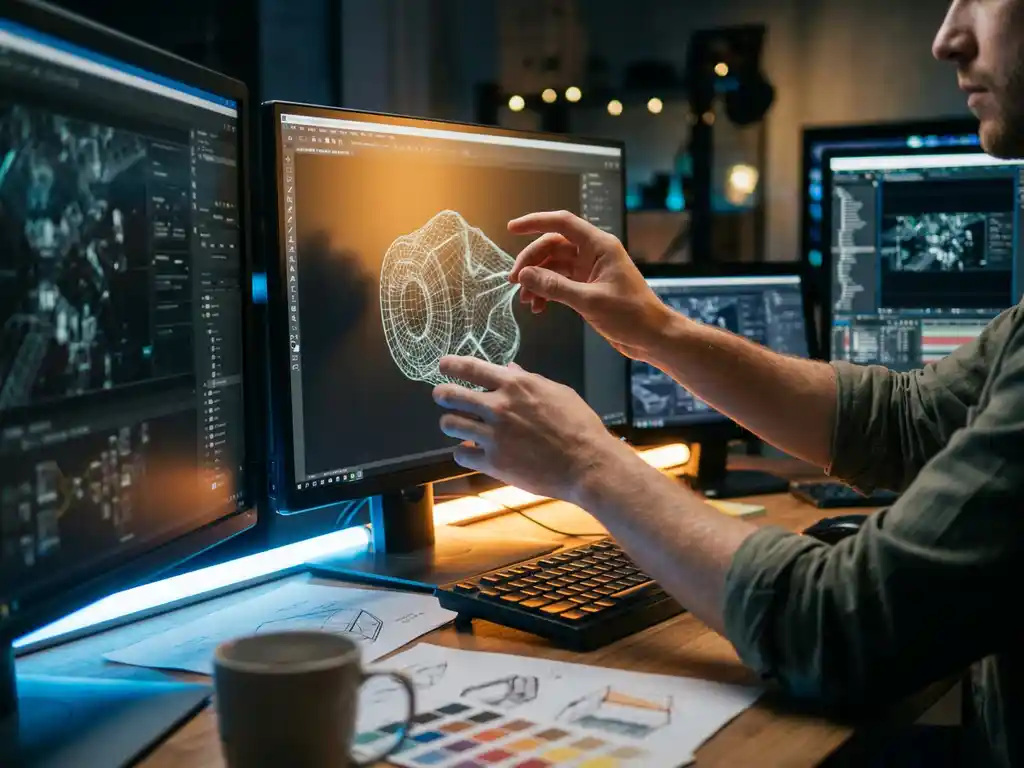
The skills needed for 3D rendering span a broad range of technical, artistic, mathematical, and professional competencies. To excel in this field, professionals need a combination of technical proficiency in 3D software, artistic skills for composition and lighting, a mathematical understanding of geometry and physics, and computer science knowledge for optimization and workflow efficiency. This guide breaks down the full 3D rendering skill set so you can identify exactly where to focus your development, whether you are just starting out or looking to reach specialist level.
What level of 3D rendering skills do you actually need?
Not everyone entering 3D rendering needs the same depth of knowledge. The skills needed for 3D rendering vary considerably depending on your goals, your industry, and the type of work you want to produce. Understanding where you currently sit on the competency spectrum helps you prioritize learning and avoid wasting time on skills that are not yet relevant to your stage of development.
Think of the tiers below as a progression roadmap, not a gatekeeping hierarchy. Every specialist started at the beginner level, and the goal is steady, deliberate advancement through each stage.
Beginner essentials
- Basic navigation of one 3D application (Blender is strongly recommended for its free access and extensive learning resources)
- Polygon modeling fundamentals: understanding vertices, edges, faces, and how to manipulate them
- Basic UV unwrapping: learning how to flatten 3D surfaces so textures apply correctly
- Using a pre-built HDRI for lighting: achieving plausible environment lighting without building a custom rig from scratch
- Render output basics: understanding resolution, file formats, and simple export settings
Intermediate professional skills
- PBR material creation in Substance Painter: authoring physically accurate roughness, metalness, and normal map channels
- Multi-light studio setups: building key, fill, and rim light configurations for product and portrait work
- Render pass compositing: separating diffuse, specular, shadow, and ambient occlusion passes for non-destructive post-processing
- Basic Python scripting for automation: writing simple scripts to batch-render variants or automate repetitive scene tasks
- Camera and composition principles: applying rule of thirds, depth of field, and focal length choices intentionally
Advanced specialist competencies
- Custom shader development: writing or building node-based shaders that replicate specific real-world material behaviors
- Procedural texturing pipelines: creating non-destructive, infinitely scalable material systems in Substance Designer or Blender’s shader graph
- Real-time rendering optimization: managing polygon budgets, baked lighting, draw calls, and Level of Detail (LOD) systems
- AI-assisted workflow integration: using AI denoising, generative texture tools, and automated pipeline scripts as standard production tools
- Multi-software pipeline management: moving assets cleanly between DCC applications, game engines, and web-based rendering platforms
At 3Dimerce, our team operates at the advanced specialist level. That depth of expertise is what allows us to deliver the stunning, photorealistic product visuals that design and luxury brands expect, consistently and at speed.
Why are outdated rendering skills limiting your competitive edge?
Outdated 3D rendering skills directly reduce a brand’s ability to compete in digital commerce. In today’s fast-paced digital marketplace, brands relying on traditional photography or basic 3D rendering techniques are falling behind competitors who leverage advanced visualization technologies. Outdated skills mean longer production times, higher costs per variant, and visuals that fail to capture the premium quality your products deserve. This translates directly to lost sales opportunities, especially when customers expect interactive, customizable product experiences that showcase every detail with stunning realism.
The solution lies in developing modern 3D rendering competencies that emphasize real-time visualization, photorealistic materials, and efficient workflow optimization. Focus on mastering contemporary rendering engines, understanding physically-based rendering (PBR) principles, and learning to create scalable visual content that adapts across multiple channels and product configurations.
How do inadequate artistic foundations undermine technical excellence?
Technical skill alone is not sufficient for professional 3D rendering — artistic foundations in composition, color theory, and lighting design are equally essential. Many technically skilled 3D artists struggle to create compelling visuals because they lack these fundamental artistic principles. Without them, even the most sophisticated rendering technology produces flat, unconvincing images that fail to engage customers or communicate product value effectively. This artistic gap becomes especially costly when creating premium product visualizations where emotional impact drives purchasing decisions.
Strengthen your artistic foundation by studying traditional art principles, analyzing photography and cinematography techniques, and practicing with real-world lighting scenarios. Develop an eye for composition and color relationships that will elevate your technical skills into truly persuasive visual storytelling.
Visual Commerce Solutions
Talk to our team about your project.
What is 3D rendering and why are specific skills important?
3D rendering is the computational process of transforming digital three-dimensional models into two-dimensional images or animations through mathematical calculations that simulate light behavior, material properties, and camera perspectives. This process requires specialized skills because it combines artistic vision with technical precision to create convincing visual representations of products, environments, or concepts.
The core 3D rendering skill set spans multiple interconnected disciplines. Artists must understand how light interacts with different materials, how to optimize geometry for efficient processing, and how to balance visual quality with rendering speed. Without proper expertise, projects suffer from unrealistic lighting, poor material representation, or inefficient workflows that waste time and resources.
The importance of skilled 3D rendering has grown as businesses recognize its value for product visualization, marketing, and customer engagement. Professional-quality rendering can significantly impact sales conversion rates and brand perception, making skilled practitioners valuable assets in competitive markets.
What technical skills do 3D rendering artists need?
3D rendering artists require technical proficiency across four interconnected areas: 3D modeling software, rendering engines, texture and material tools, and post-processing applications.
3D modeling and rendering software
Artists must master industry-standard software such as Blender, Maya, 3ds Max, or Cinema 4D, understanding their modeling tools, animation systems, and rendering engines. Knowledge of specialized rendering software like V-Ray, Arnold, or Cycles is essential for achieving photorealistic results.
Texture creation and material development
Texture and material work requires expertise in programs like Substance Painter, Photoshop, or Mari. Artists need to understand UV mapping, normal maps, displacement maps, and physically-based rendering (PBR) workflows. These skills ensure materials look convincing under various lighting conditions and viewing angles.
Post-processing and output
Post-processing capabilities in software like After Effects, Nuke, or Photoshop allow artists to enhance rendered images and create compelling final presentations. Understanding file formats, color spaces, and output specifications ensures deliverables meet professional standards across different media and platforms.
Scripting and shader programming
Python scripting is one of the most practical technical skills a 3D rendering artist can develop. In Blender, the bpy library lets artists automate scene setup, batch-render product variants across color and material configurations, and procedurally generate geometry at scale. In Maya, MEL and PyMEL serve the same purpose for pipeline automation. These scripting skills are directly applicable to scalable e-commerce visualization pipelines where dozens or hundreds of product variants need to be rendered consistently and efficiently.
Shader programming is what separates artists who can create convincing premium materials from those who rely on preset libraries. Understanding how to build PBR material graphs in Blender’s Shader Editor or Substance Designer’s node graph, controlling roughness, metalness, subsurface scattering, and emission channels with intention, gives artists precise control over how a surface reads under any lighting condition. Familiarity with shader languages such as GLSL or HLSL is an additional advantage for artists working in real-time or game engine pipelines, where custom material behavior often cannot be achieved through node editors alone.
Real-time rendering engines
Real-time rendering is a distinct skill set with its own toolchain, performance constraints, and professional applications. Engines such as Unreal Engine (with its Lumen global illumination system), Blender’s Eevee, and Three.js require artists to think differently from offline rendering workflows. Instead of waiting for a final render to evaluate quality, artists must optimize polygon counts, use baked lighting where appropriate, manage draw calls, and understand Level of Detail (LOD) systems to maintain visual quality at interactive frame rates. These constraints demand a disciplined approach to asset creation from the very start of a project.
For product visualization specifically, real-time rendering skills unlock interactive 3D configurators where customers can change materials, colors, and components live in their browser. This capability drives measurable conversion rate improvements for e-commerce brands by letting customers engage with a product in ways that static photography simply cannot replicate. At 3Dimerce, we build exactly these real-time product experiences for high-end brands, combining visual quality with the blazing-fast performance that modern consumers expect.
Emerging capture and procedural technologies
Photogrammetry, the process of deriving accurate 3D geometry and texture data from photographs, is now a standard technique in professional rendering pipelines for creating photorealistic product and environment assets. Tools like Reality Capture and Meshroom allow artists to convert real-world objects into detailed 3D models, while Quixel Megascans provides a library of scanned real-world surface materials that achieve a level of ground-truth realism that hand-crafted textures struggle to match. For brands that need their products represented with absolute material accuracy, photogrammetry is an increasingly expected skill rather than a specialist bonus.
Procedural workflows add a different dimension of scalability. Procedural texture generation in Substance Designer and procedural geometry in Blender’s geometry nodes system allow artists to create infinitely scalable, non-destructive asset pipelines. This is a critical skill for brands that need hundreds of product variants rendered consistently: instead of manually adjusting each variant, a well-built procedural system can generate the full range automatically, maintaining quality and consistency at every output.
What role do AI tools and automation play in modern 3D rendering skills?
Modern 3D rendering professionals are increasingly expected to understand and apply AI-assisted tools as part of their standard workflow. AI denoising technologies such as NVIDIA OptiX and Intel Open Image Denoise dramatically reduce the number of render samples required to produce a clean final image, cutting render times by a significant margin without sacrificing quality. Beyond denoising, AI-powered texture generation tools allow artists to create detailed, tileable surface materials from text prompts or reference images, accelerating the material creation stage of production. Prompt-based asset creation workflows are also gaining traction, enabling artists to generate base geometry or concept references that are then refined by hand, rather than building everything from scratch.
Automation skills are equally important and are now considered baseline expectations in high-end rendering studios. Artists who can script repetitive render passes, batch-process scene variants across color and material configurations, and build node-based procedural workflows reduce production time dramatically compared to those working manually. The ability to set up a render farm job, manage output naming conventions programmatically, and integrate automated quality checks into a pipeline is what allows studios to handle large-scale commercial projects without proportionally scaling their headcount. At 3Dimerce, we already integrate these advanced AI and automation workflows into every project, which means our clients receive blazing-fast, studio-quality results without needing to build or maintain that capability in-house.
How important are artistic skills compared to technical abilities?
Artistic skills and technical abilities are equally important in 3D rendering — neither alone produces professional-quality results. Technical proficiency provides the tools and methods, while artistic vision determines how those tools create compelling, emotionally resonant visuals.
Strong artistic foundations enable artists to make informed decisions about composition, color palettes, lighting mood, and visual storytelling. Understanding principles like the rule of thirds, color harmony, and atmospheric perspective helps create images that naturally draw viewer attention and communicate intended messages effectively.
However, artistic vision without technical execution falls short in professional environments. Clients expect artists to deliver high-quality results efficiently, requiring mastery of software tools, optimization techniques, and production pipelines. The most successful 3D artists balance creative intuition with technical precision.
As rendering technology becomes more accessible, artistic differentiation becomes increasingly valuable. Automated tools can handle basic technical tasks, but human creativity and artistic judgment remain essential for creating unique, memorable visual experiences that connect with audiences.
Professional and collaborative skills
Professional competencies are genuine requirements in 3D rendering roles, not optional extras. The ability to interpret a creative brief and translate abstract brand guidelines into specific visual decisions, choosing the right lighting mood, color temperature, and material finish to match a brand’s identity, is a skill that distinguishes commercially effective artists from technically capable ones. Structured feedback management is equally important: receiving revision requests constructively, communicating clearly about what is feasible within a given timeline, and delivering iterations on schedule are all skills that clients and employers evaluate alongside the quality of the renders themselves.
Collaboration with downstream disciplines is a daily reality in professional rendering work. Marketing teams, web developers, and product managers all consume rendered output, and each has different technical requirements and communication styles. Artists who understand those downstream needs, delivering files in the right format, at the right resolution, with the right naming conventions, create far less friction in a production pipeline than those who focus solely on the render itself. At 3Dimerce, our team combines these professional competencies with technical mastery to ensure every project runs smoothly from brief to final delivery, without the communication friction that slows down in-house rendering teams.
What math and computer science knowledge is required for 3D rendering?
3D rendering draws on four areas of mathematical and computational knowledge: linear algebra, spatial geometry, computer science fundamentals, and color science.
Core mathematical concepts for 3D rendering
- Linear algebra and trigonometry: These govern how 3D coordinates transform through space, how cameras project 3D scenes onto 2D screens, and how lighting calculations determine pixel colors. Artists need practical familiarity with these principles rather than advanced theoretical knowledge.
- Geometry and spatial reasoning: Understanding coordinate systems, transformations, and geometric relationships enables more efficient modeling and animation workflows. Knowledge of how polygons, vertices, and edges interact helps optimize models for rendering performance.
- Vector math in practice: Surface normals, reflection vectors, and dot products appear throughout shader logic and lighting calculations. Artists who understand these concepts can diagnose shading artifacts and build more accurate material setups without guessing.
Computer science and color science fundamentals
- Computer science fundamentals: Basic concepts like data structures, algorithms, and file management improve workflow efficiency and troubleshooting capabilities. Artists who understand how computers process 3D data can make informed decisions about model complexity, texture resolution, and rendering settings.
- Color science and digital imaging: Understanding how colors are represented digitally, how different color spaces affect final output, and how to maintain color accuracy across displays and media is crucial when delivering professional work that must meet specific technical standards.
- Scene data management: Large rendering projects involve complex hierarchies of objects, materials, lights, and cameras. Understanding how scene files are structured and how to keep them organized prevents the kind of file corruption and reference errors that can derail a production at a critical stage.
How do you develop 3D rendering skills effectively?
Effective 3D rendering skill development follows a clear progression from structured learning through to real-world application and community engagement. The artists who advance fastest are those who combine deliberate study with consistent hands-on practice, rather than consuming tutorials passively without applying what they learn.
Structured learning pathways
- Foundational courses: Start with courses that cover basic 3D concepts, software interface navigation, and fundamental modeling techniques. Online platforms such as Udemy, CG Cookie, and the official Blender documentation provide structured pathways that build core competencies in a logical sequence.
- Software-specific documentation: Reading official documentation for your chosen software, whether Blender’s manual, Autodesk’s knowledge base, or Substance’s learning hub, builds a deeper understanding of why tools behave the way they do, not just how to use them.
- Focused skill projects: Rather than attempting complex scenes immediately, isolate specific skills. Dedicate a project entirely to lighting, then another to material authoring, then another to composition. This focused approach accelerates competency in each area far more effectively than trying to improve everything at once.
Practice and community engagement
- Challenges and competitions: Participating in weekly render challenges, speed modeling contests, and community events exposes you to different approaches and professional standards while generating portfolio content under realistic time constraints.
- Feedback loops: Share work in professional forums and communities, actively seek critique, and study the feedback you receive. Honest, specific feedback from experienced artists accelerates improvement more than self-evaluation alone.
- Real-world reference study: Studying real-world use cases helps bridge the gap between technical skills and commercial applications. Understanding how 3D rendering solves actual business problems, from product configurators to campaign imagery, sharpens your ability to make decisions that serve a client’s goals rather than just your own creative preferences.
How do you build a 3D rendering portfolio that wins clients and jobs?
A strong portfolio is the most important career tool a 3D rendering artist has, and quality consistently outperforms quantity. Aim for three to five fully polished hero renders that demonstrate genuine mastery of lighting, materials, and composition rather than a large collection of mediocre work. Each piece should show the same model under at least two different lighting conditions to demonstrate that your material and lighting understanding is transferable, not the result of a lucky single setup. Reviewers evaluating a rendering portfolio are specifically looking for evidence that the artist understands light and material interaction at a fundamental level, not just that they can follow a tutorial.
Presentation matters as much as the renders themselves. ArtStation is the primary portfolio platform for professional 3D artists and provides the visibility needed for both job applications and client inquiries. Export renders at a minimum of 3000 pixels on the longest edge to ensure they display crisply on high-resolution screens. For each portfolio piece, include a brief written breakdown of the techniques used: the lighting approach, the material authoring decisions, and any specific technical challenges you solved. This process documentation signals to potential clients and employers that your results are repeatable and intentional, not accidental. Working with a studio like 3Dimerce on real client briefs is one of the fastest ways to build a portfolio that demonstrates commercial-grade rendering quality, because every project is held to the standards that design and luxury brands actually require.
Which 3D rendering specialization is right for you?
3D rendering is not a single discipline. Different specializations require meaningfully different toolsets, workflows, and artistic sensibilities. Choosing a direction early, even if you later broaden your focus, helps you develop depth faster and makes your portfolio more coherent to potential clients and employers.
Product and e-commerce visualization
Product visualization requires mastery of studio lighting rigs, photorealistic material authoring in Substance Painter, turntable rendering for 360-degree product views, and scalable variant pipelines that can handle dozens of colorways and configurations efficiently. The emphasis is on absolute material accuracy and lighting control, because customers are making purchasing decisions based on what they see. This is the specialization that 3Dimerce has refined for design and luxury brands, delivering product visuals that are indistinguishable from photography and interactive experiences that convert browsers into buyers.
- Studio lighting and HDRI control
- PBR material authoring (Substance Painter, Substance Designer)
- Turntable and variant render pipelines
- Real-time configurator integration
Architectural and interior visualization
Architectural visualization focuses on communicating spatial qualities, material relationships, and the interplay of natural and artificial light within built environments. Accuracy to real-world dimensions and lighting conditions is paramount, and clients often require images that can be used in planning applications or marketing materials before a building is constructed.
- V-Ray or Corona Renderer
- Accurate sun and sky lighting systems
- Interior lighting and IES profiles
- Large-scale scene management
Real-time and interactive rendering
Real-time rendering specialists build experiences that respond to user input, from product configurators to virtual showrooms and interactive installations. The core skill shift from offline rendering is learning to achieve high visual quality within strict performance budgets, using techniques like baked lighting, LOD systems, and optimized shader graphs rather than relying on brute-force computation.
- Unreal Engine (Lumen, Nanite)
- Real-time PBR material workflows
- Performance optimization and LOD management
- Product configurator and web-based rendering (Three.js, Babylon.js)
Film and VFX rendering
Film and VFX rendering demands the highest level of technical complexity, combining photorealistic CGI with live-action footage in ways that are invisible to the audience. Multi-pass compositing, motion tracking integration, and the management of extremely complex scene data are all standard requirements in this specialization.
- Arnold or Houdini for complex simulations and rendering
- Multi-pass compositing in Nuke or After Effects
- VFX pipeline integration and asset handoff
- Motion blur, depth of field, and volumetric effects
How 3Dimerce helps with 3D rendering excellence
3Dimerce is a visual product experience platform specializing in high-end 3D product visualization for design and luxury brands. We combine cutting-edge rendering technology with deep expertise in premium product presentation, delivering stunning visuals with blazing fast performance across every channel.
Our comprehensive 3D visualization solutions offer several key advantages for skill development and professional growth:
- Access to cutting-edge rendering technology and workflows used in premium product visualization
- Opportunity to work with high-end materials, lighting systems, and real-time rendering engines
- Experience creating scalable visual content for omnichannel deployment
- Exposure to advanced CGI techniques that deliver stunning visuals with blazing fast performance
Whether you’re looking to enhance your team’s rendering capabilities or explore how professional 3D visualization can transform your product presentation, we’re here to help you achieve exceptional results. Contact us today to discover how our expertise in high-quality 3D product configurators can elevate your visual content strategy.
Frequently Asked Questions
How long does it typically take to become proficient in 3D rendering?
The timeline varies based on your starting point and dedication, but most beginners can achieve basic proficiency in 6-12 months with consistent daily practice. Reaching professional-level skills typically requires 2-3 years of focused learning and project experience. However, mastering advanced techniques and developing a distinctive artistic style is an ongoing process that continues throughout your career.
What's the best 3D software for beginners to start learning rendering?
Blender is often recommended for beginners because it’s free, has extensive community resources, and includes powerful built-in rendering engines like Cycles and Eevee. However, if you’re targeting specific industries, consider Maya for animation/film, 3ds Max for architecture/product visualization, or Cinema 4D for motion graphics. The key is to master one software thoroughly before exploring others.
How do I know if my renders look professional enough for client work?
Professional renders should have realistic lighting with proper shadows and reflections, materials that respond convincingly to light, clean geometry without visible artifacts, and composition that effectively showcases the subject. Compare your work to industry leaders, seek feedback from experienced professionals, and ensure your renders meet technical specifications for resolution, color accuracy, and file formats required by clients.
What are the most common mistakes that prevent renders from looking photorealistic?
The biggest mistakes include unrealistic lighting (too uniform or harsh), incorrect material properties (wrong reflectance or roughness values), poor composition that lacks focal points, and over-saturation or incorrect color temperatures. Many beginners also neglect subtle details like dust, scratches, or imperfections that make objects feel real, and fail to match the lighting conditions of their intended environment.
Should I specialize in a specific type of 3D rendering or remain generalist?
Choosing the right 3D rendering specialization depends on where your interests and strengths align. Specialization often leads to higher earning potential and expert recognition, especially in niches like architectural visualization, product rendering, or character work. However, start as a generalist to discover your strengths and interests, then gradually focus on areas where you excel and enjoy working. Many successful artists maintain broad skills while having one or two specialties that define their professional brand.
How important is having a powerful computer for 3D rendering work?
While a powerful computer significantly improves workflow efficiency and enables complex scenes, it’s not an absolute requirement for learning. You can start with modest hardware and optimize your workflow through efficient modeling, lower-resolution previews, and cloud rendering services. Invest in upgrades gradually as your skills and project complexity grow, prioritizing GPU power for real-time rendering and CPU cores for final production renders.
What's the difference between real-time and offline rendering, and when should I use each?
Real-time rendering (like Eevee or Unreal Engine) provides immediate feedback and is perfect for interactive applications, quick iterations, and client presentations. Offline rendering (like Cycles or V-Ray) offers superior quality and accuracy for final production work, complex lighting scenarios, and photorealistic results. Use real-time for development and client reviews, then switch to offline rendering for final deliverables when maximum quality is required.