
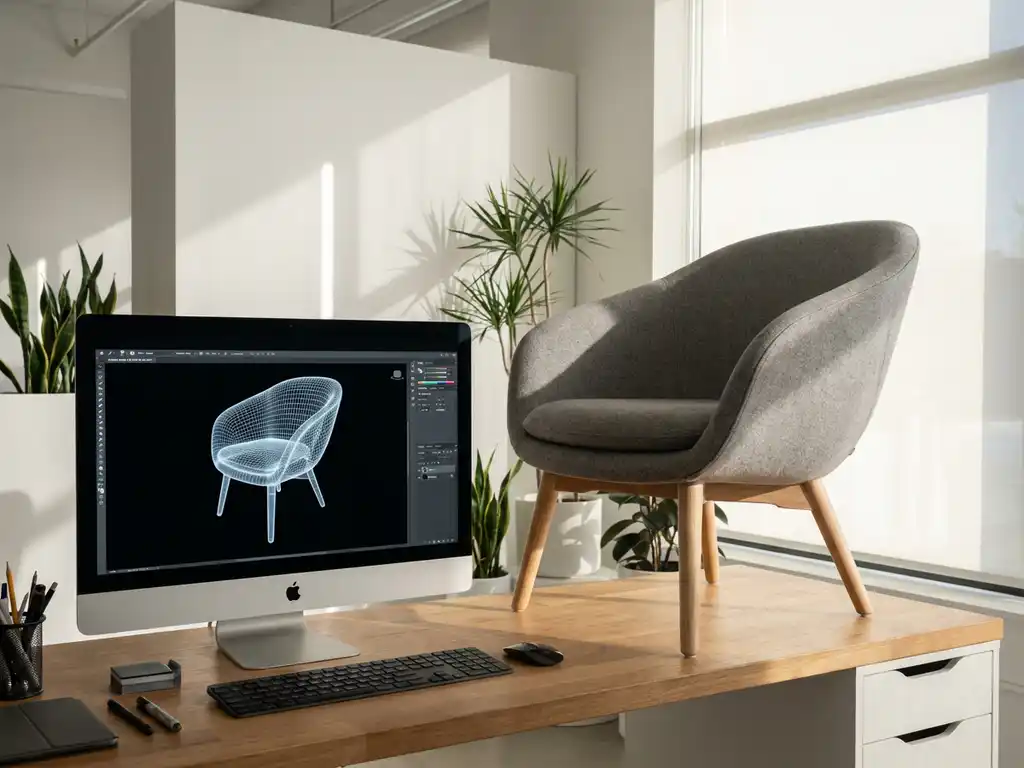
Furniture manufacturers use 3D product rendering to create unlimited visual content variations without the constraints of traditional photography. This technology generates photorealistic images of every product configuration, colour, and material combination digitally. It eliminates the need for physical prototypes and studio shoots while maintaining premium visual quality across all marketing channels.
The hidden costs of disconnected visual workflows for furniture manufacturers
Photography delays that kill your launch calendar
A single delayed photo shoot can push an entire seasonal collection launch back by weeks, costing revenue and competitive positioning at exactly the moment it matters most. Studio availability, sample shipping logistics, and last-minute design changes all compound into a fragile production chain that furniture manufacturer workflow challenges make difficult to control. For marketing managers accountable to launch deadlines, this unpredictability is one of the most damaging operational risks in the business.
Inconsistent visuals across channels that erode brand trust
When product imagery is produced across multiple shoots, studios, and timeframes, visual inconsistency becomes inevitable. Mismatched lighting, colour rendering, and styling across your website, trade catalogue, and retail displays create customer confusion and undermine the brand consistency that premium furniture positioning demands. Inconsistent visuals also contribute directly to higher return rates, as customers receive products that do not match their expectations set by the imagery.
The customisation bottleneck: when product options outpace your content team
Scaling visual content production becomes practically impossible when a sofa line offers 20 fabrics, 15 frame colours, and multiple configuration options, generating over 300 combinations. No traditional photography budget can cover that scope, which means most manufacturers show only a fraction of their range online and leave revenue on the table. Photorealistic renderings for the furniture industry exist precisely to break this bottleneck, enabling every combination to be visualised without a single additional shoot.
What is 3D product rendering and why is it essential for modern furniture manufacturers?
3D product rendering is computer-generated imagery (CGI) that creates photorealistic visuals of furniture products using digital models, materials, and lighting, without requiring physical samples or studio photography. Traditional photography cannot keep pace with modern furniture customisation demands because each new colour, fabric, or configuration requires separate photo shoots, physical samples, and studio time.
Why traditional photography cannot keep pace with modern furniture customisation
Furniture manufacturers face mounting pressure to offer extensive customisation options while maintaining visual consistency across their marketing materials. A single sofa line might offer 20 fabric choices, 15 colours, and multiple configurations, resulting in thousands of potential combinations. Photographing every variation would require enormous resources and storage space for physical samples.
3D rendering addresses these scalability challenges by creating a digital foundation that can generate any product variation on demand. Once the initial 3D model exists, manufacturers can apply different materials, adjust dimensions, and modify components without additional photography. This approach transforms content production from a physical limitation into a digital opportunity.
The technology is particularly valuable for furniture brands launching new collections or expanding into international markets, where shipping samples for photography becomes impractical. Digital workflows enable rapid content creation that matches the speed of modern product development cycles.
How does 3D rendering reduce photography costs for furniture manufacturers by up to 70%?
3D rendering reduces furniture photography costs by replacing recurring physical shoots with a one-time investment in digital asset creation. After the initial 3D models are built, generating additional images across new configurations, materials, or markets costs a fraction of traditional photography. The savings compound with every new product variation and catalogue update.
The cost breakdown reveals significant savings potential. A typical furniture photo shoot might cost £2,000–£5,000 per day, covering only a limited number of products and configurations. Physical sample production adds material costs, manufacturing time, and storage requirements. International brands often maintain sample libraries in multiple locations, creating ongoing overhead.
A simple ROI framework for furniture manufacturers
To understand the financial case clearly, consider two scenarios for a manufacturer with five product lines and 50 variations per line:
- Scenario A (traditional photography over 12 months): 12–24 shoot days at approximately £5,000 per day equals £60,000–£120,000 annually, producing roughly 250 usable product images at a high cost per image, with no coverage of the remaining hundreds of variations.
- Scenario B (3D rendering investment over 12 months): A one-time model creation investment (varying by product complexity and volume) plus a low per-render cost thereafter, enabling thousands of images per year across every configuration, material, and market variant.
Most furniture manufacturers find they can reduce photography costs significantly within the first catalogue cycle, as the per-image cost drops sharply once master models are in place. The investment typically recovers within the first or second catalogue cycle, after which every additional image generated represents near-pure savings compared to the equivalent photography cost.
Accelerating time-to-market for new furniture collections
In seasonal furniture markets, a 4–6 week photography delay can mean missing a key retail window entirely, handing competitive advantage to brands that move faster. 3D rendering compresses the product launch cycle by decoupling visual content production from physical sample availability, enabling marketing to run in parallel with manufacturing rather than waiting for it. For marketing managers at internationally operating furniture brands, this is not a marginal efficiency gain but a structural competitive advantage. The following scenarios illustrate the time-to-market impact of photorealistic renderings for the furniture industry:
- New collection launch: 3D renders can be ready weeks before physical samples exist, enabling pre-launch marketing campaigns and trade press coverage ahead of competitors.
- Seasonal catalogue updates: Swap materials and finishes digitally overnight instead of scheduling a new shoot, so faster furniture product launches become the operational norm rather than the exception.
- International market adaptation: Localise lifestyle imagery for different markets simultaneously without additional shoots, reducing time to market for furniture brands entering new territories.
3D rendering shifts variable photography costs into a one-time investment in digital asset creation. After initial model development, generating additional images costs a fraction of traditional photography. Furniture manufacturers can reallocate photography budgets toward enhanced marketing campaigns, improved customer experience, or product development initiatives.
The financial benefits extend beyond direct cost savings. Digital workflows reduce time to market for new products, enabling faster responses to trends and customer demands. Brands can test market reactions to new designs before committing to physical production, reducing inventory risk and development costs.
Visual Commerce Solutions
Talk to our team about your project.
Which furniture product categories benefit most from photorealistic 3D rendering?
The furniture products that benefit most from 3D rendering are those with high configuration complexity, where the number of material, colour, or size combinations makes traditional photography impractical at scale. Configurable and modular furniture systems see the greatest impact, but several other categories gain measurable advantages.
Upholstered furniture is an ideal application due to extensive fabric and colour options. A single chair design might offer 100+ upholstery choices, making comprehensive photography prohibitively expensive. 3D rendering enables furniture manufacturers to showcase every combination while maintaining consistent lighting and positioning.
Interactive configurators: turning customisation complexity into a sales advantage
A configurator built on 3D models lets customers freely select from manufacturer-defined options, including fabrics, finishes, and dimensions, and see an accurate photorealistic preview in real time without requiring any manual intervention from the sales or design team. This self-service model scales customer customisation without scaling headcount, which is a decisive operational advantage for growing furniture brands. The configurator logic also ensures that only valid, producible combinations are displayed, directly reducing order errors and the costly corrections that follow. We build interactive 3D furniture visualisation configurators specifically for premium furniture brands where visual accuracy and brand consistency are non-negotiable, so the furniture product configurator your customers interact with reflects your brand at its best.
Modular storage systems, office furniture, and kitchen cabinetry benefit significantly from digital visualisation. These products often feature complex configuration options where customers need to visualise different arrangements and finishes. Product configurators enable interactive exploration of these possibilities.
Outdoor furniture collections gain particular value from 3D rendering because seasonal photography windows limit traditional shoots. Weather dependencies and location requirements make digital alternatives especially attractive. High-end and luxury furniture with premium materials also benefits from 3D rendering’s ability to capture subtle texture details, including wood grain, leather surface depth, and fabric weave, with consistent accuracy.
Custom furniture manufacturers find 3D rendering essential for client presentations and approval processes. The technology enables detailed visualisation of bespoke pieces before production begins, reducing miscommunication and ensuring customer satisfaction.
How do furniture manufacturers integrate 3D rendering into their existing design and marketing workflows?
Furniture manufacturers implement 3D rendering workflows by first digitising their core product lines through detailed model creation. This process involves measuring existing products, photographing materials and textures, and building accurate digital representations that serve as the foundation for all future content generation.
The implementation process follows these key stages:
- Asset creation: Develop 3D models of furniture frames, components, and mechanisms
- Material library development: Digitise fabrics, woods, metals, and finishes with accurate physical properties
- Integration planning: Connect rendering workflows with existing product development and marketing processes
- Team training: Educate marketing, sales, and product teams on digital asset management
Successful implementation requires collaboration between product development, marketing, and IT teams. Product teams provide technical specifications and material samples. Marketing defines visual requirements and brand standards. IT ensures integration with existing e-commerce platforms and content management systems.
Many manufacturers adopt a phased approach, starting with high-volume product lines or new collections. This strategy enables teams to develop expertise while demonstrating value before expanding to complete product catalogues. Comprehensive solutions often include training and support to ensure smooth transitions.
Getting internal buy-in: aligning marketing, product, and IT teams
The biggest implementation barrier is rarely the technology itself. It is internal alignment. Decision-makers evaluating 3D rendering workflows are not just assessing a tool; they are assessing whether their organisation can successfully adopt and sustain it. Addressing this directly from the outset determines whether a rollout delivers results or stalls after the pilot phase. The following steps consistently make the difference:
- Define a shared success metric across teams: Agree on a concrete measure, such as the number of product images produced per quarter, so marketing, product, and IT are working toward the same outcome.
- Assign a dedicated digital asset owner: Appoint a single point of accountability who bridges the gap between marketing requirements and product data, preventing the handoff failures that slow most implementations.
- Run a pilot with one high-priority product line: Build internal confidence and demonstrate measurable value before committing to a full catalogue rollout.
- Establish a clear handoff protocol with your rendering partner: Define exactly how assets, revision requests, and approvals flow between your internal teams and the 3D rendering partner to eliminate ambiguity and delays.
We guide furniture manufacturers through every stage of this transition, not just the technical delivery. Our role is to act as a strategic implementation partner, ensuring that the workflow we build together fits your organisation’s structure and scales with your ambitions.
How 3D rendering connects your design, sales, and production workflows
From disconnected tools to a single digital source of truth
Most furniture manufacturers currently operate with separate tools for design (CAD), content production (photography and digital asset management), sales (e-commerce CMS), and production planning. Manual handoffs between these systems create errors, delays, and duplicated effort that accumulate into significant operational drag across the business. Scaling design workflows under these conditions is structurally difficult because every update in one system requires a manual cascade of changes across all the others.
A centralised 3D asset library changes this dynamic fundamentally. When a single master model serves as the definitive digital source of truth, every downstream system, from the e-commerce product page to the sales configurator to the print catalogue, draws from the same validated data. Integrated furniture design workflows built around this principle eliminate redundant work, reduce error rates, and give marketing, sales, and product teams a shared foundation they can trust.
How customer configurations flow from screen to production floor
Consider a concrete scenario: a customer selects a sofa configuration in an online configurator, choosing a specific fabric, frame finish, and dimension. Because the configurator is built directly on the 3D model data, that selection carries accurate dimensional specifications, material references, and component codes through to the order automatically. The production team receives an order that is ready for manufacturing without manual redrawing, re-specification, or back-and-forth clarification.
This connected visual production model eliminates one of the most common sources of production error in the furniture industry: the gap between what the customer saw and what the factory was told to build. It also removes a significant administrative burden from sales and customer service teams, who no longer need to manually translate customer choices into production briefs. The result is a faster, more accurate, and more scalable order-to-production process that supports growth without proportionally increasing overhead.
How furniture manufacturers use 3D rendering in practice
To understand what a transition to 3D rendering looks like in practice, consider a representative scenario based on the type of project we regularly support. A mid-size European upholstered furniture brand, producing sofas and armchairs across three core frame designs, had built its visual content strategy entirely around traditional photography. With 80 fabric options across its range, the brand was spending approximately £40,000 per year on photography and still only managing to show a fraction of its available combinations online. Customers who enquired about unlisted fabric options were handled manually by the sales team, creating delays and inconsistent brand presentation.
The transition began with digitising the three core frame models to an accurate, production-matched standard and building a comprehensive material library covering all 80 fabrics with physically accurate texture and sheen properties. These assets were then connected to the brand’s e-commerce platform through an interactive furniture product configurator, enabling customers to explore every combination in photorealistic quality in real time. The furniture manufacturer 3D rendering workflow also fed directly into the seasonal catalogue production process, replacing the annual photography shoot entirely.
The outcome was a complete visual coverage of the product range for the first time, a photography budget redirected toward brand campaigns rather than product documentation, and a catalogue production cycle that no longer depended on sample availability or studio scheduling. Seasonal updates that previously required weeks of coordination could be completed in days by updating the material library and regenerating the relevant renders. As one outcome summary might read: full range, faster cycles, lower cost, and a brand that finally looked as premium online as it did in the showroom.
What photorealistic quality standards should premium furniture brands expect from 3D rendering?
Photorealistic quality in furniture 3D rendering means outputs that match or exceed traditional photography in detail, material accuracy, and visual appeal, at any resolution required for print or digital use. Premium and luxury furniture brands, in particular, require renders that maintain their positioning while accurately representing craftsmanship details that justify higher price points.
Resolution and texture accuracy
Technical specifications should include high-resolution outputs suitable for large-format printing and detailed web viewing. Texture accuracy is critical for furniture rendering, particularly for wood grain, fabric weaves, and leather surfaces.
Lighting, shadow, and colour fidelity
Lighting must create natural shadows and reflections that enhance, rather than distract from, product features. Visual consistency across product lines ensures cohesive brand presentation. All renders should maintain identical lighting conditions, colour accuracy, and styling approaches. This consistency is especially important for furniture collections where products appear together in catalogues and showroom displays.
Brand consistency across formats
Quality benchmarks should address material representation accuracy, dimensional precision, and colour fidelity across different display devices. Furniture manufacturers should expect renders that accurately convey scale, proportion, and spatial relationships to prevent customer disappointment upon delivery.
Professional 3D rendering should also accommodate brand-specific requirements such as styling preferences, environmental settings, and presentation formats. The technology should support various output formats, from web-optimised images to high-resolution print materials, while maintaining consistent quality standards.
Why premium furniture brands choose 3Dimerce to scale visual content production
3Dimerce is a visual product configuration platform built specifically for premium and luxury furniture brands that need to scale content production without compromising quality. We address furniture manufacturers’ content-scaling challenges by automating rendering workflows, delivering stunning, high-fidelity visuals at speed, while eliminating the bottlenecks that prevent brands from showcasing their complete product ranges effectively.
Our platform offers furniture manufacturers:
- Automated content generation: Master 3D models produce unlimited product variations automatically, eliminating the need for reshoots whenever materials, finishes, or configurations change. Your content library grows with your range, not your photography budget.
- Seamless integration: Our platform connects directly with leading e-commerce and PIM systems, ensuring that product data and visuals stay synchronised without manual updates or version-control errors between teams.
- Interactive configurators: Customers can explore every customisation option in photorealistic quality in real time, increasing purchase confidence and reducing returns by setting accurate visual expectations before the order is placed.
- Omnichannel consistency: A single render output is automatically optimised for web, print, and retail display formats, maintaining your brand standards across every touchpoint without additional production effort.
- Rapid deployment: New collections can go live with full visual coverage before physical samples are produced, enabling pre-launch marketing campaigns that give your brand a head start in every seasonal window.
We specialise exclusively in the premium and high-end furniture segment, which means our platform is purpose-built for the complexity, quality standards, and brand requirements that define this market. We are not a general-purpose rendering service. We are the partner furniture brands choose when they refuse to compromise between visual excellence and operational efficiency, and when they need a team that understands what premium presentation actually demands at scale.
Ready to transform your furniture visualisation capabilities? Contact our team to discuss how our platform can scale your visual content production while maintaining the premium quality your customers expect.