
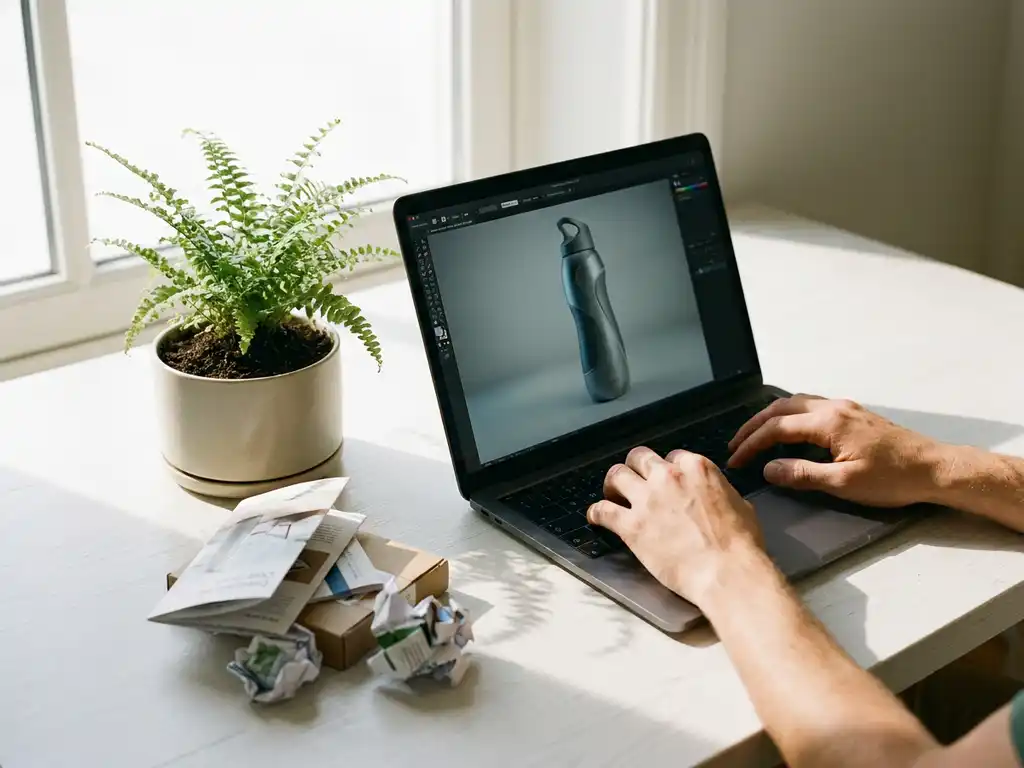
3D product rendering has emerged as a game-changing technology that enables brands to create stunning product visuals while dramatically reducing their environmental footprint. Unlike traditional photography, which requires physical samples, shipping, studio setups, and extensive resources, 3D rendering generates photorealistic product images digitally, eliminating waste and carbon emissions associated with conventional marketing production processes.
Why is traditional product photography creating an environmental crisis for brands?
Traditional product photography generates massive environmental costs that most brands don’t fully realize. Every photoshoot requires manufacturing physical prototypes, shipping samples across continents, building elaborate studio sets, and disposing of props afterward. A single furniture collection photoshoot can produce hundreds of kilograms of waste from packaging, sample products that can’t be sold, and discarded set materials. The carbon footprint multiplies when you factor in international shipping of products solely for photography purposes, studio lighting running for hours, and teams traveling to locations.
The hidden cost extends beyond immediate waste. When brands need new visuals for product variations or seasonal campaigns, the entire cycle repeats. This creates an unsustainable loop where marketing demands directly conflict with environmental responsibility, forcing brands to choose between visual quality and ecological impact.
How is outdated visual content production limiting your sustainability goals?
Brands committed to sustainability often find their marketing departments working against corporate environmental objectives. Traditional visual content production requires the constant creation of physical samples that serve no purpose beyond photography, generating waste that contradicts sustainability messaging. When customers see beautiful environmental commitments on websites illustrated with imagery that required destroying dozens of prototype products, the disconnect becomes apparent.
The solution lies in shifting to digital-first visual production. By adopting 3D rendering workflows, brands can maintain premium visual standards while aligning marketing operations with sustainability goals, creating authentic environmental stewardship that extends throughout the entire business.
Visual Commerce Solutions
Talk to our team about your project.
What is sustainable product marketing and why does 3D rendering matter?
Sustainable product marketing focuses on promoting products and services while minimizing environmental impact throughout the marketing process. This approach considers the full lifecycle of marketing activities, from content creation to distribution, seeking to reduce waste, energy consumption, and carbon emissions without compromising effectiveness.
3D product rendering plays a crucial role in sustainable marketing by replacing resource-intensive traditional photography with digital alternatives. Instead of manufacturing physical prototypes, shipping products globally, and setting up elaborate photo studios, brands can create photorealistic product images entirely through computer-generated imagery. This shift eliminates the need for physical samples, reduces transportation emissions, and allows for unlimited product variations without additional environmental cost.
The technology enables brands to showcase their entire product range, including customizable options and color variations, using only digital assets. This means a furniture manufacturer can display hundreds of fabric combinations and finishes without producing a single physical sample, while maintaining the visual quality that luxury brands demand.
How does 3D rendering reduce environmental impact compared to traditional photography?
The environmental benefits of 3D rendering become clear when comparing resource consumption with traditional photography. Conventional product photography requires manufacturing physical prototypes specifically for marketing purposes. These samples often cannot be sold afterward due to handling, lighting damage, or seasonal relevance, creating direct waste.
Transportation represents another significant impact area. Traditional photography often involves shipping products to studios, sometimes internationally, purely for visual content creation. A European furniture brand might ship products to specialized photography studios in different countries, generating substantial carbon emissions for marketing purposes alone.
3D rendering eliminates these transportation needs entirely. Once digital assets are created, they can generate unlimited variations without additional shipping or physical production. The energy consumption shifts from physical logistics to computational power, which can be optimized and powered by renewable energy sources.
Studio operations also differ dramatically. Traditional photography requires extensive lighting setups, climate control for large spaces, and disposal of props and sets. Digital rendering uses computational resources that can be precisely controlled and optimized for efficiency, often resulting in significantly lower overall energy consumption per image produced.
What are the main sustainability benefits of virtual product visualization?
Virtual product visualization delivers measurable sustainability benefits across multiple dimensions. The most immediate impact comes from eliminating physical prototype production for marketing purposes. Brands can showcase unlimited product configurations without manufacturing samples, reducing material waste and production emissions.
Resource efficiency extends to content updates and variations. When brands need to show new color options, finishes, or configurations, 3D rendering allows the instant generation of new visuals without additional physical resources. This agility supports more responsive marketing while maintaining environmental responsibility.
The technology also enables better customer decision-making, potentially reducing product returns. When customers can visualize products accurately in different configurations and environments before purchasing, they make more informed decisions. Reduced return rates mean fewer transportation emissions and less packaging waste.
Long-term benefits include reduced dependence on physical showrooms and sample libraries. Brands can create comprehensive digital catalogs that provide the same visual impact as physical displays while eliminating the ongoing environmental cost of maintaining sample inventory.
How can brands implement 3D rendering for more eco-friendly marketing campaigns?
Successful implementation of 3D rendering for sustainable marketing requires a strategic approach that balances environmental goals with visual quality expectations. Brands should start by auditing their current visual content production processes to identify the highest-impact areas for digital transformation.
The transition works best when brands focus initially on product categories with high variation potential, such as configurable furniture or customizable products. These categories offer the greatest sustainability benefits because traditional photography would require producing numerous physical samples to show all possible combinations.
Integration with existing marketing workflows is crucial. Brands should ensure their 3D rendering solution can produce content in the formats and quality levels required for all marketing channels, from e-commerce websites to print catalogs. This prevents the need to maintain parallel production systems that would reduce environmental benefits.
Training teams on digital-first thinking helps maximize sustainability impact. When marketing teams understand how to leverage 3D rendering capabilities, they can plan campaigns that would be impossible or environmentally costly with traditional photography, such as showing seasonal variations or regional customizations without additional production.
Measuring and communicating environmental benefits strengthens the business case for continued investment in sustainable marketing technologies. Brands should track metrics like reduced sample production, eliminated shipping for photography purposes, and decreased studio resource consumption to demonstrate the tangible environmental impact of their digital transformation.
How 3Dimerce supports sustainable product marketing
We specialize in creating high-quality 3D product configurators that eliminate the need for physical prototypes while delivering stunning visual results. Our platform enables brands to showcase unlimited product variations digitally, supporting sustainability goals without compromising visual excellence.
Key benefits of our solution include:
- Complete elimination of sample production for marketing purposes
- Instant generation of product variations and configurations
- Seamless integration with existing e-commerce and marketing systems
- Premium visual quality that maintains luxury brand positioning
- Scalable platform that grows with your sustainability initiatives
Our comprehensive solutions help brands transition to sustainable marketing practices while enhancing customer engagement. With over 20 years of experience in virtual visualization, we understand how to deliver the visual impact that premium brands require while supporting their environmental commitments.
Ready to transform your product marketing for sustainability? Explore our proven use cases to see how leading brands achieve their environmental goals through digital visualization. Contact our team to discuss how 3D rendering can support your sustainability objectives while enhancing your marketing effectiveness.
Frequently Asked Questions
How long does it take to transition from traditional photography to 3D rendering for our product line?
The transition timeline typically ranges from 2-6 months depending on your product complexity and catalog size. Simple products with fewer variations can be digitized within weeks, while complex configurable products may require 2-3 months for initial setup. Once your 3D assets are created, generating new visuals becomes instant, making the upfront investment worthwhile for long-term sustainability goals.
What's the cost comparison between 3D rendering and traditional product photography over time?
While 3D rendering requires higher initial investment for asset creation, it becomes significantly more cost-effective over time. Traditional photography costs multiply with each new product variant, seasonal campaign, or color option, plus ongoing expenses for samples and shipping. 3D rendering eliminates these recurring costs, typically achieving ROI within 6-12 months for brands with frequent visual content needs.
Can 3D rendered images really match the quality expectations of luxury brands?
Modern 3D rendering technology produces photorealistic images that are often indistinguishable from traditional photography. Many luxury brands already use 3D rendering without customers realizing it. The key is working with experienced 3D specialists who understand material properties, lighting, and the visual standards required for premium brand positioning while maintaining environmental benefits.
How do we measure and report the environmental impact reduction from switching to 3D rendering?
Track key metrics including eliminated prototype production (units and materials saved), reduced shipping emissions (kilometers and carbon footprint), decreased studio energy consumption, and waste reduction from props and packaging. Many brands report 60-80% reduction in marketing-related environmental impact, with specific numbers varying by product type and previous photography practices.
What happens to our existing product photography and marketing materials during the transition?
Your existing photography remains valuable and can be integrated with new 3D content during the transition period. Many brands use a hybrid approach initially, leveraging 3D rendering for new products and variations while gradually replacing older photography. This allows for smooth workflow continuity while building your sustainable marketing capabilities over time.
How does 3D rendering handle seasonal campaigns and limited-time product variations?
3D rendering excels at seasonal and limited-time campaigns because it eliminates the lead time and waste associated with producing physical samples for short-term marketing needs. You can instantly create holiday-themed visuals, seasonal color variations, or regional customizations without manufacturing temporary samples, making your marketing more agile and environmentally responsible.
What technical requirements do we need internally to manage 3D rendered content?
Most 3D rendering solutions are designed to integrate with existing marketing workflows without requiring specialized technical expertise from your team. The rendering provider typically handles the technical aspects, delivering final images in standard formats for your e-commerce, social media, and print needs. Your team focuses on creative direction and campaign strategy rather than technical implementation.