
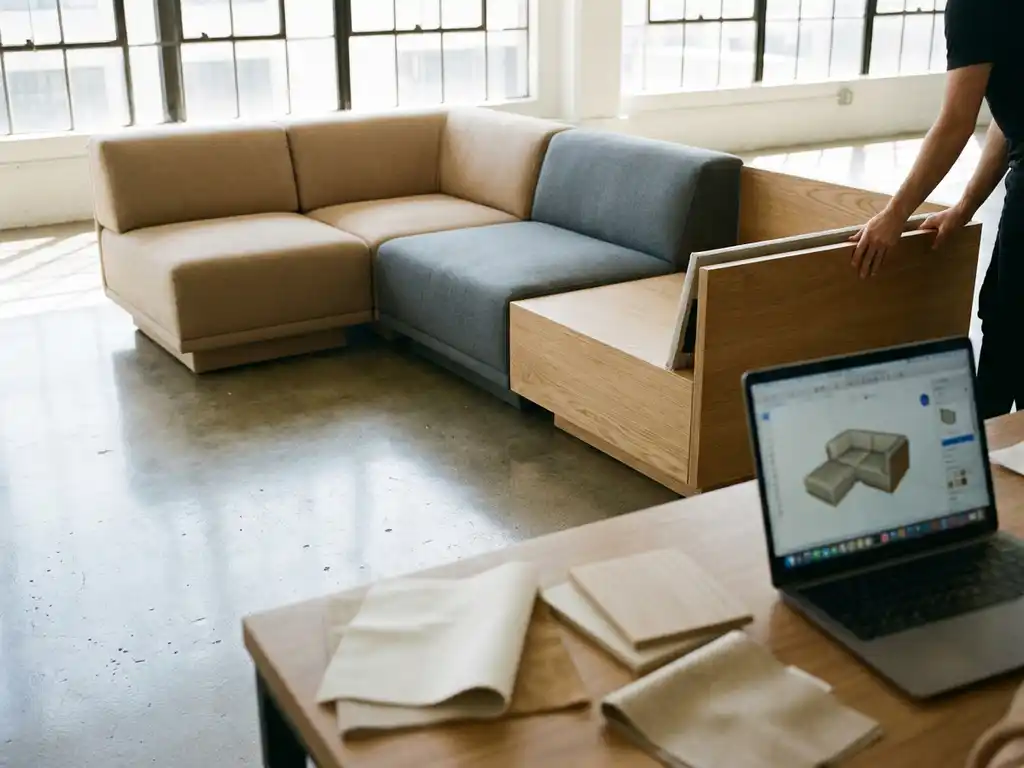
Modular furniture manufacturers typically use a combination of software tools to manage their design, production, and sales processes. The most common categories include CAD software for product engineering, ERP systems for operations, and increasingly, 3D product configurators with integrated CPQ software for sales and customer-facing experiences. For design-led brands competing in the premium segment, the visual and commercial tools have become just as critical as the production ones.
The right software stack depends on where you are in the value chain and what your biggest bottleneck is. This article walks through the key questions modular furniture brands ask when evaluating their software options — covering configurators, CPQ, CGI imagery, and how these tools work together across in-store and online channels.
What types of software do modular furniture manufacturers typically use?
Modular furniture manufacturers typically rely on four core software categories: CAD tools for product design and engineering, ERP or MRP systems for production planning and inventory, e-commerce platforms for online sales, and configurator or CPQ software to handle the complexity of customisable product variants. Premium brands increasingly add 3D visualisation tools to bridge design quality with the customer experience.
Here is a practical breakdown of what each category does:
- CAD software (e.g. AutoCAD, SolidWorks): Used by designers and engineers to model product geometry, tolerances, and component relationships.
- ERP / MRP systems: Manage production scheduling, bill of materials, stock levels, and supplier relationships.
- E-commerce platforms: Handle the online storefront, product listings, and order management.
- 3D product configurators: Allow customers to visualise and customise products in real time before purchasing.
- CPQ software (Configure, Price, Quote): Automates the pricing and quoting process when products have many configurable options.
For brands selling directly to consumers or through retail partners, the configurator and CPQ layer is where the most commercial value is being unlocked right now. The ability to let a customer see exactly what they are buying — in their preferred finish and dimensions — removes a significant barrier to conversion.
Visual Commerce Solutions
Talk to our team about your project.
What is a 3D product configurator and how does it work for furniture?
A 3D product configurator is an interactive software tool that lets customers build and visualise a product in real time by selecting dimensions, materials, colours, and components. For furniture, it works by rendering a photorealistic 3D model that updates instantly as the customer makes choices, giving them a true-to-life preview of the finished piece before committing to a purchase.
The technology behind a furniture configurator combines three core elements:
- A 3D model library: High-quality digital models of every component, finish, and configuration option in your product range.
- A rules engine: Logic that controls which combinations are valid, preventing customers from selecting incompatible options.
- A real-time rendering engine: The visual layer that produces photorealistic output, including accurate lighting, shadows, textures, and reflections.
For modular furniture specifically, configurators are particularly powerful because the number of possible combinations is enormous. A sofa with four sizes, twelve fabrics, three leg finishes, and optional modules could produce thousands of variants. A configurator handles all of that without requiring a single physical sample or photograph for each combination.
How does CPQ software fit into modular furniture sales?
CPQ software — which stands for Configure, Price, Quote — fits into modular furniture sales by automating the pricing and proposal process for complex, customisable products. When a customer or sales representative builds a configuration, CPQ software instantly calculates the correct price based on the selected options and generates an accurate quote, eliminating manual errors and speeding up the sales cycle.
For furniture brands with large product ranges, pricing manually across all possible configurations is both time-consuming and error-prone. A sales rep quoting a bespoke modular shelving system with custom dimensions, finishes, and add-ons needs to get it right the first time. CPQ software ensures that every quote reflects current pricing rules, margin targets, and product logic automatically.
The commercial impact extends beyond accuracy. When CPQ is integrated with a visual configuration platform, the quote is generated in the same environment where the customer has been building their product. There is no handover friction, no waiting for a sales rep to follow up with a spreadsheet, and no disconnect between what was visualised and what was priced.
What is the difference between CAD software and a product configurator?
CAD software is an engineering tool used internally by designers and product developers to create precise technical models of furniture components. A product configurator is a customer-facing sales tool that lets buyers interact with and personalise a finished product in real time. The two tools serve entirely different audiences and solve entirely different problems.
CAD tools like SolidWorks or Rhino are built for technical precision. They output technical drawings, tolerances, and manufacturing specifications. They require trained users and are not designed for non-technical audiences.
A product configurator, by contrast, is built for simplicity and visual impact. The goal is to make a complex, customisable product feel effortless to explore. It presents product options in an intuitive interface, rendered with photorealistic quality, so a customer in a showroom or on a website can make confident choices without any technical knowledge.
Some manufacturers assume their CAD models can feed directly into a customer-facing configurator. In practice, CAD geometry needs to be rebuilt or optimised for real-time rendering before it can deliver the visual quality that premium furniture brands require. The two tools are complementary, not interchangeable.
Should modular furniture brands use a visual configurator in-store as well as online?
Yes — modular furniture brands should use a visual configurator both in-store and online. The most effective approach is a single platform that works consistently across both environments, giving customers the same high-quality visual experience whether they are browsing from home or working with a sales consultant in a showroom. Omnichannel consistency strengthens brand perception and reduces friction at every stage of the buying journey.
In-store, a configurator transforms the role of the sales consultant. Rather than relying on fabric swatches, catalogues, and imagination, the consultant can build the customer’s ideal configuration on a large screen in real time. The customer sees exactly what they are buying, which builds confidence and shortens the decision-making process.
Online, the same tool allows customers to explore independently at their own pace, which is increasingly how high-consideration purchases begin. Many customers arrive in-store having already configured a product online, meaning the in-store visit is closer to a confirmation than an exploration.
For brands with both a webshop and physical retail presence, maintaining a consistent visual standard across both channels is a genuine competitive advantage. It also reduces the need for expensive physical showroom stock, since the configurator can represent the full product range without requiring every variant to be on the floor.
How does 3D configuration software replace traditional product photography?
3D configuration software replaces traditional product photography by generating photorealistic computer-rendered images of every product variant automatically, without the need for physical samples, studio setups, or scheduled shoots. Once the 3D models and materials are built, any combination can be rendered on demand, at any scale, for any channel.
Traditional photography for modular furniture is logistically demanding. Every new finish, size, or configuration requires a physical prototype, a studio booking, a photographer, and post-production work. For a product range with hundreds of variants, this process is slow, expensive, and difficult to scale.
CGI-based product imagery eliminates those constraints entirely. The output quality of modern rendering technology is indistinguishable from photography, with accurate textures, natural lighting, and precise shadows and reflections. Images can be produced in any format — from static product shots for a webshop to interactive 360-degree views and real-time configurator visuals.
The operational advantage compounds over time. When a new fabric or finish is added to the range, it can be applied to the entire product library digitally, generating a complete set of visuals without a single new photoshoot. For brands launching new collections or entering new markets, this agility is a significant commercial advantage.
How 3Dimerce helps modular furniture brands sell smarter
We built our platform specifically for design-led brands in the premium and luxury segment — brands that refuse to compromise on visual quality or customer experience. Our Ensemble Suite brings together 3D product configuration, photorealistic CGI imagery, and integrated CPQ software in a single platform, giving modular furniture manufacturers everything they need to present, personalise, and price their products across every channel.
Here is what that means in practice for furniture brands:
- Photorealistic 3D visuals for every product variant, generated without a single photoshoot.
- Real-time configuration that works seamlessly in-store on large screens and online on any device.
- Integrated CPQ software that generates accurate, instant quotes as customers configure, eliminating manual pricing errors.
- Headless integration that connects directly with your existing webshop or ERP without rebuilding your tech stack.
- A virtual photo studio that keeps your visual content production agile as your product range grows.
Whether you are launching a new collection, scaling your e-commerce channel, or replacing a costly showroom with a digital experience, we are here to make it happen. Get in touch with our team to see what the platform can do for your brand.
Frequently Asked Questions
How long does it typically take to implement a 3D product configurator for a modular furniture range?
Implementation timelines vary depending on the complexity of your product range, but most modular furniture brands can expect a project to take between 8 and 16 weeks from kickoff to go-live. The bulk of that time is spent building and optimising the 3D model library and configuring the rules engine for your specific product logic. Brands with a well-documented product range, clear material specifications, and an organised component library will move through the process significantly faster.
What happens to our existing CAD files — can they be used to build the configurator?
Your existing CAD files are a useful starting point and can provide accurate reference geometry, but they typically cannot be used directly in a customer-facing configurator without being rebuilt or optimised first. CAD models are engineered for technical precision, not real-time rendering, so the polygon count and file structure need to be adapted for visual performance. A good implementation partner will use your CAD data to ensure dimensional accuracy while rebuilding the assets to meet the visual quality standards required for photorealistic output.
How do we keep the configurator up to date when we add new finishes or product variants?
This is one of the most important operational questions to ask before choosing a platform. The best configurator solutions allow your team to add new materials, finishes, or components through a content management interface without requiring a full development cycle each time. When evaluating platforms, look for a clear process for adding new textures and materials digitally, so a new fabric launch translates into updated visuals across your entire product range quickly and without significant cost.
Can a configurator integrate with our existing ERP or e-commerce platform, or do we need to replace our current tech stack?
A well-architected configurator should integrate with your existing systems rather than replace them. Headless integration approaches allow the configurator to pass configuration data, pricing, and order details directly into your ERP, e-commerce platform, or CRM via API connections. Before committing to any platform, confirm that it supports integration with your specific ERP and webshop, and ask for examples of similar integrations the vendor has already completed.
What are the most common mistakes furniture brands make when rolling out a configurator?
The most frequent mistake is launching with an incomplete product range — only configuring bestsellers and leaving the rest of the catalogue out, which creates an inconsistent customer experience. A close second is underinvesting in the rules engine, leading to a configurator that allows invalid combinations and generates quoting errors downstream. Brands also sometimes neglect the in-store use case entirely, missing the significant conversion uplift that comes from equipping sales consultants with the same visual tool customers use online.
Is a 3D configurator only viable for large furniture brands, or can smaller manufacturers benefit too?
Smaller and mid-sized manufacturers can absolutely benefit, and in some cases the return on investment is even more pronounced because they typically have fewer resources to maintain large physical sample libraries or run frequent photoshoots. The key consideration is whether your product range has enough configurable complexity to justify the setup investment — if you offer multiple finishes, dimensions, or modular components, a configurator will pay for itself by reducing sampling costs, shortening sales cycles, and enabling you to sell variants that would otherwise require physical stock.
How does integrated CPQ software affect the sales process for trade or B2B customers specifically?
For trade and B2B customers such as interior designers, architects, or commercial buyers, integrated CPQ is particularly valuable because their orders are often larger, more complex, and subject to negotiated pricing or trade discounts. A CPQ system can be configured to apply different pricing tiers, discount structures, or margin rules depending on the customer type, meaning a trade buyer gets an accurate, personalised quote instantly without needing to go through a manual approval process. This removes a significant friction point that often delays or derails high-value B2B orders.