
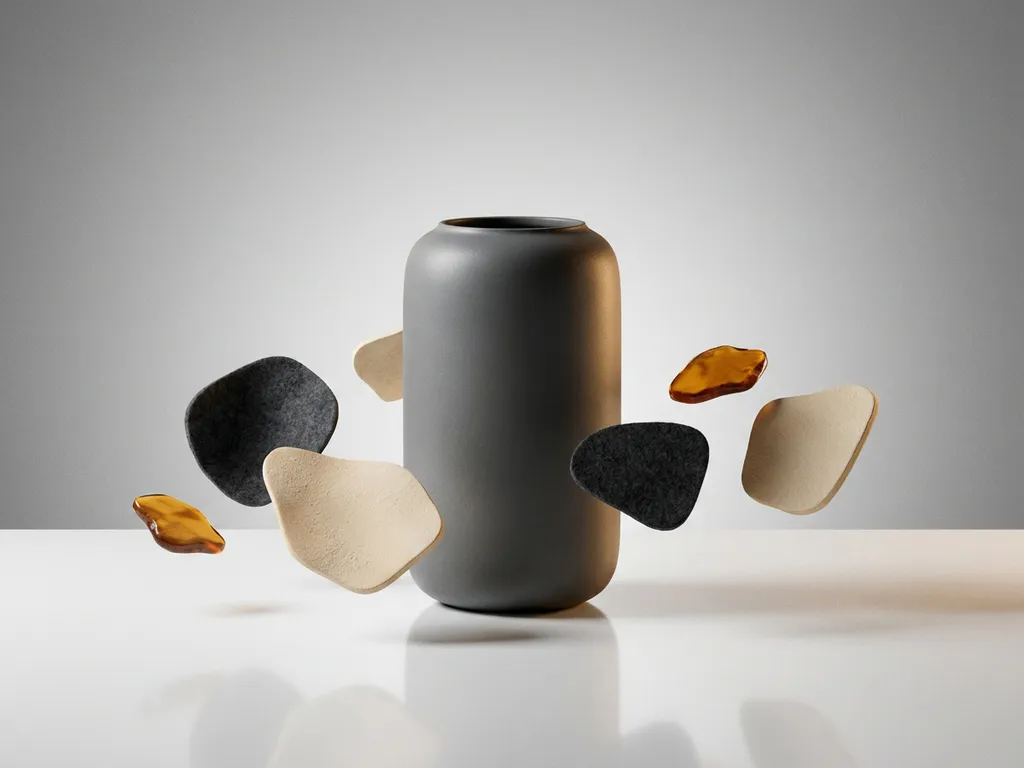
3D product rendering lets you create photorealistic images of your products entirely in a computer environment, without physical samples, studio setups, or camera crews. You can use it to generate product visuals for your webshop, sales tools, catalogues, social media, and in-store displays, all from a single set of 3D models. The sections below answer the most common questions about how product rendering works in practice and where it delivers the most value.
What types of products benefit most from 3D rendering?
Products with multiple variants, configurable parts, or premium aesthetics benefit most from 3D product rendering. This includes furniture, lighting, flooring, textiles, kitchens, outdoor products, and any design-led item that comes in a range of materials, colours, or finishes. The more variants a product has, the more rendering outperforms traditional photography on both cost and flexibility.
For high-end and design-led brands, the stakes are especially high. A sofa available in forty fabric options and three frame colours generates over a hundred possible combinations. Shooting every single one in a physical studio is practically impossible. Rendering solves this by producing every variant from one 3D model, with no additional shoot required for each new combination.
Products that benefit most share a few common characteristics:
- They are sold in multiple configurations, materials, or colour options
- They carry a premium price point where visual quality directly influences purchase decisions
- They are difficult or expensive to transport to a photo studio
- They are updated seasonally or expanded regularly with new variants
- They are sold both online and in physical retail environments
How does product rendering replace traditional photography?
Product rendering replaces traditional photography by recreating the entire photographic process digitally. Instead of placing a physical product in a studio under carefully arranged lights, a 3D artist builds a virtual version of the product and places it in a virtual environment. The result is a rendered image that is visually indistinguishable from a photograph, but produced entirely without physical samples or studio time.
The replacement is not just technical. It changes the entire production workflow. With traditional photography, every new variant requires a new product, a new shoot, and a new round of post-production. With rendering, changing a fabric colour or a surface finish is a matter of updating the 3D file. New images can be generated in hours rather than weeks.
This shift matters most for brands with large or frequently updated product ranges. The cost of a physical photoshoot scales with every new variant. The cost of rendering scales far more slowly, because the foundational 3D model is already built. Over time, rendering becomes significantly more efficient than maintaining a traditional photography operation.
Visual Commerce Solutions
Talk to our team about your project.
What is the difference between product rendering and a product configurator?
Product rendering produces static or animated photorealistic images of a product. A product configurator is an interactive tool that lets customers change product options in real time and see the result instantly. The two are closely related, but they serve different purposes. Rendering is an output format; a configurator is an interactive experience built on top of rendered or real-time 3D technology.
In practice, the most powerful solutions combine both. A product configuration solution uses 3D rendering technology under the hood to display photorealistic results as a customer makes their choices. When a customer selects a different upholstery fabric or changes a cabinet finish, the configurator renders the updated product view on the spot.
The distinction matters when deciding what your business actually needs:
- If you need static visuals for your webshop, catalogue, or social media, product rendering on its own is the right starting point.
- If you want customers to interact with product options before buying, you need a configurator that is powered by 3D rendering.
- If you operate in both online and physical retail, a configurator that works across channels gives you both the interactive experience and the rendered output from a single platform.
- If you have a large range of variants, a configurator eliminates the need to pre-render every possible combination, because it generates views dynamically as the customer configures.
How can product rendering improve conversion rates?
Product rendering improves conversion rates by giving shoppers a more complete and accurate picture of what they are buying. Uncertainty is one of the primary reasons customers abandon a purchase, especially for high-value products. When a customer can see a product in the exact material, colour, and finish they intend to order, the gap between expectation and reality closes, and confidence in the purchase increases.
This effect is strongest in categories where visual detail drives the decision. For furniture, flooring, or premium accessories, a customer choosing between two fabric options needs to see both clearly before committing. A single generic image of a product in one standard finish does not serve that customer well. Rendered images for every variant, or an interactive configurator, remove that friction entirely.
Beyond individual product pages, rendering also supports consistent visual quality across all channels. When your webshop, printed catalogue, and in-store display all show the same high-quality product imagery, your brand feels coherent and trustworthy. That consistency reinforces purchase confidence at every touchpoint, not just at the moment of clicking “add to cart.”
Where can rendered product images actually be used?
Rendered product images can be used across every channel where product visuals are needed. Because they are digital files produced to any specification, they are format-agnostic and can be adapted for online, print, and in-store use without a new shoot. This is one of the core advantages of 3D product rendering over traditional photography.
Common applications include:
- E-commerce product pages showing all variants and angles
- Interactive configurators on your webshop or in-store touchscreen
- Digital catalogues and lookbooks in PDF or online format
- Social media content including static posts and short video animations
- Printed trade catalogues and point-of-sale materials
- Virtual showrooms and digital twin environments
- Sales presentations and trade fair materials
- Advertising campaigns across digital and print channels
The same 3D model that produces your webshop imagery can also generate a lifestyle scene for a campaign, a close-up texture shot for a catalogue, or a 360-degree spin for an in-store display. This reusability is what makes rendering so cost-effective at scale.
How much does product rendering cost compared to traditional photography?
3D product rendering typically has a higher upfront cost than a single traditional photoshoot, because building a high-quality 3D model requires skilled work and time. However, once that model exists, producing additional images, variants, or formats costs a fraction of what a new photoshoot would. Over a product’s commercial lifespan, rendering is almost always more cost-effective than repeated photography.
The comparison shifts decisively in favour of rendering when you factor in the full scope of what a product range actually requires. A single product with twenty colour options needs twenty shoots if you rely on photography. With rendering, those twenty variants come from one model. Add seasonal updates, new markets, or additional formats, and the cost difference becomes substantial.
For premium and design-led brands, there is also a quality argument. Traditional photography is subject to lighting inconsistencies, sample quality issues, and retouching costs. Rendering produces perfectly consistent, perfectly lit imagery every time, which protects the visual integrity of a high-end brand across every channel and market.
How 3Dimerce helps with 3D product rendering
We build high-quality 3D product rendering and configuration solutions specifically for design-led brands and manufacturers who refuse to compromise on visual quality. Our platform is built for the premium segment, where the detail in a texture, the accuracy of a reflection, and the consistency across channels are not nice-to-haves but brand requirements.
Here is what working with us looks like in practice:
- Photorealistic output that matches or exceeds the quality of traditional studio photography
- Interactive product configurators for both online and in-store environments, built on the same 3D models
- Seamless integration with your existing webshop, ERP, or POS system through headless architecture
- Scalable production that grows with your product range without proportional increases in cost
- A single platform covering visual configuration, CGI imagery, and a virtual photo studio
- Over 20 years of experience in virtual art, CGI, and product configuration for European brands
If you are ready to replace slow, expensive photoshoots with a smarter, scalable visual production workflow, we would be glad to show you what is possible. Get in touch with us and let us explore what we can build together.
Frequently Asked Questions
How long does it take to get the first rendered images after starting the process?
The timeline depends largely on the complexity of your product and how many variants need to be covered. For a standard product with moderate complexity, expect the initial 3D modelling and first rendered outputs to take anywhere from one to three weeks. Once the base model is approved and materials are set up, generating additional variants or formats is significantly faster — often within hours or a single working day.
What do I need to provide to get started with 3D product rendering?
To build an accurate 3D model, a rendering studio typically needs technical drawings, CAD files, physical dimensions, and high-resolution reference photos of your product from multiple angles. Material samples or swatches are also helpful for replicating textures and finishes accurately. The more detailed your reference materials, the closer the final renders will be to the real product — so gathering these assets before briefing a rendering partner saves time and revision rounds.
Can 3D rendered images really match the quality of professional studio photography?
Yes — at the highest level of production, rendered images are visually indistinguishable from studio photography, and in some respects they surpass it. Rendering gives you perfect control over lighting, reflections, shadows, and material accuracy without the physical constraints of a studio. Premium brands regularly use rendered imagery in flagship campaigns, printed catalogues, and retail environments precisely because the output is consistent and controllable in ways that photography cannot always guarantee.
What happens when I update a product or launch a new variant — do I need to rebuild the 3D model from scratch?
In most cases, no. A well-structured 3D model is built to be modular, meaning that adding a new colour, material, or finish is a matter of updating the relevant material file rather than rebuilding the entire model. Structural changes — such as a new frame shape or a significantly redesigned component — may require partial remodelling, but even then you are working from an existing foundation rather than starting over. This is one of the key reasons rendering becomes more cost-efficient the longer you use it.
Is 3D product rendering suitable for smaller brands, or is it only viable at large scale?
Rendering is scalable in both directions. Smaller brands with a focused product range can still benefit, particularly if their products are design-led, come in multiple variants, or are expensive to transport and photograph repeatedly. The upfront investment in 3D modelling is the main consideration, but even for a modest range, the long-term savings on reshoots, retouching, and variant photography often justify the switch. A good rendering partner will help you assess the break-even point for your specific situation.
What is the biggest mistake brands make when adopting 3D product rendering for the first time?
The most common mistake is treating rendering as a direct one-to-one replacement for a single photoshoot, rather than as a long-term visual production infrastructure. Brands that see the most value are those that plan their 3D model library with future variants, channels, and use cases in mind from the start. Investing in a well-structured, reusable model from the outset — rather than optimising only for the immediate brief — is what unlocks the full cost and flexibility advantages of rendering over time.
Can rendered product images be used in augmented reality (AR) or virtual showroom experiences?
Yes, and this is one of the most compelling extensions of a 3D rendering workflow. The same 3D models used to produce your static rendered images can be adapted for augmented reality applications, virtual showrooms, and interactive digital twin environments. This means your investment in 3D modelling is not limited to photography replacement — it becomes the foundation for immersive customer experiences across both digital and physical retail touchpoints.