
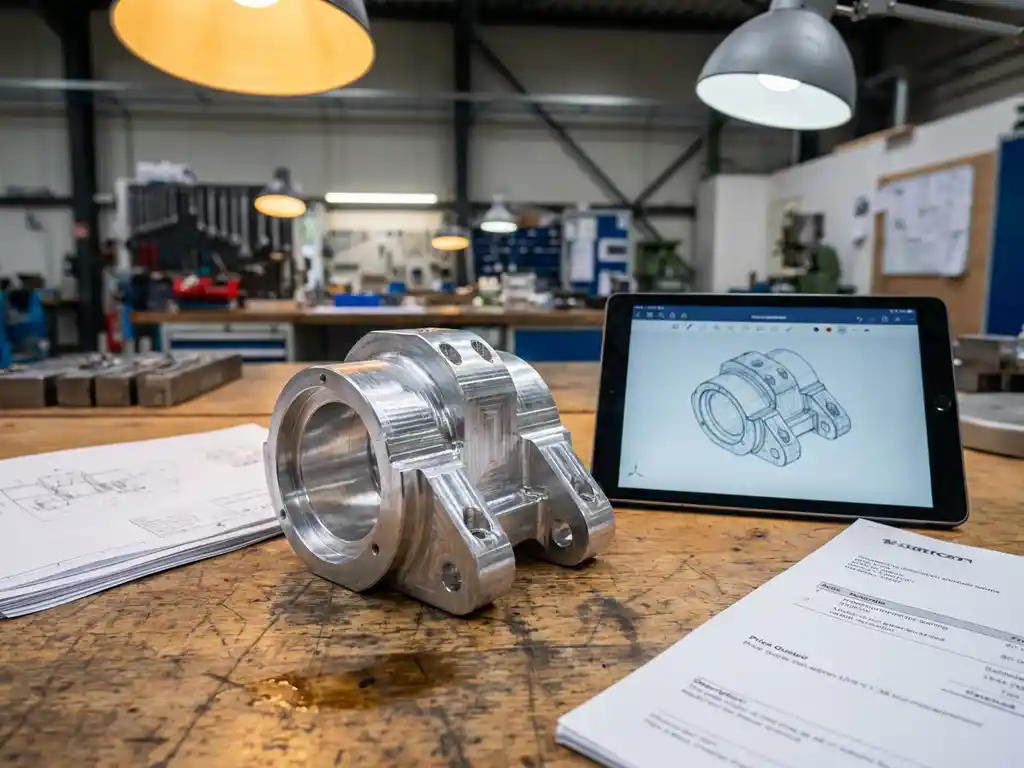
CPQ in manufacturing stands for Configure, Price, Quote — software that helps manufacturers generate accurate, customized quotes for complex products quickly and reliably. Rather than relying on spreadsheets or manual calculations, manufacturing CPQ software automates the entire quoting process from product configuration through to a finalized price proposal. Below, we unpack how it works, who benefits most, and why it has become an essential tool for modern manufacturing sales teams.
How does CPQ software work in a manufacturing context?
Manufacturing CPQ software guides sales teams and customers through a structured configuration process, applying predefined rules to ensure only valid product combinations are selected, then automatically calculating an accurate price and generating a professional quote document. The entire process can take minutes instead of days.
In practice, a manufacturer sets up the CPQ system with its full product catalog, pricing logic, and configuration rules. When a sales rep or dealer starts a new quote, the software presents available options and automatically filters out incompatible choices. Once the configuration is complete, the system applies the correct pricing — including discounts, margins, and region-specific rules — and produces a polished, ready-to-send quote.
This matters enormously in manufacturing because products are often highly configurable. A single piece of furniture, for example, might come in dozens of material finishes, multiple size variants, and various structural options. Without CPQ, pricing each combination accurately and consistently is a serious operational challenge.
What types of manufacturers benefit most from CPQ?
Manufacturers that sell configurable, design-led, or high-variation products benefit most from CPQ software. This includes furniture brands, interior product manufacturers, industrial equipment suppliers, and any company where each order involves multiple interdependent choices that affect both feasibility and price.
The more complex the product range, the greater the return on CPQ investment. Specifically, manufacturers tend to see the strongest results when they face one or more of the following:
- A large number of product variants, materials, or finishes that make manual quoting error-prone
- A dealer or distributor network that needs to quote independently without specialist support
- Long sales cycles that are slowed down by back-and-forth quoting revisions
- Premium or luxury positioning where quote accuracy and presentation quality directly affect brand perception
- Omnichannel sales environments where consistent pricing across online and in-store channels is critical
For high-end and design-focused manufacturers in particular, CPQ is not just an efficiency tool — it is a brand protection tool. An inconsistent or inaccurate quote undermines the premium experience a customer expects from a luxury product brand.
Visual Commerce Solutions
Talk to our team about your project.
What’s the difference between CPQ and a standard quoting tool?
A standard quoting tool generates a price document from a fixed product list. CPQ software goes further by actively managing product configuration logic, enforcing compatibility rules, and dynamically calculating prices based on the specific combination of options selected. CPQ is intelligent where a standard quoting tool is simply transactional.
A basic quoting tool might let a sales rep select a product and apply a price. CPQ, by contrast, guides the rep through a structured configuration, prevents invalid combinations, applies tiered or conditional pricing automatically, and produces a quote that reflects the true cost and scope of a bespoke order.
For manufacturers with complex, configurable products, the difference is significant. A standard tool still requires manual checks and specialist knowledge to produce a reliable quote. CPQ embeds that knowledge directly into the system, making accurate quoting accessible to anyone on the sales team — or even to the customer directly through a self-service channel.
How does CPQ integrate with ERP and CRM systems?
CPQ software integrates with ERP systems to ensure quotes reflect real-time pricing, inventory, and production constraints, and with CRM systems to link quotes directly to customer records and sales pipeline data. This integration eliminates data silos and creates a seamless flow from customer inquiry through to order fulfillment.
In a connected manufacturing environment, a quote generated in CPQ can automatically push order details into the ERP system, triggering production planning, procurement, or inventory checks without manual data re-entry. On the CRM side, sales managers gain visibility into which quotes are active, at what stage, and what their conversion likelihood is.
Modern CPQ platforms are designed with open APIs and headless integration capabilities, meaning they can connect with existing business systems without requiring a full technology overhaul. This makes adoption far more practical for established manufacturers who already have ERP and CRM infrastructure in place.
What problems does CPQ solve for manufacturing sales teams?
Manufacturing CPQ software primarily solves three interconnected problems: quoting errors caused by manual processes, slow turnaround times that cost sales opportunities, and inconsistent pricing across different sales channels or team members. Together, these issues directly affect revenue and customer trust.
Sales teams in manufacturing often operate under significant pressure. They are expected to quote complex, customized products accurately and quickly — often without deep technical expertise in every product line. Without CPQ, this creates several recurring pain points:
- Quoting errors: Manual configuration and pricing leads to mistakes that either cost the company margin or require uncomfortable corrections with customers.
- Slow response times: Quotes that require specialist sign-off or back-office calculation can take days, losing deals to faster competitors.
- Inconsistent pricing: Without a centralized system, different sales reps or dealers may quote the same product at different prices, undermining brand consistency.
- Poor customer experience: A slow, error-prone quoting process reflects badly on the brand, especially in premium market segments where professionalism is expected.
- Difficulty scaling: As product ranges grow, manual quoting becomes increasingly unsustainable without proportional increases in specialist sales staff.
CPQ addresses all of these by centralizing product and pricing logic, automating the quote-generation process, and making accurate quoting accessible across the entire sales organization.
How does CPQ connect to 3D product configuration?
CPQ and 3D product configuration are a natural pairing: the 3D configurator handles the visual and interactive side of product customization, while CPQ handles the pricing and quoting logic behind it. Together, they create a complete configure-to-quote experience where customers can see exactly what they are buying and receive an accurate price in the same session.
In a standalone CPQ setup, the customer or sales rep selects options through a form-based interface. When CPQ is connected to a 3D product configuration platform, every selection is immediately visualized in photorealistic 3D. The customer sees their chosen material, finish, and dimensions rendered accurately in real time — while the CPQ engine calculates the price in the background.
This combination is particularly powerful in design-led and high-end manufacturing, where the visual quality of a product is central to the buying decision. Seeing a beautifully rendered, fully customized product alongside a clear, accurate price removes hesitation and accelerates the path to purchase — both online and at the point of sale in a showroom environment.
How We Help Manufacturers Get More from CPQ
At 3Dimerce, we have built our platform specifically for manufacturers and brands that refuse to compromise on quality — in their products or in the digital experience that represents them. Our Ensemble Suite combines advanced manufacturing CPQ software with photorealistic 3D product configuration, giving your sales teams and customers a seamless journey from customization to confirmed quote.
Here is what that looks like in practice:
- Accurate pricing, every time: Our CPQ engine applies your full pricing logic automatically, eliminating manual errors and ensuring consistent quotes across every channel and sales rep.
- Stunning visuals at the point of configuration: Every product choice is rendered in real time, photorealistic 3D — so customers see exactly what they are buying before they commit.
- Flexible deployment: Whether you need CPQ with full visual configuration or as a standalone quoting solution, our Ensemble Suite adapts to your workflow.
- Seamless integration: Our headless architecture connects cleanly with your existing ERP, CRM, and e-commerce platforms without disrupting what already works.
- Built for premium brands: We work with design-led manufacturers who need their digital tools to match the quality of their physical products — no compromises.
If you are ready to replace slow, error-prone quoting with a platform that is as impressive as the products you make, we would love to show you what is possible. Get in touch with our team and let us talk through what the right solution looks like for your business.
Frequently Asked Questions
How long does it typically take to implement CPQ software in a manufacturing environment?
Implementation timelines vary depending on the complexity of your product catalog and existing tech stack, but most manufacturers can expect a structured rollout to take anywhere from a few weeks to a few months. Simpler deployments with a focused product range and clean pricing logic can go live faster, while implementations involving deep ERP integration or large, highly configurable catalogs naturally require more setup time. Choosing a CPQ platform built specifically for manufacturing — rather than a generic sales tool — significantly reduces the configuration burden and accelerates time to value.
What data do I need to prepare before setting up a CPQ system?
Before onboarding a CPQ platform, you will want to consolidate your full product catalog, all valid configuration rules (including incompatible option combinations), your pricing logic (including tiered pricing, regional variations, and discount structures), and any dealer- or channel-specific pricing agreements. The cleaner and more structured this data is going in, the faster and more accurately the system can be configured. If your pricing logic currently lives across multiple spreadsheets or in the heads of senior sales staff, the CPQ implementation process is actually a valuable opportunity to formalize and document it.
Can CPQ software handle dealer and distributor networks, not just direct sales teams?
Yes — and for many manufacturers, enabling their dealer network is one of the primary drivers for adopting CPQ in the first place. A well-implemented CPQ system allows dealers to generate accurate, on-brand quotes independently, without needing to contact the manufacturer’s internal team for every configuration query. You can set dealer-specific pricing rules, control which options are visible or available per channel, and maintain brand consistency across every quote produced — regardless of who generates it.
What are the most common mistakes manufacturers make when rolling out CPQ?
The most frequent pitfall is underestimating the importance of clean, well-structured product and pricing data before go-live — garbage in, garbage out applies directly here. Another common mistake is over-engineering the initial configuration rules, trying to replicate every edge case from day one rather than launching with a solid core and iterating. Manufacturers also sometimes fail to involve the sales team early enough in the process, which leads to low adoption rates even when the technology itself is sound. Treating CPQ as a sales enablement project — not just an IT project — is key to a successful rollout.
Is CPQ software suitable for manufacturers that also sell direct-to-consumer (DTC) online?
Absolutely, and the combination of CPQ with an online 3D configurator is particularly compelling for DTC manufacturers. When integrated into an e-commerce environment, CPQ enables customers to build and price their own custom product in real time, without any sales rep involvement — reducing friction and increasing conversion. This self-service quoting capability is especially effective for design-led brands where customers want to explore options visually before committing to a purchase.
How does CPQ software handle pricing updates — for example, when material costs change?
One of the core advantages of CPQ over manual quoting is centralized pricing management. When material costs, supplier pricing, or margin targets change, you update the pricing logic in one place and every subsequent quote automatically reflects the new figures — across all sales reps, dealers, and channels simultaneously. This eliminates the risk of outdated spreadsheets circulating in the field and ensures your quotes always protect your margins, even in volatile cost environments.
Can CPQ software scale as our product range grows?
Yes — scalability is one of the strongest arguments for adopting CPQ early, rather than waiting until manual quoting has already become unmanageable. A well-architected CPQ platform allows you to add new product lines, configuration options, and pricing rules without rebuilding the system from scratch. As your catalog grows, the CPQ engine continues to enforce accuracy and consistency automatically, meaning your sales capacity scales without a proportional increase in specialist quoting staff.