
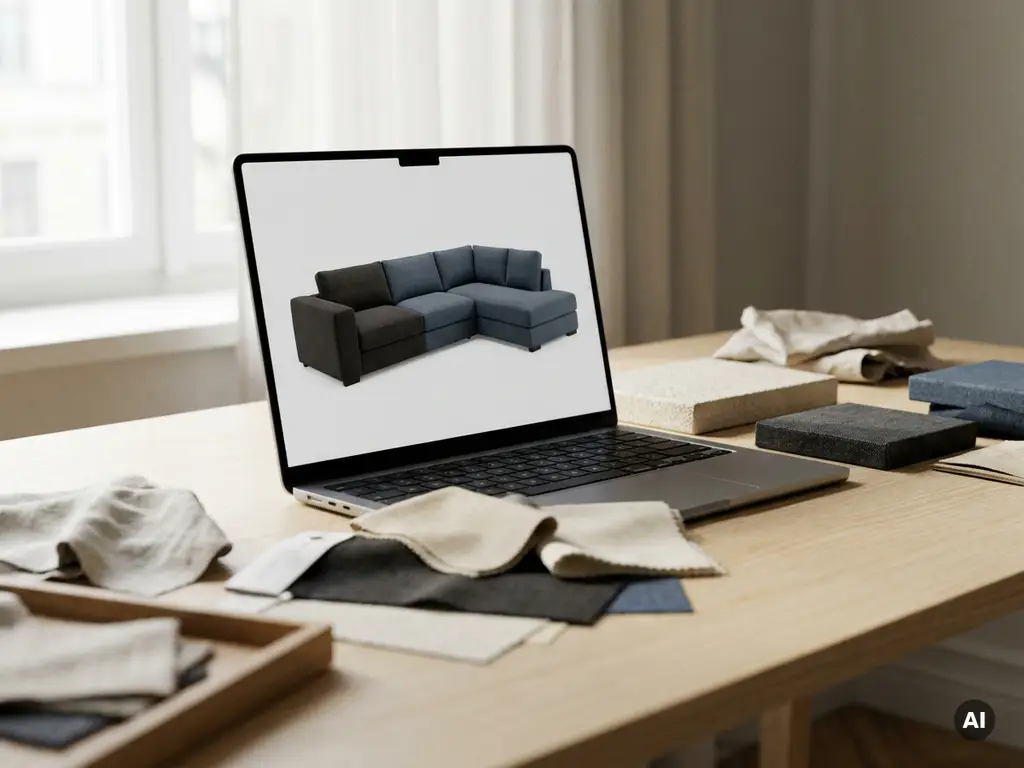
A CPQ tool can significantly reduce the need for physical product samples by replacing them with accurate, interactive digital representations of your product range. Instead of producing costly physical variants for every configuration, a CPQ solution lets customers and sales teams explore materials, colours, dimensions, and finishes in real time. The sections below unpack exactly how this works in practice.
What types of physical samples does a CPQ tool replace?
A CPQ tool can replace a wide range of physical samples, including material swatches, finish samples, size mock-ups, and fully assembled product variants. Any sample that exists primarily to show a customer what a configuration looks like or feels like is a strong candidate for digital replacement through CPQ software.
For manufacturers and retailers in the furniture, interior design, and premium product space, physical sample libraries are a significant overhead. A single product line with multiple fabrics, finishes, and frame options can generate dozens of individual samples, each requiring production, storage, shipping, and eventual disposal.
A well-built CPQ tool replaces the following sample types most effectively:
- Fabric and material swatches rendered with realistic texture and sheen
- Colour and finish variants shown under accurate lighting conditions
- Size and proportion mock-ups visualised in scaled 3D environments
- Assembled product combinations showing how components work together
- Seasonal or limited-edition variants that would otherwise require new physical production
The result is a leaner, faster, and far more scalable product presentation process, without the logistical burden of managing a physical sample library.
How does a CPQ tool show product variants without physical stock?
A CPQ tool shows product variants digitally by combining a structured product logic engine with high-quality 3D visualisation. When a customer or sales representative selects a configuration option, the software instantly updates the visual output to reflect that choice, with no physical stock required at any point in the process.
The underlying mechanism relies on a product rules engine that knows which combinations are valid, and a rendering layer that displays those combinations accurately. In advanced CPQ platforms, this rendering happens in real time and at a quality level that rivals traditional photography.
This approach delivers several practical advantages for brands with complex product ranges:
- Every valid combination is instantly available without pre-producing a single unit
- Pricing updates automatically as options are selected, keeping quotes accurate
- Sales teams can guide customers through configurations confidently, even for products they have never physically seen
- Customers can explore independently online, reducing the need for showroom visits
- New variants go live immediately once added to the system, with no photography or sampling delay
For high-end brands, this is particularly powerful. The visual quality of the digital output needs to match the premium positioning of the product, and that is precisely where a sophisticated CPQ tool earns its place.
What’s the difference between a CPQ tool and a standard product configurator?
The key difference between a CPQ tool and a standard product configurator is that CPQ software handles the full commercial transaction cycle, not just the visual selection. A product configurator lets customers choose options and see the result. A CPQ tool does that and then generates an accurate, validated price quote ready for approval or purchase.
A standard configurator is primarily a visual and selection tool. It is excellent at helping customers understand what they are choosing, but it typically stops short of pricing logic and quote generation. This means sales teams still need to manually translate a configuration into a quotation, which introduces delays and potential errors.
CPQ software closes that gap. The “Configure, Price, Quote” workflow means every selection feeds directly into a pricing engine that accounts for materials, dimensions, add-ons, and any applicable discounts or rules. The output is a professional, accurate quote that can move straight into the sales process.
For businesses selling complex or high-value products, this distinction matters considerably. A configurator improves the customer experience. A CPQ tool improves the entire sales journey, from first exploration through to signed order, which is why it is such an effective replacement for physical sampling and manual quoting processes.
How much can a CPQ tool reduce sample production costs?
While exact savings vary by business, a CPQ tool can substantially reduce sample production costs by eliminating the need to physically produce, store, ship, and replace variants. For brands with large or frequently updated product ranges, the cumulative savings across these cost categories are often significant enough to offset the investment in CPQ software within the first product cycle.
The cost reduction comes from several directions simultaneously. Physical sample production involves material costs, manufacturing time, and quality control. Storage requires warehouse space and inventory management. Distribution to showrooms, agents, or trade events adds shipping and handling costs. And when products are updated or discontinued, obsolete samples become waste.
A digital CPQ solution removes or dramatically reduces all of these. New configurations are added to the system rather than manufactured. Updates are applied once, centrally, and reflected everywhere instantly. There are no shipping costs for sending samples to a sales representative in another country, and no disposal costs when a finish is retired from the range.
For brands in the furniture and interior design sector, where product ranges are broad and configuration options are numerous, the compounding effect of these savings is particularly meaningful. The visual product solutions that make this possible also enable faster time to market, which carries its own commercial value.
When should a business still use physical samples alongside a CPQ tool?
A business should still use physical samples when the tactile experience of a material is central to the purchase decision and cannot be adequately conveyed digitally. For products where touch, weight, texture, or smell influence the buying choice, a physical sample remains valuable even when a CPQ tool handles the visual and commercial aspects of the sale.
This is not a failure of the technology. It is an honest recognition that certain sensory qualities are beyond what any screen can replicate. A customer choosing a premium leather sofa may want to feel the grain of the hide. A buyer selecting acoustic panels may want to assess the surface texture in person. In these cases, a small, targeted physical sample serves a specific purpose that the digital tool does not claim to replace.
The practical approach for most premium brands is a hybrid model:
- Use the CPQ tool for the full visual and commercial configuration experience
- Maintain a small library of material and finish samples for tactile evaluation only
- Eliminate the need for fully assembled product variants and size mock-ups entirely
- Ship targeted material samples on request rather than maintaining large showroom inventories
This approach dramatically reduces the volume and cost of physical sampling while preserving the moments where physical contact genuinely adds value to the customer’s decision.
How 3Dimerce helps reduce your dependency on physical samples
We built our Ensemble Suite specifically for brands that cannot afford to compromise on visual quality or commercial accuracy. Our CPQ software combines real-time 3D product configuration with advanced pricing logic, so your customers and sales teams can move from inspiration to accurate quotation without a single physical sample changing hands.
Here is what working with us delivers in practice:
- Photo-realistic 3D visuals that represent your product range with the quality your brand demands
- Accurate pricing, every time, generated automatically as configurations are built
- Seamless integration into your existing webshop or in-store sales environment
- Instant scalability across your full product range, including new variants and seasonal updates
- A leaner sample operation, with physical samples reserved only for the moments they genuinely add value
If you are ready to reduce your dependency on physical samples and give your customers a faster, more confident buying experience, we would love to show you what is possible. Get in touch with our team and let us walk you through the Ensemble Suite.
Frequently Asked Questions
How long does it typically take to set up a CPQ tool with our existing product range?
Implementation timelines vary depending on the complexity of your product range and the number of configuration options involved, but most businesses can expect an initial setup period of several weeks to a few months. The bulk of that time is spent digitising your product data, building the rules engine, and creating the 3D assets that represent your configurations. Working with a CPQ provider that specialises in your sector, such as furniture or interior design, can significantly accelerate this process since the underlying frameworks are already adapted to your type of product logic.
How accurate are the digital visuals in a CPQ tool compared to professional product photography?
In advanced CPQ platforms, the gap between rendered 3D visuals and professional photography has narrowed considerably. Modern real-time and ray-traced rendering can replicate material texture, sheen, light interaction, and shadow with a high degree of fidelity. That said, the quality of the output depends heavily on the quality of the 3D assets and the rendering engine used, which is why choosing a CPQ solution built for premium brands matters. For most customers making visual and commercial decisions, photo-realistic 3D renders are more than sufficient and often preferable because they show every configuration, not just the ones that were photographed.
What happens if a customer selects an invalid product combination in the CPQ tool?
A well-built CPQ tool prevents invalid combinations from being selected in the first place through its product rules engine. Options that are incompatible with a customer’s current selections are either hidden, greyed out, or flagged with a clear explanation, so the customer is always guided toward configurations that can actually be produced and priced. This not only protects your manufacturing process from unworkable orders but also gives customers a more confident and frustration-free experience, since they never reach a dead end without guidance.
Can a CPQ tool handle bespoke or made-to-measure products, or is it only suited to fixed configuration options?
CPQ tools can absolutely handle bespoke and made-to-measure products, provided the pricing and rules logic is set up to accommodate variable inputs such as custom dimensions, material quantities, or non-standard finish specifications. Rather than selecting from a fixed dropdown, customers or sales teams can enter specific measurements or requirements, and the pricing engine calculates the cost accordingly. This makes CPQ software particularly well-suited to high-end or contract furniture brands where every order may have unique specifications.
How do sales teams typically respond to transitioning from physical samples to a CPQ tool?
Initial resistance is common, particularly among experienced sales representatives who are accustomed to using physical samples as a confidence tool in customer conversations. However, adoption tends to accelerate quickly once teams experience how the CPQ tool allows them to handle any configuration query instantly, without needing to locate a sample or wait for one to be shipped. The ability to generate an accurate quote on the spot, rather than returning to the office to calculate pricing manually, is often the feature that converts the most sceptical sales team members.
Is a CPQ tool suitable for B2B sales environments, or is it primarily designed for direct-to-consumer use?
CPQ tools are well-suited to both B2B and B2C environments, and in many cases they deliver even greater value in B2B contexts. Trade customers, interior designers, and procurement teams often work with complex specifications, volume-based pricing, and approval workflows that a standard consumer configurator cannot support. A CPQ solution can be configured to display trade pricing, apply account-specific discounts, and produce formal quotation documents that meet the requirements of a professional purchasing process, making it a strong fit for brands that sell through both trade and retail channels.
What should we look for when evaluating CPQ providers to ensure the visual quality meets a premium brand standard?
When evaluating CPQ providers for a premium brand, prioritise platforms that can demonstrate photo-realistic rendering quality using your actual product materials, not just generic showcase examples. Ask to see live demos built on product ranges similar to yours in terms of material complexity and configuration depth. It is also worth assessing how the provider handles asset creation, since the quality of the 3D models underpins everything else. Finally, consider whether the platform has been designed specifically for your sector, as a CPQ tool built for industrial components will have very different visual priorities to one built for furniture or luxury interiors.