
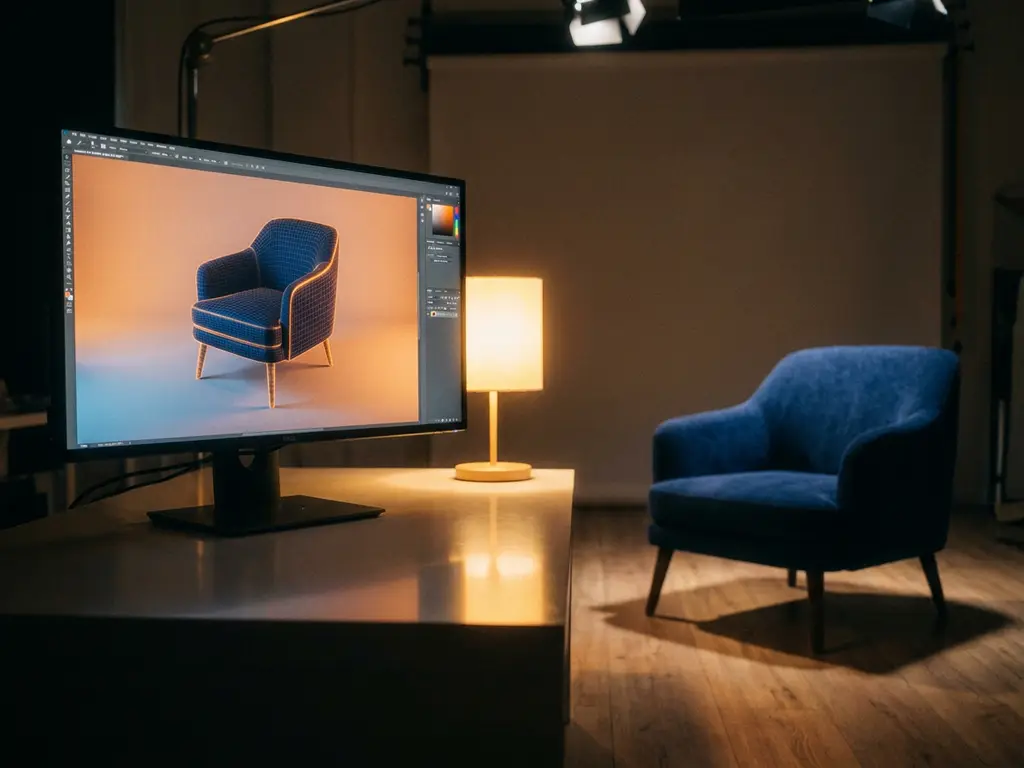
Not all product visuals are created equal — and for premium brands, the difference between photorealistic rendering and standard 3D rendering is the difference between a product visual that converts and one that creates doubt. Photorealistic rendering services employ advanced lighting simulation, physically based material accuracy, and sophisticated rendering techniques to produce imagery that is virtually indistinguishable from a professional photograph. For marketing managers and e-commerce teams at luxury and design brands, understanding this distinction is the first step toward a smarter, more scalable visual strategy. At 3Dimerce, we are specialists in photorealistic rendering services for premium markets — and this guide explains exactly what sets realistic rendering apart, and why it matters for your business.
Why Standard 3D Renders Fall Short for Premium Product Visualization
When your product visuals lack photorealistic quality, you’re essentially asking customers to use their imagination to bridge the gap between what they see and what they’ll actually receive. Basic 3D renders often feature simplified lighting, generic materials, and obvious digital artifacts that immediately signal to viewers that they’re looking at computer-generated content. This disconnect creates doubt in the customer’s mind about product quality and authenticity, which is particularly damaging for premium brands where visual excellence directly correlates with perceived value.
Customers scrolling through your product catalog may move on to competitors whose visuals better demonstrate craftsmanship and attention to detail. The solution is to invest in rendering technology that captures the subtle imperfections, natural lighting variations, and tactile qualities that make products feel real and desirable.
How Low-Quality 3D Renders Hurt Conversion Rates for Premium Brands
Subpar 3D renders create a trust barrier that directly impacts purchasing decisions, especially for high-consideration products like furniture or luxury goods. When product images look obviously computer-generated, customers question whether the actual product will match their expectations, leading to higher cart abandonment rates and increased return rates when reality doesn’t match the digital promise. This is particularly costly for brands selling configurable products, where customers need confidence that their customized choices will look exactly as presented.
The path forward involves implementing rendering workflows that prioritize material accuracy, realistic lighting environments, and attention to the small details that make digital products feel tangible and trustworthy.
Visual Commerce Solutions
Talk to our team about your project.
What is the difference between a photorealistic render and a 3D render?
The fundamental difference between photorealistic rendering and standard 3D rendering lies in the level of realism achieved through advanced lighting calculations, material properties, and post-processing techniques. Standard 3D rendering focuses on creating recognizable three-dimensional representations of objects with basic lighting and materials, often prioritizing speed and efficiency over visual fidelity. These renders typically use simplified lighting models, basic material properties, and may show obvious signs of being computer-generated.
Photorealistic rendering, on the other hand, employs sophisticated algorithms to simulate how light behaves in the real world, including complex phenomena like subsurface scattering, caustics, global illumination, and physically accurate material properties. This approach considers factors such as surface roughness, reflectivity, transparency, and how different materials interact with light at a microscopic level. The result is imagery that closely mimics what a high-end camera would capture in a professional photography studio.
The technical distinction also extends to rendering algorithms and their computational demands. Photorealistic rendering utilizes ray tracing or path tracing — techniques that calculate millions of light rays bouncing through a virtual scene to produce physically accurate shadows, reflections, and light diffusion. Standard 3D rendering, by contrast, typically relies on rasterization: a faster but less accurate method that approximates lighting rather than simulating it.
This difference in approach has a direct impact on output quality and production time. Ray-traced photorealistic renders require significantly more processing power and render time per frame, but the resulting imagery carries a level of material and lighting fidelity that rasterized renders simply cannot replicate — a critical distinction for premium brands where every visual detail signals quality to the customer.
How do these approaches compare in practice? The table below summarizes the key dimensions across Standard 3D Render, Photorealistic Render, and Traditional Photography:
- Visual realism — Standard 3D render: recognizable but visibly digital. Photorealistic render: indistinguishable from a studio photograph; realistic rendering at its highest fidelity. Traditional photography: real by definition, but subject to physical constraints.
- Production time — Standard 3D render: fast iteration, hours per asset. Photorealistic render: longer per render, but highly efficient at scale. Traditional photography: dependent on studio scheduling, logistics, and reshoots.
- Cost per variant — Standard 3D render: low per image, but limited quality ceiling. Photorealistic render: higher initial investment, near-zero marginal cost per additional variant. Traditional photography: high cost per variant — every new color or material requires a new shoot.
- Scalability for catalog updates — Standard 3D render: limited by re-modeling effort. Photorealistic render: unlimited variants from a single base model. Traditional photography: requires a full new shoot per variant.
- Material accuracy — Standard 3D render: approximated surface properties. Photorealistic render: physically based material simulation, capturing grain, sheen, and translucency. Traditional photography: accurate to the physical sample, but dependent on lighting conditions and photographer skill.
- Omnichannel consistency — Standard 3D render: consistent but visually limited. Photorealistic render: identical quality across web, print, in-store, and digital advertising. Traditional photography: consistency requires tightly controlled re-shoots across every channel update.
What Makes a 3D Render Photorealistic: Techniques, Materials, and Lighting
The Role of High-Quality 3D Models
Before any lighting or material work begins, the quality of the 3D model itself determines the ceiling of photorealistic output. High-polygon meshes capture the subtle curves, beveled edges, and dimensional precision that distinguish a premium product from a generic digital object — details that become unmistakably apparent in close-up, high-resolution renders. Shortcuts taken at the modeling stage cannot be compensated by superior lighting or post-processing; a poorly constructed mesh will always betray itself in the final image.
At 3Dimerce, every model is built or refined to the exact tolerances required for photorealistic 3D designs intended for premium and luxury markets. Whether we receive client-supplied CAD files, existing 3D models, or build from technical drawings and reference photography, our modeling standards ensure that the geometry is render-ready from the outset — with no compromises that would undermine the final visual quality.
Several key elements combine to elevate a standard 3D render to photorealistic quality. Accurate material properties form the foundation, requiring precise recreation of how different surfaces interact with light, including properties like albedo, roughness, metallic values, and normal mapping that captures surface texture details invisible to the naked eye.
Lighting plays an equally crucial role, with photorealistic renders employing physically based lighting models that simulate real-world illumination scenarios. This includes proper color temperature, light falloff, shadow softness, and the subtle color bleeding that occurs when light bounces between surfaces. High-quality photorealistic renders also incorporate environmental lighting through HDRI (High Dynamic Range Imaging) environments that provide realistic reflections and ambient illumination.
Realistic Textures and Material Digitization
Beyond geometry, the accuracy of surface materials is what truly separates a photorealistic render from a competent standard 3D render. UV mapping — the process of projecting a flat material image onto a three-dimensional surface — must be executed with precision to avoid distortion, stretching, or misalignment that would immediately read as artificial. When done correctly, it creates the seamless material coverage that makes a rendered leather sofa or woven textile feel physically present.
The digitization of physical materials into tileable PBR (Physically Based Rendering) texture maps is one of the most technically demanding aspects of photorealistic 3d rendering techniques. Fabric weaves, leather grain, stone veining, brushed metal, and lacquered wood each require custom texture creation that captures not just color, but roughness, micro-surface detail, and light interaction. At 3Dimerce, we maintain proprietary material libraries built directly from physical samples, ensuring that the digital material a customer sees in the render matches the physical product they receive — eliminating the expectation gap that drives returns.
Post-processing techniques further enhance realism by adding the finishing layer that bridges digital and photographic aesthetics. These techniques include:
- Depth of field simulation that replicates the focal blur of a professional camera lens
- Color grading that matches the warmth, contrast, and tonal range of studio photography
- Subtle surface imperfections — micro-scratches, dust, or material variation — that prevent the sterile perfection that marks obviously digital imagery
- Atmospheric effects such as light haze, bloom, and ambient occlusion that add environmental depth and mood
What Rendering Technology Powers Photorealistic Results?
The quality of a photorealistic render is inseparable from the rendering engine used to produce it. Industry-standard engines each bring distinct strengths: V-Ray is widely regarded as the benchmark for architectural and product visualization, renowned for its physical accuracy and material fidelity. KeyShot is the preferred choice for industrial design and product rendering, valued for its real-time preview capabilities and intuitive material workflow. Blender Cycles offers open-source flexibility with a powerful path-tracing engine that has earned its place in professional pipelines. Understanding which engine is best suited to a given product type and output requirement is a core part of delivering consistently excellent results.
The emergence of AI-assisted rendering workflows has introduced a new acceleration layer that is reshaping production timelines across the industry. AI denoising — the use of machine learning to intelligently reconstruct clean images from partially rendered frames — dramatically reduces render time while preserving the fine detail that luxury product imagery demands. AI-driven material generation is also advancing rapidly, enabling faster creation of complex surface maps from reference imagery. These tools are genuinely transformative for production efficiency.
At 3Dimerce, we combine proven rendering engines with modern AI-assisted acceleration tools to deliver blazing-fast turnaround without the quality compromises of fully automated AI rendering platforms. For luxury and premium product rendering, human artistic judgment and rigorous quality control remain non-negotiable — AI accelerates our workflow, but our specialists make every critical visual decision. The result is the speed that modern e-commerce demands, paired with the visual precision that premium brands require.
When should you use photorealistic rendering versus standard 3D rendering?
The choice between photorealistic and standard 3D rendering depends on your specific use case, audience expectations, and business objectives. Photorealistic rendering excels in scenarios where visual credibility directly impacts purchasing decisions, such as luxury furniture, high-end automotive products, jewelry, or premium consumer goods. When customers are making significant financial investments, the enhanced trust and confidence generated by photorealistic visuals often justify the additional time and computational resources required.
Standard 3D rendering remains appropriate for technical documentation, architectural previsualization in early design phases, gaming assets where stylization is preferred, or situations where rapid iteration and quick turnaround times are prioritized over absolute visual fidelity. It’s also suitable for products where functional understanding matters more than aesthetic appeal, such as industrial equipment or technical components.
Consider photorealistic rendering when your brand positioning emphasizes quality and craftsmanship, when you’re selling configurable products that customers need to visualize accurately, or when competing in markets where visual differentiation provides competitive advantage. The investment in photorealistic rendering typically pays dividends through improved conversion rates, reduced product returns, and enhanced brand perception. You can explore various implementation scenarios to understand which approach best serves your specific market needs.
Photorealistic Rendering by Industry: Use Cases and Applications
Furniture and Interior Design
Furniture brands face a uniquely demanding visual challenge: customers must be able to evaluate texture, scale, finish, and how a piece will integrate into their own living environment — all from a screen. Standard 3D renders rarely convey the tactile richness of a bouclé fabric, the warmth of oiled walnut, or the depth of a hand-applied lacquer finish. Photorealistic rendering solves this by reproducing material properties at a level of fidelity that allows customers to make confident purchasing decisions without a showroom visit.
The scalability benefit is equally significant: furniture brands offering multiple fabric or finish SKUs can generate every variant from a single base model, eliminating the cost and scheduling complexity of reshooting every configuration. The outcome is a richer product catalog, faster time-to-market for new collections, and measurable reductions in return rates driven by expectation mismatch. 3Dimerce is the specialist partner of choice for European furniture and interior design brands that demand the highest standard of photorealistic visualization.
Fashion and Lifestyle Products
In fashion and lifestyle, the visual presentation of a product is inseparable from the brand story it tells. The challenge is conveying material quality — the drape of a fabric, the sheen of a leather accessory, the weight of a premium garment — through a digital image that must perform across e-commerce, social media, and print simultaneously. Traditional photography is expensive, logistically demanding, and difficult to scale across seasonal collections with hundreds of SKUs.
Photorealistic 3D rendering allows fashion and lifestyle brands to produce campaign-quality imagery for every product in their catalog, in every colorway, without a single physical sample leaving the studio. New collections can be visualized and approved before production begins, reducing sampling costs and accelerating go-to-market timelines. 3Dimerce brings the visual sophistication that premium lifestyle brands demand, with the production efficiency that modern e-commerce requires.
Automotive and Mobility
Automotive visualization demands an exceptionally high level of material and lighting precision: paint metallic flake, reflective chrome trim, perforated leather interiors, and the complex interplay of light across curved body panels are all details that standard 3D rendering cannot convincingly reproduce. For automotive brands and accessory manufacturers, photorealistic rendering is the standard — not the exception — for product communication.
A single photorealistic 3D model of a vehicle or component can generate an unlimited library of marketing assets: every exterior color, every trim configuration, every lighting environment, from a single production investment. This scalability is transformative for brands launching new models or accessory ranges across multiple markets simultaneously. 3Dimerce delivers the automotive-grade visual precision that premium mobility brands trust for their most demanding product communication challenges.
Architectural and Real Estate Visualization
For real estate developers and architectural practices, the ability to sell or present a property before it is built is one of the most commercially powerful applications of photorealistic 3D rendering. Photo-realistic property rendering allows developers to market off-plan units with imagery that is indistinguishable from photography of the completed building — enabling sales campaigns to launch months or years ahead of completion.
Photorealistic 3D designs of interiors, facades, and surrounding environments give buyers the spatial and material confidence to commit to a purchase without setting foot on site. This is particularly valuable in the luxury residential and commercial development sectors, where the quality of the visual presentation directly influences the perceived value of the property. 3Dimerce brings the same level of material accuracy and lighting precision to architectural visualization that we deliver for product rendering — making us the ideal partner for premium real estate and design-led development projects.
How much more expensive is photorealistic rendering compared to basic 3D rendering?
The cost difference between photorealistic and basic 3D rendering varies significantly based on complexity, quality requirements, and production volume. Photorealistic rendering typically requires 5-10 times more computational resources and specialized expertise, translating to higher initial setup costs and longer production timelines. However, this investment often proves economical when compared to traditional photography workflows, especially for products with multiple configurations or seasonal updates.
Basic 3D rendering might cost a few hundred euros per product visualization, while photorealistic rendering can range from several hundred to several thousand euros depending on complexity, number of materials, lighting scenarios, and required output resolutions. The key consideration is return on investment rather than absolute cost. Photorealistic renders eliminate the need for physical prototypes, photography studios, and ongoing reshoot costs when products change or new variants are introduced.
For businesses with extensive product catalogs or frequent product updates, photorealistic rendering often becomes more cost-effective over time. The ability to generate unlimited variations, angles, and environmental settings from a single 3D model provides scalability that traditional photography cannot match. Additionally, the enhanced conversion rates and reduced return rates associated with accurate product visualization often offset the higher initial investment within the first year of implementation.
Photorealistic 3D Renders vs Traditional Photography: Key Advantages
Photorealistic 3D rendering offers significant advantages over traditional photography, particularly for brands managing complex product portfolios or frequent design iterations. The most immediate benefit is unlimited flexibility in lighting, angles, and environmental settings without the logistical complexity of physical photo shoots. Once a 3D model is created, you can generate images in any lighting condition, from any angle, with any background, at any resolution required.
Cost efficiency becomes apparent when dealing with configurable products or seasonal updates. Traditional photography requires new shoots for every color variant, material option, or design modification, while photorealistic rendering allows instant generation of new visuals by adjusting digital parameters. This capability is particularly valuable for furniture brands offering multiple fabric options, automotive companies showcasing different trim levels, or any business where customization is a key selling point.
Consistency across all marketing channels represents another crucial advantage. Photorealistic renders ensure identical lighting, color accuracy, and styling across web catalogs, print materials, in-store displays, and digital advertising. This consistency strengthens brand recognition and eliminates the color variations and lighting discrepancies that often occur when coordinating multiple photography sessions. The ability to maintain perfect product presentation standards across all touchpoints significantly enhances professional brand perception and customer trust.
These advantages become even more compelling when you consider how photorealistic rendering fits into a broader omnichannel visual strategy — which is exactly where our expertise at 3Dimerce makes the difference.
How We Turn Your Product Into a Photorealistic Render: Our Process
For prospects evaluating a rendering partner, understanding the production process is as important as seeing the final output. Our workflow is designed to be transparent, collaborative, and efficient — removing the uncertainty from what can otherwise feel like a complex technical undertaking.
- Brief and asset intake. Every project begins with a structured briefing. We accept a wide range of input formats: technical drawings, CAD files, sketches, existing 3D models, reference photography, and material samples with Pantone or RAL color codes. The more detail you provide at this stage, the more accurately the final renders will reflect your product. We guide you through exactly what we need.
- High-quality 3D modeling or model refinement. High-quality modeling is the non-negotiable foundation of photorealism. If you supply existing models, we refine them to the tolerances required for close-up, high-resolution rendering. If we build from scratch, we construct geometry that captures every curve, edge, and dimensional detail of your product. Model precision at this stage determines the accuracy ceiling of everything that follows.
- Material and texture mapping using PBR techniques. We apply physically based rendering materials to every surface, drawing from our proprietary material libraries — built from real physical samples — and supplemented with custom texture creation where required. UV mapping is executed with precision to ensure seamless, distortion-free material coverage across the model.
- Lighting setup and HDRI environment configuration. We configure lighting environments that are appropriate for your product category and intended use: studio lighting for clean e-commerce imagery, lifestyle environments for campaign visuals, or architectural settings for contextual renders. HDRI environments provide physically accurate ambient illumination and reflections.
- Ray-trace rendering and quality review. We run full ray-trace renders using industry-leading engines, with AI-assisted denoising to optimize production speed without sacrificing detail. Every render passes through our internal quality review process before it reaches you — checking for material accuracy, lighting consistency, and alignment with the original brief.
- Post-processing and delivery. Final renders are post-processed to add the finishing details — depth of field, color grading, subtle surface imperfections — that give our imagery its distinctively photographic quality. We deliver in all required formats and resolutions, optimized for web, print, or in-store display as needed.
Every project begins with a conversation — reach out to discuss your asset situation and we’ll tell you exactly what we need to get started.
How Our Photorealistic Rendering Services Deliver Results for Premium Brands
We specialize in delivering photorealistic rendering solutions that transform how premium brands showcase their products across digital and physical sales environments. Our advanced visual product configuration platform combines cutting-edge rendering technology with seamless integration capabilities, enabling brands to create stunning, photorealistic product visuals that drive engagement and conversions.
Our comprehensive approach includes:
- Advanced ray-tracing technology that captures every detail from surface textures to realistic lighting and shadows
- Seamless integration with existing e-commerce platforms and in-store digital solutions
- Scalable rendering workflows that accommodate extensive product catalogs without proportional cost increases
- Real-time configuration capabilities that maintain photorealistic quality even during customer customization
- Omnichannel consistency ensuring identical visual quality across web, mobile, and retail environments
Our work with European luxury furniture, premium automotive accessory, and high-end lifestyle brands has consistently delivered conversion rate improvements in the range of 15–40%, alongside measurable reductions in product return rates — outcomes that reflect the direct commercial impact of closing the gap between digital presentation and physical reality. Over more than 20 years of serving design-focused brands, we have built deep material libraries, refined lighting expertise, and developed an instinctive understanding of what premium product imagery needs to achieve. That accumulated knowledge is embedded in every render we produce. If you’d like to see portfolio examples relevant to your sector, we invite you to raise that in an initial consultation — we’re happy to share work that reflects your specific product category and market positioning.
With over 20 years of experience serving European luxury and design-focused brands, we understand the critical importance of visual excellence in maintaining premium positioning. Our platform delivers blazing-fast performance without compromising on the stunning visual quality that sophisticated customers expect. Ready to elevate your product visualization strategy? Contact us to discover how our photorealistic rendering services can transform your customer experience and drive measurable business results.
Frequently Asked Questions
How long does it typically take to create photorealistic renders for a product catalog?
The timeline varies based on product complexity and catalog size, but initial setup including 3D modeling typically takes 2-4 weeks per product family. Once the base models are created, generating new renders or variations can be completed within hours or days rather than weeks required for traditional photography. For large catalogs, the process becomes increasingly efficient as shared materials and lighting setups are reused across similar products.
Can photorealistic rendering handle complex materials like fabric, leather, or transparent glass accurately?
Yes, modern photorealistic rendering excels at complex materials through physically-based rendering (PBR) techniques. Fabric rendering captures thread patterns and light scattering, leather shows natural grain and subsurface scattering, and glass materials accurately simulate refraction and reflection. The key is using high-quality material libraries and proper shader setup that mimics real-world material properties at the molecular level.
What technical specifications should I provide to ensure accurate photorealistic renders?
Provide detailed material samples, accurate measurements, high-resolution reference photos from multiple angles, and specific color values (preferably Pantone or RAL codes). Include information about surface finishes, hardware details, and any unique characteristics like stitching patterns or surface textures. The more precise your specifications, the more accurate your final renders will be.
How do I integrate photorealistic renders with my existing e-commerce platform?
Most modern e-commerce platforms support high-resolution image integration through standard APIs or plugins. The renders are delivered in common formats (JPG, PNG, WebP) that work seamlessly with platforms like Shopify, Magento, or custom solutions. For interactive 3D experiences, additional integration may involve embedding viewer widgets or configurable product interfaces that maintain the photorealistic quality during real-time customization.
What's the biggest mistake brands make when transitioning from photography to photorealistic rendering?
The most common mistake is rushing the initial setup phase and not investing enough time in perfecting material accuracy and lighting environments. Brands often expect immediate results without understanding that photorealistic rendering requires meticulous attention to detail in the foundational elements. Another frequent error is not establishing clear quality standards and approval processes, leading to inconsistent results across the product range.
Can photorealistic renders be updated when product designs change, and how quickly?
Yes, this is one of the major advantages over traditional photography. Minor changes like color variations or material swaps can be updated within hours, while more significant design modifications typically require 1-3 days depending on complexity. The parametric nature of 3D models means that once the base structure is created, modifications propagate automatically across all angles and lighting scenarios without requiring complete recreation.
How do I measure the ROI of investing in photorealistic rendering over traditional photography?
Track key metrics including conversion rate improvements (typically 15-40% increase), reduced product return rates due to better expectation setting, decreased photography costs over time, and faster time-to-market for new products. Also measure engagement metrics like time spent on product pages and the number of product configurations explored. Most brands see ROI within 12-18 months, with ongoing savings growing as product catalogs expand.