
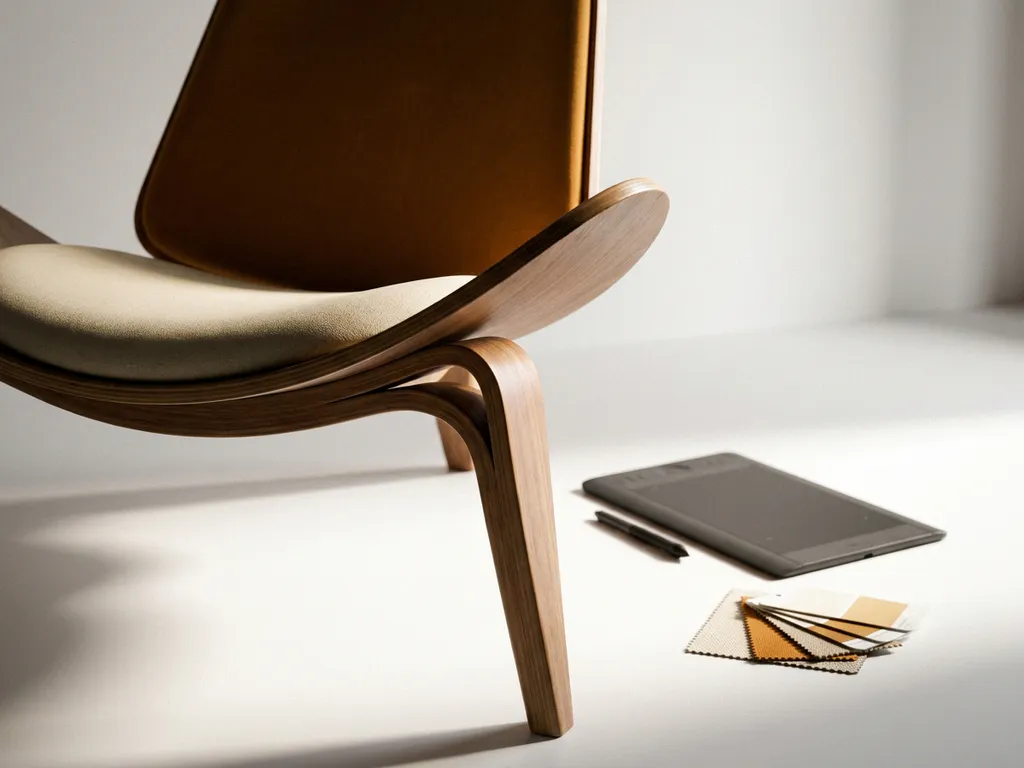
You can use 3D product rendering to show your customers exactly what they are buying, in every variant, finish, and configuration, without the need for physical samples or traditional photography. This approach is especially powerful for brands selling configurable or design-led products where visual variety is high and production costs for conventional photoshoots are significant. Below, we answer the most common questions businesses ask before making the switch to product rendering.
What types of products benefit most from 3D rendering?
Products with multiple variants, configurations, or customization options benefit most from 3D product rendering. Furniture, interior products, lighting, kitchens, outdoor living, and premium consumer goods are particularly well suited, because customers need to visualize different materials, colors, and dimensions before committing to a purchase.
The core reason is simple: the more options a product has, the more impossible it becomes to photograph every combination. A sofa available in 12 fabrics and 4 frame colors produces 48 unique combinations. A kitchen with modular components can generate thousands. Traditional photography collapses under that weight. Rendering scales effortlessly.
Beyond furniture and interiors, high-end fashion accessories, consumer electronics, automotive parts, and luxury goods all benefit significantly. Any product where visual quality directly influences perceived value is a strong candidate for 3D rendering.
How does product rendering improve the customer experience?
Product rendering improves the customer experience by giving buyers the visual confidence they need to make a decision. Instead of guessing how a product will look in a specific color or material, customers can see an accurate, photorealistic representation of exactly what they are about to order.
This has a direct effect on purchase confidence and return rates. When customers can explore every option visually, uncertainty drops. They arrive at checkout having already seen their chosen configuration, which reduces hesitation and post-purchase disappointment.
For premium and design-led brands, the quality of the visual experience also reinforces brand perception. Crisp, detailed renders that capture texture, light, and shadow communicate craftsmanship before the product even arrives at the customer’s door. That is a significant competitive advantage in high-end markets where aesthetics drive purchasing decisions.
Visual Commerce Solutions
Talk to our team about your project.
Can product rendering replace traditional product photography?
Yes, 3D product rendering can fully replace traditional product photography for most commercial use cases, including webshop imagery, catalogs, and in-store displays. For brands with large product ranges or frequent updates, rendering is not just a replacement but a clear upgrade in terms of speed, cost, and flexibility.
Traditional photography requires physical samples, studio time, lighting setups, and a separate shoot for every new variant. Once a product changes or a new color is added, the process starts again. Rendering eliminates that cycle entirely. A new material or finish can be applied digitally and rendered immediately, without touching a camera or a studio.
The one area where photography still holds an edge is in capturing unscripted lifestyle context, such as candid human interaction with a product in a real environment. However, even that gap is narrowing as CGI environments and virtual photo studios become increasingly sophisticated.
How can product rendering be integrated into an online store?
Product rendering integrates into an online store through a 3D product configurator embedded directly in the product page, allowing customers to interact with and customize products in real time. The rendering engine runs in the background, updating the visual output instantly as the customer makes selections.
Modern platforms support headless integration, meaning the rendering and configuration logic can connect to virtually any existing e-commerce environment without requiring a full platform rebuild. The configurator sits within the customer’s familiar shopping experience, and the output flows directly into the cart and order management system.
Key integration points typically include:
- Product pages where customers select variants and see them rendered in real time
- Configure, Price, Quote (CPQ) flows that update pricing as options are selected
- In-store point of sale tools that sales staff use to guide customers through complex choices
- Automated image generation for catalogs, marketing assets, and product feeds
What is the difference between a product configurator and a product renderer?
A product renderer generates photorealistic images of a product, while a product configurator is an interactive tool that lets customers build and personalize a product by selecting options. The two are closely related but serve different functions. In practice, the best solutions combine both: the configurator handles the logic, and the renderer delivers the visual output.
Think of it this way: the configurator is the engine that manages which combinations are valid, what they cost, and how they connect to the ordering process. The renderer is responsible for making those combinations look stunning. Without a strong renderer, a configurator feels flat. Without configurator logic, a renderer is just a static image tool.
For brands in the design and luxury segment, the quality of the rendering layer is critical. The visual output must match the premium positioning of the product, which means photorealistic textures, accurate lighting, and natural reflections are non-negotiable.
How do you get started with product rendering for your business?
Getting started with product rendering for your business involves four key steps: assessing your product range, preparing or commissioning 3D models, choosing the right platform, and integrating the output into your sales and marketing channels.
- Audit your product range. Identify which products have the most variants, the highest sales volume, or the greatest visual complexity. These are your best candidates for an initial rollout.
- Prepare 3D assets. High-quality rendering starts with accurate 3D models. If you already have CAD files or technical drawings, these can often be converted. If not, a specialist partner can build them from scratch.
- Choose a platform that fits your needs. Look for a solution that combines rendering quality with configurator functionality, integrates with your existing webshop or ERP, and scales as your product range grows.
- Plan your integration and rollout. Decide where the configurator will live, how it connects to your pricing and ordering systems, and whether you need in-store as well as online deployment.
The timeline and investment depend on the complexity of your product range, but many brands see a return relatively quickly through reduced photography costs, faster time to market for new variants, and measurable improvements in conversion.
How 3Dimerce helps with 3D product rendering
We built our platform specifically for brands that refuse to compromise on visual quality. At 3Dimerce, we combine photorealistic 3D product rendering with powerful configuration logic to deliver an experience that is both stunning and commercially effective. Here is what that means in practice:
- Photorealistic output that captures touchable textures, natural light, and precise reflections, matching or exceeding the quality of traditional photography
- Real-time configuration that lets customers build and visualize their product instantly, across every variant and finish
- Headless integration that connects seamlessly to your existing webshop, ERP, or in-store systems without disrupting your current setup
- A scalable SaaS platform that grows with your product range, adding new models and materials without proportional increases in cost
- In-store and online deployment for a consistent, premium brand experience across every channel
We work with mid-to-large manufacturers, furniture brands, and design-led retailers across Europe who want their digital presence to reflect the quality of their products. If you are ready to replace slow, costly photoshoots with agile, scalable 3D rendering, we would love to show you what is possible. Get in touch with our team and let us discuss how we can bring your product range to life.
Frequently Asked Questions
How long does it typically take to produce 3D product renders for a full product range?
The timeline depends on the complexity of your products and how many 3D assets already exist. For a mid-sized product range with 20–50 SKUs, initial model creation and rendering setup typically takes between 4 and 10 weeks. Once the base models and materials are in place, adding new variants or finishes is significantly faster, often a matter of days rather than weeks, which is one of the key efficiency advantages over traditional photography.
What file formats or existing assets do I need to provide to get started?
Ideally, you would provide CAD files, technical drawings, or existing 3D models, as these give rendering specialists the most accurate foundation to work from. However, if you only have physical samples, detailed product specifications, or high-resolution reference photography, a specialist partner can still build accurate 3D models from scratch. The more dimensional and material detail you can supply upfront, the faster and more precise the output will be.
How realistic is 3D product rendering compared to actual photography — will customers notice a difference?
With modern photorealistic rendering technology, the visual difference between a high-quality render and a professional photograph is effectively imperceptible to most customers. Textures, light behaviour, reflections, and shadows can all be replicated with exceptional accuracy. In fact, many leading brands now use renders across their entire webshop and catalog without any customer-facing indication that the images are computer-generated, with no negative impact on trust or conversion rates.
What happens when I update a product or launch a new variant — do I need to start the rendering process from scratch?
No, and this is one of the most significant practical advantages of 3D rendering over photography. Because your products exist as digital 3D models with configurable material and finish layers, adding a new color, texture, or configuration is a digital update rather than a new production event. A new fabric option, for example, can be mapped onto an existing sofa model and rendered across all configurations without rebuilding anything from the ground up.
Can 3D rendered images be used across all marketing channels, not just the webshop?
Yes, 3D renders are highly versatile and can be exported in any resolution or format required for webshop product pages, print catalogs, digital advertising, social media, in-store displays, and trade fair materials. Because the source is a digital model rather than a photograph, you can also re-render from different angles, in different environments, or at different scales without a new shoot. This makes your visual asset library far more flexible and cost-efficient over time.
Is 3D product rendering a viable option for smaller brands, or is it primarily suited to large manufacturers?
While large manufacturers with extensive product ranges see the fastest return on investment, 3D rendering is increasingly accessible and cost-effective for smaller brands as well, particularly those on SaaS-based platforms where setup costs are lower and pricing scales with usage. If your product has high visual complexity, multiple variants, or a premium positioning where image quality directly affects conversion, the business case can be strong regardless of company size. A focused rollout starting with your best-selling or most configurable products is a practical way to start without committing your entire catalog at once.
How does a 3D product configurator handle pricing when customers select different options?
A well-built product configurator includes CPQ (Configure, Price, Quote) logic that updates pricing dynamically as customers make selections, reflecting the cost of each chosen material, dimension, or add-on in real time. This pricing logic connects directly to your backend systems, ensuring that what the customer sees in the configurator matches exactly what flows into the cart and order management system. For complex or bespoke products, the configurator can also trigger a formal quote workflow rather than an immediate purchase, making it equally effective for B2B and trade sales environments.