
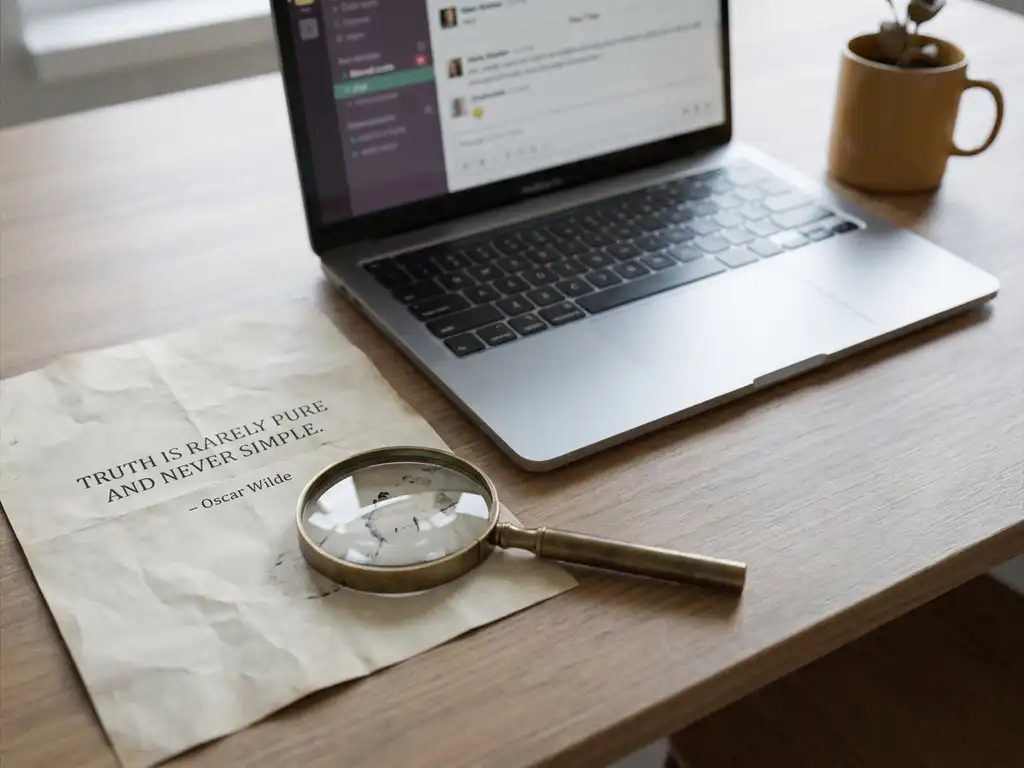
ChatGPT quotes are frequently inaccurate. The tool can generate text that looks and sounds like a genuine quote from a real person, but the words, phrasing, or even the attribution may be entirely fabricated. This applies to historical figures, living public figures, authors, and industry experts alike. The sections below unpack exactly why this happens, how common it is, and what you should do about it.
Can ChatGPT make up quotes that sound real?
Yes, ChatGPT can make up quotes that sound convincingly real. The model generates text by predicting what words are likely to follow one another based on patterns in its training data. When asked for a quote, it produces something that fits the style and voice of the named person — even if those exact words were never spoken or written.
This is not a glitch or an edge case. It is a structural feature of how large language models (LLMs) work. ChatGPT does not retrieve quotes from a verified database. It constructs them. The result can be a sentence that perfectly matches the known tone of a philosopher, CEO, or novelist, yet has no basis in reality whatsoever.
What makes this particularly problematic is that fabricated quotes often pass a casual read. They feel right. They are grammatically polished, contextually plausible, and attributed with confidence. Without checking the original source, there is no way to tell the difference between a real quote and a generated one just by reading it.
Why are ChatGPT quotes so often inaccurate?
The root cause is that ChatGPT is a generative model, not a search engine or a quote database. It was trained to produce fluent, contextually appropriate text — not to retrieve verified information. When asked to recall a specific quote, it fills in the gaps using statistical patterns rather than factual memory.
Several factors compound this problem:
- No live access to sources: ChatGPT does not browse the internet or consult a library of verified quotes during a conversation.
- Training data limitations: Even where a real quote existed in the training data, the model may have absorbed a misattributed version that was already circulating online.
- Confident tone by design: The model is optimised to sound helpful and fluent, which means it rarely signals uncertainty even when it should.
- Blending and interpolation: ChatGPT may combine the style of one person with the sentiment of another, producing a hybrid that belongs to neither.
In short, ChatGPT prioritises coherence over accuracy. A quote that sounds like something a person might say is, from the model’s perspective, a reasonable output — even if that person never said it. Now that the structural cause is clear, it helps to see what a fabricated ChatGPT quote actually looks like in practice.
What does a fabricated ChatGPT quote look like in practice?
Understanding that ChatGPT generates chatgpt quotes rather than retrieving them is one thing. Seeing the difference between a fabricated chatgpt quote and the documented original is another. The examples below show how convincing — and how wrong — AI-generated quotes can be.
Example 1: Albert Einstein
Generated by ChatGPT (not verifiable):
“The measure of intelligence is the ability to change. Wisdom is knowing when to apply it.”
No verified original found. The first sentence circulates widely online under Einstein’s name, but no primary source — letter, lecture, or publication — has ever been identified. The second sentence is a plausible stylistic extension that ChatGPT may append to make the output feel more complete. This is a classic example of interpolation: the model adds words that fit the voice without any factual basis.
Example 2: Winston Churchill
Generated by ChatGPT (not verifiable):
“Success is not final, failure is not fatal: it is the courage to continue that counts. And it is that courage which defines the leader.”
Documented situation: The first sentence is widely attributed to Churchill but has no confirmed primary source. The second sentence is a fabricated extension. ChatGPT’s training data contains countless Churchill misattributions, making it particularly prone to generating plausible-sounding additions that were never spoken or written.
Example 3: Maya Angelou
Generated by ChatGPT (not verifiable):
“You may not control all the events that happen to you, but you can decide not to be reduced by them. That choice is the beginning of your freedom.”
Documented situation: The first sentence is a documented paraphrase of a sentiment Angelou expressed in her book Letter to My Daughter, but the exact wording varies across sources. The second sentence has no known origin and appears to be a ChatGPT interpolation. The model combines a partially real sentiment with a fabricated continuation, making the full output unreliable as a verbatim quote.
In each case, the fabricated quote sounds authoritative because the model has absorbed enough stylistic information about the person to produce something tonally consistent. That is precisely what makes these outputs so difficult to detect without independent verification.
How often does a ChatGPT quote go wrong?
ChatGPT produces fabricated or distorted quotes frequently enough that the risk should be treated as a default assumption, not an occasional exception. Researchers, journalists, and educators who have tested ChatGPT’s quoting behaviour consistently find fabricated or distorted quotes appearing regularly — particularly when the request involves specific wording from lesser-known sources.
Well-documented figures such as Albert Einstein, Winston Churchill, or Mark Twain are especially prone to misattribution, partly because countless invented quotes already circulate under their names online. ChatGPT’s training data reflects that noise. For more obscure sources, the model may invent quotes wholesale because it has little reliable material to draw from.
The practical conclusion: every quote generated by ChatGPT should be independently verified before publication, regardless of how credible it looks. Understanding how often this happens naturally raises the question of what separates a hallucinated quote from a paraphrased one.
What is the difference between a hallucinated quote and a paraphrased one?
A hallucinated quote is fabricated text that ChatGPT presents as a direct, verbatim statement from a real person — complete with quotation marks and attribution — when no such statement exists. A paraphrased output is where the model summarises or restates a person’s documented views in its own words, without claiming those are the exact words used.
The distinction matters because paraphrasing, done carefully, can be a legitimate way to represent someone’s position. Hallucination is categorically different: it is the presentation of fiction as fact.
The practical risk is that users often cannot tell which they are receiving. ChatGPT does not reliably signal when it is paraphrasing versus when it is fabricating a direct quote. Both can be delivered in the same confident tone, with the same formatting. This is why treating any ChatGPT-generated quote as unverified until proven otherwise is the only safe approach.
ChatGPT vs. other AI tools: which handles quotes more accurately?
The quote hallucination problem is not unique to ChatGPT. It is a structural characteristic of all generative AI systems that produce text by predicting likely word sequences rather than retrieving verified data. The specific behaviours differ between tools, but the underlying risk is consistent across the category.
ChatGPT
ChatGPT generates text based on patterns in its training data, with no live access to external sources in its standard configuration. When asked for a verbatim quote, it produces text that fits the known style of the attributed person rather than retrieving a documented statement. The model’s confident, fluent tone makes fabricated quotes particularly difficult to identify without verification.
Google Gemini
Gemini has access to live search results in some configurations, which can reduce the frequency of hallucinated quotes when the correct wording is retrievable from indexed sources. However, Gemini remains a generative model at its core. It can still produce plausible-sounding quotes that blend retrieved fragments with generated text, and its output should be verified with the same rigour as any other AI tool.
Microsoft Copilot
Copilot is integrated with Bing search, which gives it access to web content at the time of generation. This can improve accuracy for widely published quotes, but it does not eliminate the risk of misattribution. Copilot can surface quotes from unreliable online sources, including pages that already contain misattributed material, and present them as accurate. Verification against primary sources remains necessary.
Claude
Claude, developed by Anthropic, is trained with a focus on helpfulness and reduced harmfulness, but it shares the same generative architecture as the other tools listed here. It does not have a verified quote database and can produce fabricated verbatim quotes with the same stylistic plausibility as ChatGPT. Some users report that Claude is more likely to flag uncertainty, but this behaviour is inconsistent and cannot be relied upon as a safeguard.
The conclusion is the same regardless of which tool you use: no current generative AI model is a safe standalone source for verbatim quotes attributed to real people. Verification is required for all of them.
How can you verify a quote generated by ChatGPT?
Verifying a ChatGPT-generated quote requires going back to primary or authoritative secondary sources. The quote itself, no matter how plausible it sounds, cannot be used as evidence of its own accuracy. Follow these steps:
- Search for the exact phrase in quotation marks using a search engine. If it is a real quote, it should appear in multiple credible sources.
- Check the original work if the quote is attributed to a book, speech, or interview. Look up the actual text.
- Use a quote verification resource such as Quote Investigator, which specialises in tracing the origins of widely shared quotes.
- Cross-reference with reputable databases such as academic archives, newspaper archives, or official transcripts.
- Ask ChatGPT for a source as a starting point only, then verify that source independently. ChatGPT can fabricate citations as readily as it fabricates quotes.
If you cannot find the quote in a verifiable original source, do not use it. No amount of stylistic plausibility makes an unverified quote safe to publish.
Quote verification checklist for AI-generated content
Use this checklist as a fixed part of your editorial workflow before publishing any AI-generated quote. These steps apply regardless of which AI tool produced the output, whether that is ChatGPT, Gemini, Copilot, or another platform. If you are asking yourself “is that correct?” about any quote in your draft, this checklist gives you a structured way to find out.
- Search the exact phrase in quotation marks using a search engine and confirm it appears in multiple credible, independent sources.
- Locate the primary source — the original book, speech, interview, or publication — and read the quote in context.
- Cross-reference with authoritative databases such as academic archives, newspaper archives, or official transcripts.
- Check Quote Investigator to see whether the quote is already documented as a known misattribution or has an unclear origin.
- Ask the AI tool for its source as a research lead only, then verify that source independently before treating it as reliable.
- Confirm the quote is not a known misattribution by checking whether the attributed person is commonly associated with invented quotes (Einstein, Churchill, and Twain are high-risk names).
- Record the verified source in your editorial file before the content goes to publication, so the attribution can be checked or defended if needed.
Building this checklist into your standard sign-off process is the most practical safeguard available. It takes minutes per quote and protects both your credibility and your organisation’s.
Should you use ChatGPT to find quotes for professional content?
No. ChatGPT is not a reliable tool for sourcing quotes in professional, published, or commercially sensitive content. The risk of publishing a fabricated quote is reputational, legal, and editorial. For professional use, quotes must always come from verified primary sources.
Where ChatGPT can add value in a content workflow is in drafting, ideation, and structure — not in retrieving factual statements attributed to real people. Use it to brainstorm angles, improve sentence flow, or outline a piece. Then source your quotes independently.
This distinction is especially important in B2B contexts where credibility and precision carry real commercial weight. A misattributed quote in a white paper, sales document, or product brochure can undermine trust far beyond the single piece of content it appears in.
When can AI tools be used legitimately when working with quotes?
The problem is not AI itself, but the use of AI as a source for quotes you do not already possess and cannot verify. That is an important distinction, because AI tools can be genuinely useful in quote-related workflows when the source material already exists and is in your hands.
Concrete legitimate use cases include: running thematic analysis across a set of verified customer interview transcripts to identify recurring sentiments, identifying the core message in a lengthy executive interview before writing a summary, and condensing multiple client responses from a feedback form into a representative paraphrase that captures the overall tone without misattributing any single statement. In each of these scenarios, the AI is working with content you own and have verified — it is not being asked to retrieve or generate quotes from memory.
The recommendation is to combine AI tools with a verification workflow for any output that will appear as a verbatim quote in published content. Use AI to analyse, organise, and summarise. Use primary sources to supply the actual words. That division of labour makes your content workflow both more efficient and more defensible.
Legal and ethical risks of fabricated quotes in professional content
The risks of publishing a fabricated quote extend well beyond a correction notice. For professional content teams, the consequences can be serious and lasting across several distinct dimensions.
Reputational damage is the most immediate risk. A fabricated quote in a published white paper, press release, or marketing campaign signals to readers — and to the person misquoted — that your organisation does not verify its sources. In B2B environments where credibility is a primary commercial asset, that signal is difficult to walk back. A single misattributed quote can prompt readers to question the accuracy of everything else in the document.
Legal liability is a more serious concern when the fabricated quote misrepresents the views of a living person. If a generated quote attributes a position to a CEO, public figure, or subject-matter expert that they have never held, that person may have grounds to pursue a claim for defamation or misrepresentation. This risk is particularly acute in press releases, product endorsements, and any content that implies a person’s support or approval. The fact that the quote was AI-generated is not a legal defence.
Authorship and attribution carry their own ethical dimension. Attributing text to a named author that they never wrote raises questions about intellectual honesty, particularly in academic, journalistic, and commercial publishing contexts. If a client, regulator, or journalist later traces a quote back to its AI-generated origin, the consequences for the publishing organisation’s credibility can be significant.
The underlying need in all of these scenarios is the same: systems with built-in accuracy controls, whether in content production or in the commercial documents your organisation sends to clients. That need for structural precision applies as much to your sales process as it does to your editorial workflow.
How 3Dimerce delivers accurate, reliable quoting for commercial sales
Accuracy is not only an editorial standard — it is a commercial requirement. Just as a fabricated quote in a white paper undermines confidence in the entire document, an error in a price quote undermines confidence in an entire brand. The same discipline that protects a content team from misattribution protects a B2B organisation from pricing errors and lost revenue. For businesses that need a reliable quotation format for business-critical sales processes, the answer is a system built for precision from the ground up. That is exactly what we build at 3Dimerce.
We build visual product experience software for design-led brands and manufacturers in the high-end market, where precision and presentation are equally critical. Our visual product experience platform includes Configure, Price, Quote (CPQ) capabilities through our Ensemble Suite — purpose-built to eliminate the errors that manual or AI-generated quoting introduces into the sales process. Whether you need to create a quote for a complex configured product or manage pricing across an entire high-end product range, our platform handles it with the accuracy and visual quality your clients expect.
Here is what our quoting software delivers:
- Accurate pricing every time, regardless of how complex the product configuration is
- Automated quote generation that reflects real-time product and pricing data
- Seamless integration with your existing webshop, ERP, or sales environment
- A smooth sales journey from product visualisation through to confirmed transaction
- Scalability across your full product range without additional cost per variant
For B2B businesses that need a reliable quotation format for their sales process, our CPQ software automates the full cycle: product configuration, pricing calculation, and document generation. This is particularly valuable in sectors such as high-end interiors, luxury manufacturing, and construction, where a single configuration error in a commercial quote can be as damaging as a misattributed statement in a published document. For design-led brands and manufacturers who cannot afford errors in their sales process, reliable CPQ software is not a nice-to-have — it is essential. Get in touch with our team to see how we bring accuracy and visual excellence to your sales workflow.
Visual Commerce Solutions
Talk to our team about your project.
Frequently Asked Questions
Can I prompt ChatGPT in a specific way to get more accurate quotes?
You can reduce the risk of fabrication by asking ChatGPT to only provide quotes it is highly confident about and to flag any uncertainty, but this does not eliminate the problem. A more effective approach is to ask ChatGPT to suggest where a quote might be found — for example, which book, speech, or interview — and then locate and verify the quote yourself using that lead. Think of it as using ChatGPT as a research starting point, not a research endpoint.nnFor those who use quotes for ChatGPT-assisted research regularly, the following prompt structures offer a safer starting point:nn**”I am looking for a quote on [topic] by [person]. Can you tell me which of their books, speeches, or interviews would be most likely to contain a statement on this theme? Do not generate the quote itself.”**nUse this prompt when you want a research lead rather than a generated quote. Take the suggested source and locate the actual text yourself.nn**”Is the following quote commonly attributed to [person]? Do you have any reason to believe it may be misattributed or unverifiable? Quote: [paste quote here]”**nUse this prompt to flag potential misattribution. Treat the response as a starting point only and verify via Quote Investigator or a primary source regardless of the answer.nn**”Instead of quoting [person] directly, can you paraphrase the general position they are known to hold on [topic], without using quotation marks?”**nUse this prompt when you need to represent someone’s documented views without the risk of a fabricated verbatim quote. Verify the paraphrase against known sources before publishing.nn**”Can you identify whether [specific phrase] is a documented quote or a commonly circulated misattribution?”**nUse this prompt as a preliminary check. The model may flag known misattributions, but its response is not a substitute for independent verification.nnIn every case, treat the output as a research direction, not a confirmed result. ChatGPT can fabricate citations as readily as it fabricates quotes, so any source it names must be checked independently before you rely on it.
What are the real-world consequences of publishing a fabricated ChatGPT quote?
The consequences range from reputational damage and loss of reader trust to potential legal liability, particularly if the fabricated quote misrepresents a living person’s views. In professional and commercial contexts — such as white papers, press releases, or marketing materials — a single misattributed quote can call the credibility of an entire document into question. Corrections and retractions are costly, both editorially and in terms of brand perception.
Does using a newer or more advanced version of ChatGPT fix the quote accuracy problem?
Newer model versions may perform better on some tasks, but the fundamental architecture that causes quote hallucination remains the same across versions. Large language models are still generative systems, not retrieval systems, and they do not have a verified quote database to draw from. Regardless of which version you use, the verification workflow described in this article remains necessary.
Are some types of quotes safer to request from ChatGPT than others?
Quotes from extremely well-documented sources — such as a famous line from a widely published novel or a frequently cited speech — carry slightly lower risk because the correct wording is heavily represented in training data. However, even these are not immune to distortion or misattribution. The safest rule is to treat all ChatGPT-generated quotes as unverified, regardless of the source’s prominence, and always check against the original text.
What is Quote Investigator and how do I use it to verify a quote?
Quote Investigator is a free, well-respected website run by researcher Garson O’Toole that specialises in tracing the true origins of widely shared quotes, including many that are commonly misattributed. To use it, simply search for a key phrase from the quote in the site’s search bar. If the quote has been investigated, you will find a detailed article outlining its real origin, earliest known usage, and any misattribution history — making it one of the most reliable first stops for quote verification.
How should I handle quotes in my content workflow if I use AI writing tools regularly?
The most practical approach is to separate the drafting and sourcing stages of your workflow entirely. Use AI tools freely for structuring, drafting, and refining your writing, but treat any quote that surfaces during that process as a placeholder that requires independent verification before publication. Building a simple checklist step — ‘verify all quotes against primary sources before sign-off’ — into your editorial process is an effective safeguard that protects both accuracy and credibility.
Does this quote accuracy problem apply to other AI writing tools, or is it specific to ChatGPT?
The problem applies broadly to all large language model-based tools, including Google Gemini, Microsoft Copilot, Claude, and others. Any AI system that generates text by predicting likely word sequences rather than retrieving verified data is susceptible to quote hallucination. The specific error rates and behaviours may differ between tools, but no current generative AI model should be trusted as a standalone source for verbatim quotes attributed to real people.