
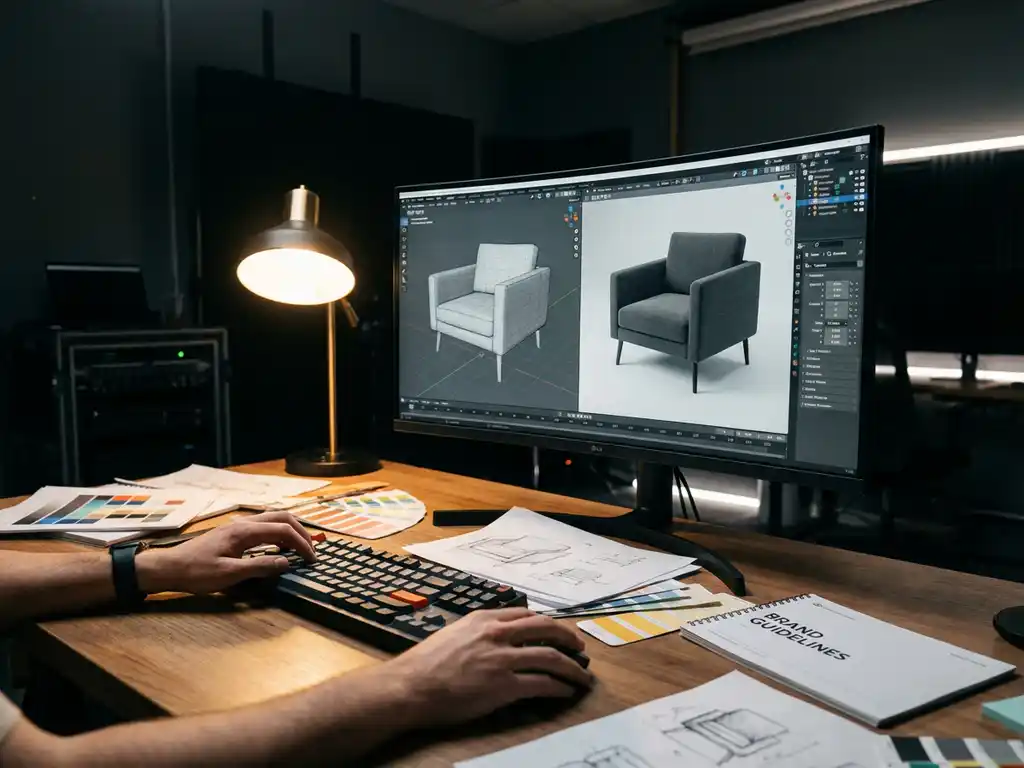
3D product rendering transforms content marketing by creating photorealistic digital product visuals without the constraints of traditional photography. This technology enables brands to produce unlimited variations, angles, and configurations while maintaining consistent quality across all marketing channels. Modern content marketing relies heavily on visual storytelling, making 3D rendering essential for brands seeking scalable, cost-effective visual content that engages customers and drives conversions.
What is 3D product rendering, and why does it matter for content marketing?
3D product rendering is computer-generated imagery (CGI) technology that creates photorealistic product visuals from digital 3D models. Unlike traditional photography, rendering produces pixel-perfect images with complete control over lighting, materials, backgrounds, and product configurations. This technology matters for content marketing because it eliminates the limitations and costs of physical photo shoots while enabling unlimited creative possibilities.
The shift from traditional photography to 3D visualization represents a fundamental change in how brands approach visual content creation. Traditional photo shoots require physical products, studio setups, professional photographers, and extensive post-production work. Each product variation or angle requires additional time and expense. 3D rendering removes these constraints by creating digital assets that can be modified, repositioned, and reconfigured instantly.
Modern consumers expect rich, detailed product visuals across every touchpoint. They want to see products from multiple angles, understand customization options, and visualize how items fit their specific needs. 3D rendering technology enables brands to meet these expectations efficiently while maintaining brand consistency across all marketing channels.
How does 3D product rendering enhance visual storytelling in marketing?
3D rendering creates compelling visual narratives by enabling dynamic product presentations that traditional photography cannot achieve. Marketers can showcase products from impossible angles, create exploded views that reveal internal components, and demonstrate functionality through animated sequences. This technology transforms static product displays into immersive storytelling experiences that capture attention and communicate value effectively.
The storytelling advantages extend beyond basic product visualization. 3D rendering allows brands to create consistent visual narratives across different contexts and environments. Products can be seamlessly integrated into lifestyle scenes, architectural spaces, or conceptual backgrounds that reinforce brand messaging. This flexibility enables marketers to craft cohesive stories that resonate with target audiences while maintaining visual authenticity.
Dynamic presentations powered by 3D technology engage customers more effectively than static imagery. Interactive elements, such as rotating product views or real-time customization previews, encourage deeper exploration and longer engagement times. These immersive experiences help customers understand products better, building confidence and reducing purchase hesitation.
What types of content can you create with 3D product rendering?
3D product rendering enables diverse content formats, including interactive configurators, 360-degree product views, augmented reality experiences, animated demonstrations, and customizable product visualizations. Each format serves specific marketing objectives while providing engaging customer experiences that traditional photography cannot deliver. The technology adapts to various marketing channels, from e-commerce platforms to social media campaigns.
Interactive configurators represent one of the most powerful applications, allowing customers to customize products in real time while seeing immediate visual feedback. These tools work particularly well for furniture, automotive, fashion, and technology products, where personalization drives purchase decisions. Customers can modify colors, materials, sizes, and features while maintaining photorealistic quality throughout the customization process.
360-degree product views and animated demonstrations showcase products comprehensively without requiring multiple physical samples. These formats work exceptionally well for complex products, where understanding functionality drives purchase decisions. Use cases span across industries, from showing mechanical assemblies to demonstrating software interfaces through 3D visualizations.
Augmented reality experiences bring products into customers’ real environments, enabling them to visualize how items fit their spaces before purchasing. This technology proves particularly valuable for furniture, home décor, and architectural products, where spatial relationships matter significantly.
How do you integrate 3D product rendering into existing marketing workflows?
Integrating 3D product rendering into existing marketing workflows requires strategic planning that considers current content creation processes, team capabilities, and technology infrastructure. Start by identifying which products benefit most from 3D visualization, then gradually expand coverage while building internal expertise. The integration process typically involves workflow optimization, team collaboration strategies, and platform integration considerations.
Content planning must accommodate the unique characteristics of 3D assets. Unlike traditional photography, 3D models can generate unlimited variations once created, enabling more dynamic content calendars. Marketing teams should plan campaigns that leverage this flexibility, creating content series that showcase different product configurations, seasonal variations, or targeted messaging for specific audience segments.
Team collaboration becomes more streamlined when 3D assets are properly managed. Design teams can work with standardized 3D models while marketing teams access rendered outputs through centralized asset libraries. This approach ensures brand consistency while enabling rapid content creation for various marketing initiatives.
Platform integration considerations include ensuring 3D content works seamlessly across existing marketing tools and channels. Modern solutions offer APIs and integrations that connect with e-commerce platforms, content management systems, and marketing automation tools, maintaining workflow efficiency while enhancing visual capabilities.
What are the key benefits of using 3D rendering for product marketing content?
The primary benefits of 3D rendering for product marketing include significant cost savings compared to traditional photography, unlimited scalability for product variations, consistent quality across all marketing channels, faster time to market for new products, and improved customer engagement metrics. These advantages compound over time, making 3D rendering increasingly valuable for growing product catalogs.
Cost-effectiveness becomes apparent when considering the total expense of traditional photo shoots versus 3D rendering. Physical photography requires studio rental, professional equipment, lighting setup, photographer fees, and post-production work for each product variation. 3D rendering eliminates these recurring costs while enabling unlimited image generation from single 3D models.
Scalability advantages prove particularly valuable for brands with extensive product ranges or frequent launches. Traditional photography becomes prohibitively expensive when covering hundreds of product variations across multiple colors, materials, or configurations. 3D rendering handles this complexity efficiently, generating consistent quality visuals regardless of catalog size.
Consistency across marketing channels ensures brand integrity while reducing production complexity. 3D assets maintain identical lighting, color accuracy, and styling across web stores, print catalogs, social media, and retail displays. This consistency strengthens brand recognition while simplifying asset management processes.
How 3dimerce helps with 3D product rendering in content marketing
We address the challenges discussed throughout this article by providing a comprehensive visual product experience platform that revolutionizes content marketing through advanced 3D rendering technology. Our solution transforms how brands create, manage, and deploy visual content across all marketing channels while maintaining the highest quality standards.
Our platform offers specific benefits for content marketing transformation:
- Blazing-fast visual generation that accelerates content creation timelines
- Seamless integration with existing marketing workflows and e-commerce platforms
- Interactive configurators that engage customers and drive conversions
- Photorealistic quality that matches premium brand positioning
- Scalable solutions that grow with expanding product catalogs
- Omnichannel consistency across all marketing touchpoints
Ready to transform your content marketing with professional 3D product rendering? Contact us to discover how our visual product experience platform can elevate your brand’s marketing capabilities while reducing costs and accelerating time to market for your content initiatives.
Related Articles
- How does 3D product rendering connect to digital asset management?
- What is the role of 3D product rendering in modern retail?
- What is the process for implementing 3D product rendering?
- Why are furniture brands switching from photography to 3D product rendering?
- How does 3D product rendering compare to CGI imagery?