
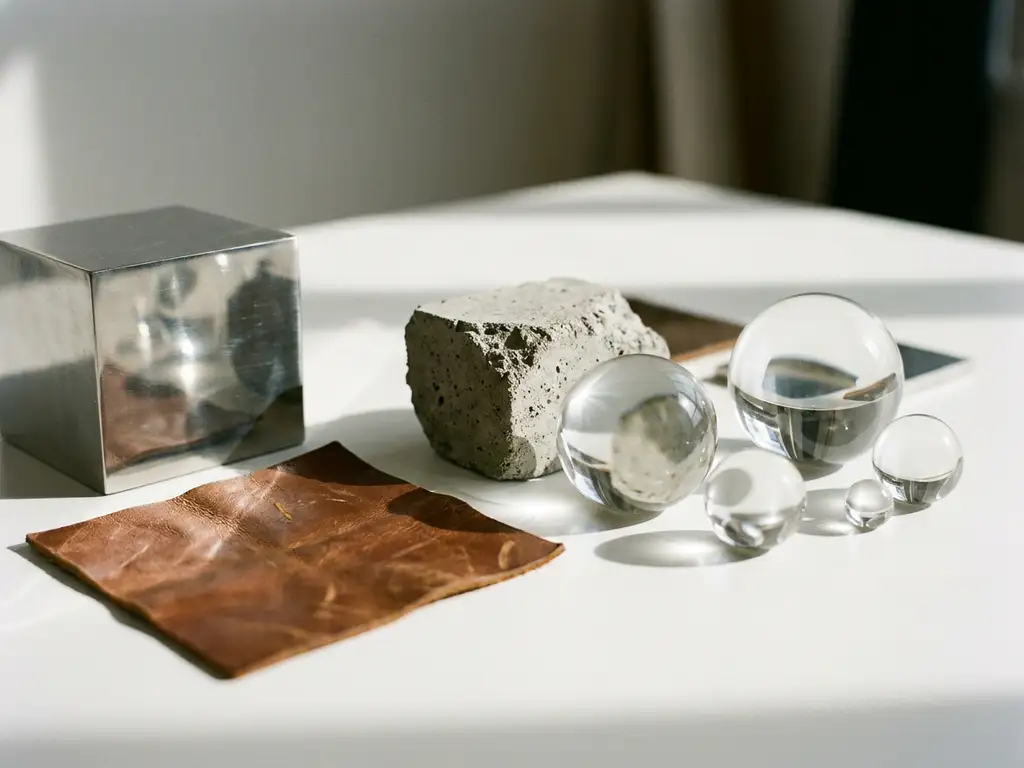
PBR materials — short for Physically Based Rendering materials — are the industry standard for creating photorealistic product visuals that behave exactly like real surfaces under any lighting condition. These materials accurately represent how light bounces, absorbs, and reflects off surfaces, creating renderings that match real-world physics with scientific precision. For brands requiring premium visual quality, PBR materials have become essential for achieving the lifelike product imagery that modern customers expect.
Why are outdated material workflows costing you competitive advantage?
Brands relying on traditional material workflows lose ground to competitors using PBR materials in measurable ways. Traditional material creation methods undermine brand visual impact beyond aesthetics — when product visuals lack the sophisticated light interaction and surface detail that PBR materials provide, customers perceive the brand as less premium than competitors who invest in photorealistic rendering. This perception gap translates directly into lost sales, particularly in luxury and design-focused markets where visual quality signals product quality.
The cost compounds when you factor in the time and resources spent on multiple revision cycles — trying to achieve realistic results with outdated material systems that cannot deliver the physical accuracy premium products require. Every round of corrections is a round of unnecessary expense that a modern PBR material workflow eliminates from the start.
What does inconsistent visual quality signal about your brand positioning?
Inconsistent material representation across a product range creates a fragmented brand experience that erodes customer confidence. When some products appear with flat, unrealistic surfaces while others showcase rich textures and proper light reflection, customers question whether the brand maintains consistent quality standards. This visual inconsistency is particularly damaging in omnichannel environments where customers encounter products across multiple touchpoints — web, mobile, in-store displays, and digital configurators.
The solution lies in adopting a unified PBR material workflow that ensures every product visualization maintains the same high standard of photorealism, reinforcing premium positioning at every customer interaction. A consistent PBR rendering approach removes the guesswork and replaces it with a repeatable, physics-driven standard that scales across an entire product catalog.
What are PBR materials and why do they matter?
A PBR material — short for Physically Based Rendering material — is a digital surface definition that simulates how real materials interact with light using the laws of physics. Each PBR material is built from a set of texture maps — including albedo, roughness, metallic, and normal maps — that together define how a surface absorbs, reflects, and scatters light under any lighting condition. For brands, this means product visuals that look authentic and consistent whether rendered in a bright studio, a lifestyle environment, or an interactive online configurator.
PBR materials represent a fundamental shift in how digital surfaces interact with light. Unlike traditional materials that rely on artistic interpretation — manually painted highlights, shadows, and reflections — PBR materials use scientifically accurate parameters to recreate authentic surface characteristics. The core PBR parameters include:
- Albedo: the base color of a surface independent of lighting
- Roughness: how much light scatters across a surface, determining matte or glossy appearance
- Metallic: whether a surface behaves as a conductor or dielectric, governing reflection behavior
- Normal mapping: surface micro-detail that affects how light interacts without increasing geometry complexity
The importance of PBR materials extends beyond technical accuracy. For brands operating in competitive markets, these parameters provide the visual fidelity necessary to showcase products with confidence. When customers can see realistic fabric weaves, authentic wood grain patterns, or precise metal finishes, they develop stronger emotional connections to products before purchase — reducing uncertainty and building trust in a brand’s quality standards.
What are the different types of PBR texture maps?
PBR materials achieve their realism through a system of specialized texture maps, each controlling a distinct aspect of surface behavior. Understanding how these PBR texture maps work — individually and together — helps brands appreciate why physically based rendering produces results that traditional workflows simply cannot match.
Albedo / Base Color Map
The albedo map defines the pure base color of a surface, entirely free of any baked-in lighting, shadows, or highlights. In a PBR material workflow, this separation is critical: because no artificial shading is embedded in the color data, the rendering engine can apply physically accurate lighting from any direction without conflict. For a luxury ceramic vase, the albedo map captures the exact glaze color as it would appear in neutral, shadowless light — ensuring the hue stays true whether the product is shown under warm showroom lighting or cool daylight.
Roughness Map
The roughness map controls how much light scatters across a surface, determining whether it reads as polished and mirror-like or matte and diffuse. In a PBR material, roughness values range from 0 (perfectly smooth) to 1 (fully rough), with the rendering engine calculating light scatter accordingly. A roughness map on a brushed stainless steel appliance defines precisely where the surface scatters light softly versus reflects it sharply, making the finish appear authentically machined rather than digitally painted.
Metallic Map
The metallic map distinguishes between conductive surfaces (metals) and non-conductive surfaces (dielectrics such as wood, fabric, or plastic), which behave fundamentally differently under light. Metals reflect colored specular highlights and absorb almost no diffuse light, while dielectrics do the opposite — and the metallic map tells the PBR rendering engine which rule to apply at every point on the surface. For a fine jewelry piece combining 18k gold settings with a pearl center stone, the metallic map ensures each material type receives physically correct light treatment without manual override.
Normal Map
The normal map encodes surface micro-detail — such as fabric weave, wood grain texture, or leather pore structure — as directional light information, adding apparent depth without increasing the geometric complexity of the 3D model. This makes normal maps essential for performance-efficient PBR material workflows, particularly in web-based product configurators where polygon count directly affects load speed. A normal map on a bouclé sofa fabric captures the looped yarn structure so convincingly that customers can perceive the tactile quality of the material from a product image alone.
Ambient Occlusion (AO) Map
The ambient occlusion map simulates the soft shadowing that occurs in crevices, corners, and areas where surfaces meet closely — the subtle darkening that gives objects visual weight and grounding in a scene. In a PBR material, the AO map works in combination with environment lighting to add contact shadow depth that would otherwise require expensive ray-traced calculation at render time. For a marble tabletop with inlaid brass detailing, the AO map deepens the recessed joints, making the craftsmanship legible and visually convincing.
Height / Displacement Map
The height map — or displacement map — defines the actual physical elevation of surface features, allowing the rendering engine to push and pull geometry to create true three-dimensional surface relief rather than simulated depth. Unlike normal maps, which only affect light direction, displacement maps alter the silhouette of a surface, making embossed leather, carved stone, or knurled metal appear genuinely three-dimensional from any viewing angle. This level of surface authenticity is particularly valuable for luxury product categories where tactile quality is a core brand promise.
Emissive Map
The emissive map defines areas of a surface that emit their own light, independent of the scene’s lighting setup — used for backlit displays, illuminated dials, LED indicator strips, or glowing brand logos. In a PBR material workflow, emissive maps are carefully calibrated to maintain energy-accurate brightness values that integrate naturally with the surrounding environment rather than appearing as flat, painted-on glow. For a premium consumer electronics product, an emissive map on the power indicator ensures the light reads as genuine illumination rather than a post-processed effect.
How PBR texture maps work together as a system
No single PBR texture map tells the complete story of a surface — it is the combination of all maps working in concert that produces the photorealistic result. The albedo provides the color foundation, the roughness and metallic maps govern how light interacts with that color, the normal and displacement maps add structural depth, the AO map anchors the surface in its environment, and the emissive map introduces self-generated light where needed. Together, these PBR texture maps give the rendering engine everything it needs to simulate a physically accurate material under any lighting condition, at any camera angle, across any platform.
How do PBR materials improve visual realism?
PBR materials achieve superior realism by adhering to the fundamental laws of physics that govern light behavior. The key principle is energy conservation: the amount of light reflected by a surface never exceeds the amount received. Traditional materials often violate this principle, producing surfaces that look flat or artificially bright under certain lighting conditions — PBR materials automatically maintain this balance, ensuring surfaces appear naturally lit in any environment.
- Energy conservation accuracy — PBR materials never reflect more light than they receive, eliminating the artificial glow common in traditional renders and producing surfaces that read as genuinely physical.
- Environment-adaptive lighting — surfaces update their highlights and shadows correctly as lighting conditions change, from bright showrooms to intimate lifestyle settings, without any manual artist correction.
- Subsurface scattering — translucent materials like fabric, wood, and stone show light penetration depth, adding the subtle richness that distinguishes premium product visualizations from basic renderings.
- Angle-dependent reflectance — PBR materials replicate the Fresnel effect, where reflectivity increases at grazing angles just as it does on real surfaces, adding a layer of optical authenticity that customers perceive as quality.
- Consistent cross-environment appearance — a PBR material that looks correct in one lighting setup looks correct in all others, making it possible to produce unlimited scene variations from a single material definition.
This dynamic behavior means product visualizations maintain photorealistic quality whether displayed in a bright retail environment or an intimate home setting — a consistency that traditional material workflows cannot reliably achieve.
What’s the difference between PBR and traditional materials?
The difference between PBR materials and traditional materials is most clearly understood through a concrete example. Imagine a luxury velvet sofa rendered with a traditional material workflow: the fabric appears flat, its highlights are painted directly into the texture at a fixed angle, and when the scene lighting shifts to a lifestyle environment, those baked-in highlights break — the sofa looks wrong, the fabric reads as plastic, and the premium positioning the brand has invested in evaporates. Revision after revision is required to correct the material for each new context, each one adding cost and delay.
Now render the same sofa with a PBR material. The velvet pile depth is captured in the normal and displacement maps, the roughness map drives authentic light scatter across the fabric surface, and the subsurface scattering parameter adds the warm luminosity that makes velvet immediately recognizable. Move that material into a showroom render, a lifestyle photograph composite, or a real-time web configurator — it looks correct in every context, without a single manual adjustment. That is the PBR material workflow advantage: physics-driven accuracy that scales.
| Criterion | Traditional Materials | PBR Materials |
|---|---|---|
| Lighting Accuracy | Baked-in highlights and shadows; breaks under new lighting | Physics-driven response; accurate under any lighting condition |
| Consistency Across Environments | Requires manual rework per scene or environment | Consistent appearance across all environments automatically |
| Production Time | High — iterative manual corrections per lighting setup | Low — one material definition works everywhere |
| Revision Cycles | Frequent — each new context may require material rework | Minimal — physics accuracy reduces the need for correction |
| Cross-Platform Reliability | Inconsistent — results vary across software and platforms | Reliable — standardized PBR workflows transfer across tools |
| Long-Term Scalability | Poor — material libraries become fragmented and outdated | Excellent — a single PBR library scales across the full product range |
How do PBR materials streamline the rendering workflow?
PBR materials reduce production time by eliminating the iterative guesswork that characterizes traditional material workflows. Because PBR materials follow predictable physical laws, artists reach accurate results faster and with greater confidence. The standardized physically based rendering workflow also means materials created by different team members maintain consistent quality and behavior — reducing the review and revision cycles that drive up production costs.
- Faster material sign-off — because PBR materials look correct from the first lighting test, fewer review rounds are needed before a material is approved for production use.
- Reusable material libraries — a PBR material created for one product can be applied across an entire range, with roughness and color variations handled through map adjustments rather than full rebuilds.
- Lighting-agnostic composition — teams can focus on scene composition and storytelling rather than correcting material behavior, accelerating the creative process for seasonal campaigns and product launches.
- Seamless handoff between tools — standardized PBR material formats transfer reliably between software environments, reducing friction when assets move between design, visualization, and development teams.
- Scalable collection updates — when a product line expands, PBR material variants can be generated systematically, ensuring new additions match the visual standard of existing products without starting from scratch.
Real-world examples from our client implementations demonstrate significant time savings in both material creation and rendering phases — particularly when managing large product catalogs that require consistent visual quality across hundreds of SKUs.
Which 3D software and rendering engines support PBR materials?
PBR materials are supported natively across all major 3D software platforms and rendering engines, making PBR development a practical and future-proof investment regardless of your existing technical stack. Understanding how each tool implements physically based rendering helps teams evaluate PBR feasibility within their current workflow.
Blender
Blender implements PBR materials through its Principled BSDF shader, which consolidates the full metallic/roughness workflow into a single, artist-friendly node. The shader supports all core PBR texture map inputs — albedo, roughness, metallic, normal, and displacement — and produces physically accurate results in both the Cycles ray-trace renderer and the real-time Eevee engine. For product visualization teams, Blender’s open-source nature and active development community make it an excellent platform for PBR material creation and iteration without licensing overhead.
Autodesk Maya & 3ds Max
Autodesk’s Maya and 3ds Max both support PBR materials natively through the Arnold renderer’s aiStandardSurface shader and the integrated Physical Material in 3ds Max, both of which follow the metallic/roughness PBR workflow. These tools are widely used in high-end product visualization and virtual photography pipelines, where PBR material consistency across complex multi-product scenes is essential. The Autodesk ecosystem’s deep integration with asset management systems makes it particularly well suited to large-scale PBR material library workflows.
Cinema 4D
Cinema 4D supports physically based rendering through its native Redshift and Arnold integrations, as well as the built-in Physical Renderer, all of which accept standard PBR texture map sets. Its node-based material editor provides an intuitive interface for assembling PBR materials from individual texture maps, making it accessible to visualization teams transitioning from traditional workflows. Cinema 4D’s motion graphics capabilities also make it a strong choice for brands that need PBR materials to perform in animated product presentations and campaign content.
Unreal Engine
Unreal Engine implements a fully PBR-compliant material system at its core, with Lumen — the engine’s real-time global illumination system — providing dynamic, physically accurate lighting that responds to PBR materials in real time. This makes Unreal Engine the leading platform for interactive product configurators, virtual showrooms, and immersive brand experiences where PBR material quality must hold up under user-controlled lighting and camera movement. For brands investing in real-time commerce experiences, Unreal Engine’s PBR rendering capabilities represent the current performance benchmark.
Unity
Unity’s High Definition Render Pipeline (HDRP) provides a full PBR material workflow optimized for high-fidelity product visualization and interactive applications across web, mobile, and desktop platforms. Unity’s PBR materials use the same metallic/roughness texture map conventions as other major tools, ensuring that material assets transfer cleanly between platforms without requiring full rebuilds. For brands deploying product configurators or augmented reality experiences, Unity’s cross-platform PBR support makes it a practical choice for reaching customers across every digital touchpoint.
We assess each client’s existing software environment and ensure PBR materials are delivered in the correct format for seamless integration — whether that means Blender-native node setups, Unreal Engine material instances, or cross-platform texture map packages compatible with the full range of tools above. Our PBR development process is designed to meet your team where it already works.
Which industries benefit most from PBR materials?
PBR materials deliver measurable advantages across industries where surface authenticity directly influences purchase decisions. The following sectors represent the strongest alignment between PBR rendering capabilities and brand value creation.
Luxury furniture & interior design
The furniture and interior design sector depends on material authenticity more than almost any other category — customers are buying surfaces as much as they are buying forms. PBR materials handle the specific material types that define this sector with a level of accuracy that traditional rendering cannot approach:
- Velvet — roughness and normal maps capture the directional sheen that makes velvet immediately recognizable, communicating tactile quality through the screen.
- Bouclé — displacement and normal mapping reproduce the looped yarn texture at a level of detail that supports premium pricing through visual credibility.
- Oak veneer — albedo and normal maps together capture the fine grain variation and surface warmth that distinguishes real wood from imitation finishes.
- Marble — subsurface scattering parameters replicate the translucent depth of natural stone, giving marble surfaces the luminous quality that photographs of real stone possess.
- Brushed brass — the metallic map combined with a directional roughness map produces the anisotropic highlight pattern characteristic of brushed metal, signaling craftsmanship at a glance.
For furniture brands, this material precision directly supports premium positioning and reduces the purchase hesitation that arises when customers cannot physically inspect a product before buying.
Fashion & jewelry
Fashion and jewelry brands sell materials as much as they sell objects — the hand of a silk blouse, the depth of a full-grain leather bag, the brilliance of a diamond are the product. PBR materials capture these qualities with the fidelity that luxury customers expect:
- Silk — anisotropic roughness parameters replicate the characteristic cross-grain sheen of woven silk, distinguishing it from synthetic alternatives in a product image.
- Full-grain leather — normal and displacement maps capture the natural pore structure and surface variation that signal genuine leather quality to discerning buyers.
- 18k gold — the metallic map and roughness values combine to produce the warm, high-reflectance appearance specific to gold alloys, distinguishable from silver or platinum at a glance.
- Diamonds — refraction and dispersion parameters within a PBR material simulate the internal light behavior of cut diamonds, producing the fire and brilliance that drives purchase intent for fine jewelry online.
- Anodized aluminum — the metallic and roughness map combination captures the semi-matte, color-saturated finish of anodized surfaces, critical for contemporary jewelry and accessories brands.
In a category where customers cannot try before they buy, PBR material accuracy is not a visual enhancement — it is a commercial necessity that directly supports online conversion rates.
Automotive
Automotive visualization demands the highest level of surface accuracy because buyers are evaluating finish quality as a proxy for engineering precision and brand prestige. PBR materials are the standard for automotive rendering precisely because they handle the sector’s most demanding surface types:
- Clear-coat paint — layered PBR materials simulate the depth and reflectance variation between the base coat and clear coat, producing the wet-look depth that distinguishes premium automotive finishes.
- Carbon fiber weave — normal and metallic maps together capture the directional reflectance pattern of woven carbon fiber, communicating performance and technical sophistication.
- Polished chrome — near-zero roughness values and a full metallic response produce the mirror-like reflectance of chrome trim, which reads immediately as quality hardware to automotive buyers.
- Perforated leather — displacement mapping reproduces the regular perforation pattern of premium interior leather, adding the tactile visual detail that justifies luxury interior specifications.
For automotive brands, PBR material accuracy in digital configurators and marketing assets directly supports the brand perception that justifies premium pricing in a highly competitive market.
Consumer electronics
Consumer electronics brands compete on industrial design as much as on specification — the surface treatment of a device communicates quality, precision, and brand identity before a single feature is read. PBR materials render the electronics sector’s characteristic surface types with the accuracy that premium positioning demands:
- Matte soft-touch plastic — high roughness values and a dielectric metallic response produce the even, light-absorbing quality of rubberized soft-touch coatings without the flat, painted appearance of traditional materials.
- Hairline-brushed aluminum — anisotropic roughness parameters replicate the fine directional scratch pattern of machined aluminum, communicating precision manufacturing at a glance.
- Tempered glass — refraction, roughness, and specular parameters combine to render the optical clarity and subtle surface reflectance of high-quality display glass.
- Anodized titanium — the metallic map and roughness values capture the distinctive semi-matte, color-depth appearance of anodized titanium, differentiating premium devices from mid-market alternatives.
For electronics brands, PBR material quality in product imagery and configurators signals the same engineering precision as the device itself — making it a direct contributor to brand equity and conversion.
Architecture & spatial visualization
Architecture and spatial visualization practices increasingly rely on PBR materials to produce client presentations, planning renders, and immersive virtual walkthroughs that accurately represent the material palette of a proposed space. PBR rendering is the standard for architectural visualization precisely because built environments involve the most complex material interactions — light bouncing between multiple surfaces simultaneously:
- Concrete — roughness and normal maps capture the aggregate texture and tonal variation of formed or polished concrete, distinguishing architectural-grade finishes from generic grey surfaces.
- Frosted glass — roughness and transmission parameters simulate the diffuse light transmission of sandblasted or acid-etched glass, essential for accurate daylighting studies.
- Terrazzo — albedo and normal maps together reproduce the aggregate chip pattern and polished surface of terrazzo flooring, communicating material richness in interior visualization.
- Aged copper — roughness variation and color-mapped patina simulate the natural oxidation gradient of weathered copper cladding, adding material authenticity to facade visualizations.
For architecture and design practices, PBR material accuracy in client presentations reduces specification uncertainty, builds client confidence, and supports faster project approval — making it a direct contributor to project velocity and practice reputation.
What results do brands achieve with professional PBR materials?
PBR material implementation delivers results that go beyond improved aesthetics — it changes how efficiently brands produce visual content and how effectively that content converts. The following outcomes reflect the types of improvements our clients consistently experience across different industry verticals.
Luxury furniture brand: eliminating revision cycles
A leading Scandinavian furniture brand came to us with a recurring problem: their traditional material workflow required between four and seven revision rounds per product before materials were approved for use in campaign renders and configurator assets. Each revision cycle involved manual texture corrections for new lighting environments, consuming weeks of production time per collection launch. After implementing a comprehensive PBR material library covering their full range of upholstery fabrics, wood veneers, and metal finishes, the brand cut their material revision cycles by more than half — with most materials passing approval in the first or second review. The consistency of physically based rendering across all their visual touchpoints also allowed them to launch new collection assets simultaneously across web, print, and in-store displays for the first time.
European fine jewelry maison: accelerating online conversion
A European fine jewelry maison approached us because their existing product imagery — produced with a combination of traditional 3D rendering and photography — was failing to communicate the brilliance and material quality of their high-value pieces to online buyers. The inconsistency between photographic and rendered assets was creating a fragmented brand experience that undermined customer confidence at the point of purchase. We implemented PBR materials for their full collection — including 18k gold, platinum, diamond, and colored gemstone surfaces — delivering assets that maintained consistent material quality across their e-commerce platform, digital lookbook, and social media channels. The maison reported a meaningful improvement in online configurator engagement and a reduction in return rates attributed to product expectation mismatch.
Consumer electronics brand: faster time-to-market for new SKUs
A premium consumer electronics brand needed to accelerate the production of visual assets for new product variants — color and finish options that previously required individual photography sessions for each SKU. By building a PBR material library covering their core surface types — hairline-brushed aluminum, anodized titanium, tempered glass, and soft-touch polymer — we enabled the brand’s internal visualization team to generate new finish variants directly from the existing material library without additional photography. This reduced their time-to-market for new SKU visual assets from several weeks to a matter of days, allowing the brand to respond to market trends and launch new colorways with a speed that their traditional workflow could not support.
How 3Dimerce helps with PBR material implementation
We specialize in creating sophisticated PBR material libraries that elevate product visualizations to premium standards. Our approach combines deep technical expertise with an understanding of luxury and high-end brand requirements, ensuring materials not only look stunning but perform consistently across all customer touchpoints — web, mobile, and in-store displays.
Our PBR material categories
- Metals (brushed, polished, patinated) — from hairline-brushed aluminum to aged bronze, our metal PBR materials capture the specific reflectance and roughness characteristics that distinguish premium hardware from generic finishes.
- Fabrics (velvet, silk, bouclé, leather) — our fabric PBR materials use layered normal, roughness, and subsurface parameters to reproduce the tactile qualities that drive purchase confidence in fashion and furniture categories.
- Wood & stone (veneers, marble, terrazzo) — we produce wood and stone PBR materials with the grain variation, subsurface depth, and surface polish accuracy that luxury interior and furniture brands require.
- Glass & ceramics — our glass and ceramic PBR materials accurately simulate refraction, transmission, and surface gloss, from optical-quality display glass to hand-finished ceramic glazes.
- Specialty finishes (carbon fiber, anodized surfaces) — for automotive, electronics, and industrial design clients, we create specialty PBR materials that capture the directional reflectance and surface precision of engineered finishes.
Our technical delivery standards
- Texture resolution up to 4K and 8K — we deliver PBR texture maps at the resolution your application demands, from web-optimized 2K sets to 8K maps for close-up product visualization and print.
- Metallic/roughness and specular/glossiness workflows — we support both major PBR workflow conventions, ensuring material assets integrate cleanly with your existing pipeline regardless of which standard your team uses.
- Compatible file formats (PNG, EXR, TIFF) — all PBR texture maps are delivered in the format your software requires, with color-managed EXR files available for HDR-accurate workflows.
- Named software compatibility (Blender, Maya, 3ds Max, Unreal Engine, Unity, Cinema 4D) — we test and verify every PBR material delivery against your specific software environment, eliminating integration friction and ensuring immediate usability.
- Ongoing material library management — as your product range evolves, we maintain and extend your PBR material library so every new product launches with the same visual standard as your existing catalog.
Ready to transform your product visualizations with professional-grade PBR materials — from brushed metals and luxury fabrics to specialty engineered finishes? Our team understands the unique challenges facing luxury brands and design-focused manufacturers. Discover how our visual product configuration platform can showcase your products with the realism they deserve. Contact us today to discuss your specific material requirements and see how PBR technology can enhance your brand’s visual impact.
Visual Commerce Solutions
Talk to our team about your project.
Frequently Asked Questions
How long does it typically take to convert existing traditional materials to PBR format?
The conversion timeline depends on your material library size and complexity, but most projects range from 2-6 weeks. Simple materials like basic metals or plastics can be converted in days, while complex fabrics or layered materials requiring custom texture work may take 1-2 weeks each. We recommend prioritizing your most frequently used or brand-critical materials first to see immediate impact.
Can PBR materials work with our current 3D software and rendering engines?
Most modern 3D applications and rendering engines support PBR workflows, including Blender, Maya, 3ds Max, Cinema 4D, and game engines like Unity and Unreal Engine. However, older software versions may require updates or plugins. We assess your current technical stack during consultation and provide recommendations for seamless integration without disrupting your existing workflows.
What's the file size impact of switching to PBR materials, and how does this affect website performance?
PBR materials typically use 3-5 texture maps compared to traditional single textures, which can increase file sizes initially. However, our optimization techniques including texture compression, LOD systems, and progressive loading actually improve performance while maintaining quality. Most clients see 20-30% faster load times due to more efficient rendering processes.
How do we maintain brand color accuracy when implementing PBR materials across different devices and screens?
PBR materials use color-managed workflows that ensure consistent appearance across devices when properly implemented. We establish color profiles specific to your brand standards and test materials across various screen types during development. The physics-based approach actually provides more predictable color reproduction than traditional materials.
What happens to our existing product configurators when we upgrade to PBR materials?
Existing configurators can be upgraded to support PBR materials without losing functionality. We typically implement a hybrid approach during transition, allowing both material types to coexist while gradually replacing traditional materials. Your customers won’t experience any disruption, and the enhanced visual quality often leads to increased engagement and conversion rates.
How do we train our design team to create and modify PBR materials effectively?
We provide comprehensive training covering PBR fundamentals, material authoring best practices, and your specific workflow requirements. Training typically includes hands-on workshops, documentation, and ongoing support during the first few months. Most design teams become proficient within 2-3 weeks, with advanced techniques developing over time through practical application.
What's the ROI timeline for implementing PBR materials in our product visualization workflow?
Most clients see immediate improvements in customer engagement and reduced revision cycles within the first month. Quantifiable ROI typically appears within 3-6 months through increased conversion rates, reduced photography costs, and faster time-to-market for new products. Luxury brands often report 15-25% increases in online sales due to enhanced product presentation quality.