
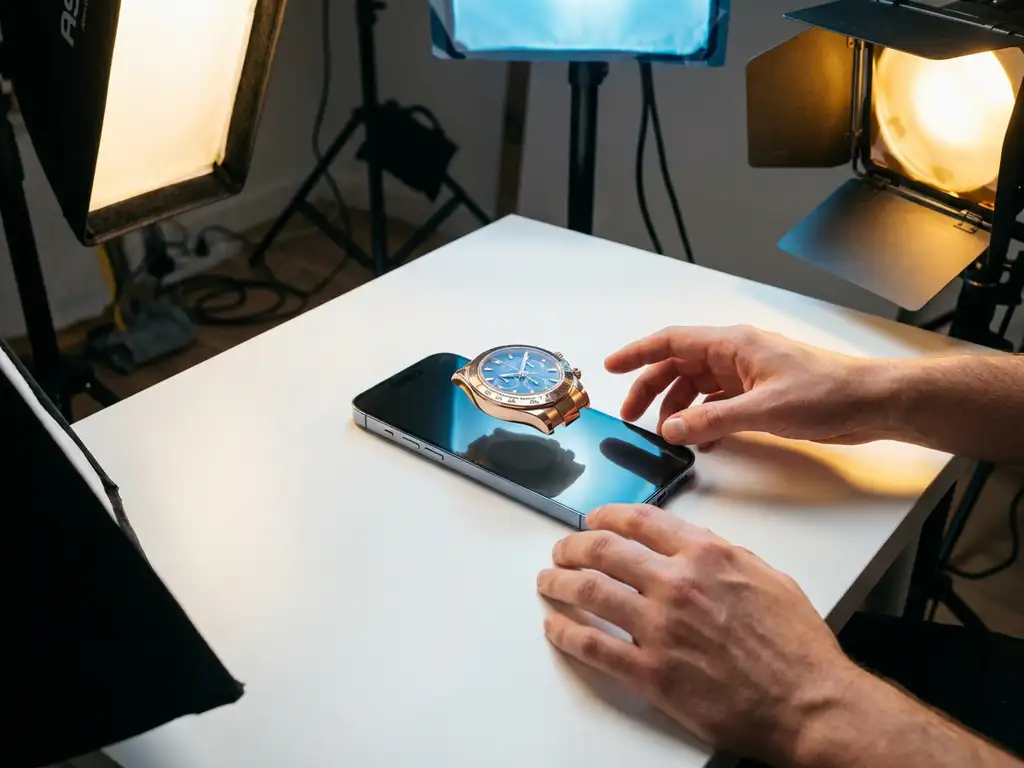
Product visualization is the process of creating digital representations of products using computer-generated imagery (CGI) and 3D modeling technology to showcase items in realistic, interactive formats. This technology transforms how businesses present their products to customers, moving beyond traditional photography to create dynamic, customizable visual experiences that can be viewed from multiple angles, configured in real time, and integrated across digital platforms.
Why are outdated product images costing you sales opportunities?
Static product photography creates a significant barrier between your customers and their purchase decisions. When potential buyers can only view fixed angles of your products, they struggle to fully understand what they’re considering, leading to hesitation at the point of sale. This uncertainty translates directly into abandoned shopping carts, longer decision cycles, and lost revenue. Research consistently shows that customers who can interact with products digitally demonstrate higher engagement rates and conversion percentages than those limited to traditional product galleries.
The solution lies in implementing interactive product visualization software that allows customers to explore products from every angle, customize features in real time, and see exactly what they’re purchasing before committing. This approach eliminates guesswork and builds confidence in buying decisions.
How is limited product customization holding back your competitive advantage?
Today’s consumers expect personalization in every aspect of their shopping experience, yet many businesses still present products as fixed entities with limited variation options. This approach puts you at a significant disadvantage compared to competitors who offer dynamic customization capabilities. When customers cannot visualize how product modifications will look, they often choose simpler alternatives or delay purchases entirely, directly impacting your market position and revenue potential.
Advanced product visualization platforms enable real-time customization, allowing customers to modify colors, materials, configurations, and features while instantly seeing the results. This capability transforms browsing into an engaging, interactive experience that drives both satisfaction and sales.
Visual Commerce Solutions
Talk to our team about your project.
What is product visualization and why does it matter?
Product visualization is the use of CGI, 3D modeling, and interactive rendering technologies to create digital representations of physical products — without requiring physical prototypes or traditional photography. It serves multiple business functions simultaneously: reducing production costs, accelerating time-to-market, enabling unlimited product variations, and delivering consistent visual experiences across all sales channels.
The importance of product visualization extends beyond cost savings. Modern consumers — particularly in B2B environments — expect sophisticated digital experiences that match the quality and complexity of the products they’re evaluating. Companies that invest in high-quality product visualization software gain measurable advantages through improved customer engagement, reduced return rates, and stronger brand perception. The technology also enables businesses to showcase products that don’t yet exist physically, supporting pre-orders and market testing initiatives.
How does 3D product visualization work?
3D product visualization is a multi-stage technical process that converts physical product data into interactive, photorealistic digital experiences. It begins with building a detailed digital model and ends with real-time rendering that customers can interact with directly in a browser or application.
The core stages of 3D product visualization
- 3D modeling — Creates the precise geometric structure of the product using specialized software.
- Texture mapping — Applies realistic surface materials, including fabric weaves, metal finishes, or wood grain, to the model.
- Lighting simulation — Replicates natural and artificial lighting conditions, including shadows and reflections.
- Real-time rendering — Generates the final visual output instantly as users interact with or configure the product.
- Platform integration — Embeds the 3D model across e-commerce sites, in-store displays, and other digital touchpoints.
Modern product visualization software integrates all five stages seamlessly. Advanced implementations also incorporate physics simulations to demonstrate how products move or function, adding another layer of realism. Integration capabilities allow a single 3D model to operate consistently across multiple platforms simultaneously, ensuring uniform product presentation throughout the customer journey.
What’s the difference between product visualization and traditional photography?
The fundamental difference is scalability. Traditional photography requires a physical product, controlled lighting, professional equipment, and a separate shoot for every variation, angle, or configuration change. Product visualization generates unlimited images from a single 3D model — instantly, consistently, and without reshooting.
Traditional photography involves recurring costs each time a product or variation changes. Product visualization requires an upfront investment in 3D modeling that then produces unlimited visual content on demand. For businesses with large product catalogs or frequent design updates, this difference becomes substantial over time.
The practical advantages of product visualization over traditional photography include:
- Instant generation of new product variants without reshooting
- Consistent lighting and image quality across the entire catalog
- Ability to showcase products before manufacturing is complete
- Seamless visual updates when product designs change
- Unlimited angles and configurations from a single 3D asset
You can explore various use cases to understand how different industries apply this technology in practice.
What types of product visualization exist?
Product visualization is not a single technology — it encompasses several distinct approaches, each suited to different business needs and stages of the customer journey.
- Static 3D rendering — Produces high-quality images comparable to professional photography, but with greater flexibility, consistency, and no physical shoot required.
- Interactive 3D viewers — Allow customers to rotate, zoom, and examine products from any angle directly in a web browser or mobile application.
- Product configurators — Enable real-time customization where customers modify colors, materials, features, and components while seeing immediate visual feedback.
- Augmented reality (AR) visualization — Allows customers to place virtual products in their real physical environment using a smartphone or tablet, particularly valuable for furniture and home decor.
- Virtual showrooms — Create fully immersive digital environments where customers can explore entire product collections in realistic, context-appropriate settings.
Each visualization type serves different stages of the customer journey, from initial product discovery through final purchase decisions. The most effective product visualization strategies combine multiple types to support customers at each stage.
How can product visualization improve customer experience?
Product visualization reduces purchase uncertainty by giving customers comprehensive, interactive product information before they buy. When customers can explore a product thoroughly — rotating it, configuring it, and seeing it in context — they develop greater confidence in their decisions. This directly reduces return rates and increases post-purchase satisfaction.
The convenience factor also significantly enhances experience. Instead of visiting physical showrooms or requesting samples, customers can explore full product ranges from any location at any time. This accessibility is particularly valuable for B2B buyers who need to coordinate decisions across multiple stakeholders or evaluate numerous options before committing to substantial purchases.
Personalization capabilities extend the benefit further. Real-time configuration allows customers to see products tailored specifically to their requirements — not just color changes, but functional modifications, size adjustments, and feature selections that produce genuinely personalized solutions. The immediate visual feedback helps customers understand the impact of each choice, reducing confusion and supporting more informed decisions.
How 3Dimerce helps with product visualization
We specialize in creating sophisticated product visualization software built specifically for design-focused, luxury, and high-end market segments — where visual accuracy, material fidelity, and performance are non-negotiable. Our platform delivers stunning visuals with blazing-fast performance, combining advanced 3D product configurators with seamless omnichannel integration so brands can create immersive product experiences that reflect their premium positioning.
Our approach focuses on several key areas:
- High-quality 3D modeling that captures intricate product details and premium materials with exceptional accuracy
- Real-time configuration capabilities that support unlimited customization options without performance compromise
- Omnichannel integration supporting both online and in-store environments from a single asset
- Scalable solutions that grow with your product range without proportional cost increases
- Professional support throughout implementation and ongoing optimization
With over 20 years of experience in virtual art, design, and CGI, we understand the exacting requirements of premium brands that cannot afford to compromise their quality standards in digital environments. Our solutions are purpose-built to replace costly traditional photography workflows while delivering superior visual results that strengthen brand perception and drive measurable sales performance.
Ready to transform your product presentation strategy? Contact us to discover how our product visualization platform can elevate your customer experience and streamline your visual content production.
Frequently Asked Questions
How long does it typically take to implement product visualization software across an existing product catalog?
Implementation timelines vary based on catalog size and complexity, but most businesses can expect 4-12 weeks for full deployment. The process involves 3D model creation (1-3 weeks per product line), platform integration (2-4 weeks), and testing phases (1-2 weeks). Companies with extensive catalogs can prioritize high-value products first and roll out additional items gradually to accelerate time-to-market.
What's the typical ROI timeline for investing in product visualization technology?
Most businesses see positive ROI within 6-18 months, depending on their product complexity and sales volume. Initial benefits include reduced photography costs (immediate), decreased return rates (within 3 months), and increased conversion rates (within 6 months). Companies with high-value or highly customizable products often see faster returns due to the significant impact on customer confidence and purchase decisions.
Can product visualization software integrate with existing e-commerce platforms and CRM systems?
Yes, modern product visualization platforms are designed for seamless integration with popular e-commerce systems like Shopify, Magento, WooCommerce, and enterprise solutions like Salesforce Commerce Cloud. Integration typically involves API connections that sync product data, pricing, and inventory information automatically. Most platforms also offer plugins or modules that simplify the integration process for common systems.
How do you ensure 3D models accurately represent the actual product quality and materials?
Accurate representation requires detailed material sampling, precise color calibration, and advanced texture mapping techniques. Professional 3D artists use high-resolution photography, material samples, and color-calibrated monitors to ensure digital models match physical products exactly. Regular quality reviews and customer feedback help maintain accuracy standards, while advanced rendering engines simulate realistic lighting and surface properties.
What happens to existing product photography investments when switching to 3D visualization?
Existing photography can complement 3D visualization rather than being completely replaced. High-quality product photos serve as reference materials for 3D model creation and can be used for lifestyle shots or marketing materials. The transition typically involves a gradual shift where new products use 3D visualization while existing photography is phased out during regular content updates, maximizing the value of previous investments.
How do mobile users interact with 3D product visualizations, and what are the performance considerations?
Modern product visualization software is optimized for mobile devices using responsive design and progressive loading techniques. Users can rotate, zoom, and configure products using touch gestures, with simplified interfaces for smaller screens. Performance optimization includes compressed 3D models, adaptive quality settings based on device capabilities, and cloud-based rendering to ensure smooth experiences even on older smartphones.
What training or technical expertise is required for staff to manage product visualization software?
Most product visualization platforms are designed for non-technical users, requiring minimal training for day-to-day operations like updating product information or adding new configurations. Basic training typically takes 2-4 hours for content managers, while more advanced features may require additional sessions. Many providers offer comprehensive onboarding, documentation, and ongoing support to ensure teams can effectively manage the system without extensive technical backgrounds.