
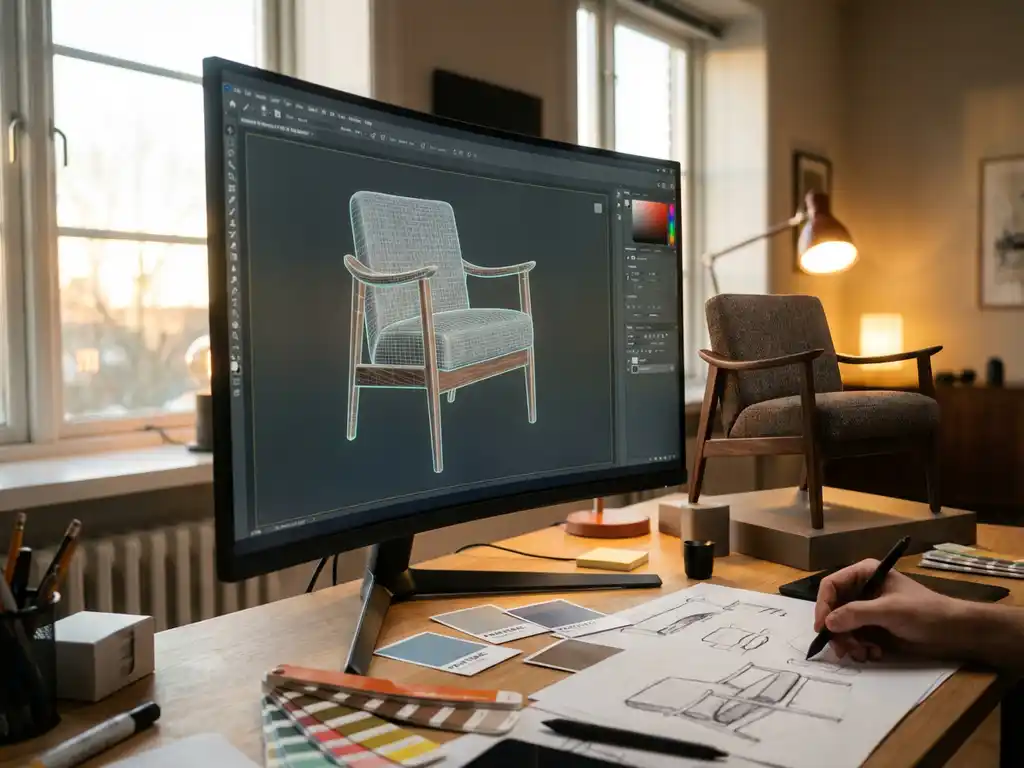
Implementing 3D product rendering becomes essential when traditional photography can’t keep pace with your product variations or when your visual content needs exceed what conventional solutions can deliver. The optimal timing depends on your product complexity, market positioning, and growth trajectory. Most businesses benefit from early adoption when launching configurable products, expanding their catalogue, or competing in premium markets where visual quality directly impacts sales.
What are the key signs your business needs 3D product rendering?
Your business needs 3D product rendering when traditional photography becomes a growth bottleneck, particularly if you offer multiple product configurations or frequently update your catalogue. Key indicators include rising photography costs, delayed product launches due to visual content production, and difficulty maintaining consistent imagery across all sales channels.
Several business indicators signal readiness for 3D rendering implementation. Product complexity is the primary driver—if your products offer multiple colours, materials, or configuration options, traditional photography becomes exponentially more expensive and time-consuming. Each variation requires separate photo shoots, styling, and post-production.
Market positioning requirements can also indicate readiness for 3D rendering. Premium brands competing in luxury segments need consistently high-quality visuals that reflect their positioning. When your current imagery fails to convey product quality, or your competitors offer superior visual experiences, 3D rendering provides a compelling solution.
Operational challenges provide additional signals. If you’re experiencing delays between product development and market launch due to photography scheduling, or if maintaining visual consistency across online and offline channels proves difficult, 3D rendering removes these constraints by enabling scalable visual content production.
How do you know if your product catalog is ready for 3D visualization?
Your product catalogue is ready for 3D visualization when your products have clearly defined specifications, consistent design patterns, and sufficient configurability to justify the initial setup investment. Products with standardized dimensions, materials, and component relationships translate most effectively into 3D environments.
Assessment criteria for product suitability focus on several key factors. Configurability levels determine ROI potential—products with multiple finish options, size variations, or modular components benefit most from 3D visualization. Simple, single-variant products may not justify the initial investment unless they are part of a broader product family.
Technical specifications play a crucial role in feasibility assessment. Products with well-documented dimensions, material properties, and assembly relationships enable accurate 3D model creation. Complex organic shapes or highly detailed textures require more sophisticated rendering approaches but remain achievable with proper planning.
Consider your catalogue’s growth trajectory when evaluating readiness. If you regularly introduce new products or variations, 3D visualization provides long-term scalability. The initial investment in creating 3D assets pays dividends as your catalogue expands, since new variations require minimal additional effort compared to traditional photography.
Visual Commerce Solutions
Talk to our team about your project.
What’s the difference between implementing 3D rendering early versus waiting?
Early 3D rendering implementation provides competitive advantages and cost savings that compound over time, while delayed implementation often results in higher costs and missed opportunities. Early adopters establish market differentiation and build scalable visual content systems before competitors, creating sustainable advantages in customer experience and operational efficiency.
Early adoption benefits include establishing competitive positioning before rivals invest in similar technology. Customers increasingly expect interactive, customizable product experiences, and early implementation positions your brand as innovative and customer-focused. This perception advantage becomes harder to achieve once 3D visualization becomes standard industry practice.
Cost implications favour early implementation for growing businesses. Initial 3D asset creation requires significant investment, but ongoing content production costs decrease dramatically. Early adopters spread this investment over longer periods while building comprehensive 3D libraries that support future growth and product development.
Delayed implementation risks include increased competitive pressure and higher switching costs. As customer expectations rise and competitors offer superior visual experiences, catching up requires more substantial investment while potentially losing market share. Technical integration also becomes more complex as existing systems and processes become entrenched around traditional photography workflows.
When should you prioritize 3D product rendering over traditional photography?
Prioritize 3D product rendering over traditional photography when you offer configurable products, need rapid content creation, or require consistent visuals across multiple channels. 3D rendering excels for products with numerous variations, complex customization options, or when time-to-market speed provides a competitive advantage.
Product types that benefit most from 3D rendering include furniture, interior design elements, and configurable manufactured goods. These categories typically offer multiple finish options, size variations, or modular components that make traditional photography expensive and time-consuming. Budget considerations often favour 3D rendering for these product types despite higher initial costs.
Time-to-market requirements frequently determine the optimal approach. If product launches depend on rapid visual content creation, 3D rendering provides significant advantages. Once initial 3D assets exist, creating new variations or configurations takes hours rather than the days or weeks required for traditional photography sessions.
Long-term scalability needs should guide decision-making for growing businesses. Traditional photography costs scale linearly with catalogue expansion, while 3D rendering costs decrease per product as libraries expand. Consider your five-year product roadmap when evaluating approaches, as 3D rendering investment pays dividends over extended periods.
Channel consistency requirements also influence prioritization decisions. If you sell through multiple online platforms, physical showrooms, and printed catalogues, maintaining visual consistency becomes challenging with traditional photography. 3D rendering ensures identical product representation across all touchpoints while enabling channel-specific optimizations.
How 3Dimerce helps with strategic 3D rendering implementation
We provide comprehensive 3D product visualization solutions that transform how businesses present and sell configurable products. Our platform combines advanced rendering technology with strategic implementation guidance to ensure optimal timing and execution for your specific market position and business objectives.
Our approach to strategic implementation includes:
- Product assessment and roadmap development – We evaluate your catalogue readiness and create phased implementation plans that align with business priorities.
- Seamless integration capabilities – Our platform solutions integrate with existing e-commerce systems and sales environments without disrupting current operations.
- Scalable visual content creation – Once initial 3D assets are established, we enable rapid creation of new variations and configurations.
- Cross-channel consistency – Our technology ensures identical product representation across online stores, physical showrooms, and sales presentations.
We specialize in serving premium brands and manufacturers that require exceptional visual quality that matches their market positioning. Our experienced team has developed proven implementations that demonstrate how strategic 3D rendering timing creates competitive advantages and operational efficiencies that compound over time.
Ready to explore how 3D product rendering can transform your business? Contact our team to discuss your specific requirements and develop an implementation strategy that aligns with your growth objectives.