
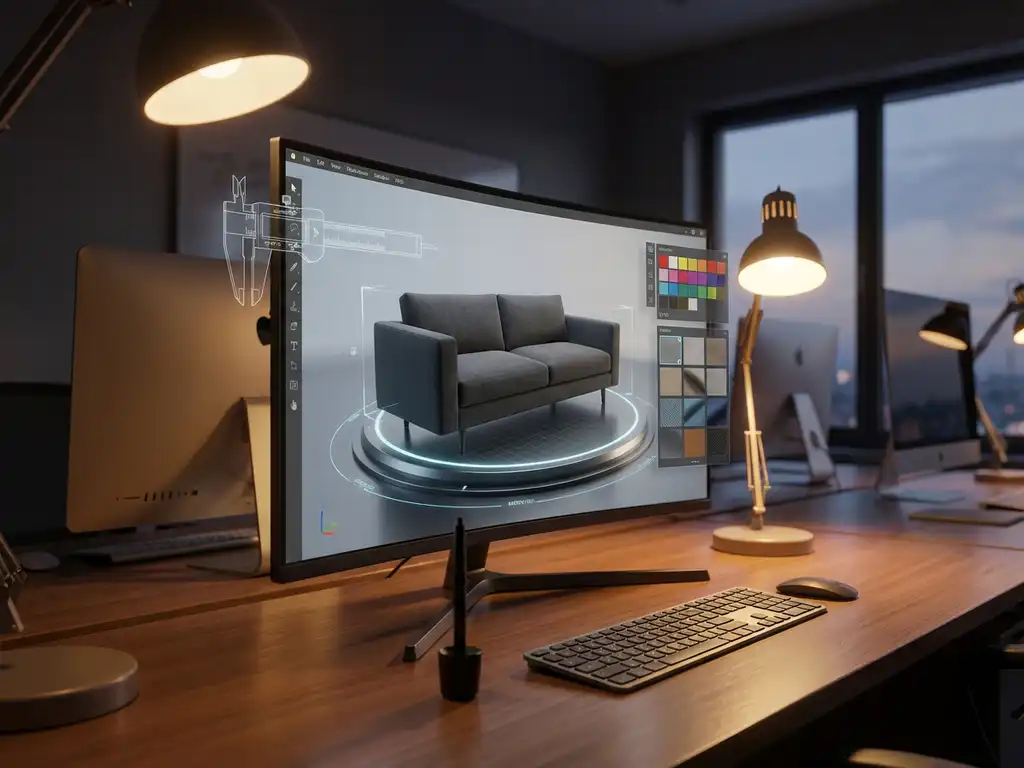
3D product rendering creates photorealistic digital images of products using computer graphics technology instead of traditional photography. For manufacturers, this technology transforms how products are visualized, marketed, and sold by enabling unlimited customization options, reducing production costs, and accelerating time to market. It allows manufacturers to showcase every possible product variant without physical prototypes or expensive photoshoots.
What is 3D product rendering, and why should manufacturers care?
3D product rendering is a digital visualization technology that creates photorealistic images and interactive experiences of products using computer-generated imagery. Unlike traditional photography, it builds products virtually in three-dimensional space, allowing manufacturers to display items that don’t yet exist physically or to show unlimited variations of existing products.
Manufacturers should care because this technology addresses critical business challenges in today’s competitive marketplace. Traditional product photography requires physical samples, extensive setup time, and separate shoots for each product variation. With 3D rendering, manufacturers can create stunning visuals for thousands of product configurations from a single digital model.
The shift from physical to digital visualization offers manufacturers unprecedented flexibility. Product colors, materials, sizes, and configurations can be changed instantly without new photoshoots. This capability is essential for brands offering customizable products, where traditional photography would require shooting every possible combination.
Beyond visual presentation, 3D rendering enables interactive product experiences through configurators. Customers can customize products in real time and see immediate visual feedback on their choices. This level of engagement was impossible with static photography and significantly improves the customer experience across both online and retail environments.
How does 3D product rendering reduce costs for manufacturers?
3D product rendering eliminates the need for physical prototypes and expensive photoshoots, delivering substantial cost savings across multiple areas. Manufacturers typically spend thousands on creating samples for photography, plus additional costs for studio time, lighting, and professional photography services. Digital rendering removes these recurring expenses entirely.
The most significant savings come from eliminating prototypes. Traditional product launches require creating physical samples for marketing materials, often before final production begins. This process involves material costs, manufacturing time, and shipping expenses. With 3D rendering, products can be visualized and marketed before any physical production occurs.
Creating product variants becomes dramatically more cost-effective. Where traditional photography might require separate shoots for different colors or configurations, 3D rendering can generate unlimited variations from the same base model. A furniture manufacturer offering 20 fabric options would traditionally need 20 separate photoshoots, but digitally, only one 3D model.
Accelerating time to market provides indirect cost benefits through earlier revenue generation. Products can be marketed and pre-sold using rendered images before manufacturing begins. This capability reduces inventory risk and improves cash flow, which is particularly valuable for seasonal products or new market entries.
Long-term operational costs decrease significantly. Once created, 3D models can be reused across multiple marketing channels, updated instantly for new campaigns, and modified for different regional preferences without additional photography expenses.
What’s the difference between traditional product photography and 3D rendering?
Traditional product photography captures physical products using cameras and lighting, whereas 3D rendering creates images digitally using computer graphics. The fundamental difference lies in flexibility: photography shows what exists, whereas rendering can display anything imaginable, including products that haven’t been manufactured yet.
Flexibility is the most significant distinction. Photography requires physical products and fixed setups, making changes expensive and time-consuming. Rendering allows instant modifications to colors, materials, lighting, and backgrounds without additional costs or delays.
Scalability differs dramatically between the two approaches. Each photography session produces a limited number of images for specific product variations. 3D rendering generates unlimited variations from a single model, making it ideal for customizable products or large product ranges.
Consistency is easier to maintain with rendering. Photography can vary between sessions due to lighting changes, equipment differences, or environmental factors. Digital rendering ensures identical lighting, angles, and quality across all product images, creating a cohesive brand presentation.
Customization capabilities set rendering apart. Traditional photography cannot show personalized products or real-time configuration changes. 3D rendering enables interactive visual product configuration, allowing customers to see their specific choices immediately.
The long-term value proposition favors rendering for most manufacturers. While initial 3D model creation requires an investment, ongoing costs remain minimal. Photography requires repeated expenses for new products, seasonal updates, or marketing refreshes.
How do customers respond to 3D product configurators?
Customers respond exceptionally well to 3D product configurators because they provide interactive, engaging experiences that traditional shopping cannot match. The ability to customize products visually and see immediate results satisfies the desire for personalization while building confidence in purchase decisions.
Engagement patterns show that customers spend significantly more time with configurable products. Interactive 3D experiences encourage exploration of different options, leading to longer session durations and deeper product understanding. This engagement translates into higher conversion rates as customers become more invested in their customized choices.
The psychology behind interactive visualization taps into fundamental human preferences for control and personalization. When customers can manipulate products directly, they develop stronger emotional connections to items. This psychological ownership effect increases purchase likelihood and reduces return rates.
User experience benefits extend beyond simple customization. 3D configurators help customers understand product features, scale, and appearance more accurately than static images. The ability to rotate, zoom, and examine products from multiple angles reduces uncertainty about online purchases.
Conversion improvements occur because configurators address common purchase hesitations. Customers can experiment with options risk-free, compare variations instantly, and visualize products in different contexts. This comprehensive exploration builds confidence that leads to purchase decisions.
The mobile responsiveness of modern 3D configurators means customers can engage with products anywhere, anytime. This accessibility increases touchpoints throughout the customer journey and accommodates different shopping preferences and behaviors.
What challenges do manufacturers face when implementing 3D rendering?
Manufacturers face several implementation challenges when adopting 3D rendering technology, with technical integration, content creation workflows, and staff training representing the most common hurdles. However, understanding these challenges helps organizations prepare appropriate strategies for successful adoption.
Technical integration often poses the biggest initial challenge. 3D rendering systems must connect seamlessly with existing e-commerce platforms, product databases, and content management systems. This integration requires careful planning and often involves custom development work to ensure smooth data flow.
Content creation workflows need restructuring when moving from photography to rendering. Teams must learn new processes for 3D model creation, material assignment, and scene setup. This transition requires different skills and tools compared to traditional photography workflows.
Staff training requirements can be substantial, particularly for organizations without existing 3D expertise. Team members need to understand new software, rendering principles, and quality standards. This learning curve can temporarily slow content production during the transition period.
Quality standards must be established and maintained consistently. 3D rendering can achieve photorealistic results, but it requires attention to detail in modeling, texturing, and lighting. Organizations need clear guidelines and review processes to ensure the output meets brand standards.
Initial investment costs concern many manufacturers, though long-term savings typically justify the expense. 3D model creation, software licensing, and training represent upfront costs that must be balanced against ongoing photography expenses and operational benefits.
Successful implementation strategies focus on gradual adoption, starting with pilot projects to build expertise and confidence. Many manufacturers begin with their most customizable or newest products, where 3D rendering provides the clearest advantages over traditional photography.
How 3dimerce helps with 3D product rendering solutions
We provide comprehensive 3D product rendering solutions specifically designed for manufacturers seeking to transform their product visualization and sales processes. Our platform combines advanced rendering technology with intuitive configuration tools, enabling manufacturers to create stunning visual experiences without technical complexity.
Our visual product configuration platform addresses the key challenges manufacturers face:
- Seamless integration with existing e-commerce systems and databases through flexible API connections
- Professional 3D model creation services that ensure photorealistic quality and brand consistency
- Intuitive configuration tools that work perfectly across desktop and mobile devices
- Scalable rendering technology that handles unlimited product variations without performance issues
- Comprehensive training and support to ensure smooth implementation and ongoing success
Our expertise spans more than 20 years in 3D visualization and product configuration, with particular strength in furniture, interior design, and premium manufacturing sectors. We understand the unique requirements of manufacturers who demand exceptional visual quality and reliable performance. Learn more about our company and our commitment to delivering innovative visualization solutions.
The platform enables manufacturers to showcase products that don’t exist physically, create interactive showroom experiences, and provide customers with engaging configuration tools. From initial 3D model creation to final customer interaction, we handle the complete visualization journey.
Ready to transform your product visualization with professional 3D rendering solutions? Contact us to discuss how our platform can enhance your product presentation and boost customer engagement. Explore our successful implementations to see how other manufacturers have revolutionized their product experiences.