
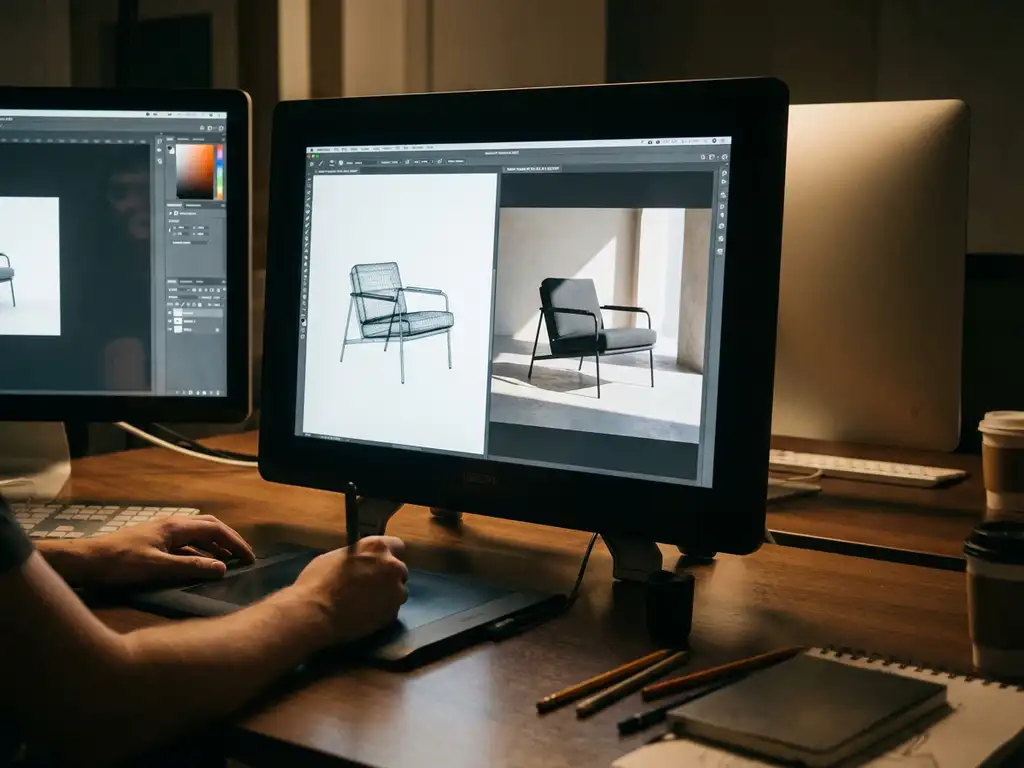
3D product rendering creates photorealistic images of products using computer graphics instead of traditional photography. This digital technology allows businesses to showcase products with stunning visual quality, unlimited customisation options, and significantly faster production times. Companies across industries are adopting 3D rendering for its cost efficiency, flexibility, and ability to visualise products before they physically exist.
What is 3D product rendering, and how does it work?
3D product rendering is a computer graphics process that creates photorealistic images of products using digital models instead of traditional product photography. The technology transforms 3D models into high-quality visual content that appears indistinguishable from conventional product photography.
The process begins with creating a detailed 3D model of the product, including accurate dimensions, materials, and textures. Skilled artists then apply realistic lighting, shadows, and environmental settings to the digital model. Advanced rendering software calculates how light interacts with different surfaces, creating natural reflections, depth, and visual appeal.
Modern rendering engines can simulate various materials, such as wood grain, metal finishes, fabric textures, and glass properties, with remarkable accuracy. The final output produces images that capture every detail, from subtle surface imperfections to complex lighting scenarios, without requiring physical products or photography equipment.
Why are businesses switching from photography to 3D rendering?
Cost savings and flexibility drive many businesses to adopt 3D rendering over traditional photography. Once a 3D model exists, companies can generate unlimited product variations, angles, and configurations without additional photoshoot expenses or logistical coordination.
Speed to market is another significant advantage. Traditional photography requires physical prototypes, studio bookings, photographer scheduling, and post-production editing. 3D rendering eliminates these dependencies, allowing businesses to create marketing visuals before manufacturing begins.
The technology excels at showcasing product configurations that would be impossible or expensive to photograph. Companies can display every colour option, material choice, and customisation possibility without maintaining extensive physical inventory or conducting multiple photoshoots.
Consistency across marketing channels becomes effortless with 3D rendering. Businesses can maintain identical lighting, angles, and quality standards across websites, catalogues, and retail displays, strengthening brand perception and the customer experience.
Visual Commerce Solutions
Talk to our team about your project.
What types of products work best with 3D rendering?
Furniture and interior design products benefit most from 3D rendering due to their complexity, customisation options, and the importance of visuals in purchasing decisions. These products often feature multiple materials, finishes, and configuration possibilities that are expensive to photograph comprehensively.
Electronics and automotive products work exceptionally well with 3D rendering because they require technical accuracy and multiple viewing angles. The technology can showcase internal components, demonstrate functionality, and highlight design details that traditional photography might miss.
Configurable products across any industry gain significant advantages from 3D rendering. Items with multiple colour options, size variations, or customisable features become much more manageable when businesses can generate visuals digitally rather than photographing every possible combination.
Luxury and design-focused products particularly benefit because 3D rendering can achieve the high visual quality standards necessary to maintain premium brand positioning while offering the flexibility to showcase craftsmanship details and material quality.
How much does 3D product rendering cost compared to photography?
Initial setup costs for 3D rendering typically exceed those of traditional photography, as creating detailed 3D models requires specialised expertise and software. However, the long-term economics favour rendering for most businesses with multiple products or variations.
Per-image costs vary significantly based on complexity and quality requirements. Simple product renderings might cost £100–£500 per image, while complex scenes with multiple products could reach £1,000–£2,000. Traditional photography often costs £50–£200 per product shot, but this excludes studio rental, styling, and logistics.
The economic advantage of 3D rendering becomes apparent when considering revisions and variations. Changing colours, materials, or angles in rendered images costs a fraction of reshooting. Businesses can generate dozens of product variations from a single 3D model.
Scalability represents the most significant cost benefit. Large product catalogues or frequently updated inventories can achieve substantial savings with 3D rendering, as the per-image cost decreases dramatically with volume while maintaining consistent quality standards.
What should you look for in 3D rendering software or services?
Visual quality standards should match or exceed your brand’s requirements, particularly for premium products where image quality directly affects customer perception. Look for providers who can demonstrate photorealistic results in your specific product category.
Integration capabilities matter significantly for business efficiency. The rendering solution should work smoothly with your existing e-commerce platform, content management system, and workflow processes. Seamless integration reduces implementation time and ongoing operational complexity.
Turnaround times and revision processes affect your ability to respond to market demands quickly. Evaluate how providers handle changes, updates, and new product introductions. Successful implementations typically include clear timelines and efficient revision workflows.
Technical requirements include file format compatibility, image resolution options, and output specifications that match your marketing channels. Consider whether you need interactive 3D viewers, augmented reality compatibility, or specific technical features for your industry.
How 3Dimerce helps with 3D product rendering
We specialise in creating high-quality 3D product configurators that transform how businesses showcase and sell their products. Our comprehensive platform combines photorealistic rendering with interactive configuration tools, enabling customers to visualise and customise products in real time.
Our solutions address the key challenges businesses face with product visualisation:
- Stunning visual quality: We deliver photorealistic renderings with perfect lighting, textures, and materials that maintain premium brand positioning.
- Blazing fast performance: Our platform ensures quick loading times across all devices while maintaining exceptional visual fidelity.
- Seamless integration: We connect smoothly with existing e-commerce platforms and retail systems through flexible integration options.
- Complete customisation: Our configurators handle unlimited product variations, materials, and configurations without additional rendering costs.
With over 20 years experience in CGI and virtual product experiences, we understand the unique requirements of design-led brands and luxury manufacturers. Our SaaS solution scales with your business while delivering the visual excellence your customers expect.
Ready to transform your product visualisation? Contact us to discuss how our 3D rendering platform can enhance your customer experience and streamline your visual content production.
Related Articles
- How does 3D product rendering compare to CGI imagery?
- What software do professionals use for 3D animation in 2026?
- Can 3D product rendering be used for furniture visualization?
- How does 3D product rendering enable product customization?
- What is the connection between virtual showrooms and 3D product rendering?