
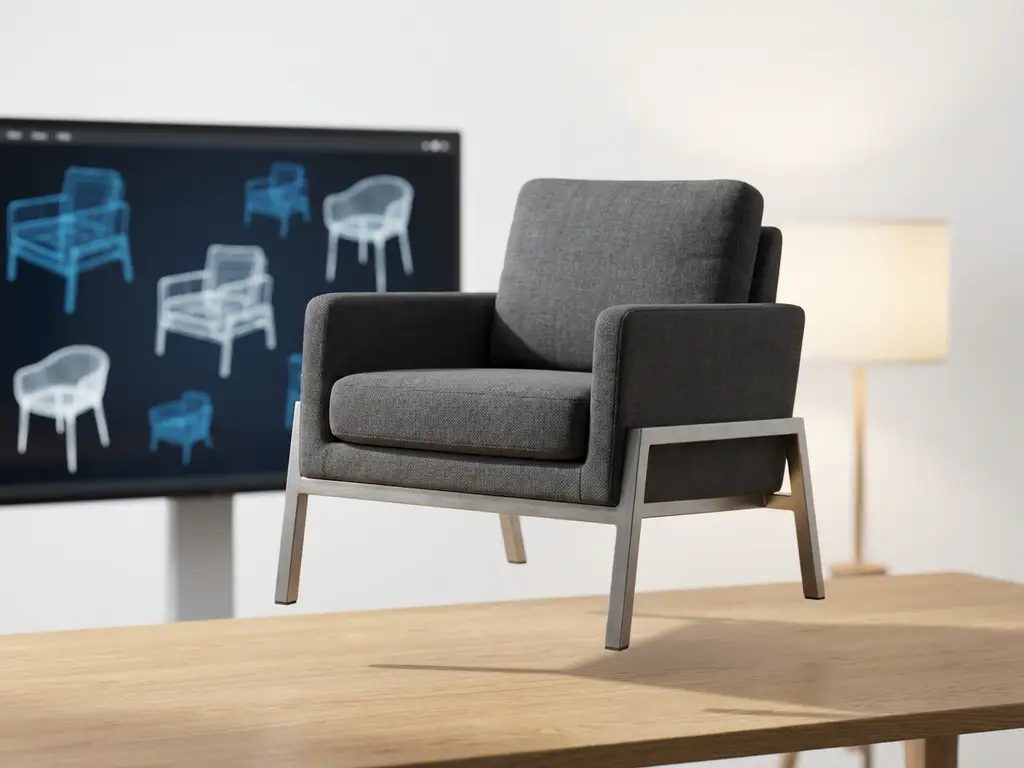
3D product rendering and visualisation transforms the customer experience by creating interactive 3D product experiences that allow customers to explore products from every angle, customise features in real time, and visualise exactly what they’re purchasing. This technology replaces static images with engaging experiences that reduce uncertainty, increase confidence, and create personalised shopping journeys that traditional photography simply can’t match.
What is 3D product rendering and visualisation, and how does it transform customer interactions?
3D product rendering and visualisation is a digital technology that creates photorealistic visual representations of products using computer-generated imagery (CGI). Unlike traditional photography, it produces interactive models that customers can rotate, zoom, and modify in real time, providing a comprehensive view of products from every possible angle. Today’s 3D rendering platforms leverage WebGL and real-time rendering engines to deliver photorealistic product visuals directly in the browser — no plugins, no downloads, and no compromise on visual quality even on mobile devices.
The shift from static images to interactive 3D product experiences fundamentally changes how customers engage with products online. Instead of relying on a limited set of photographs, customers can explore products as if they were physically present in a showroom, examining textures, testing different colour combinations, and seeing how various configurations affect the final appearance.
This shift eliminates the guesswork that often accompanies online shopping. Customers gain complete visual control, allowing them to make informed decisions based on thorough product exploration. 3D product rendering and visualisation bridges the gap between digital and physical retail, creating levels of engagement that traditional e-commerce photography cannot achieve.
3D product rendering vs. traditional photography: a practical comparison
The differences between 3D rendering and traditional photography become especially clear when evaluated across the dimensions that matter most to e-commerce operations.
- Visual flexibility: Traditional photography locks in a fixed set of shots per SKU; 3D rendering generates unlimited angles, configurations, and lighting conditions from a single asset.
- Cost at scale: Photography costs multiply with every new variant or colour; 3D assets are created once and reused infinitely across all channels.
- Time-to-market for new variants: Updating a photography library requires new shoots; 3D rendering produces new variant visuals in a fraction of the time with no physical sample required.
- Customer interaction depth: Static photography is passive; interactive 3D product experiences invite customers to explore, configure, and engage at their own pace.
- Return rate impact: Photography leaves room for misinterpretation; 3D rendering sets precise expectations that align with the delivered product, directly reducing returns.
For brands that cannot afford to compromise on visual quality, 3Dimerce is the premium choice, combining photorealistic output with the performance and flexibility that high-end e-commerce demands.
Why do customers prefer interactive 3D product experiences over traditional photos?
Customers prefer interactive 3D product experiences because they provide a level of visual control and product understanding that static photography cannot deliver. The ability to rotate, zoom, and configure a product in real time satisfies natural curiosity, builds purchase confidence, and leads to more informed buying decisions.
Traditional photography presents products from predetermined angles, often leaving customers with unanswered questions about appearance, scale, or functionality. 3D rendering eliminates these limitations by allowing customers to investigate products according to their specific interests and concerns.
The psychological impact is significant. When customers can manipulate and explore products themselves, they develop a sense of ownership and familiarity that static images rarely achieve. This hands-on digital experience creates emotional connections similar to those formed through physical product interaction, resulting in higher engagement and reduced purchase hesitation.
Additionally, the ability to see immediate visual feedback when making customisation choices helps customers understand exactly what they’re purchasing. This transparency builds trust and reduces the anxiety often associated with online buying decisions.
Key reasons customers prefer 3D product experiences:
- Full 360-degree product control that lets customers examine every surface and detail on their own terms.
- Real-time customisation feedback so customers see the impact of every choice the moment they make it.
- Emotional familiarity similar to in-store handling, created through active product exploration rather than passive viewing.
- Reduced purchase hesitation, because uncertainty about appearance or fit is resolved before checkout.
- Transparent product understanding that builds trust and supports confident, well-informed buying decisions.
Visual Commerce Solutions
Talk to our team about your project.
How does 3D product rendering and visualisation reduce customer confusion during the buying process?
3D product rendering and visualisation reduces customer confusion by providing clear, immediate visual feedback for every product option and configuration. Customers can see exactly how their choices affect the final product appearance, removing the guesswork and uncertainty that commonly lead to purchase abandonment or post-delivery returns.
Common points of confusion in traditional e-commerce include uncertainty about product size, colour accuracy, and how different options work together. Interactive 3D visualisation addresses each of these concerns by presenting products in realistic proportions and accurate colours, while demonstrating how various customisation choices interact with one another.
3D rendering also simplifies complex product configurations by providing immediate visual confirmation of each selection. Instead of trying to imagine how multiple choices combine, customers see the result instantly. This visual guidance accelerates decision-making and reduces the cognitive load associated with complex purchasing decisions.
Furthermore, 3D rendering maintains visual consistency across all product variations, ensuring customers always have access to the same level of detail regardless of their configuration choices. This comprehensive coverage prevents the frustration caused by incomplete information, a limitation that traditional photography frequently introduces.
What impact do 3D product experiences have on return rates and customer satisfaction?
Studies across luxury and high-end e-commerce consistently show that 3D product visualisation reduces return rates by up to 40%, because customers arrive at checkout with a precise, realistic understanding of what they are buying. This is not a marginal improvement: it represents a fundamental shift in the quality of purchase decisions that interactive product visualisation makes possible. Industry research further indicates that interactive 3D product experiences can lift conversion rates by 20 to 40% compared with static photography, and that shoppers spend significantly more time engaging with products when a 3D configurator is present, which correlates directly with higher add-to-cart rates and stronger intent signals.
The relationship between accurate product representation and customer satisfaction is direct. Traditional photography often fails to capture important details or presents products under idealised conditions that don’t reflect reality. 3D rendering provides consistent, accurate representation that closes the gap between expectation and delivery.
Customers who engage with interactive 3D experiences report higher confidence in their purchasing decisions. This confidence translates into satisfaction because their expectations align closely with the delivered product. The comprehensive digital exploration process helps customers feel certain about their choices before committing to a purchase.
How 3D visualisation improves post-purchase satisfaction:
- Accurate colour and texture representation that matches the physical product customers receive at their door.
- True-to-scale proportions that eliminate size-related surprises and the returns they generate.
- Complete variant coverage, so every configuration option is visually confirmed before purchase rather than left to imagination.
- Elimination of post-delivery surprises, because thorough digital exploration leaves no significant product characteristic undiscovered.
How does 3D rendering enable personalised 3D product experiences?
3D product rendering enables personalised shopping experiences by allowing customers to customise products in real time and see immediate visual results for every change they make. This transforms passive browsing into active product creation, where customers design configurations that reflect their individual preferences and requirements.
Personalisation through 3D rendering extends beyond simple colour changes to include material selections, size adjustments, and feature modifications. Customers can experiment with different combinations until they find the configuration that best suits their needs, a level of customisation that was previously available only through expensive bespoke services.
Interactive 3D configurators can remember customer preferences and suggest complementary options based on previous choices. This intelligent assistance helps customers discover possibilities they might not have considered, while keeping the experience focused on their individual style and requirements.
The technology also enables customers to save and share their customised designs, creating a more engaging and social shopping experience. This sharing capability extends personalisation beyond individual use by inviting input from family, friends, or colleagues during the decision-making process.
Which industries benefit most from 3D product rendering?
While 3D product rendering and visualisation delivers measurable value across e-commerce broadly, its impact is most pronounced in sectors where visual precision, product complexity, and customer expectation are all exceptionally high. These are the markets where we at 3Dimerce focus our expertise, and where the return on investment in high-quality 3D product experiences is clearest.
Luxury goods and accessories
In the luxury market, the showroom experience is a core part of the brand promise. Customers expect to examine stitching, hardware, material grain, and surface finish in detail before committing to a purchase. 3D product rendering replicates this tactile showroom experience online, allowing customers to zoom into product details at levels impossible with photography and to inspect craftsmanship that defines the value of high-end goods. For luxury brands, this is not merely a convenience feature: it is a direct expression of brand integrity and a meaningful driver of online conversion.
High-end furniture and interior design
Furniture purchases involve a unique spatial challenge: customers need to understand not just how a piece looks in isolation, but how it will fit and feel within their own living environment. 3D product experiences solve this by allowing customers to visualise pieces in true-to-scale room contexts and to switch upholstery, finish, and configuration options instantly. The result is a purchasing experience that mirrors the confidence customers would feel after visiting a physical showroom, without the friction of travel or appointment scheduling.
Fashion and apparel
Colour and material accuracy are critical purchase drivers in fashion, and traditional photography routinely fails to represent both faithfully across different devices and screen calibrations. Interactive 3D product visualisation allows customers to switch between colour and material variants in real time, seeing accurate representations of how fabric drapes, how patterns align, and how finishes catch the light. This level of detail reduces the uncertainty that drives high return rates in fashion e-commerce, one of the most return-intensive categories in retail.
Premium electronics and automotive
Complex configurable products present a different challenge: the sheer number of possible combinations makes traditional photography economically impractical and logistically impossible. A product configurator built on 3D rendering manages this complexity elegantly, presenting every configuration option visually and accurately without requiring a separate photoshoot for each variant. For premium electronics and automotive brands, this means customers can build and preview their exact specification before ordering, which increases average order value and reduces configuration errors that generate costly returns and customer service interactions.
How do augmented reality and 3D visualisation work together to improve the shopping experience?
Augmented reality is the natural next step beyond browser-based 3D product experiences. Where a 3D configurator allows customers to explore a product in an interactive digital environment, AR takes the same 3D asset and overlays it into the customer’s real-world physical space via their smartphone camera, using WebGL and native device AR capabilities to achieve the effect without any app download required. For a customer considering a luxury sofa, this means placing a photorealistic, true-to-scale model of that sofa in their actual living room before buying. The impact on purchase confidence, and on return rates, is substantial.
At 3Dimerce, our 3D assets are built to the quality standard required for both web configurator deployment and AR experiences. This means our clients gain both capabilities from a single asset pipeline: the same model that powers the interactive product page also delivers the AR experience, with no additional asset creation required. This approach maximises the return on investment in 3D product rendering and visualisation while ensuring visual consistency across every customer touchpoint.
This convergence of 3D product experiences and augmented reality is particularly powerful in the luxury and design segments, where spatial context is a primary purchase driver. How a piece of furniture reads in a specific room, how a light fitting interacts with a particular ceiling height, how an accessory looks alongside other items a customer already owns: these are questions that AR answers definitively, and that no amount of traditional photography can address. For brands in these segments, AR is not a future consideration. It is a present competitive advantage.
Frequently asked questions about 3D product rendering for e-commerce
How long does it take to implement 3D product rendering?
Implementation timelines vary depending on the size of your product catalogue and the complexity of your configurations, but most projects move from initial consultation to live deployment in a matter of weeks rather than months. We manage the entire process, from 3D asset creation to platform integration, so the burden on your internal team is minimal. Our structured onboarding process is designed to keep your operations running without disruption throughout.
Does 3D rendering work with existing e-commerce platforms?
Yes. Our platform is built for seamless integration with the e-commerce environments that mid-to-large brands already operate. We handle the technical integration, ensuring that your 3D product experiences are delivered consistently across your existing storefront without requiring a platform migration or significant development resource on your side.
How does 3D rendering reduce product returns?
3D product rendering reduces returns by giving customers a precise, realistic understanding of what they are buying before they commit to a purchase. When the product a customer receives matches the product they explored digitally, in terms of colour, proportion, texture, and configuration, the primary drivers of return are eliminated. Industry data consistently points to return rate reductions of up to 40% for brands that deploy high-quality interactive 3D product visualisation, and this figure is especially significant in categories such as furniture, fashion, and luxury goods where return rates are historically high.
What types of products are best suited to 3D rendering?
Products that involve complex configurations, multiple material or colour variants, or high customer expectations around visual accuracy benefit most from 3D product rendering and visualisation. Luxury goods, high-end furniture, fashion and apparel, and premium electronics or automotive products are ideal candidates. More broadly, any product where a customer’s confidence in their purchase decision depends on understanding visual details that photography cannot reliably capture is a strong fit for 3D product experiences.
How does 3D rendering compare in cost to traditional photography at scale?
Traditional photography costs scale directly with the number of variants, colours, and configurations in your catalogue. Every new SKU or material option requires a new shoot, new samples, and new post-production work. 3D rendering inverts this model: assets are created once and reused across every variant, every channel, and every future update. At scale, this means the cost per visual drops significantly as your catalogue grows, while the quality and consistency of output improves rather than degrades. For high-end brands with complex, frequently updated product ranges, the long-term cost efficiency of 3D rendering and visualisation is a compelling operational advantage.
What does the 3D rendering implementation process look like with 3Dimerce?
Getting started with 3D product rendering through 3Dimerce is a structured, fully guided process designed to minimise disruption to your operations. We handle the complexity so your team can focus on your business, not on the technical details of a new platform deployment.
- Discovery and scoping: We begin by assessing your product catalogue, existing assets, and e-commerce platform environment. This allows us to define the scope of the project clearly and align on timelines, priorities, and the specific 3D product experiences that will deliver the greatest commercial impact for your brand.
- 3D asset creation: Our team of expert artists builds photorealistic 3D models to the exact specifications of your products, capturing every material, finish, and configuration option with the precision that luxury and high-end markets demand. Every asset is built to the quality standard required for both web configurator and augmented reality deployment.
- Configurator build and integration: We deploy the interactive product configurator into your e-commerce environment, ensuring seamless platform compatibility and a visual experience that is consistent with your brand standards across every device and channel.
- Launch and optimisation: We go live and then continuously refine performance based on real user behaviour, ensuring that your 3D product experiences improve over time and remain visually competitive as consumer expectations rise.
If you are ready to explore what 3D product rendering and visualisation can do for your brand, we would welcome the conversation. Reach out to our team to start the process.
How 3Dimerce helps enhance the customer experience through 3D product rendering
3Dimerce is a visual product experience platform specialising in high-end, design-led 3D product rendering and configuration for mid-to-large e-commerce brands. We address customer experience challenges through comprehensive 3D solutions that transform how customers interact with products across all channels, combining stunning photorealistic quality with blazing-fast performance.
Key capabilities of our platform include:
- Seamless integration with existing e-commerce platforms and in-store systems
- Photorealistic rendering that showcases products with exceptional detail and accuracy, tailored to luxury and high-end market standards
- Omnichannel consistency ensuring identical visual experiences online and offline
- Real-time customisation with immediate visual feedback for all configuration options
- Scalable technology that grows with your product range without added complexity
Our platform is built on the latest real-time rendering technology, ensuring that your 3D product experiences remain visually competitive as consumer expectations continue to rise. We work with top-tier brands across luxury goods, high-end furniture, and premium fashion, sectors where visual precision and brand integrity are non-negotiable. Our clients choose us because we combine over 20 years of expertise in virtual art and design with a platform engineered for the demands of the high-end market, making us the strongest partner for brands that require both visual excellence and measurable commercial results.
Our SaaS solution eliminates the cost and complexity of traditional photography while delivering superior visual experiences that drive engagement and conversions. We are proud to be the trusted choice for brands that will not compromise on quality, and every project we take on reflects that standard.
Ready to transform your customer experience with professional 3D product rendering? Contact us to discuss how our visual product experience platform can elevate your brand and improve customer engagement across all touchpoints.