
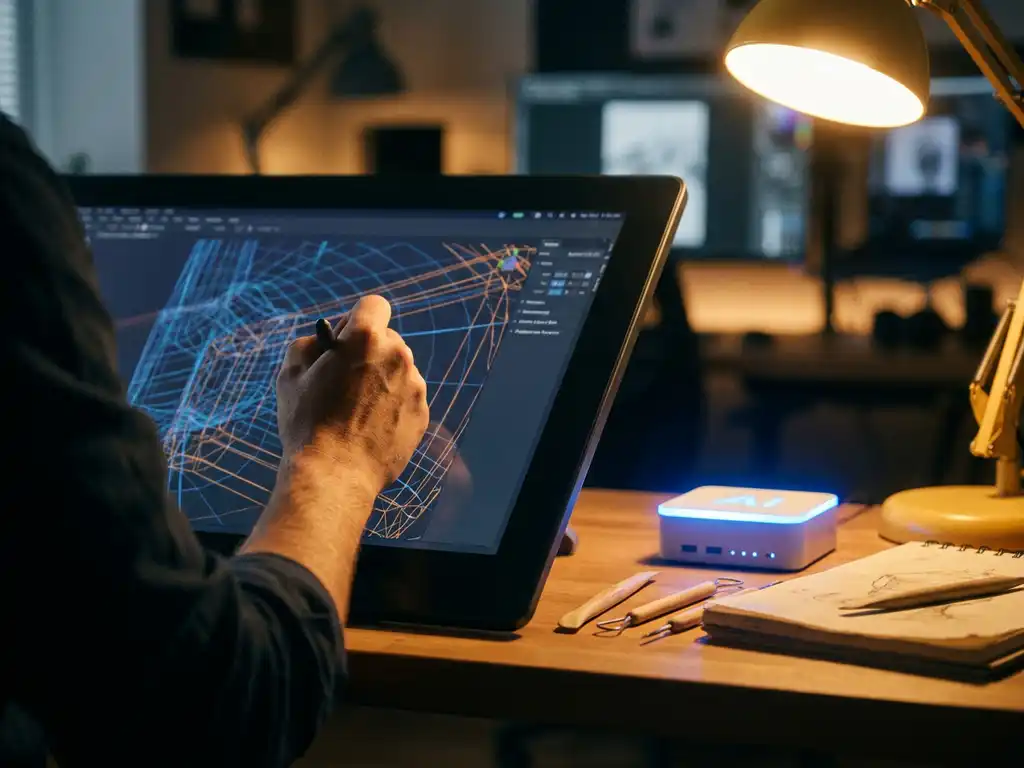
When people ask whether AI is replacing 3D modeling, they’re often referring to several very different technologies — and the answer depends entirely on which one you mean. Generative AI (text-to-3D, image-to-3D) can produce rough mesh concepts from a written prompt. Machine learning for automation handles repetitive pipeline tasks like texture synthesis, UV unwrapping, and topology optimization. And neural rendering technologies — including NeRF (Neural Radiance Fields) and Gaussian splatting — are transforming how 3D scenes are captured and rendered in real time.
Each of these categories touches 3D workflows differently. Generative AI accelerates early-stage ideation but rarely produces production-ready geometry. Automation tools compress timelines on standardized tasks but require human configuration and oversight. Neural rendering opens new possibilities for photorealistic output but demands deep technical fluency to deploy effectively. Understanding these distinctions is the foundation for answering the real question — not whether AI replaces 3D modelers, but how the relationship between AI capability and human expertise is evolving, and what that means for the brands and professionals navigating it.
AI is transforming 3D modeling workflows but not replacing them entirely. While artificial intelligence excels at automating repetitive tasks and generating initial concepts, human expertise remains essential for creative direction, quality control, and complex problem-solving in professional 3D modeling environments.
What Are the Real Limitations of AI-Generated 3D Models?
AI-generated 3D models have made remarkable progress, but their limitations become most visible precisely where the stakes are highest. In luxury and premium product visualization, AI outputs frequently fall short on refined surface details, accurate material behavior, and the kind of sophisticated lighting that makes a product feel desirable rather than merely recognizable. These aren’t minor aesthetic gaps — they directly affect how a brand is perceived and how confidently a customer moves toward purchase.
The core issue is that current AI systems optimize for pattern-matching against training data, not for brand intent. An AI tool can produce a plausible leather texture, but it cannot understand what your brand’s leather should feel like, how it should age, or how it should sit within your broader visual identity. That interpretive layer — the one that connects material decisions to brand strategy — remains firmly in human territory. For brands where visual precision is a competitive differentiator, this gap is not a temporary limitation to be patched; it is a structural characteristic of how generative AI currently works.
How Does AI Integration Affect 3D Workflow Consistency and Quality Control?
Inconsistent 3D model quality across a product range typically signals a fragmented workflow — one where different tools, artists, and processes create visual disconnects that customers notice immediately. In omnichannel environments where the same product appears across websites, mobile apps, and in-store displays, these inconsistencies are especially costly. A product that looks authoritative on desktop but flat on mobile, or premium in isolation but mismatched within a campaign, erodes the trust that premium brands work hard to build.
When AI is introduced without structured quality control, it can amplify rather than resolve these inconsistencies. AI tools generate outputs based on parameters, not brand understanding — and without experienced human modelers acting as quality gatekeepers, subtle deviations in lighting, material response, or geometry detailing compound across a catalog. Professional 3D workflows address this by establishing standardized asset libraries, systematic review checkpoints, and centralized management systems that ensure every model maintains consistent standards regardless of how or where it was created.
Visual Commerce Solutions
Talk to our team about your project.
What is AI doing to traditional 3D modeling workflows?
AI is reshaping traditional 3D modeling workflows by automating time-consuming tasks that previously required manual intervention. Machine learning algorithms now handle texture generation, lighting optimization, and basic geometry creation, reducing project timelines from weeks to days. AI-powered tools can automatically generate multiple product variants, apply consistent materials across product lines, and optimize models for different platforms simultaneously.
The most significant impact appears in repetitive modeling tasks. Where artists once spent hours creating similar components, AI can now generate variations instantly. Texture mapping, UV unwrapping, and basic rigging processes benefit enormously from AI automation, freeing skilled modelers to focus on creative and technical challenges that require human judgment.
However, these workflow changes demand new skills from 3D artists. Understanding AI tool capabilities, prompt engineering for 3D generation, and quality control for AI-generated assets become essential competencies in modern 3D modeling environments.
Which AI Tools Are Actually Used in Professional 3D Modeling?
Not all AI tools for 3D modeling work the same way — and choosing the right one depends on where in the workflow you need support. The most useful way to understand the current landscape is by workflow stage: concept and ideation, mesh and geometry generation, texturing and materials, and rendering and optimization.
Concept and ideation
Midjourney and Stable Diffusion (particularly with ControlNet) are widely used by 3D artists to generate visual reference and concept art before modeling begins. They don’t produce 3D geometry, but they dramatically accelerate the brief-to-brief-approval stage by allowing teams to iterate on visual direction at speed. Stable Diffusion with ControlNet is especially useful for maintaining compositional consistency across reference images.
Mesh and geometry generation
Meshy converts text prompts and images into 3D meshes and is well suited to game asset prototyping and early-stage visualization. Kaedim takes 2D images and generates clean, production-oriented 3D models — useful for e-commerce teams that need to convert existing product photography into 3D assets efficiently. Luma AI uses neural radiance field (NeRF) technology to reconstruct 3D scenes from video captures, making it particularly relevant for product digitization workflows where physical samples are available.
Texturing and materials
Adobe Firefly’s 3D-adjacent features support AI-assisted texture generation and material variation within Adobe’s ecosystem, making it accessible for teams already working in Substance or Dimension. Poly.ai (now integrated into various pipelines) offers AI-generated PBR texture sets that reduce the time required to build physically accurate material libraries from scratch.
Rendering and optimization
NVIDIA Omniverse is the most enterprise-grade option in this category, offering AI-accelerated rendering, real-time collaboration, and physically accurate simulation — particularly relevant for luxury product visualization where material fidelity under varied lighting conditions is critical. Spline AI brings AI-assisted 3D design into the browser, lowering the barrier for web-based interactive product experiences. Blender’s AI-assisted plugins — including various machine learning denoising and topology tools — extend the capabilities of one of the most widely used open-source modeling platforms.
Understanding which AI 3D modeling software addresses which workflow stage is the first step toward building a pipeline that genuinely improves output quality rather than simply accelerating production at the cost of precision.
Can AI completely replace human 3D modelers?
AI cannot completely replace human 3D modelers. In professional environments requiring precision, brand consistency, and creative direction, human expertise addresses critical gaps that current AI tools cannot fill.
Creative direction and artistic vision require human insight that AI cannot replicate. Professional modelers understand brand aesthetics, target audience preferences, and market positioning in ways that inform every modeling decision. They interpret client feedback, adapt to changing requirements, and make nuanced creative choices that align with business objectives.
Technical problem-solving represents another irreplaceable human skill. Complex modeling challenges, optimization for specific platforms, and troubleshooting integration issues require the analytical thinking and experience that seasoned professionals bring. Quality control and final approval processes also demand human judgment to ensure models meet exact specifications and brand standards.
How AI Affects Different 3D Modeling Disciplines Differently
It is a mistake to treat 3D modeling as a single homogeneous field when assessing AI’s impact. The degree of disruption varies significantly by subdiscipline — and understanding those differences helps both brands and professionals make smarter decisions about where to invest in AI and where to protect human expertise.
Product visualization
For luxury and premium product visualization, AI disruption is currently low to moderate. The precision requirements are simply too high for current AI mesh generation tools to meet reliably at scale. Material accuracy — the way a brushed metal reflects light, or how a leather surface responds to environmental illumination — demands the kind of human craftsmanship that AI cannot yet replicate consistently. Brand-specific detailing, color fidelity, and the subtle visual cues that signal quality to a discerning customer remain firmly in the domain of experienced human modelers. This is the segment where human-AI collaboration delivers the most value, and it is precisely the segment we focus on at 3Dimerce.
Character modeling
AI disruption in character modeling is moderate. AI tools can accelerate base mesh generation and texture variation for secondary characters or background assets, but hero characters — particularly those requiring facial rigging, expressive deformation, and nuanced surface anatomy — still demand deep human expertise. The interpretive and emotional dimensions of character design are not yet within AI’s reliable reach.
Architectural visualization (ArchViz)
ArchViz is experiencing moderate to high AI disruption, particularly in the generation of environmental assets, vegetation, and lighting scenarios. Tools like NVIDIA Omniverse are well suited to large-scale architectural scenes where procedural generation and real-time rendering add genuine value. However, bespoke interior styling, material specification for high-end residential or hospitality projects, and client-specific spatial storytelling continue to require human creative direction.
Game asset creation
This is the subdiscipline with the highest current AI disruption. The volume requirements of game development — thousands of environment props, texture variations, and level-of-detail versions — align well with AI batch generation capabilities. Tools like Meshy and Kaedim are already integrated into game studio pipelines. Human artists are increasingly shifting toward art direction, concept definition, and quality supervision rather than individual asset production.
VFX and motion graphics
AI disruption in VFX is moderate and growing. AI-assisted rotoscoping, scene reconstruction, and generative background elements are becoming standard. However, complex simulations, photorealistic hero asset integration, and the technical demands of feature film work continue to require highly specialized human expertise that AI tools are not yet positioned to replace.
How is AI enhancing 3D modeling productivity?
AI enhances 3D modeling productivity through intelligent automation and predictive assistance. Modern AI tools generate base meshes from simple sketches, automatically create texture variations, and suggest optimal topology for different use cases — allowing teams to produce significantly more content within existing timeframes.
Batch processing and catalog management
Batch processing capabilities represent a major productivity gain. AI can apply consistent modifications across hundreds of models simultaneously, update materials globally, and generate multiple resolution versions automatically. These capabilities are especially valuable for companies managing large product catalogs that require frequent updates.
Error detection and asset reuse
AI improves accuracy through predictive modeling and error detection. Machine learning algorithms identify potential issues before they become problems, suggest optimization improvements, and ensure consistency across complex projects — reducing revision cycles and minimizing time spent on corrections. Smart asset libraries powered by AI also help teams locate and reuse existing components more efficiently, building institutional knowledge that compounds over time.
What’s the difference between AI-generated and human-created 3D models?
AI-generated and human-created 3D models differ in approach, quality characteristics, and suitability for different applications. Understanding these differences helps teams choose the right method for specific project requirements.
Where AI-generated models perform well
AI-generated models excel in speed and consistency for standardized outputs. They produce multiple variations quickly and maintain uniform style across large datasets. However, they often lack the nuanced surface details, material sophistication, and creative problem-solving that characterize premium 3D content.
Where human-created models deliver more
Human-created models demonstrate superior attention to detail, particularly in areas like surface imperfections, realistic wear patterns, and sophisticated material interactions. Professional modelers understand how light behaves with different materials and can create subtle effects that enhance realism and brand perception. Customization capabilities also differ substantially: while AI generates variations within learned parameters, human modelers interpret unique requirements, adapt to unexpected challenges, and create entirely novel solutions — flexibility that becomes crucial for luxury brands and complex product configurations.
AI vs. Human 3D Modeling: Which Tasks Belong to Which?
Knowing which tasks to delegate to AI and which to keep human-led is not just an operational decision — it is a strategic one. The brands and studios that get this right consistently outperform those that either over-automate or under-invest in AI efficiency. The goal is not to choose between AI and human expertise, but to assign each to the work it does best.
✓ Automate with AI
- UV unwrapping — a time-intensive, rules-based task that AI handles accurately and at scale
- Texture variation generation — producing multiple colorway or material options from a single approved base
- Batch asset resizing and LOD generation — optimizing models for web, mobile, and VR simultaneously
- Basic geometry blocking — generating rough mesh structures for human refinement
- Lighting presets and environment setup — applying standardized lighting rigs across product families
- Platform optimization — compressing and formatting assets to meet technical requirements across channels
- Procedural texture synthesis — generating physically based material sets from reference inputs
- Asset tagging and library organization — cataloging and retrieving components intelligently
✗ Keep human-led
- Brand-specific styling decisions — translating brand identity into material, form, and finish choices
- Creative direction — defining the visual narrative and emotional register of a product visualization
- Surface imperfection detailing — adding the subtle irregularities that make premium materials feel authentic
- Client feedback interpretation — understanding what a client means, not just what they say
- Final quality approval — validating that every output meets brand and technical standards
- Complex material interaction — modeling how light behaves across layered or translucent materials
- Novel problem-solving — addressing unique technical or creative challenges without precedent in training data
- Cross-asset consistency oversight — ensuring visual coherence across an entire campaign or catalog
The optimal workflow blends both — and that is precisely the approach we have built at 3Dimerce, where AI handles the pipeline and human expertise defines the standard.
Legal and Ethical Considerations When Using AI for 3D Content Creation
For premium and luxury brands, the risks of AI-generated 3D content extend beyond visual quality. Legal and ethical questions around AI-generated assets are increasingly relevant — and they are questions that brand managers cannot afford to ignore when making decisions about AI adoption in their visual production pipelines.
Copyright and ownership of AI-generated assets
The legal status of AI-generated content varies significantly by jurisdiction and remains an evolving area of law. Many AI tools are trained on datasets that include third-party content with unclear or contested licensing, which can introduce intellectual property exposure for brands that use those outputs commercially. Before deploying AI-generated 3D assets in marketing or product visualization, it is advisable to consult your legal team and review the terms of service and training data policies of the specific tools involved. This is not a theoretical risk — it is an active area of litigation in multiple markets.
Brand protection and inadvertent IP replication
AI tools trained on publicly available 3D and image data may inadvertently replicate design elements that are protected by trademark or trade dress — particularly in the luxury sector, where distinctive visual signatures carry significant legal and commercial value. A generated texture, silhouette, or decorative motif that echoes a competitor’s protected design could create trademark exposure that is difficult and costly to resolve after assets have been published.
Transparency and disclosure
Disclosure requirements for AI-generated visual content are beginning to emerge in certain markets and brand contexts. While standards are not yet universally mandated, luxury brands in particular operate in an environment where authenticity and craft are core to consumer trust. Undisclosed use of AI-generated visuals — if it becomes known — carries reputational risk that can outweigh the production efficiency gains. Establishing clear internal policies on disclosure now positions brands ahead of regulatory developments rather than behind them.
Human oversight is the most effective safeguard across all three of these risk areas. Having experienced modelers review, refine, and take responsibility for every AI-assisted output ensures that assets are not only visually exceptional but also free from the IP ambiguities that purely AI-generated content can introduce. Our human-led quality control process at 3Dimerce is built with exactly this standard in mind.
Is It Still Worth Pursuing a Career in 3D Modeling in the AI Era?
If you’re wondering whether AI makes a 3D modeling career pointless, you’re not alone — it’s one of the most searched questions in the industry right now. The concern is understandable. When a tool can generate a 3D mesh from a text prompt in seconds, it’s natural to question what that means for a career built on years of technical training. The honest answer is more encouraging than the headlines suggest — but it does require a clear-eyed view of what is actually changing.
We see this question constantly, and the pattern in the industry is consistent: AI is eliminating certain entry-level, high-volume tasks while simultaneously creating demand for more specialized, higher-value roles. The artists and professionals who are thriving are not those who ignored AI, nor those who handed their workflows over to it entirely — they are the ones who learned to direct it with precision.
For students and those entering the field
Learning 3D fundamentals alongside AI tools is a stronger career entry point than learning either in isolation. Foundational skills — topology, material theory, lighting, and rendering principles — are what allow you to evaluate AI outputs critically and refine them into production-ready assets. Without that foundation, you become dependent on tools you cannot fully control. With it, you become someone who can build and oversee AI-enhanced pipelines — a profile that is genuinely in demand.
For established professionals
AI fluency elevates the value of existing expertise rather than threatening it. A senior modeler who understands how to configure, direct, and quality-control AI tools can now deliver the output of a larger team — making them more competitive, not less. The transition requires investment in new skills, but the return on that investment is a career profile that is significantly more resilient to commoditization. Specialization in areas where AI is weakest — luxury product visualization, complex material work, creative direction — compounds that advantage further.
Emerging roles that blend 3D expertise with AI fluency include:
- AI Workflow Supervisor — designs and manages AI-assisted production pipelines
- 3D Prompt Engineer — specializes in writing precise generation prompts for topology, material, and lighting intent
- Generative Asset Curator — oversees the selection, refinement, and quality approval of AI-generated assets
- AI Quality Director — responsible for maintaining brand and technical standards across AI-augmented output
The future of 3D modeling careers belongs to those who treat AI as a tool to be mastered, not a force to be feared — and who invest in the specialized skills that AI cannot replicate.
Should 3D artists learn AI tools or stick to traditional methods?
3D artists should learn AI tools while maintaining strong foundations in traditional methods. The most competitive professionals combine AI efficiency with traditional craftsmanship — a hybrid approach that maximizes both speed and quality.
Learning AI tools provides concrete advantages in productivity and project scope. Artists who master AI-assisted workflows can handle larger projects, deliver faster turnarounds, and offer clients more comprehensive services. These capabilities translate directly into increased earning potential and career opportunities.
Traditional skills remain the foundation of professional competence. Understanding fundamental modeling principles, material behavior, and lighting theory enables artists to direct AI tools effectively and recognize when AI outputs need human refinement. Without this foundation, artists become dependent on tools they cannot fully control or optimize.
Concrete Steps to Future-Proof Your 3D Modeling Career
- Start using AI for early-stage ideation and concept blocking. Tools like Midjourney and Stable Diffusion are well suited to generating visual reference and initial direction before modeling begins. Integrating them into your concept phase reduces time-to-approval without compromising the quality of your final output.
- Learn prompt engineering specifically for 3D asset generation. This means developing the ability to write precise prompts that describe topology intent, material properties, and lighting conditions — not just aesthetic mood. Prompt engineering for 3D is a distinct skill from general generative AI use, and it is one that significantly improves the quality of AI outputs you work with.
- Develop deep specialization in a subdiscipline where AI is weakest. Luxury product visualization, complex character rigging, and photorealistic material creation are areas where human expertise commands a premium and AI tools remain unreliable. Specializing here insulates your career from commoditization and positions you for higher-value work.
- Build a hybrid portfolio that demonstrates both AI-assisted speed and human-refined quality. Show the before-and-after of an AI-generated base mesh refined to production standard. Show the scale of output you can deliver with an AI-augmented workflow. This kind of portfolio communicates both efficiency and craftsmanship — exactly what clients in the premium segment are looking for.
- Position yourself as an AI workflow architect. The most sought-after 3D professionals in 2026 are not just executing tasks — they are designing and overseeing the pipelines that others work within. Developing the ability to evaluate, configure, and optimize AI tools at a systems level is the single highest-leverage skill investment available to a working 3D artist today.
What does the future hold for 3D modeling careers?
The future of 3D modeling careers will be shaped by market segmentation as much as by technology. AI adoption will not be uniform across the industry — commodity and low-budget 3D work will face the most significant disruption, as AI tools become capable of meeting the quality bar for that segment at a fraction of the cost. But the premium and luxury product visualization market tells a different story. Higher precision requirements, brand-specific detailing, and the reputational stakes involved in high-end visual content mean that human expertise will remain central to this segment for the foreseeable future. This is not wishful thinking — it is a structural characteristic of what luxury brands require and what current AI can reliably deliver.
The lean team trend is already reshaping how companies structure their 3D production capacity. AI-augmented teams of skilled specialists are now producing the output that previously required larger generalist studios. For brands, this creates a compelling strategic argument: partnering with an AI-enhanced specialist delivers more output at lower cost than expanding an in-house team — and with higher consistency than working with commodity providers. For professionals, it means that deep specialization combined with AI fluency is a more durable career position than broad generalist competence.
Emerging roles that reflect this evolution include:
- AI Creative Director — oversees the creative and strategic direction of AI-assisted production pipelines
- Generative Material Specialist — develops and curates AI-assisted PBR material libraries for brand-specific applications
- 3D Prompt Engineer — translates creative briefs into precise AI generation parameters
- Visual QA Lead — responsible for final quality validation across AI-augmented asset libraries
- AI Pipeline Architect — designs and optimizes end-to-end AI-integrated 3D production workflows
Career longevity in this environment depends on continuous learning and deliberate specialization. The professionals who will lead 3D modeling in 2026 and beyond are those who view AI as a capability multiplier — one that amplifies human creativity rather than substituting for it — and who invest accordingly in the skills that sit at the intersection of technical mastery and AI fluency.
The Hybrid Approach in Practice: How Premium Brands Use AI-Enhanced 3D Modeling
Imagine a premium lifestyle brand launching a new accessories line — fifty-plus SKUs, each requiring photorealistic visualization across multiple colorways, surface finishes, and platform formats. Under a traditional workflow, this would represent weeks of modeling time and significant coordination overhead. Under a well-designed hybrid AI + human workflow, the same scope becomes manageable without sacrificing the visual quality the brand demands.
The workflow begins with AI generating initial mesh variations and texture options directly from product specifications and reference photography. This stage compresses what would previously be days of blocking and iteration into hours, giving the human modeling team a structured starting point rather than a blank canvas. From there, experienced modelers take over — refining surface details, calibrating material behavior to match the physical product, and applying the brand-specific styling decisions that no AI tool can make autonomously. The gap between a plausible AI-generated asset and a brand-accurate production asset is precisely where human expertise earns its value.
Once the approved master assets are in place, AI re-enters the workflow for batch processing: generating platform-optimized versions for web, mobile, and AR simultaneously, applying approved material variations across the full SKU range, and preparing export packages that meet each channel’s technical requirements. A human QA team then validates every final output against brand guidelines before delivery. The result is a workflow that routinely delivers 40–60% reductions in project timelines compared to fully manual production — without the quality compromises that come from removing human judgment from the process.
This is exactly the workflow we have built at 3Dimerce — combining AI speed with the human expertise that luxury brands demand. It is not a theoretical framework; it is how we deliver stunning visuals at a pace that keeps up with the demands of modern product launches.
How 3Dimerce combines AI with expert 3D modeling for premium brands
3Dimerce combines advanced AI capabilities with two decades of 3D modeling expertise to deliver stunning visual product experiences that meet the highest quality standards. Our platform leverages artificial intelligence to accelerate production workflows while ensuring every model meets the exacting requirements of luxury and premium brands. We are built specifically for the higher segment — where visual precision, brand consistency, and tailored output are non-negotiable.
Our AI-enhanced approach delivers:
- Automated generation of product variants while maintaining brand consistency
- Intelligent optimization for blazing-fast performance across all devices
- Advanced material systems that create touchable textures and natural lighting effects
- Seamless integration with existing workflows through headless architecture
- Quality control systems that ensure every visual meets premium brand standards
Ready to explore how AI-enhanced 3D modeling can transform your product visualization? Contact our team to discuss your specific requirements and see how we can help you achieve stunning visuals with unprecedented speed and efficiency.
Frequently Asked Questions
How do I evaluate whether my current 3D modeling workflow needs AI integration?
Start by identifying bottlenecks in your current process. If your team spends excessive time on repetitive tasks like texture variations, basic geometry creation, or batch processing updates, AI integration can provide immediate value. Calculate the proportion of time spent on routine modeling versus creative work; if routine tasks consume more than 60% of your workflow, AI tools can significantly improve efficiency while freeing your team for higher-value creative decisions.
What’s the biggest mistake companies make when implementing AI in 3D modeling workflows?
The most common mistake is attempting to remove human oversight entirely, which leads to inconsistent quality and brand misalignment. Companies often rush to automate everything without establishing proper quality control checkpoints or training their teams to effectively direct AI tools. Success requires maintaining human creative direction while strategically automating specific tasks — not wholesale replacement of professional expertise.
How can I maintain brand consistency when using AI-generated 3D models across different products?
Establish standardized style guides and material libraries that serve as templates for AI generation, then implement systematic quality review processes at key workflow stages. Use centralized asset management systems to ensure consistent lighting setups, material properties, and presentation standards. Most importantly, designate experienced human modelers as quality gatekeepers who can identify and correct subtle inconsistencies that AI might miss.
Which 3D modeling tasks should I prioritize for AI automation versus keeping manual?
Prioritize AI for repetitive, time-intensive tasks like texture generation, basic geometry creation, UV unwrapping, and batch processing of similar assets. Keep manual control for creative direction, complex problem-solving, brand-specific styling decisions, and final quality approval. Focus AI on tasks with clear parameters and predictable outputs, while reserving human expertise for nuanced creative and technical challenges.
How do I train my 3D modeling team to work effectively with AI tools?
Start with prompt engineering training to help artists communicate effectively with AI systems, then focus on quality assessment skills to identify when AI outputs need human refinement. Provide hands-on experience with AI-assisted workflows while emphasizing how traditional modeling fundamentals inform better AI direction. Create internal guidelines for when to use AI versus manual methods, and establish mentorship programs pairing AI-experienced artists with those learning these new capabilities.
What ROI can I expect from implementing AI-enhanced 3D modeling workflows?
Many companies report significant reductions in project timelines for standard modeling tasks, with the ability to produce substantially more content within existing timeframes. Initial setup costs and training investments typically require several months to recoup. The greatest long-term value comes from improved consistency across large product catalogs and the ability to take on larger projects without proportionally increasing staff — leading to meaningful competitive advantages in fast-moving markets.
How do I ensure AI-generated 3D models will work properly across different platforms and devices?
Implement automated optimization workflows that generate multiple resolution versions simultaneously, and establish testing protocols for each target platform during the AI generation process. Use AI tools that include platform-specific optimization features, but always validate performance through actual device testing. Create standardized export settings and compression guidelines that maintain visual quality while meeting technical requirements for web, mobile, and VR applications.