
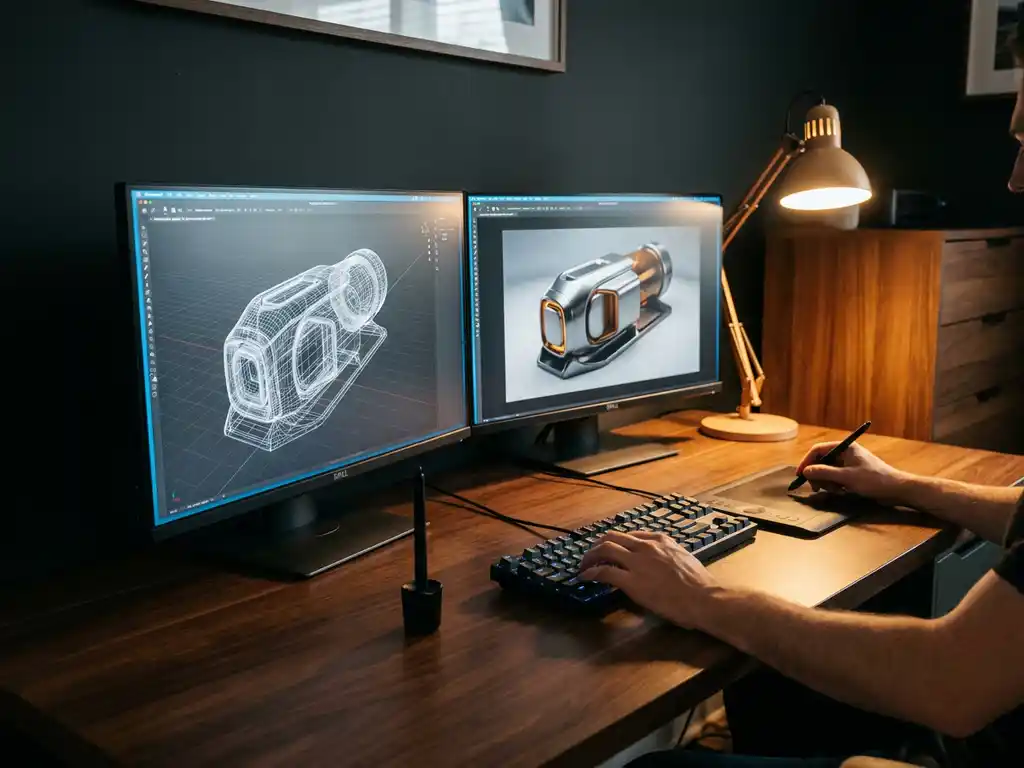
The rise of artificial intelligence in 3D rendering has sparked intense debate across the creative industry. While AI can now generate impressive visual content in seconds, traditional CGI rendering still dominates professional workflows for good reason. AI rendering excels at speed and iteration but struggles with the precision, control, and photorealistic quality that high-end brands demand for their product visualization.
Why is inconsistent visual quality damaging your brand perception?
Inconsistent product visuals — varying in lighting, texture, or proportion across channels — signal low quality to customers, even when the product itself is premium. AI-generated renders are particularly prone to these inconsistencies, making high-end products appear cheap or unreliable. For luxury brands and design-focused manufacturers, this mismatch directly undermines the brand positioning they have invested heavily to build.
The solution lies in establishing strict visual standards and workflows that prioritize quality control over speed. Professional 3D rendering pipelines ensure every product image maintains the same level of photorealism, accurate materials, and lighting conditions that reflect your brand’s premium positioning.
How are rushed rendering decisions costing you long-term flexibility?
Many companies adopt AI rendering solutions without evaluating future scalability or customization requirements. AI tools typically offer limited control over specific product configurations, material variations, and environmental settings — constraints that become costly when expanding a product line or adapting visuals for different markets and sales channels.
Instead of chasing quick fixes, invest in rendering solutions that grow with your business. Look for platforms that offer both speed and granular control, allowing you to maintain visual consistency while scaling your product visualization across multiple touchpoints.
Visual Commerce Solutions
Talk to our team about your project.
What is AI rendering and how does it work?
AI rendering is the use of machine learning algorithms to generate 3D images and animations without traditional modeling and lighting processes. These systems train on large datasets of existing images to learn patterns, textures, and lighting behaviors. When given a prompt or basic input, AI rendering tools can produce visual content in minutes rather than hours or days.
The technology typically works through neural networks that understand relationships between objects, materials, and environments. Some AI rendering tools focus on style transfer, while others generate entirely new scenes from text descriptions. Output quality and controllability vary significantly depending on the specific AI model and its training data.
Can AI rendering match traditional CGI quality?
No — current AI rendering technology cannot consistently match the photorealistic quality and precision of professional CGI workflows. AI excels at creating stylized or concept art quickly, but it struggles with accurate product representation, precise material properties, and controlled lighting scenarios that brands require for product visualization.
Traditional 3D rendering allows artists to control every aspect of a scene: exact material properties, precise camera angles, and specific lighting setups. This level of control ensures that product features, proportions, and brand colors are represented accurately across all marketing materials. AI rendering often produces impressive results but lacks the reliability and precision needed for high-stakes commercial applications.
What are the advantages of AI rendering over traditional methods?
AI rendering offers significant speed advantages for specific applications. Content creators can generate multiple concept variations in minutes, making the technology valuable for early-stage design exploration and rapid prototyping. It also lowers the barrier to entry, allowing non-technical users to produce visual content without extensive 3D modeling skills.
Cost efficiency is another advantage, particularly for high-volume, lower-stakes content creation. AI tools can generate social media visuals, concept art, or background elements at a fraction of traditional rendering costs. The technology is also improving rapidly, with new models regularly offering better quality and more control options.
However, these advantages come with trade-offs in quality control and customization that make AI rendering unsuitable for luxury and design-focused markets where precision and brand accuracy are non-negotiable.
What can’t AI rendering do that traditional rendering can?
AI rendering cannot provide the precise control over product accuracy that professional commercial applications require. Traditional 3D rendering allows exact specification of material properties, lighting conditions, and geometric details — ensuring products appear exactly as intended. This precision is essential for product configurators where customers need to see accurate representations of their chosen customizations.
Complex configurations and brand consistency
Complex product configurations remain a significant challenge for AI systems. Traditional rendering handles intricate mechanical assemblies, fabric behaviors, and precise color matching reliably. AI rendering struggles with these technical requirements and cannot consistently maintain brand visual standards across large product catalogs or adapt to specific technical specifications that manufacturers require.
System integration
Professional 3D rendering workflows integrate directly with CAD systems, product information management (PIM) databases, and e-commerce platforms. AI rendering tools typically operate as standalone systems and cannot easily connect with existing business processes or product data management infrastructure — a critical limitation for brands managing large or frequently updated product ranges.
Will AI rendering replace jobs in the 3D industry?
AI rendering is more likely to transform roles in the 3D industry than to eliminate them. While some routine tasks are becoming automated, demand for skilled 3D artists who can work across both AI tools and traditional techniques is growing. Professional artists are increasingly using AI as a productivity tool while retaining the quality control and technical expertise that complex projects require.
New hybrid roles are emerging that combine AI tool management with traditional 3D skills — focusing on quality assurance, pipeline integration, and bridging the gap between automated generation and professional output standards. The most competitive professionals are those who understand both technologies and can select the right approach for each project.
What does the future hold for AI and traditional rendering?
The most likely outcome is hybrid workflows that combine AI efficiency with traditional rendering precision. AI will continue to handle rapid iteration and concept development, while traditional methods maintain dominance in final production and quality-critical applications. This combination allows studios to accelerate creative processes without sacrificing the control and quality that professional work demands.
AI tools are expected to become more controllable and better integrated with traditional 3D pipelines over time. Rather than replacing existing workflows, AI will enhance them — automating repetitive tasks, generating base materials, or creating environmental elements that artists refine using traditional techniques. You can explore real-world examples of how different industries are adapting these technologies in our use cases section.
How 3Dimerce helps with professional 3D rendering
3Dimerce is a visual product configuration platform built specifically for the luxury, design, and high-end manufacturing markets — where visual precision, brand accuracy, and configurability are non-negotiable. We combine the efficiency of modern rendering technology with the granular control that premium brands require, delivering stunning photorealistic visuals at speed. Here’s how we ensure your product visualization meets the highest standards:
- Photorealistic quality: Our rendering technology delivers stunning visuals with accurate materials, lighting, and proportions that reflect your product’s true quality.
- Complete configurability: Every aspect of your product can be customized and visualized in real-time, from materials and colors to complex mechanical assemblies.
- Seamless integration: Our platform connects directly with your existing systems and workflows, ensuring consistent visual quality across all sales channels.
- Scalable solutions: Whether you need a single product configurator or a comprehensive visual platform, our solutions grow with your business.
Ready to see how professional 3D rendering can elevate your brand’s product visualization? Contact us to discuss your specific requirements and discover why leading European brands trust us with their most important product presentations.
Frequently Asked Questions
How do I know if my current product visualization needs upgrading from AI to traditional rendering?
Look for inconsistencies in lighting, material representation, or product proportions across your marketing materials. If customers frequently ask questions about product appearance or if your visuals don’t match the actual product quality, it’s time to consider professional 3D rendering. Premium brands should also evaluate whether their current visuals reflect their brand positioning and price point.
What's the typical timeline and cost difference between AI and traditional 3D rendering projects?
AI rendering can produce initial results in minutes to hours but often requires multiple iterations to achieve acceptable quality. Traditional 3D rendering takes longer initially (days to weeks for setup) but delivers consistent, high-quality results faster once the pipeline is established. While AI appears cheaper upfront, the total cost often balances out when factoring in revision cycles and quality control requirements.
Can I use AI rendering for some products and traditional rendering for others within the same brand?
This approach can work but requires careful brand guideline management to maintain visual consistency. Consider using AI for concept development, social media content, or lower-stakes applications, while reserving traditional rendering for hero products, e-commerce, and customer-facing configurators. Establish clear quality standards and review processes to ensure all visuals align with your brand image.
How do I transition from AI rendering to professional 3D rendering without disrupting my current workflows?
Start by identifying your most critical product visualization needs and migrate those first. Work with a rendering partner who can integrate with your existing systems and provide training for your team. Plan for a gradual transition where you can compare quality and efficiency between methods before fully committing. Most professional rendering platforms offer migration support and can work alongside existing tools during the transition period.
What should I look for when evaluating 3D rendering platforms for my business?
Prioritize platforms that offer integration capabilities with your current systems (CAD, PIM, e-commerce), real-time rendering capabilities, and granular control over materials and lighting. Evaluate the quality of their output samples, their ability to handle your specific product types, and their scalability options. Also consider their support for different output formats and their track record with businesses similar to yours.
How can I measure the ROI of investing in professional 3D rendering over AI solutions?
Track metrics like conversion rates, customer questions about product appearance, return rates due to expectation mismatches, and time spent on revision cycles. Professional rendering typically shows ROI through reduced customer service inquiries, higher conversion rates, fewer returns, and faster time-to-market for new products. Also consider the long-term value of reusable 3D assets and the ability to quickly adapt visuals for different markets and channels.