
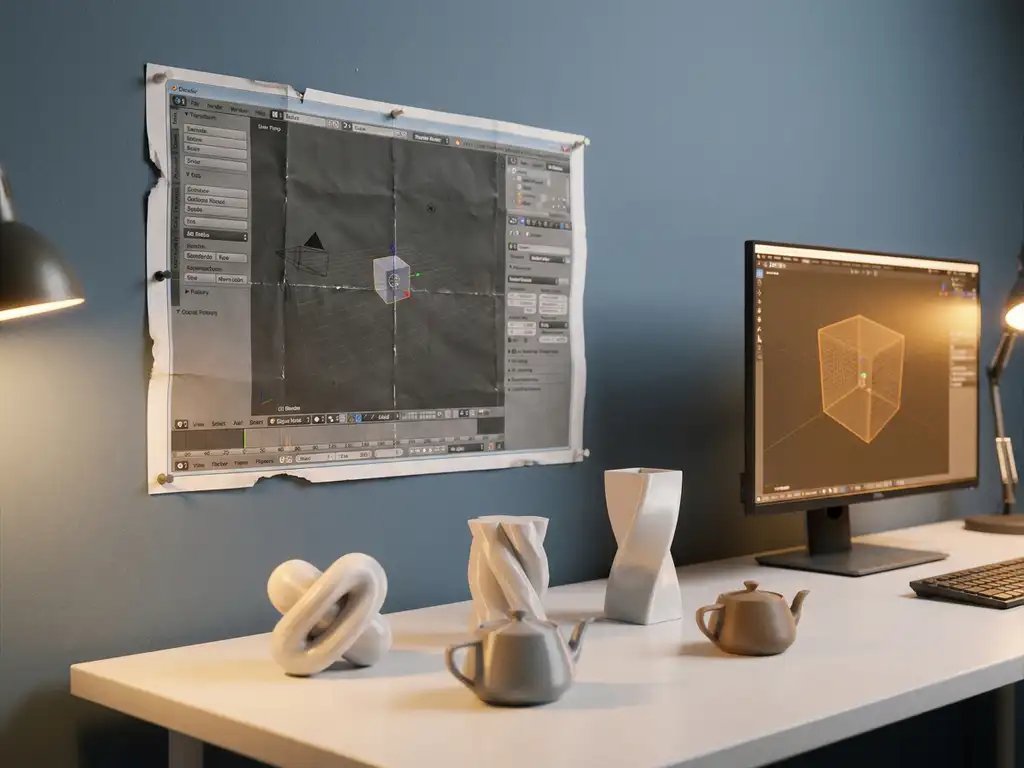
Yes, Blender 3D is absolutely worth learning in 2026. It has grown from a niche open-source tool into a genuinely professional-grade 3D software suite used by studios, freelancers, and product designers worldwide. Whether you are just starting out or looking to expand your creative toolkit, Blender offers a powerful entry point into the world of 3D without any upfront cost. This article unpacks the most common questions people ask before committing to learning it.
What can you actually do with Blender in 2026?
Blender 3D is a complete 3D creation suite that covers modeling, sculpting, rigging, animation, rendering, simulation, video editing, and compositing, all within a single application. In 2026, it supports real-time rendering through its EEVEE engine and photorealistic output through Cycles, making it suitable for everything from game assets to cinematic visual effects.
Here is a practical overview of what Blender is used for today:
- 3D modeling and product visualization — creating detailed objects, furniture, packaging, and product renders
- Character animation and rigging — building animated characters for film, games, and interactive media
- Architectural visualization — rendering interior and exterior spaces with photorealistic lighting
- Motion graphics and VFX — creating title sequences, particle effects, and composited visuals
- Sculpting — digital sculpting for organic shapes, characters, and concept art
- 3D printing preparation — modeling objects for physical production
The scope of what Blender can handle has expanded significantly over recent major releases. It is no longer a tool you outgrow quickly — many professionals use it as their primary or sole 3D application throughout their entire career.
Is Blender good enough to compete with paid 3D software?
Yes, Blender 3D is competitive with paid tools like Autodesk Maya, Cinema 4D, and 3ds Max for most use cases in 2026. While industry pipelines at large studios sometimes still favor established paid software for legacy reasons, Blender’s rendering quality, toolset depth, and active development cycle mean it holds its own in the majority of professional contexts.
The key differences come down to specific workflows rather than overall quality. Maya still dominates character animation pipelines in large film and game studios. Cinema 4D remains popular in motion graphics for its tight integration with After Effects. But for product visualization, architectural rendering, indie film, and freelance work, Blender is not just a budget alternative — it is often the preferred choice.
One genuine advantage Blender holds is its community-driven development. Because it is open-source and backed by the Blender Foundation, updates are frequent, transparent, and driven by real user needs rather than subscription revenue targets. For independent creators and small studios, this makes Blender an exceptionally strong long-term investment.
Visual Commerce Solutions
Talk to our team about your project.
How long does it take to learn Blender?
Most beginners can become functionally competent in Blender 3D within three to six months of consistent practice. Reaching a professional level — where you can produce client-ready work efficiently — typically takes one to two years, depending on your background, the complexity of your target discipline, and how much time you dedicate each week.
Learning speed depends heavily on what you want to do with it:
- Basic modeling and rendering — achievable within a few weeks for someone with no 3D background
- Product visualization and still renders — solid results within two to four months with focused practice
- Character rigging and animation — a steeper curve, often requiring six months or more to work confidently
- Simulation (cloth, fluid, particles) — intermediate to advanced territory, best tackled after mastering the fundamentals
- Full production pipeline fluency — one to two years for professionals moving into studio-quality output
The learning curve in Blender used to be notoriously steep, largely due to its non-standard interface. Since the 2.8 redesign, the interface has become significantly more intuitive, and this has made the early stages of learning considerably more approachable for newcomers.
What jobs and industries actually hire Blender users?
Blender 3D skills are in demand across a wide range of industries in 2026, including game development, film and television, product design, architecture, e-commerce, and advertising. Employers typically care more about the quality of your portfolio output than which specific software you used to create it, which gives Blender users a strong footing in the job market.
Industries actively hiring people with Blender skills include:
- Game development studios — for asset creation, environment design, and character modeling
- Film and animation production — particularly indie studios and post-production companies
- Product and industrial design — for prototyping, visualization, and presentation renders
- Interior design and architecture — for photorealistic space visualizations
- E-commerce and retail brands — for product imagery, 3D configurators, and virtual showrooms
- Advertising and marketing agencies — for motion graphics, CGI campaigns, and branded visual content
- Freelance platforms — where 3D artists work directly with brands, agencies, and designers
The e-commerce and retail sector in particular has seen strong growth in demand for 3D visualization talent. Brands increasingly need high-quality CGI product imagery and interactive configuration experiences to replace costly traditional photography at scale.
Should you learn Blender or a paid tool first?
For most beginners, learning Blender 3D first is the smarter choice. It is free, fully featured, and teaches the same core 3D principles — modeling, lighting, shading, rendering — that apply across every major 3D application. Once you understand those fundamentals in Blender, transitioning to a paid tool is far easier than starting from scratch.
The main reason to start with a paid tool instead would be if you are entering a specific professional environment that mandates it. If a studio you want to join runs an entirely Maya-based pipeline, learning Maya makes sense. If you are targeting motion graphics work at an agency deeply embedded in the Adobe ecosystem, Cinema 4D may be worth prioritizing. But for everyone else, Blender is the most practical and cost-effective starting point.
It is also worth noting that many professionals use Blender alongside paid tools rather than instead of them. Knowing Blender does not close doors — it opens them, while keeping your software costs at zero during the learning phase.
Where do you find the best resources to learn Blender in 2026?
The best resources for learning Blender 3D in 2026 are a mix of free YouTube channels, structured online courses, and the official Blender documentation. The community around Blender is one of the most active in the 3D world, which means high-quality tutorials are available at every skill level.
Top places to start:
- Blender Guru (YouTube) — the classic starting point, known for the beginner donut tutorial that has introduced millions of people to Blender
- Grant Abbitt (YouTube) — excellent for character modeling and game-ready assets
- CG Cookie — a structured learning platform with courses specifically designed for Blender
- Udemy — affordable paid courses with lifetime access, useful for structured learning paths
- Blender’s official documentation and tutorials — underrated and regularly updated alongside new releases
- Blender Artists community forum — a great place to get feedback on your work and learn from others
The key to learning Blender efficiently is combining structured tutorials with personal projects. Following tutorials builds knowledge; building your own projects builds skill. Starting a personal project early — even a simple one — forces you to problem-solve and retain what you learn far more effectively than passive watching alone.
How 3Dimerce Takes 3D Visualization Further
Learning Blender 3D gives you a powerful foundation in 3D creation — but for brands and manufacturers who need to deploy high-quality 3D visuals at scale, a professional platform purpose-built for that challenge makes all the difference.
That is exactly what we do at 3Dimerce. As a European leader in visual product experience, we help premium brands and manufacturers replace costly photoshoots and physical sample libraries with stunning, photorealistic CGI and interactive product configuration. Here is what working with us looks like in practice:
- Photorealistic 3D product imagery — CGI output that matches or exceeds traditional photography, produced faster and at a fraction of the cost
- Interactive product configurators — let customers explore every variant, finish, and option in real time, both online and in-store
- Virtual showrooms and digital twins — immersive brand environments that work across all devices without compromise
- Seamless integration — our platform connects directly with your existing webshop, POS system, or e-commerce environment through headless integration
- Scalable visual content — add new products and variants without additional photoshoots or proportional increases in budget
Whether you are a furniture brand looking to scale your visual content, a retailer wanting to bring product configuration into your physical stores, or a manufacturer ready to eliminate dependency on physical prototypes, we have built our platform specifically for you. Explore our visual product solutions to see what is possible, or get in touch with our team to discuss your specific needs.
Frequently Asked Questions
Do I need a powerful computer to run Blender effectively?
Blender can run on modest hardware, but your system’s performance will directly affect render times and viewport responsiveness. For comfortable everyday use, a dedicated GPU (NVIDIA or AMD), at least 16GB of RAM, and a multi-core processor are recommended. Cycles rendering in particular benefits enormously from a capable GPU — tasks that take hours on a CPU can complete in minutes with GPU acceleration enabled.
Can I use Blender professionally without any formal 3D design education?
Absolutely — many working Blender professionals are entirely self-taught. What matters most to clients and employers is the quality of your portfolio, not your academic background. That said, investing time in understanding foundational design principles such as composition, lighting, and colour theory will meaningfully elevate the quality of your output, regardless of how you acquired those skills.
What is the biggest mistake beginners make when learning Blender?
The most common mistake is tutorial-hopping — watching video after video without completing projects independently. Tutorials build familiarity, but real skill develops when you attempt to create something on your own and have to problem-solve without a guide. Set a goal to finish at least one personal project for every two or three tutorials you complete, and your progress will accelerate significantly.
Is Blender suitable for creating 3D product visuals for e-commerce, or do I need specialist software?
Blender is genuinely capable of producing photorealistic product imagery suitable for e-commerce, and many freelancers and small studios use it for exactly that purpose. However, for brands that need to deploy product visuals at scale — across hundreds of SKUs, variants, and configurations — a purpose-built platform like 3Dimerce offers the workflow efficiency, integration capabilities, and scalability that a standalone Blender setup cannot easily match.
How do I know which area of Blender to focus on first?
Start by identifying the type of work you ultimately want to produce — product renders, character animation, architectural visualization, or something else — and work backwards from there. Hard-surface modeling and basic rendering are the most transferable foundations regardless of your end goal, so most learners benefit from starting there. Avoid trying to learn every feature at once; depth in one area will serve you far better than surface-level familiarity with everything.
Can Blender files and assets be used in other 3D software or game engines?
Yes — Blender supports export to widely used formats including FBX, OBJ, GLTF, and USD, which are compatible with game engines like Unreal Engine and Unity, as well as other 3D applications. GLTF in particular has become the standard format for real-time and web-based 3D, and Blender’s GLTF export is robust and well-maintained. This interoperability makes Blender a practical part of larger multi-tool pipelines.
Will the Blender skills I learn now still be relevant in a few years as the software updates?
Yes — while Blender releases updates frequently, the core principles of modeling, shading, lighting, and rendering remain consistent across versions. New features are typically additive rather than replacing existing workflows, so skills built today transfer forward cleanly. The broader 3D fundamentals you develop in Blender are also largely software-agnostic, meaning they remain valuable even if you transition to other tools later in your career.