
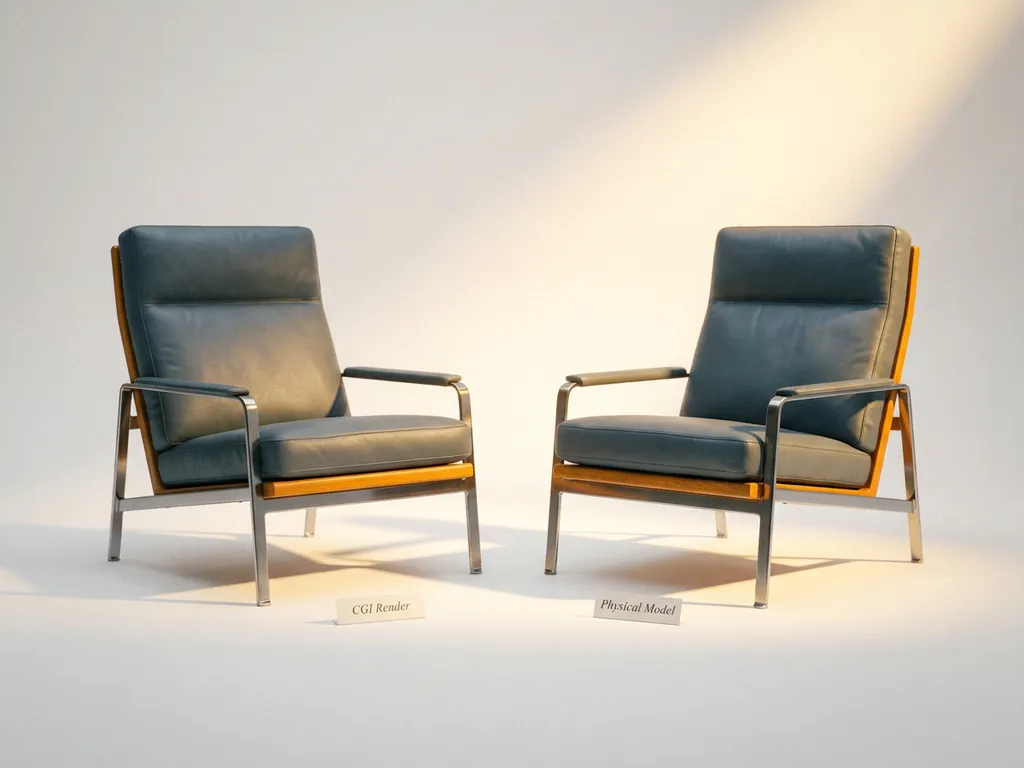
Investing in 3D product rendering is worth it for any manufacturer or brand that sells configurable, design-led, or visually complex products. It replaces costly, time-consuming traditional photography with scalable, photorealistic digital visuals that can be produced faster, updated instantly, and deployed across every sales channel simultaneously. For premium brands in particular, the quality and flexibility of modern 3D rendering simply cannot be matched by conventional methods. Below, we answer the most common questions brands ask before making the switch.
What do you actually get with 3D product rendering?
With 3D product rendering, you get photorealistic digital images and animations of your products created entirely from 3D models, without a single physical photoshoot. Every material, finish, colour, and configuration can be visualised at any angle, in any environment, at any scale, giving you complete creative control over how your product is presented.
The practical output goes far beyond static images. Depending on your setup, 3D rendering can deliver:
- High-resolution product images for your webshop, catalogue, and marketing materials
- Real-time interactive configurators that let customers personalise products online or in-store
- 360-degree product views and animated sequences
- Lifestyle renders placing your product in curated interior or brand environments
- Digital twins that mirror your physical product range exactly
What makes this particularly powerful for design-led brands is the level of detail achievable. Touchable textures, natural light and shadow, perfectly irregular surfaces, modern rendering technology produces visuals that are indistinguishable from photography, and in many cases more consistent and more controlled than anything a camera can capture on set.
How does 3D rendering compare to traditional product photography?
3D product rendering outperforms traditional photography in scalability, cost efficiency, and flexibility, especially for brands with large product ranges or multiple configuration options. Photography requires a physical product, a studio, a crew, and a full reshoot every time something changes. 3D rendering requires none of that once your models are built.
The comparison becomes even clearer when you factor in variant volume. A sofa available in 12 fabrics, 3 leg finishes, and 2 sizes represents 72 combinations. Photographing every variant is practically impossible. Rendering every variant takes a fraction of the time and cost, and any future update, a new fabric, a revised leg design, requires only a model adjustment, not a new shoot.
Photography still has its place for hero campaigns and editorial content. But for product range coverage, consistency across channels, and the ability to respond quickly to product changes, 3D rendering is the more practical and cost-effective solution at scale.
Visual Commerce Solutions
Talk to our team about your project.
What is the ROI of 3D product rendering for manufacturers?
The ROI of 3D product rendering for manufacturers comes primarily from three areas: reduced photography costs, faster time to market, and improved conversion rates. Brands that switch from traditional photography to 3D rendering typically eliminate recurring studio costs, reduce visual production lead times significantly, and gain the ability to launch new products or variants without waiting for physical samples.
Beyond direct cost savings, the commercial impact is equally significant. When customers can visualise a product in their preferred configuration before purchasing, they buy with more confidence. That confidence translates into higher conversion rates, fewer returns, and a stronger perception of your brand.
For manufacturers selling through retail partners or distributors, 3D assets also reduce the need for physical sample libraries and showroom stock, which carries its own logistical and financial overhead. A well-built library of 3D product models becomes a long-term asset that pays dividends across every channel you operate in.
Which product types benefit most from 3D rendering?
Products that are configurable, design-led, or available in many variants benefit most from 3D product rendering. Furniture, interior products, lighting, kitchen and bathroom fixtures, flooring, textiles, and outdoor living products are among the strongest use cases, because these categories combine high visual complexity with extensive customisation options.
The common thread across all high-performing use cases is this: the product’s visual presentation is central to the purchase decision, and no single photograph can capture the full range of what the product can be. If your product comes in multiple materials, colours, sizes, or configurations, 3D rendering is almost always the better solution for visual content at scale.
Simpler, standardised products with few or no variants benefit less from rendering, since a single photoshoot may cover all needed assets. But the moment your product range grows or your customers expect personalisation, 3D rendering becomes a strategic necessity rather than a nice-to-have.
How does 3D rendering support omnichannel sales?
3D product rendering supports omnichannel sales by providing a single, consistent visual asset library that can be deployed across your webshop, in-store configurators, printed catalogues, and sales tools simultaneously. Every channel shows the same product, in the same quality, with the same level of detail, regardless of where the customer encounters your brand.
This consistency is particularly valuable for premium brands, where visual quality is directly tied to brand perception. Inconsistent imagery across channels, sharp on the website, blurry in the brochure, absent in-store, undermines the premium positioning you have worked to build.
In a retail or showroom environment, interactive 3D configurators allow sales staff and customers to explore the full product range together in real time, without needing physical samples for every option. That removes friction at the point of sale and makes it easier to close on high-value, complex orders. You can explore our full range of solutions to see how visual configuration works across both digital and physical environments.
When is the right time to switch to 3D product rendering?
The right time to switch to 3D product rendering is when your visual content production can no longer keep pace with your product range, your variant volume, or your channel requirements. If you are launching a new product line, replatforming your e-commerce environment, or feeling the pressure of inconsistent visuals across channels, those are clear signals that the switch makes sense now.
Other strong indicators include:
- Your photography costs are growing faster than your product range
- New product launches are delayed because physical samples are not ready in time
- Customers are asking for customisation options you cannot currently visualise
- Competitors are already offering interactive product experiences online or in-store
- Your sales team lacks effective tools to guide customers through complex configuration choices
In 2026, the expectation for high-quality, interactive product visuals is no longer limited to the most digitally advanced brands. It has become a baseline expectation in premium product categories. Waiting for a “perfect moment” often means ceding ground to competitors who moved earlier.
How We Help You Get More from 3D Product Rendering
At 3Dimerce, we have spent over 20 years building visual product experiences for manufacturers and brands in the design, furniture, and luxury interiors market. Our platform is built specifically for brands that refuse to compromise on quality, and it is designed to scale with your product range without adding complexity or cost per variant.
Here is what working with us looks like in practice:
- Photorealistic 3D rendering that matches or exceeds the quality of traditional photography, delivered at a fraction of the time and cost
- Interactive product configurators for online and in-store use, giving your customers the confidence to customise and buy
- Seamless integration with your existing webshop, ERP, or sales environment through headless architecture
- A scalable asset library that grows with your product range, with no reshoot required for new variants or finishes
- Consistent visuals across every channel, from your webshop to your retail partners to your printed catalogue
If you are ready to replace slow, expensive photography workflows with a smarter, more scalable approach to product visualisation, we would love to show you what is possible. Get in touch with our team and let us talk through what the right solution looks like for your brand.
Frequently Asked Questions
How long does it take to build a 3D product model from scratch?
The timeline for building a 3D product model depends on the complexity of the product, but most standard furniture or interior products can be modelled within one to three weeks. Highly detailed or technically complex products may take longer. Once the base model is complete, generating additional variants, colours, finishes, or configurations requires only a fraction of that initial time, which is where the real efficiency gains compound over your product lifecycle.
What do I need to provide to get started with 3D product rendering?
To get started, you typically need to supply technical drawings, CAD files, physical product samples, or detailed reference photography so the 3D modelling team can accurately recreate your product. Material swatches, finish specifications, and brand guidelines are also helpful for ensuring the final renders match your product and visual identity precisely. The more detailed and accurate your source materials, the faster and more faithful the 3D model will be.
Can 3D rendered images really look as realistic as professional photography?
Yes — with modern rendering technology, photorealistic 3D images are routinely indistinguishable from studio photography, and in many cases they offer greater consistency and control than a physical shoot can achieve. Lighting, shadows, reflections, and material textures can all be dialled in with precision and reproduced identically across every image in your library. Many leading premium brands have already made the switch without their customers noticing any difference in visual quality.
What happens when I update a product — do I need to rebuild the 3D model from scratch?
No — one of the key advantages of 3D rendering is that product updates require only targeted adjustments to the existing model rather than a complete rebuild. If you change a fabric, revise a leg profile, or introduce a new finish, those changes are applied directly to the model and new renders are generated without a full reshoot or a new modelling project. This makes 3D assets significantly more future-proof than a traditional photography library.
How does a 3D product configurator actually work for customers shopping online?
An online 3D product configurator lets customers select their preferred options — materials, colours, dimensions, components — and see the product update in real time, either as a rendered image or as an interactive 3D view. Each selection triggers a visual change that reflects exactly what the customer will receive, removing guesswork and building purchase confidence. This kind of interactive experience has been shown to increase conversion rates and reduce returns, particularly for high-value or customisable products.
Is 3D product rendering only viable for large brands with big budgets?
Not at all — while enterprise-scale brands were early adopters, 3D rendering has become increasingly accessible to mid-sized manufacturers and growing brands, particularly those with configurable or design-led product ranges. The investment is most justified when your product range includes multiple variants or when recurring photography costs are already significant, both of which apply to many brands well below enterprise scale. The key is evaluating the cost per visual over time rather than comparing the upfront investment to a single photoshoot.
Can 3D renders be used for printed catalogues and trade materials, not just digital channels?
Absolutely — high-resolution 3D renders are fully suitable for print, and many brands use the same asset library to serve their webshop, printed catalogue, trade brochures, and point-of-sale materials simultaneously. This is one of the most practical benefits of building a centralised 3D asset library: you produce the visual once and deploy it everywhere, at any resolution and in any format your channel requires. It eliminates the need to commission separate shoots for print versus digital.