
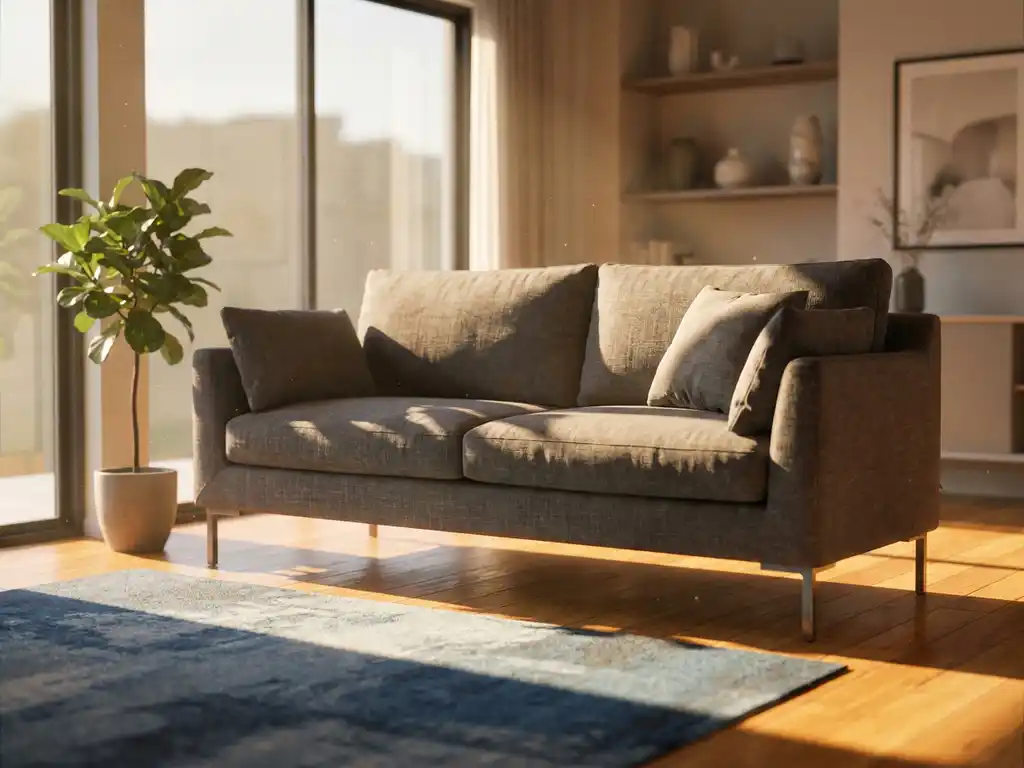
For furniture and home decor brands, the question is no longer whether customers want to visualize products in their own space before buying. They do, and they expect it. The real question is whether your brand is equipped to deliver that experience at the quality level your products deserve. 3D product rendering combined with augmented reality (AR) placement technology allows your customers to place photorealistic 3D models of your products in their actual rooms using nothing more than a smartphone camera. The result: higher conversion rates, fewer returns, and a premium brand experience that sets you apart from competitors still relying on flat photography. This page explains how the technology works, what it delivers commercially, and how we help premium brands implement it at scale.
What is poor product visualization really costing your brand?
The numbers are stark. Industry data consistently shows that a significant share of furniture purchases are returned due to size, style, or color mismatches with the customer’s expectations. In fact, research indicates that around 64% of furniture returns are directly attributable to inadequate visualization at the point of purchase. This uncertainty translates directly into abandoned shopping carts, with potential buyers clicking away rather than taking the risk. Without clear spatial context, even premium products appear generic, forcing customers to rely on guesswork about proportions, colors, and how pieces will complement their existing decor.
Extended browsing sessions followed by cart abandonment often signal that customers want your products but lack confidence in their choice. When shoppers spend significant time on product pages but do not convert, they are typically struggling to envision the product in their personal environment. This hesitation costs brands both immediate sales and long-term customer relationships, as frustrated shoppers may turn to competitors offering better visualization experiences. The solution is not better photography. It is a fundamentally different visualization paradigm: one where customers can place your exact product, in their exact room, before they buy.
Visual Commerce Solutions
Talk to our team about your project.
What is virtual product placement and how does it work?
Virtual product placement is a technology that allows customers to digitally position 3D rendered products within their real-world environments. The process begins with creating highly detailed 3D models of products, complete with accurate textures, materials, and lighting properties. These models are then integrated into AR applications or web-based configurators that can access a device’s camera or accept uploaded room photos.
The technology works by detecting surfaces and spatial dimensions in the customer’s environment, then anchoring the 3D product model to those surfaces with proper scale and perspective. Advanced systems account for lighting conditions, shadows, and reflections to create photorealistic integration. Customers can move, rotate, and resize products in real time, experimenting with different configurations until they find the perfect fit for their space.
How shoppers place photorealistic 3D models in their space using a mobile camera
The mobile camera AR experience is straightforward by design. Here is how the process works from the moment a shopper decides to visualize a product:
- Open the AR viewer directly in your smartphone browser or the retailer’s app. No download is required for browser-based experiences.
- Point your camera at the floor or wall where you want to place the item. The system begins reading your environment immediately.
- Surface detection activates automatically. The AR product visualization engine identifies the surface and anchors the photorealistic 3D product model at accurate scale, aligned to your real space.
- Walk around the product to view it from every angle. The model stays fixed in place as you move, giving you a true sense of how it occupies the room.
- Adjust color, material, or size using the configurator panel without leaving the AR view. Every change updates the model instantly.
- Add to cart with full confidence. You have seen the product in your space, in your chosen configuration, at true scale. The guesswork is gone.
This seamless flow from mobile device camera to photorealistic 3D product placement is what separates a genuinely useful AR visualization experience from a gimmick. We engineer every step of this journey to be intuitive, fast, and visually exceptional.
Can customers see how furniture looks in their actual room?
Yes — and the accuracy of modern 3D product rendering technology has reached a level where visualizations are virtually indistinguishable from actual photographs. Sophisticated rendering engines simulate real-world physics, including how light interacts with different materials, how fabrics drape, and how wood grains reflect ambient lighting. This makes it possible for customers to make confident, informed purchase decisions before a product ever enters their home.
Customers can upload photos of their rooms or use live camera feeds to place furniture with remarkable precision. The technology automatically adjusts for room lighting, calculates proper shadows, and accounts for how a product’s color may appear under different lighting conditions throughout the day. Many platforms now offer room scanning capabilities that create detailed 3D maps of spaces, ensuring that furniture placement respects actual room dimensions and obstacles like doorways or existing furniture.
What’s the difference between 3D configurators and AR placement tools?
3D configurators and augmented reality (AR) placement tools serve different but complementary purposes in the customer journey. A 3D configurator focuses on product customization — allowing customers to modify colors, materials, dimensions, and features while seeing real-time visual updates. These tools excel at helping customers design their preferred product variant before considering where it will go.
An AR placement tool specializes in spatial visualization. It takes a finalized product design and helps customers understand how it will look and fit within their specific environment. The most effective solutions combine both technologies, allowing customers to first configure their ideal product, then immediately place it in their room to evaluate the result. This integrated approach delivers a complete visualization experience — from customization through spatial planning — within a single customer journey.
What are the common challenges of implementing AR visualization — and how are they solved?
Decision-makers evaluating AR visualization technology rightly want to understand the risks before committing. Three implementation concerns come up consistently, and each has a well-established solution.
File size and loading speed
Large 3D model files can slow page load times significantly if they are not properly optimized. We address this through optimized file formats, specifically GLB for broad cross-platform compatibility and USDZ for iOS devices, combined with aggressive compression and progressive loading techniques. A base model appears instantly while additional detail loads in the background, so shoppers are never left waiting for an experience to begin.
Cross-device compatibility
AR experiences must work consistently across iOS and Android devices as well as desktop browsers. We test and optimize every deliverable across device types, and our use of WebGL and WebXR standards ensures broad compatibility without requiring app downloads. Whether a customer is using the latest flagship smartphone or an older mid-range device, the experience performs reliably.
Customer adoption and ease of use
The best technology fails if customers do not use it. We design every AR interface to be intuitive enough for first-time users, with no setup, no calibration steps, and no learning curve. Customers simply tap to place and interact naturally. High adoption rates follow directly from low friction, and low friction is something we build into every solution from the ground up.
How do customers access virtual placement features?
Virtual product placement features are accessible directly through web browsers or dedicated mobile apps, requiring no special software downloads. Browser-based solutions use WebGL and WebXR technologies to deliver 3D experiences across devices, from smartphones to desktop computers. These platforms typically offer multiple interaction methods: customers can upload room photos for static placement, use live camera feeds for real-time AR, or work within pre-designed room templates.
Mobile apps often provide the most sophisticated AR experiences, leveraging device sensors for precise tracking and measurement. Many retailers integrate these features directly into their e-commerce platforms, enabling seamless transitions from product browsing to visualization to purchase. Some advanced systems also offer collaborative features where multiple family members can view and discuss placements together, regardless of their physical location.
Why leading brands choose 3Dimerce over other AR visualization platforms
Retailers evaluating AR visualization platforms often compare enterprise tools before committing. Platforms like Threekit have brought 3D configuration into the mainstream conversation, and that is a positive development for the industry. But for brands in the premium, design, and luxury segment, the question is not simply whether a platform supports AR product visualization. The question is whether it delivers the photorealistic quality, the tailored service, and the performance your products and your customers deserve. On those criteria, 3Dimerce stands in a category of its own.
Four differentiators define our position. First, our photorealistic rendering quality is engineered specifically for luxury and design brands, where material accuracy, lighting fidelity, and visual detail are non-negotiable. Second, we build fully bespoke 3D models from the ground up for each client, rather than relying on template-based approaches that produce generic results. Third, our platform delivers blazing-fast rendering and AR placement performance across every device, including mobile camera AR visualization where shoppers place photorealistic 3D product models directly in their own space. Fourth, with more than 20 years of expertise in premium visual commerce, we bring a depth of craft and technical knowledge that newer entrants simply cannot match. If your brand demands the best, we invite you to contact us for a personalized demo.
Why do brands invest in 3D visualization technology?
Brands invest in 3D product visualization technology because it delivers measurable improvements across three dimensions: customer engagement, conversion rates, and post-purchase satisfaction, while simultaneously reducing the operational costs associated with traditional photography and high return volumes. Companies implementing comprehensive 3D rendering solutions consistently report meaningful increases in conversion rates of 20 to 40% and reductions in return rates of around 30%, making the investment case straightforward for furniture and home furnishings retailers.
The broader market signals are equally compelling. By 2020, more than four in ten retailers had already integrated AR into their customer experience, according to industry research. Among consumers who have used mobile AR, nearly three quarters report high satisfaction with the experience. Perhaps most striking for revenue-focused teams: a significant share of online shoppers indicate they are willing to pay a premium for products they can customize and preview in AR before buying. For brands in the furniture and home decor sector, these numbers represent both a competitive benchmark and a clear mandate to act.
Beyond immediate sales metrics, 3D visualization technology provides long-term competitive advantages. It enables brands to showcase their entire product catalog without the costs and logistics of traditional photography, supports rapid product launches, and creates more engaging customer experiences that build brand loyalty. The technology also generates valuable behavioral data, showing which products customers interact with most and how they prefer to configure items, which informs future product development and marketing strategies.
How virtual photography eliminates the cost and complexity of traditional product photography
Virtual photography is the process of rendering photorealistic product images entirely from 3D models, eliminating the need for physical samples, studio setups, and post-production retouching. A single high-quality 3D master model can generate hundreds of product images across all color, material, texture, and size variants in a fraction of the time a traditional shoot would require. For brands managing large catalogs, this is not a marginal efficiency gain. It is a structural transformation in how product imagery is produced and maintained.
Traditional photography requires shipping physical samples, booking studios, hiring photographers, and repeating the entire process for every new variant or seasonal update. With virtual photography, once the 3D master model exists, all variant imagery is generated on demand. For brands managing catalogs of hundreds or thousands of SKUs, this represents a structural reduction in time-to-market and photography budget. We deliver this capability at luxury-grade quality, ensuring that every rendered image meets the visual standards your brand has built its reputation on.
Where is AR in retail heading? What forward-thinking brands are preparing for
Next-generation AR is moving well beyond simple product placement. The emerging frontier is hyper-personalization: systems that learn a customer’s style preferences, room dimensions, and existing furniture to proactively suggest complementary pieces and complete room compositions. AR is increasingly being used not only to close initial sales but also to surface upsell and cross-sell opportunities at the moment a customer is most engaged, while they are actively designing their space and emotionally invested in the outcome. For brands that position themselves correctly, AR becomes a revenue amplifier, not just a visualization tool.
The boundary between online and in-store is also dissolving rapidly. Retailers are beginning to deploy AR experiences in physical showrooms, allowing customers to visualize custom configurations on the showroom floor rather than only at home. For brands investing in high-quality 3D assets today, those assets are reusable across every future AR touchpoint, from e-commerce product pages to in-store installations to social commerce integrations. That makes the investment in premium 3D models a durable strategic asset rather than a single-channel expense. We are the partner equipped to help brands build this future-ready visual infrastructure now, with the craft and technical precision the luxury segment demands.
How 3Dimerce helps with 3D product rendering
At 3Dimerce, we specialize in creating sophisticated 3D product rendering solutions that transform how customers experience and purchase products. Our visual product experience platform combines advanced configurators with photorealistic rendering technology, enabling brands to offer seamless product customization and spatial visualization experiences, all within a single, integrated environment.
Our comprehensive approach includes:
- Photorealistic 3D product models engineered to luxury-grade standards, with accurate materials, textures, and lighting that match physical samples
- Real-time configuration tools supporting unlimited color, material, and dimension variants, all generated from a single master model
- Virtual photography output that replaces traditional product shoots for your entire catalog
- Mobile camera AR placement allowing shoppers to visualize products in their own space via smartphone, with no app download required
- GLB and USDZ file delivery ensuring compatibility across both Android and iOS devices
- Seamless integration with leading e-commerce environments including Shopify and other major platforms
- Cross-device rendering optimized for consistent visual quality from mobile to desktop
- Dedicated production support from briefing through delivery, with the quality control expected by premium and luxury brands
Our platform is built to scale with your entire product catalog, not just your flagship pieces. Whether you need 3D models and AR visualization for ten products or ten thousand, our production pipeline is engineered to deliver consistent photorealistic quality at volume. Brands across the furniture and home decor sector rely on us to bring their full assortment to life in 3D, enabling every product, in every configuration, color, and material, to be experienced virtually before it is purchased. This catalog-first approach means your visualization investment compounds in value as your range grows, rather than requiring repeated one-off production efforts.
Over more than two decades working with premium brands in furniture, interior design, and luxury home decor, we have developed a production methodology that combines artistic craftsmanship with technical precision. Every 3D asset we deliver is built to perform: visually stunning, blazing fast, and ready to deploy across every channel where your customers encounter your brand. Our tailored solutions are built for the design and luxury segment, scaling with your product range while delivering the visual excellence your customers expect. Ready to transform your product visualization experience? Contact us to discover how our 3D rendering technology can elevate your brand’s digital presence.
Frequently Asked Questions
How accurate are the measurements when placing 3D furniture in my room?
Modern 3D placement tools can achieve measurement accuracy within 1-2 inches when used properly. The key is ensuring your device’s camera can clearly see reference points like walls, floors, and existing furniture. For the most precise results, measure your space manually first and use those dimensions to verify the digital placement looks proportionally correct.
What should I do if the 3D product looks different from what I receive?
While 3D rendering technology has become highly accurate, slight variations can occur due to manufacturing tolerances or screen display differences. Most retailers using professional 3D visualization offer satisfaction guarantees or easy return policies. Before purchasing, check the product specifications and materials list to ensure they match your expectations from the 3D preview.
Can I save and share my room designs with family members for feedback?
Yes, most advanced 3D visualization platforms allow you to save multiple room configurations and share them via email or social media links. Some platforms even offer real-time collaboration features where family members can view and comment on your designs from their own devices, making group decision-making much easier.
Do I need special lighting in my room for AR placement to work effectively?
While AR placement works in various lighting conditions, natural daylight or bright, even artificial lighting produces the best results. Avoid placing products in very dim or harsh directional lighting, as this can affect the accuracy of shadow rendering and color representation. The technology automatically adjusts for most lighting conditions, but good illumination helps ensure optimal performance.
How do I handle products that need to fit through doorways or up stairs?
Many 3D placement tools now include delivery path checking features that highlight potential access issues. Measure your doorways, hallways, and stairwells beforehand, then use the product’s dimensions (usually displayed in the 3D interface) to verify clearance. Some platforms even offer virtual delivery simulation to show how large items will navigate through your space.
What happens if my internet connection is slow – will 3D visualization still work?
Most modern 3D visualization platforms are optimized for various connection speeds, with progressive loading that displays basic models first, then adds detail as bandwidth allows. However, for the smoothest experience with real-time AR features, a stable broadband connection is recommended. Many platforms also offer offline modes where you can download product models for local viewing.
Can I use 3D placement tools to rearrange my existing furniture along with new purchases?
Some advanced platforms allow you to create digital versions of your existing furniture by photographing items from multiple angles or selecting from furniture libraries. This enables complete room redesigns where you can experiment with both new purchases and rearranged existing pieces. Check if your retailer’s platform offers room planning features beyond just product placement.