
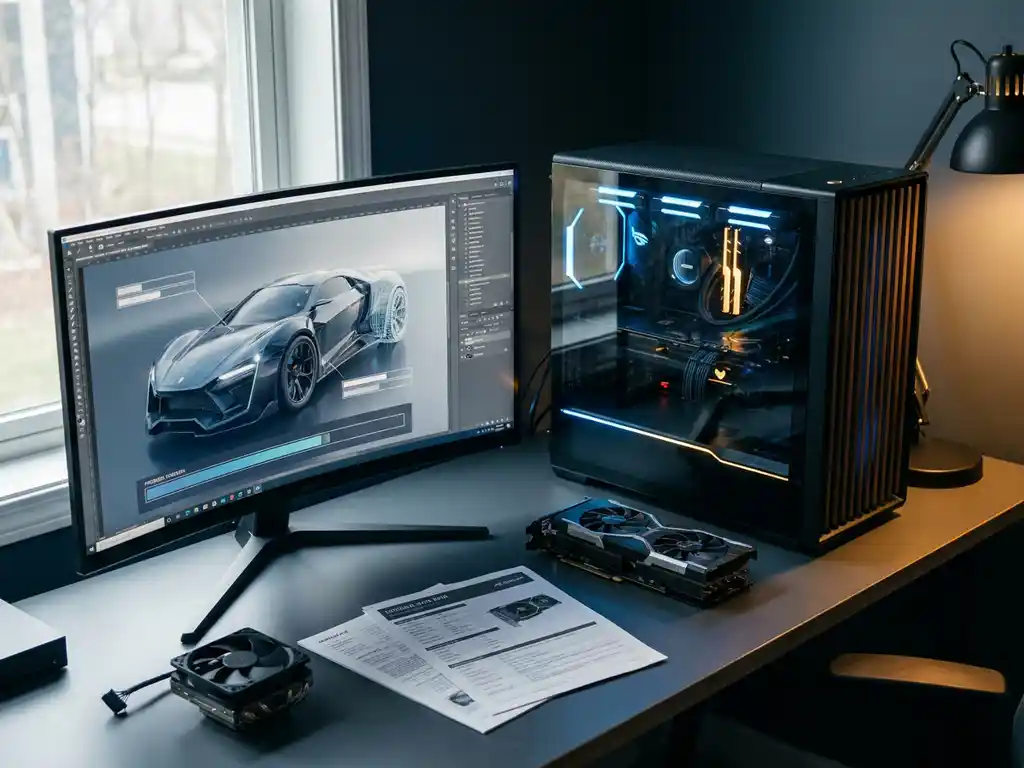
You do not need a high-end PC to run Blender 3D, but your hardware choices will directly affect how fast and comfortably you can work. A mid-range machine handles most tasks well, while more demanding projects like rendering complex scenes or working with high-polygon models will benefit from stronger specs. Below, we answer the most common questions about Blender hardware so you know exactly what you need.
What are the minimum system requirements to run Blender?
Blender’s official minimum requirements are modest: a 64-bit processor running at 2 GHz or faster, 4 GB of RAM, a graphics card with 1 GB of VRAM and OpenGL 4.3 support, and a display with 1280×768 resolution. On these specs, Blender will open and function, but complex scenes will feel sluggish.
These minimums are best understood as a floor, not a target. Meeting them means Blender runs, not that it runs well. For any serious 3D work, including product modeling, animation, or rendering, you will want hardware that comfortably exceeds these baseline figures. Think of the minimum requirements as the starting point for a casual exploration of the software, not a production-ready setup.
Does Blender need a dedicated GPU to work?
No, Blender does not require a dedicated GPU to run. It can operate using integrated graphics found in most modern processors. However, a dedicated GPU makes a significant difference, particularly for Cycles rendering and viewport performance in complex scenes. Without one, GPU rendering is unavailable and you rely entirely on your CPU.
If you plan to use Blender’s Cycles render engine, a dedicated GPU from NVIDIA or AMD is highly recommended. NVIDIA cards benefit from CUDA and OptiX support, which can dramatically reduce render times. AMD cards work well through HIP. For simpler tasks like modeling and basic animation, integrated graphics can be sufficient, but the moment you start rendering photorealistic visuals, a dedicated card pays for itself in saved time.
Visual Commerce Solutions
Talk to our team about your project.
How much RAM does Blender actually need?
For comfortable everyday use in Blender 3D, 16 GB of RAM is the practical sweet spot. The official minimum is 4 GB, which is enough to open the software, but real projects with textures, modifiers, and multiple objects will consume significantly more memory. Heavy scenes, simulations, or high-resolution rendering can push requirements to 32 GB or beyond.
RAM affects how much scene data Blender can hold in memory at once. Running out of RAM forces Blender to use slower disk-based memory, which causes noticeable slowdowns or crashes. If you work with detailed product models, large texture maps, or particle systems, 32 GB gives you comfortable headroom. For professionals doing production-level rendering or complex simulations, 64 GB is not unusual.
What slows Blender down the most?
The biggest performance bottlenecks in Blender are insufficient VRAM, slow render hardware, and high polygon counts in the viewport. These three factors account for the majority of slowdowns most users experience. A weak CPU or GPU will make rendering painfully slow, while too little VRAM causes the viewport to stutter or crash during complex scenes.
Here are the most common culprits that slow Blender down:
- Low VRAM: Large textures and complex geometry quickly fill GPU memory, causing crashes or forcing Blender to fall back to slower CPU rendering.
- High polygon counts: Dense meshes without proper level-of-detail management bog down the viewport even on capable hardware.
- Too many light sources: Each light adds rendering complexity, especially in Cycles with path tracing enabled.
- Slow storage: Loading large texture libraries from a traditional hard drive rather than an SSD adds significant wait times.
- Insufficient RAM: When Blender runs out of system memory, performance drops sharply as it swaps data to disk.
- Outdated GPU drivers: Blender relies heavily on up-to-date drivers for GPU rendering and viewport performance.
Can you run Blender on a laptop?
Yes, you can run Blender on a laptop, and many professionals do. The key factor is whether the laptop has a dedicated GPU rather than relying solely on integrated graphics. A modern laptop with a mid-range discrete GPU, 16 GB of RAM, and an SSD will handle most Blender tasks competently, though thermal throttling can limit sustained performance.
Laptops introduce one challenge that desktops do not: heat management. During long renders, laptops can throttle their CPU and GPU to prevent overheating, which slows performance below what the specs suggest. Choosing a laptop with good cooling, or using an external cooling pad, helps maintain consistent performance. For on-the-go modeling and scene building, a well-specified laptop is perfectly capable. For overnight production renders, a desktop or dedicated render farm will always outperform it.
What PC specs give the best Blender performance for the money?
For the best price-to-performance ratio in Blender 3D in 2026, aim for a mid-range dedicated GPU with at least 8 GB of VRAM, a modern multi-core CPU, 32 GB of RAM, and an NVMe SSD. This configuration handles the full range of Blender tasks without the premium price of top-tier workstation hardware.
A practical high-value build looks like this:
- GPU: A mid-range NVIDIA RTX card with 8 to 12 GB of VRAM delivers fast Cycles rendering via OptiX and strong viewport performance.
- CPU: A modern processor with at least 8 cores helps with CPU rendering, simulations, and multitasking alongside Blender.
- RAM: 32 GB gives comfortable headroom for complex scenes, large textures, and running other applications simultaneously.
- Storage: An NVMe SSD as your primary drive ensures fast project loading, texture access, and software responsiveness.
- Display: A color-accurate monitor at 1920×1080 or higher lets you evaluate your work accurately without investing in a workstation display.
This kind of setup avoids the diminishing returns of flagship hardware while still handling professional-quality 3D work with ease.
How 3Dimerce helps with 3D product visualization
Running Blender on capable hardware is one way to produce 3D visuals, but for brands and manufacturers who need photorealistic product imagery at scale, building and managing that workflow in-house comes with real costs: hardware investment, software expertise, and the time it takes to produce, update, and distribute visuals across every channel.
That is exactly the challenge we solve at 3Dimerce. Our visual product experience platform is built for brands that demand stunning, photorealistic product visuals without the overhead of an in-house 3D production pipeline. Here is what we bring to the table:
- High-quality 3D product configurators that let customers explore every variant, finish, and configuration in real time.
- CGI imagery that matches or exceeds traditional photography in quality, produced faster and at a fraction of the cost.
- Seamless integration into your existing webshop or in-store sales environment through headless architecture.
- Scalable output that grows with your product range without requiring proportional increases in budget or production time.
- A platform built for premium brands in furniture, interiors, and design-led product categories where visual quality is non-negotiable.
If your brand is ready to move beyond the limitations of traditional photography and deliver a truly immersive product experience, we would love to show you what is possible. Get in touch with our team and let us build something exceptional together.
Frequently Asked Questions
Can I upgrade my existing PC to run Blender better without buying a whole new system?
Yes, targeted upgrades are often the most cost-effective path to better Blender performance. The highest-impact single upgrade is typically adding a dedicated GPU or swapping to one with more VRAM, followed by increasing RAM to 32 GB if you are currently running 16 GB or less. Replacing a traditional hard drive with an NVMe SSD is also a low-cost upgrade that noticeably reduces load times for textures and project files.
How much VRAM do I actually need, and what happens if I run out?
For most Blender projects in 2026, 8 GB of VRAM is a comfortable minimum for GPU rendering, with 12 GB or more recommended if you work with high-resolution textures or complex scenes. When your scene exceeds available VRAM, Blender will either crash the render, fall back to slower CPU rendering, or produce an out-of-memory error — none of which are ideal mid-project. Keeping an eye on Blender’s memory usage stats in the Properties panel helps you catch this before it becomes a problem.
Is an NVIDIA GPU always better than AMD for Blender, or does it depend?
NVIDIA cards currently hold a practical advantage for most Blender users because OptiX support delivers significantly faster Cycles rendering on RTX-generation hardware. That said, AMD cards running HIP are a fully functional alternative and have improved substantially in recent Blender releases. If GPU rendering speed is your primary concern, NVIDIA RTX cards offer the best performance per dollar right now; if you are on a tighter budget or primarily modeling rather than rendering, a capable AMD card is a perfectly reasonable choice.
What is the biggest mistake beginners make when buying hardware for Blender?
The most common mistake is over-investing in CPU speed while underspecifying GPU VRAM. Many beginners assume a faster processor is the key to Blender performance, but for rendering with Cycles and for smooth viewport interaction, the GPU and its VRAM capacity matter far more. A mid-range GPU with 8–12 GB of VRAM will outperform a top-tier CPU paired with a weak or integrated graphics solution in almost every practical Blender scenario.
Does the number of CPU cores or the clock speed matter more for Blender?
It depends on what you are doing. CPU rendering in Cycles scales well across many cores, so a processor with more cores and threads — even at a slightly lower clock speed — will typically produce faster render times. For viewport interaction, modifier evaluation, and simulation baking, higher single-core clock speeds become more relevant. For a well-rounded Blender workstation, a modern processor that balances both, such as a current-generation AMD Ryzen or Intel Core chip with 8 to 16 cores, covers both use cases effectively.
Can Blender use multiple GPUs to speed up rendering?
Yes, Blender’s Cycles engine supports multi-GPU rendering, allowing you to combine the power of two or more compatible GPUs to reduce render times. You can enable this in Blender’s Preferences under the System tab by selecting all available devices. Keep in mind that VRAM does not pool between GPUs — each card must individually hold the full scene in memory — so adding a second GPU helps with render speed but not with VRAM capacity limitations.
How do I know if my hardware is actually the bottleneck, or if it is something in my Blender scene setup?
A good first step is to check Blender’s built-in statistics overlay in the viewport, which shows polygon count, memory usage, and object data in real time. If your hardware usage is high but your scene stats seem reasonable, the hardware is likely the limiting factor. If your GPU and CPU are not being fully utilized but Blender still feels slow, the issue is often scene-side — such as unoptimized geometry, excessive subdivision, or too many high-resolution textures — which can be addressed through better scene management rather than a hardware upgrade.