
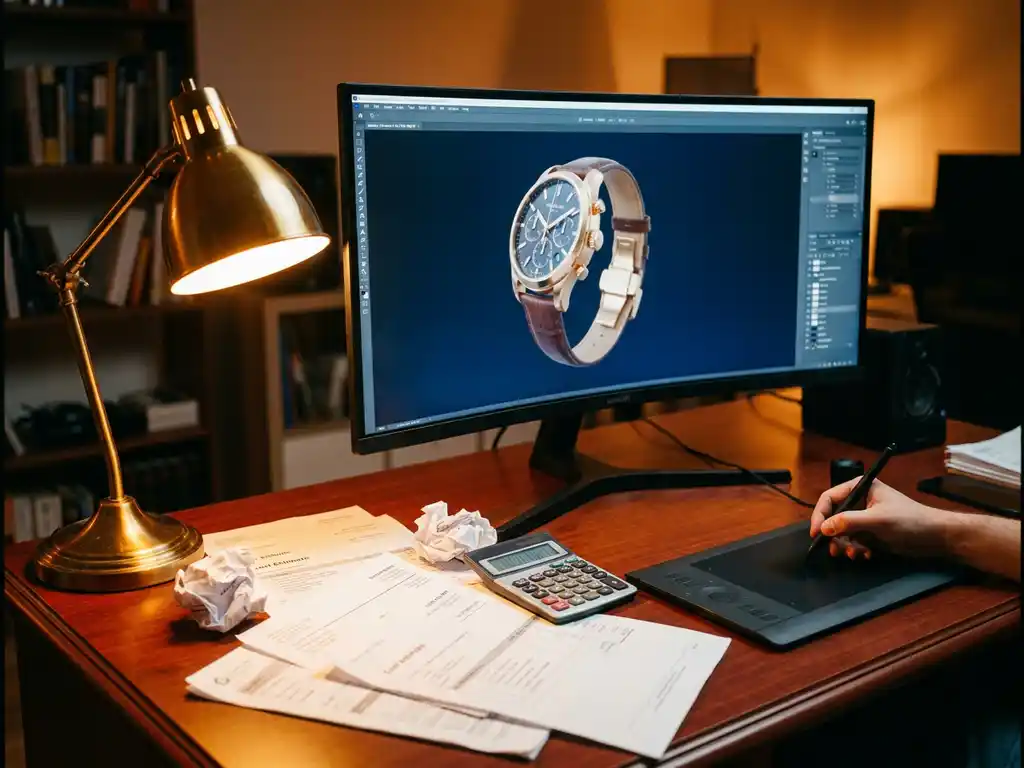
3D product rendering cost in 2026 ranges from €50 to €500 per image, depending on complexity, material requirements, and the level of photorealism your brand demands. Whether you’re pricing a single hero shot or building a full product catalog, understanding what drives rendering pricing helps you budget accurately, avoid hidden fees, and choose the right partner. This guide breaks down every pricing factor and shows why high-quality 3D product visualization delivers a stronger ROI than traditional photography for most modern brands.
Why do 3D rendering costs become unpredictable — and how can you prevent it?
Many brands discover too late that 3D rendering projects can spiral beyond initial estimates, sometimes doubling or tripling expected costs. This happens because traditional rendering services often quote based on basic parameters, then add charges for revisions, additional angles, material variations, or rush delivery. When you’re launching a new product line with dozens of configurations, these unexpected costs can quickly consume your entire visual content budget, forcing you to compromise on quality or delay your launch timeline.
The solution lies in choosing a rendering partner that offers transparent, scalable pricing from the start. Look for providers who include reasonable revisions in their base price and offer package deals for multiple product variants rather than charging per individual render.
How does choosing the cheapest 3D rendering option affect conversion rates?
Low-cost 3D rendering services frequently deliver visuals that lack the photorealism and material accuracy that premium brands require. Poor lighting, unrealistic textures, or inconsistent quality across a product range can undermine customer confidence and reduce conversion rates, particularly for high-value categories like furniture, luxury goods, and consumer electronics. When customers can’t trust what they see online, they’re less likely to complete a purchase.
Instead of focusing solely on cost per render, evaluate the total return on investment. Higher-quality 3D visuals that accurately represent your products and maintain brand standards generate better engagement, higher conversion rates, and fewer returns due to unmet expectations.
Visual Commerce Solutions
Talk to our team about your project.
What factors determine 3D product rendering costs and pricing?
The cost of a 3D product render is determined by six core variables that directly affect the time and expertise required to produce it. Each factor can independently move a render from the simple tier to the luxury tier. Understanding them before requesting a quote allows marketing and e-commerce teams to scope projects accurately and avoid mid-project cost surprises.
- Model complexity: Simple geometric products require significantly less modeling time than intricate designs with multiple moving parts, fine detailing, or organic shapes.
- Material requirements: Basic flat colors cost less than complex surfaces such as custom fabric textures, wood grains, brushed metals, or translucent materials, each of which requires skilled shader work.
- Number of product variants: Additional color options, configurations, or sizes increase the total render count, though many providers offer volume discounts for variants sharing the same base model.
- Lighting and environment setup: A single neutral studio setup is the most economical option; multiple lighting scenarios or custom lifestyle backgrounds add time and cost.
- Output resolution and format: Print-ready, high-resolution files require longer render times than web-optimized outputs.
- Turnaround time: Rush delivery, typically defined as delivery within 2–3 business days, adds 25–50% to standard pricing.
3D rendering price by industry
Generic price ranges only tell part of the story. The examples below show how 3D product rendering cost breaks down across specific industries, so you can immediately connect the numbers to your own product reality.
- Furniture & Interior — Modular sofa with 4 fabric variants and 2 configurations: This typically requires 8–12 renders. With fabric complexity and configuration switching, expect a total product rendering price of €900–€2,400, far below the cost of an equivalent photoshoot, and without a single logistics headache.
- Luxury Accessories — Leather handbag with 3 colorways: Precise material shading for leather grains, hardware finishes, and stitching detail places this in the complex tier. Three colorways across 4 angles yields roughly 12 renders, with a 3D product render cost of approximately €1,200–€2,400.
- Consumer Electronics — Wireless speaker with 2 finish variants: Clean geometry with carefully crafted surface finishes sits comfortably in the standard tier. Two variants across 5 angles produces around 10 renders at a total rendering pricing of €750–€1,500.
- Lifestyle & Outdoor — Garden chair collection of 6 pieces: Outdoor materials such as powder-coated metal and woven resin require skilled shader work. A six-piece collection at 3 angles each yields 18 renders, typically ranging from €1,350–€3,600 depending on material complexity.
In every category, once the base 3D models exist, adding further color variants or configurations costs a fraction of the original investment, making 3D rendering the most scalable visual production method available to product-led brands.
How much does a 3D product render cost per image in 2026?
A single 3D product render typically costs between €50 and €500 in 2026, depending on product complexity and quality requirements. Simple items, such as solid-color packaging or basic geometric products, fall toward the lower end of that range. Highly detailed, photorealistic renders for luxury or design-led brands sit at the higher end. Even our most accessible tier delivers the stunning photorealism that modern e-commerce demands.
The table below breaks down the four main complexity tiers to help you identify where your products sit at a glance:
| Complexity Level | Example Products | Price Range per Render | Typical Turnaround | What Is Included |
|---|---|---|---|---|
| Simple | Basic geometric items, solid-color products, packaging | €50–€100 | 3–5 business days | 1 angle, standard studio lighting, web format, photorealistic finish |
| Standard | Chairs, tables, consumer electronics, standard finishes | €75–€150 | 3–5 business days | Up to 3 angles, neutral environment, web & print formats |
| Complex | Multi-material products, organic shapes, detailed hardware | €150–€300 | 5–7 business days | Multiple angles, custom material shading, all formats, revision rounds |
| Luxury / High-End | Designer furniture, premium leather goods, multi-surface finishes | €200–€500 | 5–10 business days | Multiple angles, unlimited revisions, precision material work, all formats |
Volume significantly impacts per-render pricing. A single render priced at €300 may drop to €150–€200 per image when ordered as part of a batch of 20 renders of the same product in different configurations, making larger projects considerably more economical.
Which 3D rendering pricing model fits your project best?
Three main pricing models are used in the 3D rendering industry: per-image pricing, project-based pricing, and subscription pricing. Each suits a different type of buyer and volume requirement.
Per-image pricing charges a fixed rate for each individual render. It is straightforward for small or one-off projects but becomes expensive at scale. This model works best when you need occasional renders or have unpredictable volume requirements.
Project-based pricing bundles multiple renders into a single quote, typically offering 15–30% savings compared to individual image pricing when you commit to a defined scope. It is well suited to comprehensive product launches with a fixed deliverable list.
Subscription pricing provides monthly access to rendering services for a fixed fee, making costs predictable for brands with ongoing needs. Monthly costs typically range from €2,000 to €10,000 depending on volume and complexity. This model suits companies that regularly launch new products or require frequent visual updates to their catalog.
How does 3D rendering cost compare to traditional product photography?
3D product rendering and traditional photography are often compared on upfront cost alone, but a complete comparison must account for the full production cycle. Traditional photography for a single product, including studio rental, equipment, lighting, photographer fees, and post-production, can reach €500–€1,500 once multiple angles and configurations are included, despite basic per-product shoot rates appearing lower at €50–€100. The comparison below makes the difference clear across the factors that matter most to marketing and e-commerce decision-makers.
- Upfront cost per product: Traditional Photography: €500–€1,500 (studio, crew, post-production) | 3D Rendering: €50–€500 depending on complexity tier
- Cost per additional color variant: Traditional Photography: New shoot required (€200–€500) | 3D Rendering: Material swap only (€30–€75)
- Turnaround for 20 product variants: Traditional Photography: 2–4 weeks | 3D Rendering with us: 3–5 business days
- Flexibility for changes after delivery: Traditional Photography: Requires a reshoot | 3D Rendering: Adjustments made at minimal cost within the existing model
- Scalability: Traditional Photography: Linear cost increase per product | 3D Rendering: Decreasing per-render cost as catalog grows
- Quality consistency across catalog: Traditional Photography: Dependent on shoot conditions | 3D Rendering: Identical lighting and environment across every image
- Long-term cost for large catalogs: Traditional Photography: Compounds rapidly with each variant and update | 3D Rendering: Base models reused indefinitely, new variants at a fraction of original cost
3D rendering becomes increasingly cost-effective as a product range grows. Once a 3D model is built, producing additional views, color variants, or configuration options costs a fraction of organizing new photoshoots. You can explore our use cases to see how brands achieve significant cost savings through strategic 3D implementation. For brands managing catalogs of 20 or more products, 3D product rendering cost is consistently 40–60% lower than equivalent photography, with zero studio logistics.
Is 3D rendering worth it before investing in expensive custom furniture?
For brands commissioning custom furniture at €3,000–€8,000 per unit, the financial exposure from a production error is substantial. Without pre-approval visuals, stakeholders are essentially signing off on materials, proportions, and finishes they have never seen in context. A 3D render produced at a product rendering price of €150–€400 allows every decision-maker, from the creative director to the buyer, to validate the design before a single piece enters production. Adjustments that take minutes in 3D can cost thousands once manufacturing has begun.
The risk calculus is straightforward: a single production mistake on a custom furniture run can cost 10–20 times the price of a render. Beyond error prevention, 3D renders serve as a powerful pre-launch sales tool, enabling brands to take orders, gather retailer feedback, and build marketing assets before the physical product exists. This compresses the time between design approval and revenue generation in a way that no other visualization method can match.
We are specialists in high-end furniture visualization, with the material accuracy and photorealistic quality that luxury and design-forward brands demand. Whether you are validating a single bespoke piece or preparing an entire collection for market, our 3D render price delivers the visual certainty that protects both your production budget and your brand’s reputation. Integrating this step into your development process is not an added cost. It is the most effective risk management tool available at any 3D product rendering cost level.
What hidden costs should you budget for in 3D rendering projects?
Beyond the quoted per-render rate, three cost categories frequently catch buyers off guard in 3D rendering projects. Knowing them in advance allows marketing and procurement teams to build a more accurate total project budget.
Revision cycles are the most common unexpected expense. Most providers include 2–3 revision rounds in their base price; additional changes typically cost €25–€75 per revision depending on complexity. Clearly defining requirements, including reference images, material specs, and lighting preferences, before work begins minimizes these charges.
File format conversions and output variations add costs many clients don’t anticipate. Websites, print catalogs, and social media platforms each require different image sizes, formats, and quality settings. Budget an additional 10–15% for multi-format delivery if it is not included in your provider’s base package.
Rush delivery fees significantly impact total project cost. Standard rendering timelines of 7–10 business days maintain base pricing, but requesting delivery within 2–3 days typically adds 25–50% to the total. Planning visual content needs well in advance is the most reliable way to avoid these premium charges.
How 3Dimerce manages 3D rendering costs for design-forward brands
We specialize in high-end product visualization for design-forward brands, combining photorealistic quality with the pricing transparency and speed that modern marketing teams demand. Our approach eliminates the hidden costs and mid-project surprises that are common with traditional 3D rendering providers, while consistently delivering the visual quality that luxury and design-led brands require.
- Scalable SaaS pricing: Our platform-based approach means lower per-render costs as your needs grow, with transparent pricing tiers that scale with your business, so your 3D product rendering cost decreases as your catalog expands.
- Unlimited revisions included: We include comprehensive revision cycles in our base pricing, eliminating unexpected charges for refinements and adjustments.
- Multi-format delivery: All standard output formats are included, from web-optimized images to print-ready files, without additional conversion fees.
- Blazing fast turnaround for premium work: Our streamlined production workflow delivers photorealistic renders of even the most complex luxury products within 3–5 business days, without rush fees and without compromising the material accuracy your brand requires.
- Luxury-grade photorealism as standard: Every render we produce meets the visual standards of high-end e-commerce and print, with precise material shading, studio-quality lighting, and brand-consistent output across your entire catalog. This is not an upgrade; it is our baseline product rendering price commitment.
What brands achieve with transparent 3D rendering pricing
The impact of switching to a transparent, high-quality 3D rendering partner becomes tangible quickly. A mid-sized European furniture brand with 120 SKUs moved from studio photography to our 3D product rendering platform and, by batching color variants and configurations, reduced their per-image visualization cost by over 50% while cutting delivery time from three weeks to four days. The savings were reinvested directly into expanding their product catalog for the following season.
Brands in the luxury furniture segment typically reduce total visualization spend by 40–55% after their first full product catalog is rendered with us, while simultaneously gaining the flexibility to launch new colorways and configurations without scheduling a single photoshoot. For marketing teams managing tight launch windows, that combination of lower 3D product rendering cost and faster delivery is transformative. A lifestyle accessories brand with three product lines consolidated their entire visual production with us and eliminated rush fees entirely by working within our standard turnaround, freeing budget that had previously been absorbed by last-minute photography logistics.
Ready to discover how our visual product configuration platform can transform your product visualization while controlling costs? Contact us today to discuss your specific requirements and receive a transparent, comprehensive quote for your 3D rendering needs.
How to estimate your 3D rendering budget before requesting a quote
Building a reliable 3D product rendering cost estimate before contacting a provider puts you in a stronger negotiating position and speeds up the quoting process considerably. The five-step framework below lets you construct a rendering pricing estimate using your product list and the complexity tiers outlined in the pricing table above.
- Count your total SKUs and multiply by the number of angles needed. A standard product page typically requires 3–5 angles per item. Multiply your SKU count by your target angle count to get your baseline render volume.
- Classify each product by complexity tier. Use the pricing table above, Simple, Standard, Complex, or Luxury/High-End, and apply the corresponding price range to each SKU group. This gives you a tier-weighted render budget.
- Add 20–30% for color or material variants. Once a base model exists, additional colorways and material options are produced at roughly 20–30% of the original render cost. Multiply your variant count by this reduced rate and add it to your baseline.
- Add a 15% contingency buffer for revisions if working with a new provider. This covers any alignment work during the first project. Note that with us, unlimited revisions are already included in our base pricing, so this buffer can be redirected to expanding your render scope.
- Subtract your estimated volume discount. For orders exceeding 50 renders, volume discounts of 20–40% are standard. Apply this reduction to your subtotal to arrive at a realistic net budget figure.
Share this estimate with us when you reach out. It helps us deliver a precise, transparent quote faster and ensures there are no surprises once the project begins. The more detail you bring to the first conversation, the more accurately we can match our 3D product rendering cost structure to your exact needs.
Frequently Asked Questions
How do I calculate the total budget needed for my 3D rendering project?
Start by listing all product variants, angles, and configurations you need. Multiply the number of renders by your provider’s per-image rate, then add 15-20% buffer for revisions and format variations. For projects over 50 renders, negotiate volume discounts that can reduce costs by 20-40%.
What information should I provide to get an accurate 3D rendering quote?
Provide detailed product specifications, reference images or CAD files, desired quality level, number of angles/configurations needed, and your timeline. Include examples of the visual style you want and specify all output formats required. The more detailed your brief, the more accurate your quote will be.
Can I start with a small batch of renders and scale up later without price penalties?
Most reputable providers offer scalable pricing that improves with volume, even when you start small. However, clarify upfront whether your provider offers retroactive volume discounts or if you need to commit to larger quantities initially to secure better rates.
What's the most cost-effective way to handle multiple product color variations?
Once your base 3D model is created, color variations typically cost only 20-30% of the original render price. Request all color options upfront rather than adding them later, as batch processing is significantly more economical than individual requests.
How can I avoid revision costs while still ensuring quality results?
Create detailed style guides with reference images, specify lighting preferences, and request a test render for your first product before proceeding with the full batch. Most revision costs stem from unclear initial requirements rather than provider errors.
Is it worth investing in higher-priced 3D rendering for B2B products?
Yes, especially for high-value B2B products where purchase decisions involve multiple stakeholders. Professional-quality renders build credibility and can significantly impact deal closure rates, often justifying the 2-3x cost difference compared to basic rendering.
What should I do if my 3D rendering project goes over budget mid-way?
Immediately communicate with your provider to understand why costs increased and negotiate solutions. Options include reducing complexity on remaining renders, splitting the project into phases, or adjusting deliverable requirements. Transparent providers will work with you to find cost-effective solutions.
What is the average 3D product rendering price for a furniture collection?
A furniture collection of 10–30 pieces with multiple material options typically requires 30–90 renders, with a total 3D product rendering price ranging from €3,000 to €18,000 depending on complexity. Once base models are built, additional configurations — new fabrics, finishes, or colorways — are produced at approximately 20–30% of the original render cost, making ongoing catalog expansion highly economical.
How does 3D rendering pricing work for luxury and high-end products?
Luxury and high-end products typically command €200–€500 per render due to the need for custom material shading, precise lighting environments, and multiple revision rounds to meet exacting brand standards. Every surface — whether it is hand-stitched leather, brushed brass hardware, or woven fabric — must be reproduced with the accuracy that premium audiences expect. We are specialists in this segment: our photorealistic output is designed specifically for premium brands where visual credibility directly impacts conversion, and our pricing is structured to make luxury-grade visualization accessible at scale.