
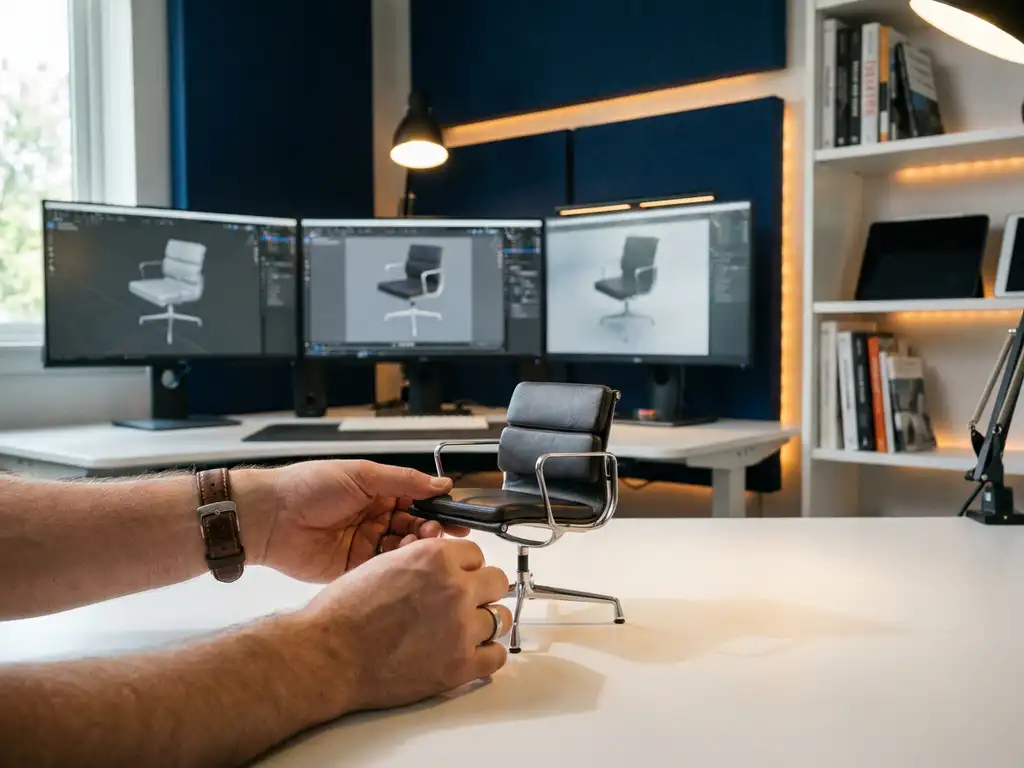
Product visualization is the process of creating digital representations of physical products using advanced rendering technologies, allowing customers to view, customize, and interact with items before purchase. This technology has become essential for modern businesses as it bridges the gap between online shopping and the tactile experience of physical retail, enabling companies to showcase their products in stunning detail while reducing costs and accelerating time-to-market.
What is dynamic and interactive product visualization?
Dynamic product visualization and interactive product visualization are two closely related but distinct capabilities that together define the modern standard for digital product presentation. Understanding the difference helps businesses choose the right approach — and the right partner — for their specific needs.
Dynamic product visualization refers to real-time rendering systems that automatically generate accurate product imagery on demand. Rather than relying on pre-shot photography, a dynamic product visualization platform uses a single 3D model to produce every variant — every color, material, and configuration — instantly. This means catalog-scale updates can be published without new photoshoots, without studio bookings, and without waiting weeks for revised assets. For brands managing hundreds or thousands of SKUs, this capability alone transforms the economics of product content production. Our real-time 3D visualization for product customization makes this possible at scale, with blazing-fast rendering that never compromises on visual quality.
Interactive product visualization places control in the hands of the customer. Users rotate products through 360 degrees, switch materials and finishes with a single click, place items in their own space via augmented reality, and move through a guided configurator flow — all in real time, directly in the browser. This user-driven exploration creates a level of engagement and purchase confidence that static imagery simply cannot replicate. As a product visualization tool and platform, 3Dimerce delivers both dynamic and interactive capabilities simultaneously, giving premium brands a single, unified solution that serves every stage of the customer journey.
Why are outdated product images costing you more customers than you realize?
Static product photography creates a significant barrier between your customers and their purchasing decisions. When shoppers can only view fixed angles and predetermined configurations, they struggle to envision how products will look in their specific environment or with their preferred customizations. This uncertainty directly translates to abandoned shopping carts, longer sales cycles, and lost revenue. Research consistently shows that customers who can interact with products through dynamic visualization are significantly more likely to complete purchases and report higher satisfaction levels. The solution lies in implementing interactive product visualization software that allows customers to explore every angle, texture, and configuration option in real time, creating the confidence they need to buy.
How is relying on physical prototypes slowing down your product launches?
Traditional product development cycles depend heavily on creating physical prototypes and conducting expensive photoshoots for every variant and configuration. This approach creates bottlenecks that can delay product launches by weeks or months, especially when dealing with complex customizable products. Each design change requires new prototypes, fresh photography sessions, and updated marketing materials across all channels. The cost compounds quickly when you factor in logistics, studio time, and the opportunity cost of delayed market entry. Modern businesses are shifting toward digital-first approaches using advanced CGI (computer-generated imagery) and 3D configuration technology, enabling them to visualize and market products before physical production even begins, dramatically accelerating their go-to-market strategy.
Visual Commerce Solutions
Talk to our team about your project.
What is digital product visualization and why is it essential for modern businesses?
Digital product visualization encompasses various technologies — including CGI rendering, interactive 3D configurators, and augmented reality — that create realistic, interactive representations of physical products. It transforms how businesses present their offerings by providing immersive, detailed views that traditional photography cannot match. Modern product visualization software enables companies to showcase products in multiple configurations, environments, and customization options without the need for extensive physical inventory or costly photoshoots.
The business case for advanced visualization is compelling and measurable. Businesses using interactive 3D configurators and dynamic product visualization consistently report:
- Conversion rate improvements of 20–40% compared to static product imagery, as customers gain the confidence to commit to a purchase
- Return rate reductions of 20–35%, as buyers arrive with a more accurate expectation of the product they will receive
- Photography cost savings of 50–70% at catalog scale, once the initial 3D model library is established
- Time-to-market acceleration of several weeks per product launch cycle, eliminating the dependency on physical prototypes and studio bookings
For businesses dealing with configurable or customizable products — such as furniture, fashion, industrial equipment, or luxury goods — visualization technology eliminates the impossible task of photographing every possible variant. Instead, a single 3D model can generate unlimited configurations, dramatically reducing content production costs while ensuring consistency across all marketing channels.
What are the different product visualiser tools and techniques?
Product visualization covers several distinct approaches, each serving different business needs and technical requirements. From entry-level photography solutions to fully immersive virtual reality environments, the right technique depends on your product complexity, catalog size, and customer journey. The table below provides a structured comparison to help you evaluate your options.
| Technique | Best For | Cost Level | Scalability | Implementation Time | 3Dimerce Offers |
|---|---|---|---|---|---|
| 360-Degree Photography | Simple products with few variants | Medium | Low — each variant requires a new shoot | Short | No |
| CGI Rendering | Large catalogs, unlimited variants, premium brands | Medium–High (high ROI at scale) | Very High — one model, infinite outputs | Medium | Yes — blazing-fast, premium quality |
| Augmented Reality (AR) | Furniture, décor, fashion — in-home and in-store placement | Medium–High | High | Medium | Yes — mobile and POS-ready |
| Interactive 3D Configurator | Configurable and customizable premium products | High (strong ROI) | Very High | Medium–Long | Yes — blazing-fast, premium quality |
| Product Video | Lifestyle, functionality, brand storytelling | Medium–High | Low — reshoots required for variants | Medium | No |
| Virtual Reality (VR) | High-end retail showrooms, B2B sales environments | High | Medium | Long | No |
Product videos combine motion, narration, and styling to communicate brand story and product functionality — particularly effective for complex or lifestyle-oriented products where demonstrating real-world use is key to conversion. Virtual reality visualization creates fully immersive product experiences, enabling customers to explore products in a virtual showroom — an increasingly valuable tool for high-end furniture, automotive, and B2B equipment sales. For brands that need CGI rendering, interactive 3D configurators, or AR — the three highest-impact techniques for configurable premium products — 3Dimerce is the specialist partner of choice.
How does 3D product configuration technology work?
Building the 3D product model
Every 3D product configurator begins with the creation of a highly accurate 3D model built from precise product specifications, engineering drawings, and physical material references. Our modeling team works directly with your design and production data to ensure every dimension, surface, and detail is captured faithfully. The result is a master digital asset that serves as the foundation for every visual output — from e-commerce imagery to AR experiences.
Once the master model is complete, it is structured to support every configuration option your product offers. Materials, finishes, components, and structural variants are all mapped into the model’s architecture, enabling the configuration engine to swap, combine, and render them without any manual intervention for each new variant.
Real-time rendering and visual accuracy
Our real-time 3D visualization for product customization uses advanced rendering technology to generate photorealistic imagery the moment a customer makes a selection. There is no waiting, no pre-rendered image library, and no compromise on quality. The rendering engine handles:
- Photorealistic material shaders that accurately replicate fabric, leather, wood, metal, and lacquer surfaces
- Dynamic lighting that responds to the product’s environment and configuration in real time
- High-resolution texture mapping for surface detail that holds up under close inspection
- Mobile optimization ensuring blazing-fast performance across all devices, from desktop to smartphone
Configuration logic and pricing integration
Beneath the visual layer sits a sophisticated rule-based configuration engine that governs every combination a customer can select. This engine ensures structural validity, material compatibility, and manufacturability — preventing customers from creating impossible or problematic configurations while preserving maximum design freedom.
- Rule-based configuration logic that enforces product constraints and compatibility rules automatically
- Dynamic pricing calculation that updates in real time as options are selected
- Inventory availability checks that prevent customers from selecting out-of-stock combinations
- ERP and PIM system connectivity through APIs and webhooks for seamless back-end synchronization
Modern configurators also incorporate user experience design principles, presenting complex customization options in intuitive interfaces that guide customers through the selection process. Real-world implementations demonstrate how this technology transforms the customer experience across various industries.
What’s the difference between traditional photography and CGI product visualization?
Traditional photography requires physical products, professional lighting setups, and skilled photographers to capture each variant and angle. While photography produces authentic images, it faces significant limitations when dealing with customizable products or large product catalogs. Every configuration change necessitates new photography sessions, making it expensive and time-consuming to maintain current visual content.
CGI product visualization creates images using computer-generated 3D models and advanced rendering algorithms. This approach offers unlimited flexibility for showcasing products in any configuration, environment, or lighting condition without physical constraints. Once the initial 3D model is created, generating new images for different variants becomes a matter of adjusting parameters rather than organizing new photoshoots.
Quality differences have largely disappeared with modern CGI technology. Advanced rendering engines produce photorealistic images that are often indistinguishable from traditional photography. In some cases, CGI surpasses photography by enabling perfect lighting conditions, eliminating unwanted reflections and shadows, and ensuring consistent quality across all product variants.
Cost and scalability favor CGI significantly, especially for businesses with extensive product catalogs or frequent updates. While initial setup requires investment in 3D modeling and software, the long-term cost per image decreases substantially as the product range expands.
Product visualization across industries: use cases and results
The value of dynamic and interactive product visualization varies by sector, but the underlying challenge is consistent: how do you present a complex, configurable product in a way that drives confident purchasing decisions? Here is how 3Dimerce addresses that challenge across the industries we serve.
Furniture & interior design
A premium furniture brand with hundreds of fabric, finish, and configuration combinations faces a near-impossible photography task. Capturing every variant at the quality level luxury buyers expect would require months of studio time and budgets that scale unsustainably with catalog growth. With dynamic product visualization, a single 3D model renders every combination on demand — the right sofa in the right fabric, in the right room context, instantly. Beyond the configurator, AR visualization allows customers to place furniture in their own home before purchasing, dramatically reducing return rates. We build these end-to-end visual commerce experiences specifically for the furniture and interior design sector.
Fashion & apparel
Seasonal collections move fast, and traditional photography struggles to keep pace. CGI product visualization allows fashion brands to produce campaign-quality imagery before physical samples are even produced, compressing the time between design approval and market launch. Interactive product visualization enables customers to explore colorways, fabric options, and styling combinations in real time — creating a more engaging online experience that bridges the gap between digital browsing and in-store discovery. For high-end fashion labels, the visual quality of our rendering matches the standard their brand demands.
Luxury goods & jewelry
In the luxury segment, every visual detail communicates brand value. A single poorly lit render or an inaccurate material representation can undermine years of brand-building. Our CGI pipeline is calibrated for the precision that luxury goods require — accurate gemstone rendering, metal surface behavior under different lighting conditions, and engraving or personalization options presented in photorealistic detail. For jewelry and accessories brands, dynamic product visualization means customers can configure personalized pieces and see an accurate representation of the finished item before committing to a bespoke order.
Industrial & B2B products
Complex industrial and B2B products — machinery, modular systems, technical equipment — are notoriously difficult to present through conventional photography. Configuration options are extensive, lead times are long, and the sales cycle involves multiple stakeholders who need to visualize the final specification clearly. Interactive product visualization shortens the sales cycle by enabling sales consultants and customers to configure products together in real time, generating accurate visual outputs and pricing summaries on the spot. We deliver these tools for manufacturers who need their sales teams equipped with a professional, reliable product visualization tool that works in the field as effectively as it does online.
How do you implement product visualization in your existing sales process?
Implementing product visualization successfully requires four clearly defined steps: auditing your current process, integrating the technology, training your team, and measuring outcomes.
Successful implementation begins with auditing your current sales process to identify where enhanced visualization will have the greatest impact. Most companies find the highest value in e-commerce product pages, in-store sales consultations, and marketing materials where customers make configuration decisions.
Technical integration requires careful planning to ensure compatibility with existing systems. Modern product visualization software typically offers APIs and plugins for popular e-commerce platforms, making integration more straightforward than in the past. The key is choosing flexible solutions that adapt to your current technology stack rather than requiring complete system overhauls.
Staff training plays a crucial role in maximizing the benefits of new visualization tools. Sales teams need to understand how to guide customers through configuration options effectively, while technical staff require knowledge of content management and system maintenance procedures.
Measuring success involves tracking relevant metrics such as conversion rates, time spent on product pages, configuration completion rates, and customer satisfaction scores. These metrics help optimize the implementation and demonstrate return on investment to stakeholders.
How 3Dimerce delivers interactive and dynamic product visualization for premium brands
At 3Dimerce, we deliver premium product visualization through our Visual Commerce Platform — a purpose-built system combining photorealistic CGI, real-time 3D configurators, and AR capabilities designed exclusively for luxury and high-end brands. Our platform is not a generic visualization tool adapted for the premium market; it is engineered from the ground up for the visual standards, configuration complexity, and performance demands that design-led and luxury brands require.
Our solution offers several key advantages:
- Blazing-fast performance across all devices with stunning visual quality that matches your premium brand positioning — no compromises on speed or fidelity
- Seamless integration with existing e-commerce platforms and point-of-sale systems through headless architecture and open APIs
- A scalable platform that grows with your product range without proportional cost increases — one model, unlimited outputs
- Comprehensive support from initial 3D modeling through ongoing content management and optimization
- Exclusive focus on luxury, design, and high-end manufacturing — we serve furniture manufacturers, fashion labels, luxury goods brands, and premium industrial producers who demand the highest visual standards
- Intuitive catalog management that empowers marketing teams to publish product updates, add new variants, and manage AR visualization platforms without developer involvement — keeping your visual content current without technical bottlenecks
Trusted by premium brands across Europe, we have helped manufacturers and retailers in furniture, fashion, and luxury goods transform the economics and quality of their product content. One of our luxury furniture clients reduced their catalog photography budget by over 60% within the first year of switching to our CGI platform. Brands in the fashion and accessories sector have used our interactive product visualization capabilities to launch seasonal collections faster and with greater visual consistency than their previous photography workflows allowed. We bring the same commitment to every engagement: stunning visuals, blazing-fast delivery, and a platform built for the brands that refuse to compromise.
With over 20 years of experience serving European manufacturers and retailers in the design and luxury segment, we understand the unique demands of premium product visualization. Our technology enables brands to eliminate dependency on costly photoshoots while maintaining the visual excellence that high-end customers expect. Contact us to discover how we can transform your product visualization strategy and accelerate your digital transformation.
How does working with 3Dimerce work? Our implementation process
Adopting a new interactive product visualization platform is a significant decision, and we believe transparency about our process is the best way to build confidence before a single contract is signed. Here is exactly how we work with clients from first conversation to live deployment.
- Discovery & Audit (Week 1–2): Our team meets with your key stakeholders — typically your e-commerce manager, product team, and IT lead — to audit your current visualization setup, catalog structure, and system architecture. We identify where interactive and dynamic product visualization will deliver the greatest commercial impact and define the project scope, priorities, and success metrics together.
- 3D Modeling & Asset Creation (Weeks 3–8): Our 3D modeling specialists build your product assets using your engineering files, design specifications, and physical material references. Every model is built to the photorealistic standard our platform requires. You review and approve each model before it enters the configuration pipeline. For complex catalogs, we phase the asset creation to deliver the highest-priority products first.
- Configuration Logic & Rules Setup (Weeks 6–10): We map your product’s configuration rules — material compatibility, structural constraints, pricing logic, and inventory rules — into the platform’s configuration engine. This is where your product’s complexity is translated into a seamless, error-free customer experience. Your product and commercial teams validate the logic against real-world scenarios.
- Platform Integration (Weeks 8–12): Our technical team integrates the Visual Commerce Platform with your existing e-commerce stack, PIM, ERP, and any point-of-sale systems. We use headless APIs and established connectors for major platforms to minimize disruption to your existing infrastructure. Your IT team is involved at every stage and receives full technical documentation.
- Quality Review & Approval (Weeks 10–14): Before launch, we conduct a comprehensive quality review covering visual accuracy, configuration logic, performance across devices, and integration reliability. Physical product samples are compared against rendered outputs. You sign off on every aspect before anything goes live.
- Launch & Ongoing Optimization: We support your go-live and monitor performance in the first weeks after launch. Beyond deployment, we provide ongoing optimization — updating assets as your catalog evolves, refining configuration logic, and ensuring your marketing team can manage catalog updates independently through our intuitive platform interface.
Contact us to start your discovery session and receive a tailored implementation plan built around your products, your systems, and your timeline.
Frequently Asked Questions
How long does it typically take to implement a 3D product configurator for my business?
Implementation timelines vary based on product complexity and catalog size, but most projects take 6-12 weeks from initial 3D modeling to full deployment. Simple products with fewer customization options can be ready in 4-6 weeks, while complex configurable products with extensive rule sets may require 3-4 months. The process includes 3D model creation, configuration logic development, system integration, and thorough testing to ensure seamless performance.
What happens to my existing product photography and marketing materials after switching to CGI visualization?
Your existing photography doesn’t become obsolete immediately – many businesses run hybrid approaches during transition periods. CGI visualization is typically implemented for new products and major variants first, while existing photography remains for established items. Over time, you can gradually replace static images with interactive CGI as you update your catalog, creating a more cohesive and engaging visual experience across all products.
How do I ensure the CGI renderings accurately represent my actual products?
Accuracy depends on precise 3D modeling using exact product specifications, materials samples, and color references. Professional visualization providers use calibrated color systems and material libraries that match real-world properties. The process includes multiple review stages where physical samples are compared against digital renderings, with adjustments made until the CGI achieves photorealistic accuracy that meets your quality standards.
Can product visualization technology integrate with my existing inventory management system?
Yes, modern product visualization platforms are designed with integration capabilities through APIs and webhooks that connect to most inventory management systems. This ensures that configuration options reflect real-time stock availability, preventing customers from selecting unavailable combinations. The integration also enables automatic pricing updates and can trigger inventory alerts when configured products approach stock limits.
What's the typical return on investment for implementing advanced product visualization?
Most businesses see ROI within 12-18 months through increased conversion rates (typically 20-40% improvement), reduced photography costs, and faster product launches. Additional benefits include decreased return rates due to better customer understanding of products, reduced sales consultation time, and the ability to market products before physical production. The exact ROI depends on your current photography costs, product complexity, and sales volume.
How do I train my sales team to effectively use interactive product configurators?
Effective training focuses on understanding customer journey mapping and guiding prospects through configuration options without overwhelming them. Sales teams should learn to identify customer needs first, then demonstrate relevant features and customization options. Most visualization platforms include training materials and best practices guides, and many providers offer hands-on workshops to help teams master the technology and integrate it naturally into their sales conversations.
What technical requirements do my customers need to use 3D product configurators?
Modern configurators are designed to work on standard web browsers and mobile devices without requiring special software or plugins. Most solutions use WebGL technology that’s supported by all major browsers on desktops, tablets, and smartphones. The main requirement is a stable internet connection, and leading platforms optimize performance to ensure smooth operation even on older devices or slower connections.