
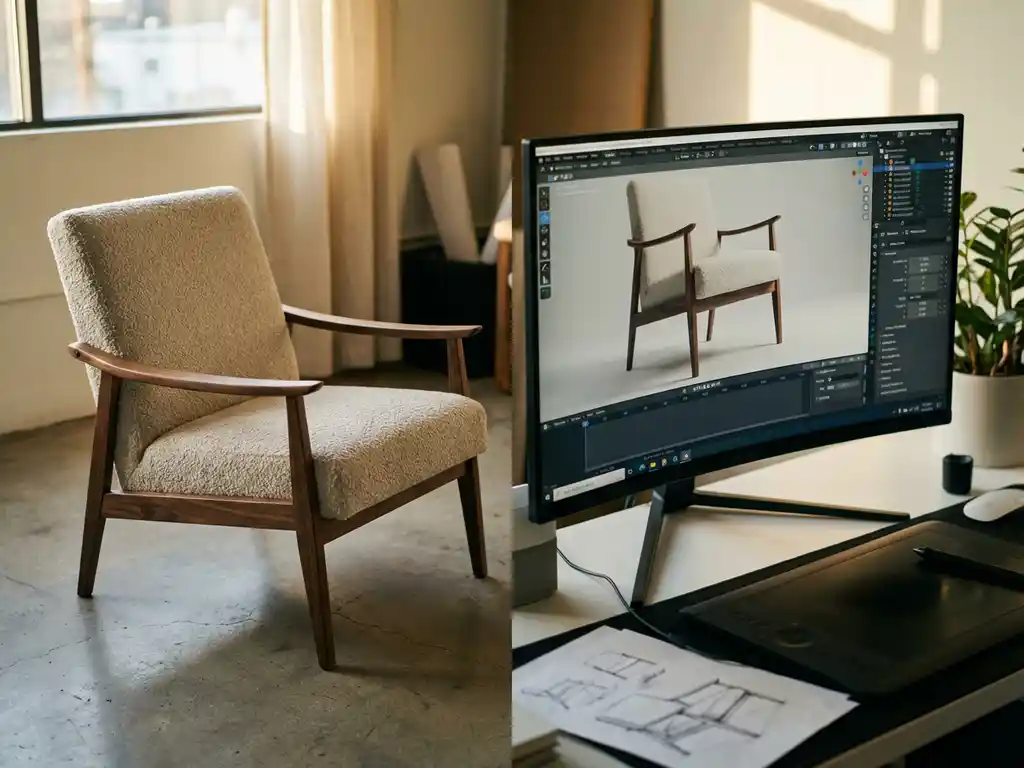
AI is transforming 3D product rendering by automating complex processes, reducing production time from weeks to hours, and enabling real-time quality improvements. Machine learning algorithms now handle lighting calculations, texture generation, and scene optimization that previously required extensive manual work. This technological shift is making high-quality product visualization more accessible and cost-effective for businesses across industries.
In this article, you will learn:
- What AI-powered 3D product rendering is and why it represents a fundamental shift in product visualization.
- How AI reduces rendering time by up to 90% and improves visual quality compared to traditional CGI workflows.
- The key challenges and limitations — including luxury material accuracy and brand color fidelity — that businesses should anticipate.
- How AI will transform product configurators and enable real-time customization at scale.
- What the future of AI in CGI, AR/VR, and personalized visual experiences means for your brand.
What is AI-powered 3D product rendering, and why does it matter?
AI-powered 3D product rendering combines artificial intelligence with traditional computer graphics to automate and enhance the creation of photorealistic product images. Techniques such as neural radiance fields (NeRF) and diffusion-based synthesis allow AI systems to analyze lighting patterns, material properties, and scene composition to generate high-quality visuals with minimal human intervention. This technology represents a fundamental shift from manual rendering processes to intelligent automation — one that directly reduces cost and time-to-market for product visualization.
The impact stems from AI’s ability to learn from vast datasets of real-world imagery and apply that knowledge to synthetic scenes. Traditional CGI-based product visualization workflows required skilled artists to manually adjust every aspect of lighting, materials, and camera angles. AI systems can now make these decisions automatically, understanding how different materials react to light and how products appear in various environments.
This transformation reduces the barrier to entry for high-quality product visualization. Businesses no longer need large teams of specialized 3D artists to create professional-grade imagery. AI handles the technical complexity while maintaining the visual quality that premium brands require.
How does AI improve the speed and quality of 3D rendering?
AI algorithms accelerate rendering processes by predicting pixel values and optimizing computational paths — in production environments, this can reduce render times by up to 90% compared to traditional CPU-based methods, compressing multi-day workflows into hours. For a typical e-commerce catalog of 500 SKUs, this speed advantage can translate into weeks of recovered production time per launch cycle. As of 2026, these gains are no longer theoretical — they are being realized by forward-thinking brands in furniture, fashion, and luxury retail.
Machine learning techniques enhance visual quality through intelligent denoising and upscaling. AI-driven denoising networks and path-tracing accelerators analyze scene composition and automatically adjust parameters such as depth of field, exposure, and color grading to produce more accurate and appealing final images. AI can identify and correct artifacts that would typically require multiple rendering passes to eliminate, delivering higher-quality results in a fraction of the time.
The practical difference between traditional and AI-enhanced workflows is significant. Where conventional rendering might require overnight processing for complex scenes, AI-powered systems can deliver comparable results in minutes. This speed enables iterative design processes, allowing teams to experiment with different product configurations and receive immediate visual feedback.
Automated optimization features continuously improve output quality without manual intervention. AI systems learn from each rendering task, building knowledge about what produces the best results for specific product types and viewing conditions.
AI Rendering vs. Traditional CGI: A Side-by-Side Comparison
For business decision-makers evaluating whether to adopt AI-powered rendering, the differences between traditional CGI and AI-driven workflows go well beyond speed. The table below illustrates the key dimensions across which these two approaches diverge — helping you understand where the most meaningful gains are realized in a production environment.
| Dimension | Traditional CGI Rendering | AI-Powered Rendering |
|---|---|---|
| Production time per SKU | Days to weeks | Hours |
| Number of specialists required | Multiple dedicated 3D artists | Reduced — AI handles technical execution |
| Cost per image | High — intensive manual labor | Significantly lower at scale |
| Iteration speed | Slow — each change requires manual rework | Fast — adjustments generate updated visuals in minutes |
| Consistency across variants | Variable — dependent on individual artist | High — AI applies uniform parameters across all SKUs |
| Scalability | Linear — more products require proportionally more time | Exponential — output scales without proportional cost increase |
For design and luxury brands, the quality ceiling of AI rendering has now reached parity with traditional photorealistic CGI. What once required weeks of painstaking manual work from senior 3D artists can today be achieved through intelligent automation — without compromising the visual precision that premium positioning demands. This is precisely the standard we hold ourselves to at 3Dimerce.
That said, human artistry still adds irreplaceable value in areas such as creative direction, brand storytelling, and the final refinement of hero visuals. The most effective AI rendering pipelines — including our own — combine automated efficiency with expert human oversight, ensuring that every image reflects both technical excellence and genuine brand character.
Visual Commerce Solutions
Talk to our team about your project.
What are the biggest challenges AI faces in 3D product visualization?
Despite its advantages, AI-powered 3D product rendering has meaningful limitations that businesses should understand before adopting it. Current technology struggles with consistency across different product types and materials — particularly complex textures such as fabric, leather, or translucent surfaces. Quality can vary between similar scenes, which means human oversight remains necessary to ensure brand standards are maintained.
Integration with existing design and e-commerce systems creates additional hurdles. Many AI rendering tools operate as standalone applications, making it difficult to incorporate them into established production workflows. This disconnection can slow output rather than accelerate it, particularly for businesses managing large or complex product catalogs.
Technical limitations become more apparent with highly detailed products or unusual material combinations. AI systems trained primarily on common consumer goods may underperform with specialized industrial products or luxury items that have unique surface properties. Accurate brand color reproduction — critical for fashion and premium design brands — remains a known challenge for current AI rendering systems.
The rendering of hero products with complex geometry presents a further challenge. Multi-component furniture assemblies, layered textile products, or items combining multiple distinct materials require a level of structural understanding that generic AI models do not always possess. In these cases, human-in-the-loop review remains essential — a trained specialist must validate that every component is rendered correctly and that the overall composition reflects the product’s real-world appearance. This is where professional AI rendering pipelines, like the one we operate at 3Dimerce, distinguish themselves from off-the-shelf solutions.
Maintaining Brand Color Accuracy at Scale
One of the most underappreciated challenges in AI texture generation and photorealistic material rendering is the faithful reproduction of brand-specific colors. AI models trained on generic datasets often misrepresent Pantone-matched brand colors, particularly for materials such as anodized aluminum, matte fabric, or high-gloss lacquer finishes. A subtle shift in hue or saturation — imperceptible in isolation — can undermine brand consistency across a full product catalog.
Professional AI rendering pipelines address this through calibrated material libraries and color-profile integration, ensuring that every rendered asset adheres to the brand’s approved color standards. At 3Dimerce, we build and maintain material libraries tailored specifically to each client’s product range, so that brand color fidelity is preserved whether you are rendering ten SKUs or ten thousand. For luxury and design brands where visual precision is a direct expression of quality, this level of control is not optional — it is fundamental.
High-gloss lacquers, natural stone, hand-stitched leather, and precious metals each present distinct rendering challenges that require specialized AI training data and material modeling. These surfaces interact with light in highly complex ways — reflections, subsurface scattering, and micro-surface detail all contribute to the perception of quality. Achieving accurate results at scale demands both advanced AI capability and deep material expertise, a combination that sets specialist partners apart from generalist rendering platforms.
Human expertise remains essential for creative direction, brand consistency, and quality control. AI optimizes technical parameters effectively, but decisions about market positioning, aesthetic intent, and brand identity still require human judgment.
How will AI transform product configurators and customization tools?
AI will enable product configurators to move beyond static menus of options toward intelligent, personalized experiences. By analyzing user behavior and preferences, AI can automatically surface the most relevant customization choices, reducing decision fatigue while increasing customer satisfaction. Real-time 3D configuration capabilities allow customers to see their selections instantly across multiple viewing angles and environments — without waiting for manual updates.
Automated variant generation becomes practical when AI understands a product’s structure and design rules. Instead of manually creating every possible configuration, systems generate new combinations on demand, ensuring customers always see an accurate representation of what they are purchasing. This capability is particularly valuable for furniture and design products, where customization options can number in the thousands.
Personalized recommendations will emerge from AI’s ability to analyze customer behavior at scale. Systems will learn which color combinations, materials, and features appeal to different customer segments, offering tailored suggestions that support both conversion and satisfaction.
AI will also inform configurator interface design by identifying where users drop off or hesitate, allowing teams to adjust the experience based on real interaction data rather than assumptions.
AI-Powered 3D Rendering Across Industries: Furniture, Fashion, and Luxury Goods
The impact of AI 3D rendering is not uniform across sectors — it is shaped by the specific visualization challenges and commercial pressures of each industry. Understanding how AI addresses these sector-specific needs is critical for decision-makers evaluating whether and how to adopt it. Below, we examine three industries where the technology is delivering the most transformative results.
Furniture and Interior Design
Furniture presents some of the most demanding challenges in 3D product visualization for e-commerce. Products combine multiple distinct materials — wood grain, fabric upholstery, metal hardware, glass — each requiring accurate rendering of texture, reflectivity, and surface variation. AI rendering handles these complex multi-material compositions with a consistency and speed that traditional CGI workflows struggle to match at catalog scale.
Beyond static imagery, real-time 3D configuration is transforming how customers engage with furniture online. AI-powered configurators allow shoppers to select fabric colors, wood finishes, and dimensions and immediately see a photorealistic representation of their chosen combination — in some cases, visualized within their own room dimensions using AR integration. For furniture retailers managing thousands of possible configuration variants, this capability eliminates the need to pre-render every combination, dramatically reducing production overhead while improving the customer experience.
Fashion and Apparel
In fashion, the cost and logistical complexity of physical sample photography for every SKU variant has long been a bottleneck for brands managing large seasonal collections. AI rendering addresses this directly by generating fabric drape, sheen, and colorway variants at scale — producing accurate visual representations of garments without the need for physical samples. For a brand launching hundreds of colorways across multiple styles, this represents a fundamental shift in how visual content is produced and scaled.
AI texture generation has advanced to the point where fabric behavior — including the way a material folds, catches light, or moves — can be simulated with high fidelity. This enables fashion brands to present products consistently and accurately across all digital channels, from e-commerce product pages to social media and digital lookbooks, all generated from a single 3D asset rather than multiple separate photoshoots.
Luxury Goods and Jewelry
For luxury goods and jewelry, the rendering bar is exceptionally high. Precious metals must reflect light with precision, gemstones must refract and scatter light convincingly, and hand-crafted surface details must be visible at the micro level. These are exactly the rendering challenges where generic AI tools fall short — and where specialist expertise makes the decisive difference.
3Dimerce specializes in this high-end segment, delivering AI-generated product visuals that are indistinguishable from professional studio photography. Our approach combines advanced AI rendering with deep knowledge of luxury material properties, ensuring that every visual communicates the quality and craftsmanship that luxury consumers expect. For brands where a single image can define a purchase decision worth thousands, the precision we bring to photorealistic product rendering is not a detail — it is the entire point.
What does the future of AI in 3D product rendering and CGI look like?
The near-term trajectory of AI in 3D product rendering points toward fully automated content creation pipelines, where product specifications automatically generate AI-generated product visuals and complete visual campaigns across multiple channels and formats. Advanced neural networks — powered by generative AI and real-time neural rendering — will increasingly understand brand aesthetics and adapt imagery to different platforms and audiences while maintaining visual consistency. Integration with augmented reality (AR) and virtual reality (VR) will create immersive shopping experiences that reduce the gap between digital and physical retail.
Real-Time Photorealistic Rendering on Mobile and AR/VR
Anticipated developments include real-time photorealistic rendering on mobile devices, enabling customers to visualize products in their own spaces with greater accuracy than current AR tools allow. As processing power on consumer devices continues to advance, the gap between studio-quality rendering and what is achievable in a live AR environment will narrow significantly. For furniture, interior design, and luxury goods brands, this means customers will be able to make confident purchasing decisions based on a near-perfect digital preview of the physical product.
VR integration will take this further, enabling fully immersive product experiences — virtual showrooms, interactive product demonstrations, and brand environments — all powered by AI rendering that adapts in real time to user interaction. These experiences will become an increasingly important differentiator for premium brands seeking to replicate the sensory richness of physical retail in digital channels.
Hyper-Personalized Dynamic Product Imagery
AI will also enable dynamic product imagery that adapts to individual customer profiles — showing the same product in different contexts based on browsing behavior and preferences. A customer who consistently engages with minimalist interior design content might see a sofa rendered in a clean, Scandinavian-inspired setting, while another customer with a preference for maximalist aesthetics sees the same product in a richly styled environment. This level of personalization increases relevance, dwell time, and ultimately conversion rates for luxury e-commerce brands where emotional engagement is a key purchase driver.
Product marketing will evolve toward dynamic, personalized visual experiences that respond to customer needs in real time — fundamentally changing how brands present products and how customers make purchasing decisions.
The Democratization of High-Quality CGI for All Business Sizes
The long-term implication for the CGI industry is a broad democratization of high-quality visualization. Smaller businesses will gain access to visual quality that was previously feasible only for major brands, while established companies will redirect creative resources toward strategy and brand development rather than technical execution. The cost and complexity barriers that once made photorealistic product rendering the exclusive domain of large enterprises are steadily being removed by advances in AI.
At 3Dimerce, we are committed to making enterprise-grade AI visualization accessible without enterprise-scale complexity — bringing the same stunning visual quality we deliver to leading design and luxury brands within reach of ambitious businesses at every stage of growth.
The future of AI-powered 3D rendering is not a distant prospect — it is available today for brands ready to act. At 3Dimerce, we have built our platform around precisely these emerging capabilities, combining cutting-edge AI with deep expertise in the design and luxury segment. Discover what this means for your product visualization below.
How 3Dimerce Elevates Your Brand with AI-Powered 3D Product Visualization
3Dimerce integrates AI into a visual product experience platform built for the design, luxury, and high-end market — where visual accuracy and brand consistency are non-negotiable. Our AI-enhanced system automatically optimizes lighting, materials, and scene composition, delivering the photorealistic product rendering for e-commerce that premium brands demand at a fraction of traditional production time. Every output is tailored to the product and brand, not generated from a generic template.
Key capabilities of our AI-driven platform include:
- Automated rendering optimization that delivers fast visual updates without sacrificing quality
- Intelligent material and lighting adjustment calibrated for high-end product presentation
- Real-time configuration rendering that responds instantly to customer choices
- Seamless integration with existing e-commerce and sales systems
- Scalable visual content generation that grows with your product range
We combine AI efficiency with hands-on creative expertise, ensuring that every visual meets your brand standards while benefiting from the latest advances in rendering technology. Our experienced team specializes in implementing AI-powered solutions that transform product visualization workflows for businesses in furniture, fashion, electronics, and luxury goods. Ready to see what AI-powered 3D rendering can do for your product presentation? Contact us to discuss your project.