
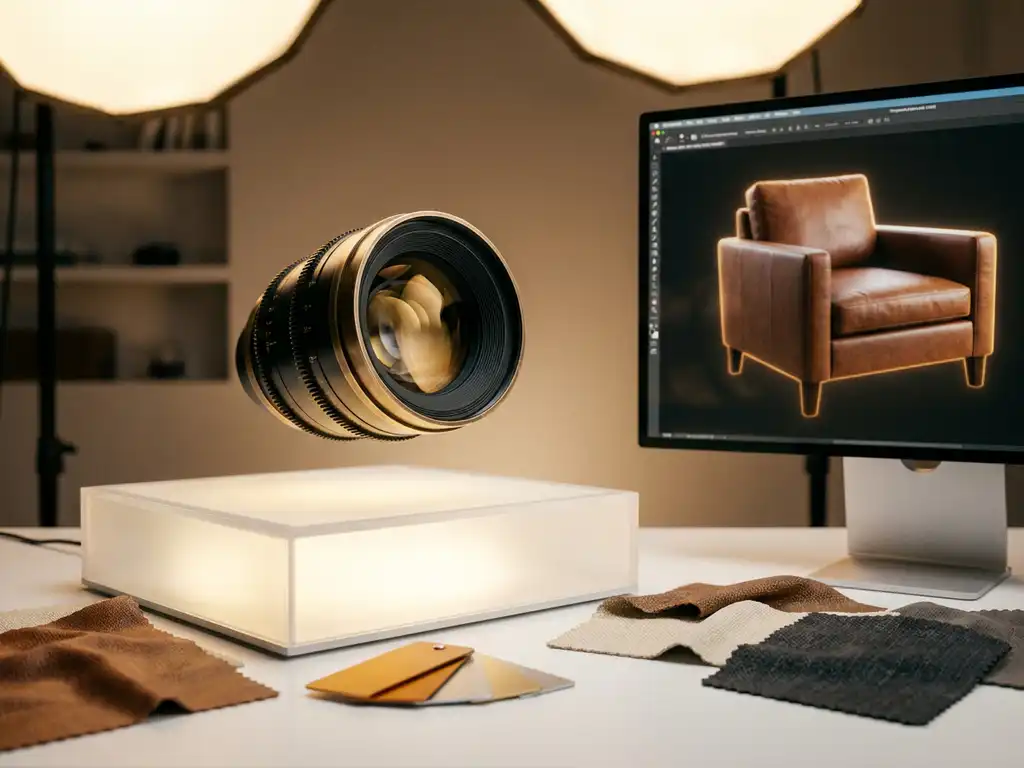
3D product rendering is the process of creating photorealistic images or animations of a product using computer-generated imagery (CGI) software. Instead of physically building and photographing a product, a 3D model is built digitally, lit, textured, and rendered into a final visual. It is especially valuable for brands selling configurable, design-led, or high-end products where visual quality directly influences purchase decisions. Below, we answer the most common questions about how it works, what it delivers, and how to get the most from it.
How does 3D product rendering actually work?
3D product rendering works by building a digital model of a product, applying realistic materials and textures, setting up virtual lighting, and then processing the scene through rendering software to produce a final image. The result is a computer-generated visual that can look indistinguishable from a traditional photograph, but is produced entirely in a digital environment.
The process typically follows these steps:
- 3D modelling: A detailed digital model of the product is created, capturing its exact geometry, proportions, and design details.
- Texturing and materials: Surface properties are applied to the model, including colour, gloss, roughness, fabric weave, wood grain, or any other material characteristic.
- Lighting setup: Virtual light sources are positioned to simulate natural or studio lighting conditions, including shadows, reflections, and ambient light.
- Rendering: The software processes the scene and calculates how light interacts with every surface, producing the final image.
- Post-processing: Minor adjustments to contrast, colour grading, or composition may be applied to finalise the output.
Modern rendering engines have become extraordinarily powerful, capable of producing images with touchable textures, perfectly irregular contours, and natural light behaviour that mirrors the physical world. For brands with large product ranges or frequent updates, this digital workflow is far faster and more scalable than organising repeated physical photoshoots.
What makes a product render look photorealistic?
A photorealistic product render depends on three core elements working together: an accurate and detailed 3D model, physically correct material definitions, and a well-constructed lighting environment. When all three are executed at a high level, the resulting image is virtually indistinguishable from a studio photograph.
Material quality is often the most critical factor. Every surface in the real world reflects, absorbs, and scatters light differently. A velvet sofa behaves nothing like a polished marble tabletop. High-quality rendering uses physically based rendering (PBR) techniques, which simulate how real materials interact with light rather than simply applying a flat colour or texture. This produces the subtle imperfections, depth, and tactile quality that make an image feel real.
Lighting is equally important. Harsh or poorly placed virtual lighting immediately reveals a render as artificial. Skilled lighting setups replicate the soft gradients, natural shadows, and reflected highlights that the human eye instinctively associates with real photography. For premium and luxury products, this level of precision is not optional; it is what separates a convincing visual from a digital illustration.
Finally, the resolution and detail of the 3D model itself matters. Rounded edges, surface imperfections, and fine structural details all contribute to the sense of physical presence. A model that is too geometrically clean or simplified will look artificial regardless of how well it is textured or lit.
Visual Commerce Solutions
Talk to our team about your project.
What’s the difference between product rendering and traditional product photography?
The key difference between 3D product rendering and traditional product photography is that rendering produces images entirely in a digital environment, while photography captures a physical product in the real world. Rendering offers greater flexibility, scalability, and long-term cost efficiency, while traditional photography has historically been valued for its immediate realism.
Here is how the two approaches compare across the factors that matter most to product brands:
- Speed: Traditional photography requires physical samples, studio booking, styling, shooting, and editing. Rendering can produce new visuals from an existing 3D model in a fraction of the time.
- Cost at scale: Photography costs multiply with every new variant, colour, or configuration. Rendering costs remain relatively stable once the base model exists, making it far more economical for large or configurable product ranges.
- Flexibility: Changing a background, colour, material, or environment in a render takes minutes. Reshooting a physical product to achieve the same change takes days.
- Consistency: Renders can be produced to exact specifications every time, ensuring perfectly consistent visuals across all channels and markets.
- Configurability: Rendering is the only practical approach when a product has dozens or hundreds of possible configurations. Photography simply cannot keep pace.
For brands selling design-led or premium products, the quality gap between rendering and photography has effectively closed. High-end 3D product rendering now routinely matches or exceeds the visual standard of professional studio photography, while offering far greater agility.
What types of products benefit most from 3D rendering?
Products that benefit most from 3D rendering are those with multiple configurations, variants, or customisation options, or those that are expensive and complex to photograph at scale. Furniture, interior design products, lighting, kitchen and bathroom fittings, outdoor equipment, and luxury goods are among the strongest use cases.
The common thread is complexity and variety. A sofa available in twelve fabric options, three leg finishes, and two sizes creates hundreds of possible visual combinations. Photographing every combination is logistically impractical and prohibitively expensive. A 3D rendering approach solves this entirely: once the model is built, any configuration can be rendered on demand.
Products where tactile quality and premium perception are central to the brand also gain significantly from high-quality rendering. When the rendering accurately conveys the weight, texture, and craftsmanship of a product, it supports the premium positioning of the brand in a way that flat or inconsistent photography cannot.
Products that are still in development also benefit. Renders can be produced before a physical prototype exists, enabling brands to use accurate visuals in catalogues, marketing materials, and sales tools ahead of launch.
How can product rendering be used across sales channels?
3D product rendering can be deployed consistently across every sales channel, including e-commerce, in-store retail, printed catalogues, sales presentations, and digital advertising. Because the visuals are generated digitally, the same underlying assets can be adapted and repurposed for each channel without additional photoshoots.
In an e-commerce environment, rendered images can be combined with interactive product configuration tools that allow customers to customise a product and see their chosen configuration visualised in real time. This significantly reduces purchase uncertainty and increases conversion, particularly for high-value or complex products.
In physical retail, rendered visuals support in-store configurator screens and point-of-sale displays, enabling sales staff to guide customers through options without relying on physical samples or printed swatches. This is especially valuable for showroom environments where floor space is limited but the product range is wide.
For marketing and brand communications, rendered imagery provides a consistent visual standard across all touchpoints. Whether a product appears on a website, in a social media campaign, in a printed brochure, or on a trade show stand, the visual quality and brand presentation remain uniform. This consistency is a significant asset for premium brands where visual coherence is central to brand equity.
What should you look for in a product rendering solution?
When evaluating a 3D product rendering solution, the most important factors are visual output quality, scalability across your product range, integration capability with existing sales and e-commerce systems, and the level of support provided during implementation. For premium brands, quality is non-negotiable; the visuals must reflect the standard of the products they represent.
Key criteria to assess include:
- Photorealism: Can the solution produce renders that genuinely match the quality of professional photography? Ask to see examples from comparable product categories.
- Scalability: How efficiently can new products, variants, or configurations be added? The cost per additional variant should decrease as your library grows, not increase.
- Integration: Does the solution integrate smoothly with your webshop, ERP, or CPQ system? Headless integration capabilities are particularly valuable for complex environments.
- Configuration capability: If you sell configurable products, can customers interact with and customise the product visually in real time?
- Performance: Do the visuals load quickly across all devices, including mobile? Speed matters as much as quality for online conversion.
- Industry experience: Does the provider have a proven track record in your sector, particularly in design-led or premium product categories?
The right solution should feel like a long-term platform investment, not a one-off production service. As your product range evolves, the system should grow with it without requiring proportional increases in budget or effort.
How We Help You Get the Most from 3D Product Rendering
We built our platform specifically for brands and manufacturers who refuse to compromise on visual quality. At 3Dimerce, we combine over two decades of expertise in CGI and virtual product experiences to deliver rendering solutions that are as fast as they are stunning. Here is what working with us looks like in practice:
- Photorealistic output at every scale: Our renders capture touchable textures, natural light behaviour, and perfectly irregular contours that bring even the most complex products to life.
- Real-time product configuration: We integrate rendering directly into interactive configurators, enabling customers to visualise their exact choices online or in-store.
- Seamless integration: Our platform connects with your existing webshop, CPQ system, and point-of-sale environment through flexible headless integration.
- Omnichannel consistency: One set of digital assets, perfectly adapted across every channel, from your webshop to your showroom floor.
- Scalable without extra cost per variant: Once your product is modelled, adding new configurations, colours, or materials is fast and cost-efficient.
If you are ready to replace slow, expensive photoshoots with a smarter, more scalable approach to product visuals, we would love to show you what is possible. Get in touch with our team and let us talk through your product range and goals.
Frequently Asked Questions
How long does it typically take to produce a 3D product render from scratch?
The timeline depends on the complexity of the product and the number of assets required, but a typical project moves from 3D modelling through to final renders within one to three weeks. Simple products with straightforward geometry and few material variants can be turned around faster, while highly complex or configurable products with large asset libraries naturally take longer. Once the base model is built and approved, producing additional variants, colour options, or scene setups is significantly quicker than the initial build.
What files or information do I need to provide to get started with 3D product rendering?
To build an accurate 3D model, a rendering studio or platform will typically need technical drawings, CAD files, or detailed reference photographs of the product from multiple angles. Material samples, fabric swatches, finish specifications, and brand colour references are also essential for achieving accurate textures and surface properties. The more precise the reference material you can provide, the closer the final render will be to the real product — which is especially important for premium or design-led products where accuracy directly affects brand perception.
Can 3D product renders be used before a physical product exists?
Yes, and this is one of the most strategically valuable applications of 3D rendering. Brands can commission photorealistic visuals based on design files or CAD data before a physical prototype or production sample has been made, enabling them to use accurate imagery in pre-launch marketing, catalogues, trade show materials, and sales tools. This removes the dependency on physical production timelines and allows marketing and sales teams to go to market faster and with greater visual confidence.
How do I know if the renders will accurately represent my product's materials and finishes?
Reputable rendering providers will produce material and finish tests as part of the onboarding or approval process, allowing you to review and sign off on how each fabric, surface, or finish is represented before full production begins. Providing physical samples or detailed finish specifications gives the 3D team the reference points needed to calibrate materials accurately. It is also worth asking to see examples of comparable materials the provider has rendered previously — a strong portfolio in your product category is a reliable indicator of what you can expect.
What is the difference between static 3D renders and real-time rendering, and which do I need?
Static renders are pre-produced, high-resolution images generated by processing a scene through rendering software — ideal for product pages, catalogues, advertising, and any context where a fixed, high-quality image is required. Real-time rendering, by contrast, generates visuals dynamically as a user interacts with a product configurator, updating instantly as they change colours, materials, or configurations. If your products are configurable and you want customers to visualise their choices online or in-store, real-time rendering integrated into an interactive configurator is the more powerful approach — and the one that tends to have the greatest impact on conversion.
Will 3D product renders work well on mobile devices?
Yes, provided the solution has been built with performance optimisation in mind. High-resolution static renders should be properly compressed and served in modern image formats to ensure fast load times on mobile without sacrificing visual quality. For real-time configurators, the rendering engine must be optimised for mobile performance, as slower load times or laggy interactions on smaller devices will undermine the user experience and reduce conversion. When evaluating a rendering solution, it is worth specifically testing its mobile performance across different devices and connection speeds before committing.
What are the most common mistakes brands make when adopting 3D product rendering for the first time?
The most frequent mistake is underinvesting in the quality of the initial 3D models, which then limits the quality of every render produced from them — it is far more cost-effective to build accurate, high-detail models from the outset than to rebuild them later. Brands also sometimes treat rendering as a like-for-like replacement for photography rather than as a more flexible, scalable system, missing the opportunity to produce variant imagery, lifestyle scenes, and configurator assets from the same underlying asset. Finally, failing to plan for integration with existing e-commerce or sales systems early in the process can create unnecessary delays and technical friction down the line.