
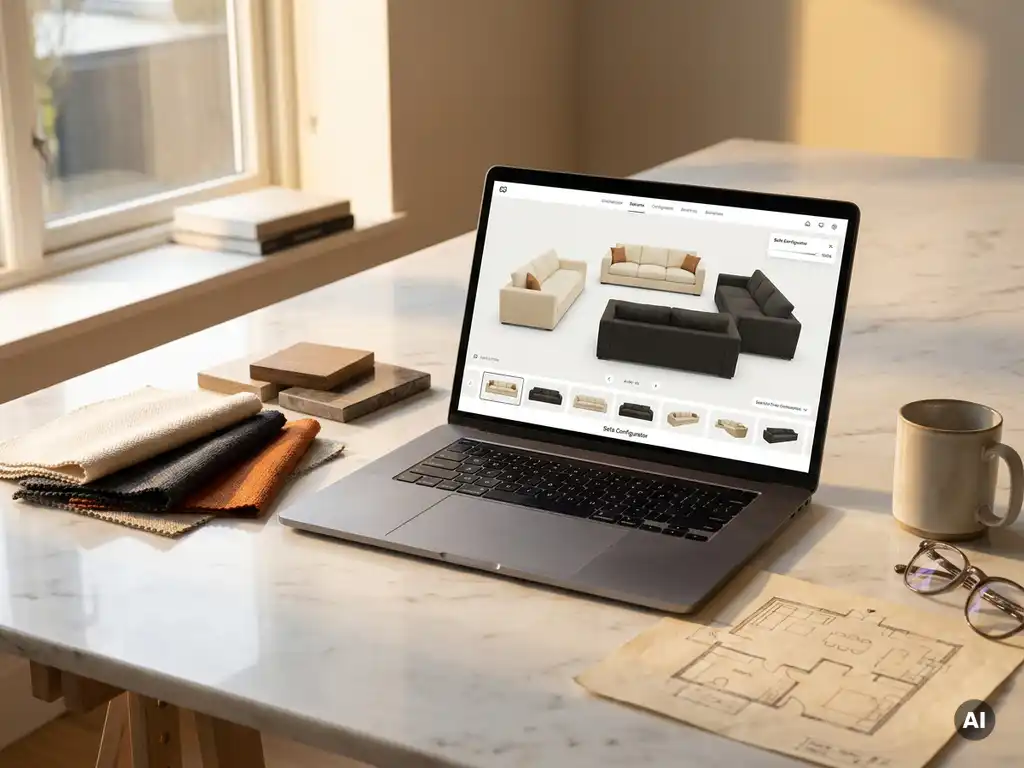
The best CPQ software for the furniture and interior design industry combines photorealistic visual product configuration with accurate, rules-based pricing and quoting, all in one seamless platform. Generic CPQ tools fall short for design-led brands because furniture is complex: materials, dimensions, finishes, and custom combinations all affect price in ways that require specialist logic. Below, we answer the most common questions buyers in this industry ask before choosing a CPQ solution.
What makes CPQ software different for furniture and interior design?
CPQ software for furniture and interior design must handle a level of product complexity that most off-the-shelf CPQ tools are not built for. A sofa can come in dozens of fabric options, multiple configurations, and custom dimensions, each combination carrying its own price logic. A strong CPQ tool in this space translates that complexity into a smooth, guided buying experience without overwhelming the customer or the sales team.
Standard CPQ platforms are often designed around relatively simple product catalogues. Furniture and interior brands deal with configurable products where a single item can produce thousands of valid variants. The CPQ software needs to enforce compatibility rules (so a customer cannot select incompatible materials or sizes), calculate accurate prices in real time, and ideally display the result visually so the customer can see exactly what they are ordering.
For premium and luxury furniture brands in particular, the visual output matters as much as the pricing accuracy. A CPQ tool that produces a price quote without showing a photorealistic render of the configured product leaves a gap that erodes confidence at the point of sale.
What features should furniture brands look for in CPQ software?
Furniture brands should prioritise CPQ software that offers real-time visual configuration, rules-based pricing logic, and seamless integration with their existing sales and commerce infrastructure. Beyond these core requirements, the following features separate good CPQ tools from great ones in this sector.
- Visual product configuration: The ability to render configured products in photorealistic 3D, so customers see exactly what they are buying
- Rules-based pricing engine: Automatic price calculation that accounts for materials, dimensions, finishes, and any custom options, with no manual errors
- Compatibility logic: Prevents invalid combinations from being selected, reducing order errors and customer service burden
- Multi-channel support: Works consistently across the webshop, in-store touchscreens, and sales team devices
- Quote generation: Produces clean, professional quotes that can be sent to customers or used internally by sales teams
- Scalability: Handles a growing product range without requiring manual updates for every new variant
For high-end brands, visual quality is non-negotiable. A CPQ tool that generates accurate quotes but presents products with flat, unconvincing imagery undermines the premium positioning the brand has worked hard to build.
How does CPQ software integrate with e-commerce and ERP systems?
CPQ software integrates with e-commerce and ERP systems through APIs and headless architecture, allowing product data, pricing rules, and order information to flow between platforms without manual re-entry. This integration is what makes CPQ genuinely useful at scale rather than just a standalone quoting tool.
On the e-commerce side, integration means the configurator and pricing engine sit inside the webshop experience. A customer configures their product, sees the price update in real time, and can proceed to checkout, all within the same environment. There is no handoff to a separate tool or a call to a sales rep to confirm the price.
On the ERP side, integration ensures that confirmed orders carry accurate product specifications and pricing directly into production and fulfilment workflows. This eliminates transcription errors that are common when sales teams manually transfer quote details into back-office systems.
The most flexible CPQ platforms use headless integration, which means the CPQ logic can be embedded into any front-end environment, whether that is an existing webshop, a custom retail kiosk, or a branded sales app, without requiring a full platform migration.
What’s the difference between a product configurator and CPQ software?
A product configurator lets customers build and visualise a customised product, while CPQ software goes further by adding pricing logic and quote generation to that configuration process. In short, a configurator shows what a product looks like; CPQ software also tells you what it costs and produces a formal quote.
Many furniture brands start with a visual configurator to improve the online shopping experience. This is valuable, but it leaves a gap: the customer can see their configured sofa in the right fabric and size, but they cannot immediately get an accurate price or a quote to take to a decision maker. CPQ software closes that gap.
The distinction matters most in B2B sales environments, where a configured product often needs to go through an approval or procurement process before purchase. A CPQ tool generates the documentation that makes that process possible: a detailed, accurate quote that reflects every specification the customer selected.
For furniture and interior design brands selling to both consumers and trade buyers, the ideal solution combines both: a photorealistic configurator that also functions as a full CPQ tool, handling pricing rules and quote output within the same platform.
Can CPQ software replace physical showrooms and sample libraries?
CPQ software with integrated 3D visualisation can significantly reduce, and in many cases replace, the need for physical showrooms and sample libraries. When customers can configure a product in photorealistic detail, seeing accurate material textures, lighting, and proportions on screen, the need to visit a physical location or handle physical samples drops considerably.
This is one of the most tangible operational benefits for furniture and interior design brands. Physical showrooms are expensive to maintain and impossible to keep fully stocked with every variant. Sample libraries require constant updating as materials and finishes change. A digital CPQ platform with high-quality rendering solves both problems.
That said, some customers, particularly in the luxury segment, still value a tactile experience for final decisions. The practical outcome for most brands is a hybrid model: the CPQ platform handles the bulk of the configuration and shortlisting process digitally, with physical samples reserved for the final confirmation stage. This dramatically reduces the volume of samples needed and shortens the overall sales cycle.
Which CPQ solution fits furniture and interior design brands best?
The best CPQ solution for furniture and interior design brands is one built specifically for configurable, design-led products, combining photorealistic visual configuration with robust pricing logic, seamless integration, and the scalability to grow with a complex product range. Generic CPQ platforms built for simpler product categories rarely meet the visual and technical demands of this sector.
How 3Dimerce helps furniture brands with CPQ
We built our Ensemble Suite specifically for brands where product complexity and visual quality are both non-negotiable. Our CPQ tool is designed to handle the full depth of furniture and interior design product ranges, from materials and finishes to custom dimensions and compatibility rules, while delivering the kind of photorealistic output that premium brands need to maintain their positioning.
Here is what our CPQ solution offers furniture and interior design brands:
- Accurate, rules-based pricing: Every configuration produces a correct price automatically, with no manual calculation or room for error
- Photorealistic 3D visualisation: Customers see their configured product rendered with touchable textures, natural lighting, and precise detail, blazing fast
- Seamless e-commerce integration: Our headless architecture means the CPQ tool works inside your existing webshop or in-store environment without a platform overhaul
- Scalable across your full range: Add new products, materials, or variants without rebuilding your pricing logic from scratch
- Professional quote generation: Sales teams and trade buyers get clean, accurate quotes that reflect every specification selected
Whether you are looking to replace costly photoshoots, reduce dependency on physical showrooms, or give your sales team a more powerful tool at point of sale, we have the experience and the platform to make it happen. Get in touch with us to see how our CPQ solution fits your brand.
Frequently Asked Questions
How long does it typically take to implement CPQ software for a furniture brand?
Implementation timelines vary depending on the complexity of your product range and how many systems need to be integrated, but most furniture brands can expect a phased rollout spanning anywhere from a few weeks to a few months. Platforms built specifically for configurable products, like the 3Dimerce Ensemble Suite, are designed to reduce setup time by offering pre-built compatibility logic and headless integration rather than requiring a full custom build. Starting with your highest-priority product lines and expanding from there is a practical approach that delivers early value while the broader rollout continues.
What if my product catalogue is very large or changes frequently — can CPQ software keep up?
A well-architected CPQ platform is designed to scale with your catalogue, meaning you can add new materials, dimensions, finishes, or entirely new product lines without rebuilding your pricing logic from scratch. The key is choosing a solution with a rules-based pricing engine that applies logic dynamically rather than requiring manual price entry for every variant. Frequent catalogue changes, such as seasonal collections or updated material options, should be manageable through a content management layer rather than requiring developer intervention each time.
Can CPQ software handle both B2C and B2B sales processes at the same time?
Yes, and for furniture brands serving both retail consumers and trade buyers, this dual capability is one of the most valuable things to look for in a CPQ platform. On the B2C side, the configurator guides consumers through a visual, self-service buying journey that ends at checkout. On the B2B side, the same configuration process generates a formal, detailed quote that trade buyers can take through their internal procurement or approval process. The ideal platform handles both flows within the same environment, with role-based pricing or discount logic applied automatically depending on the buyer type.
How do I know if my existing 3D assets are good enough to use in a CPQ configurator?
Most CPQ platforms for furniture work with standard 3D file formats such as OBJ, FBX, or GLTF, but the quality of your visual output depends heavily on the quality of the underlying 3D models and material textures. If your brand already has 3D assets from previous product photography or CAD workflows, these can often be adapted for use in a configurator. If not, a specialist CPQ provider will typically offer asset creation or optimisation services as part of the onboarding process, ensuring the rendered output meets the visual standard your brand requires.
What are the most common mistakes furniture brands make when choosing CPQ software?
The most frequent mistake is selecting a generic CPQ platform built for simpler product categories, such as software or industrial components, and then discovering it cannot handle the visual and configurational complexity of furniture. A related mistake is prioritising price over fit, opting for a cheaper tool that requires extensive customisation to handle materials, dimensions, and compatibility rules, which often ends up costing more in development time than a purpose-built solution would have. Finally, many brands underestimate the importance of visual quality, choosing a platform that produces accurate quotes but presents products with flat or unconvincing imagery that undermines the premium positioning they have built.
Does CPQ software work for made-to-order or fully bespoke furniture, or only for products with predefined variants?
CPQ software can absolutely support made-to-order and bespoke furniture, provided the platform’s pricing engine is capable of handling open-ended inputs such as custom dimensions or client-specified materials, not just selections from a fixed list. The key is how the pricing logic is structured: a robust rules-based engine can apply pricing formulas to variable inputs, so a custom width or a non-standard fabric specification still produces an accurate, automated quote rather than requiring manual calculation. For highly bespoke products, CPQ software typically works best as a starting point that a sales team can then refine, rather than a fully self-service checkout tool.
How does CPQ software affect the sales team's day-to-day workflow?
For most sales teams, CPQ software removes the most time-consuming and error-prone parts of the quoting process: manually calculating prices across complex configurations, chasing product information across spreadsheets, and reformatting quotes for different clients. Instead, the sales rep guides the customer through a visual configuration, the system calculates the correct price automatically, and a professional quote is generated in seconds. The practical result is shorter sales cycles, fewer order errors, and more time available for relationship-building and closing, rather than administrative work.