
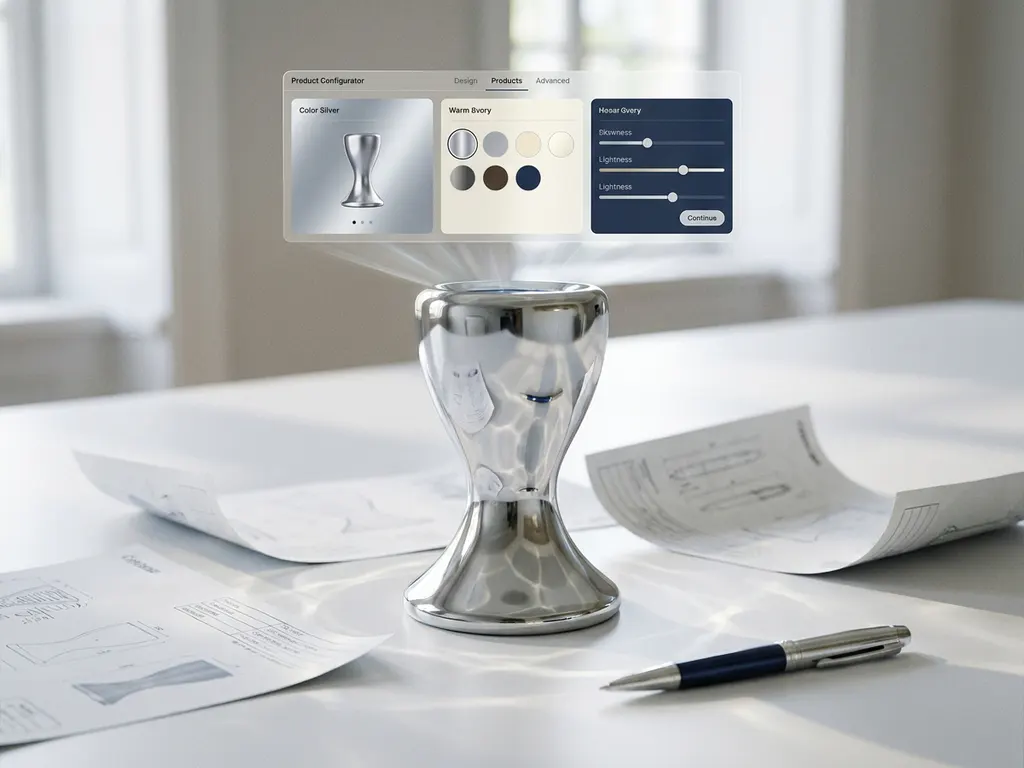
The best CPQ software depends on your product complexity, sales environment, and the level of visual experience you want to offer customers. For manufacturers and brands selling configurable, design-led products, the right CPQ platform goes far beyond pricing tables — it connects product logic, visual presentation, and the entire sales journey in one seamless flow. Below, we answer the most common questions buyers ask when evaluating CPQ solutions in 2026.
What does a CPQ solution actually do day-to-day?
A CPQ (Configure, Price, Quote) solution automates the process of building accurate product configurations, calculating the correct price, and generating a professional quote — in real time. For sales teams and customers alike, this means fewer errors, faster decisions, and a smoother path from product interest to signed order.
On a practical level, CPQ software sits at the intersection of product management, pricing logic, and the sales process. Each day, it handles tasks like:
- Applying complex pricing rules automatically when a customer selects options or quantities
- Preventing invalid product combinations before they reach the quote stage
- Generating branded, accurate quotes in seconds rather than hours
- Syncing product and pricing data with your ERP or e-commerce platform
- Supporting sales reps and in-store staff with guided selling tools
For manufacturers with large, configurable product ranges, this daily automation is a genuine competitive advantage. It removes the manual back-and-forth between sales, production, and finance — and gives customers confidence that what they see is exactly what they will get.
What are the key differences between CPQ platforms?
The key differences between CPQ platforms come down to three dimensions: the complexity they can handle, the visual experience they offer, and how well they connect with your existing systems. Entry-level tools cover basic pricing rules and quote generation. Advanced platforms support complex product logic, real-time 3D visualization, and deep integrations across your entire sales ecosystem.
When comparing CPQ solutions, the distinctions that matter most in practice are:
- Configuration depth: Can the platform handle thousands of variants, conditional rules, and interdependent options without slowing down?
- Visual capability: Does the configurator show customers what they are actually building, or does it rely on text descriptions and static images?
- Integration flexibility: How easily does it connect with your ERP, webshop, or PIM system?
- User experience: Is it intuitive enough for an end customer at home, and equally useful for a sales rep in a showroom?
- Scalability: Can it grow with your product range without a cost increase for every new variant?
For brands in the premium or design-led segment, visual quality is often the deciding factor. A CPQ platform that generates accurate prices but presents a poor visual experience does not reflect the brand standard customers expect.
Visual Commerce Solutions
Talk to our team about your project.
Which CPQ software works best for manufacturers?
For manufacturers, the best CPQ software is one that understands product logic at a deep level — handling materials, finishes, dimensions, and component dependencies — while keeping the experience effortless for both sales teams and end customers. Manufacturing CPQ software needs to bridge the gap between production reality and customer-facing simplicity.
Manufacturers face unique challenges that generic sales tools were never designed to solve. Products often have hundreds or thousands of valid combinations, pricing structures tied to materials and volumes, and lead times that vary by configuration. A purpose-built manufacturing CPQ platform handles all of this behind the scenes, presenting only valid, buildable options to the customer.
The strongest platforms for manufacturers also support the full sales cycle — from initial configuration in a webshop or showroom, through to quote generation and order handoff to production. When CPQ is combined with high-quality 3D visualization, manufacturers gain an additional advantage: customers can see exactly what they are ordering before production begins, which reduces costly change requests and returns.
Explore our visual product experience solutions to see how configuration, pricing, and stunning imagery work together in a single platform built for product manufacturers.
How does CPQ integrate with existing e-commerce and ERP systems?
Modern CPQ software integrates with e-commerce and ERP systems through APIs and headless architecture, allowing product data, pricing rules, and order information to flow automatically between platforms. This means your configurator stays in sync with your product catalogue, your prices reflect live data, and completed quotes feed directly into your order management process.
Integration depth varies between platforms, but the most important connections to look for are:
- ERP integration: Ensures pricing, stock, and production data are always current without manual updates
- Webshop integration: Embeds the configurator directly into your existing product pages so customers never leave your environment
- PIM integration: Keeps product specifications and variant data consistent across every channel
- CRM integration: Passes quote and customer data to your sales team automatically
Headless integration is particularly valuable for brands that have already invested in a strong e-commerce environment. Rather than replacing what works, a headless CPQ layer connects to it — adding configuration and quoting capability without disrupting the customer experience you have built. The result is a seamless journey where customers can view, customize, and purchase in the same environment.
What should you look for in a CPQ vendor before signing?
Before signing with a CPQ vendor, evaluate their experience in your specific industry, the visual quality of their output, the ease of implementation, and the long-term total cost of ownership. A vendor who understands the complexity of configurable, design-led products will save you significant time and frustration compared to a generalist provider.
The questions worth asking every vendor in your shortlist include: Do they have proven references in manufacturing, furniture, or premium product categories? How is the platform priced as your product range scales? What does implementation support look like, and how long does onboarding typically take? And critically, what happens when your product range changes — how quickly can new configurations be added?
Beyond the product itself, the vendor relationship matters. CPQ is not a set-and-forget tool. Product ranges evolve, pricing structures change, and sales channels expand. You need a partner who is collaborative, technically capable, and genuinely invested in your long-term success — not just the initial sale.
How 3Dimerce helps manufacturers get CPQ right
We built our Ensemble Suite specifically for brands and manufacturers who refuse to compromise on visual quality or pricing accuracy. Our CPQ solution does more than generate quotes — it connects configuration logic, real-time 3D imagery, and advanced pricing rules into a single, seamless experience that works in your webshop and in-store.
Here is what sets our approach apart for manufacturing CPQ:
- Accurate pricing, every time: Our advanced pricing quotation engine handles complex rules, variants, and dependencies automatically — no manual checking required
- Stunning visuals at every step: Customers see photorealistic 3D renders of their exact configuration as they build it, presented blazing fast on any device
- Scalable without extra cost per variant: Add new products, finishes, and options without a proportional increase in production or licensing costs
- Seamless integration: Our headless architecture connects cleanly with your existing webshop, ERP, and sales tools
- Built for premium brands: Our platform is designed for the high-end market — where visual quality and brand consistency are non-negotiable
If you are evaluating manufacturing CPQ software in 2026 and want a platform that matches the quality of your products, we would love to show you what is possible. Get in touch with our team and let us walk you through a demo tailored to your product range.
Frequently Asked Questions
How long does it typically take to implement a CPQ solution for a manufacturer?
Implementation timelines vary based on product complexity and integration requirements, but most manufacturers can expect a phased rollout ranging from a few weeks for simpler catalogues to several months for large, highly configurable product ranges. The biggest time investment usually comes from structuring your product logic, pricing rules, and integration with existing ERP or e-commerce systems — not the platform itself. Choosing a vendor with proven manufacturing experience and dedicated onboarding support can significantly reduce this timeline and help you avoid costly configuration mistakes early on.
What if my product range changes frequently — will I need to rebuild my CPQ configuration each time?
A well-architected CPQ platform should make product updates straightforward, not a full rebuild. Look for solutions that allow you to add new variants, finishes, or pricing rules through an intuitive back-end interface without requiring developer involvement every time. Scalable platforms — like those built on headless architecture — are specifically designed to absorb product range changes without disrupting the customer-facing experience or incurring significant additional cost per new variant.
Can CPQ software handle custom or bespoke orders, or is it only suited to predefined configurations?
Advanced CPQ platforms can absolutely support bespoke and made-to-order products, not just fixed catalogue configurations. The key is a rules engine flexible enough to define what is and is not buildable, so customers and sales reps are guided toward valid custom options rather than a blank free-text form. For manufacturers operating in the premium or design-led space, this is often essential — the configurator becomes the tool that makes bespoke feel effortless while protecting production feasibility behind the scenes.
What is the difference between a product configurator and a full CPQ solution — do I need both?
A product configurator handles the selection and visualization of options, while a full CPQ solution adds pricing logic and quote generation on top of that configuration layer. In practice, many businesses start with a standalone configurator and later realize they need the pricing and quoting capabilities to complete the sales journey. If your goal is to move customers from ‘I like this product’ to ‘I want to buy this product’ without involving a sales rep at every step, a full CPQ solution — ideally with integrated 3D visualization — is the more complete and commercially effective choice.
How does CPQ software impact the in-store or showroom sales experience, not just online?
CPQ is equally powerful in a physical sales environment, where it equips sales reps and in-store staff with a guided selling tool that eliminates guesswork and manual pricing lookups. A rep can walk a customer through a full configuration on a tablet or screen, show them a photorealistic render of their chosen options, and generate an accurate, branded quote on the spot — all without needing to call back to head office. This consistency between online and in-store experiences also reinforces brand trust and reduces the risk of quoting errors that lead to production problems later.
What are the most common mistakes companies make when choosing a CPQ platform?
The most common mistake is selecting a generic or entry-level CPQ tool based on price alone, only to find it cannot handle the depth of product logic or the visual quality that customers expect. A second frequent misstep is underestimating the importance of integration — choosing a platform that works well in isolation but creates data silos with your ERP, webshop, or CRM. Finally, many buyers overlook the vendor relationship itself: CPQ is a long-term investment, and a vendor who is unresponsive or inflexible after the contract is signed can turn a promising platform into a costly bottleneck.
Is CPQ software only relevant for B2B sales, or can it work for direct-to-consumer channels too?
CPQ is highly effective in both B2B and direct-to-consumer (DTC) contexts, though the user experience priorities differ slightly. In B2B, the focus tends to be on complex pricing rules, volume-based discounts, and quote approval workflows. In DTC, the emphasis shifts toward a seamless, self-service configuration experience that guides consumers to a confident purchase decision without sales rep involvement. The best modern CPQ platforms — particularly those with strong 3D visualization — are built to serve both channels simultaneously, maintaining brand consistency and pricing accuracy whether the end user is a trade buyer or a retail customer at home.