
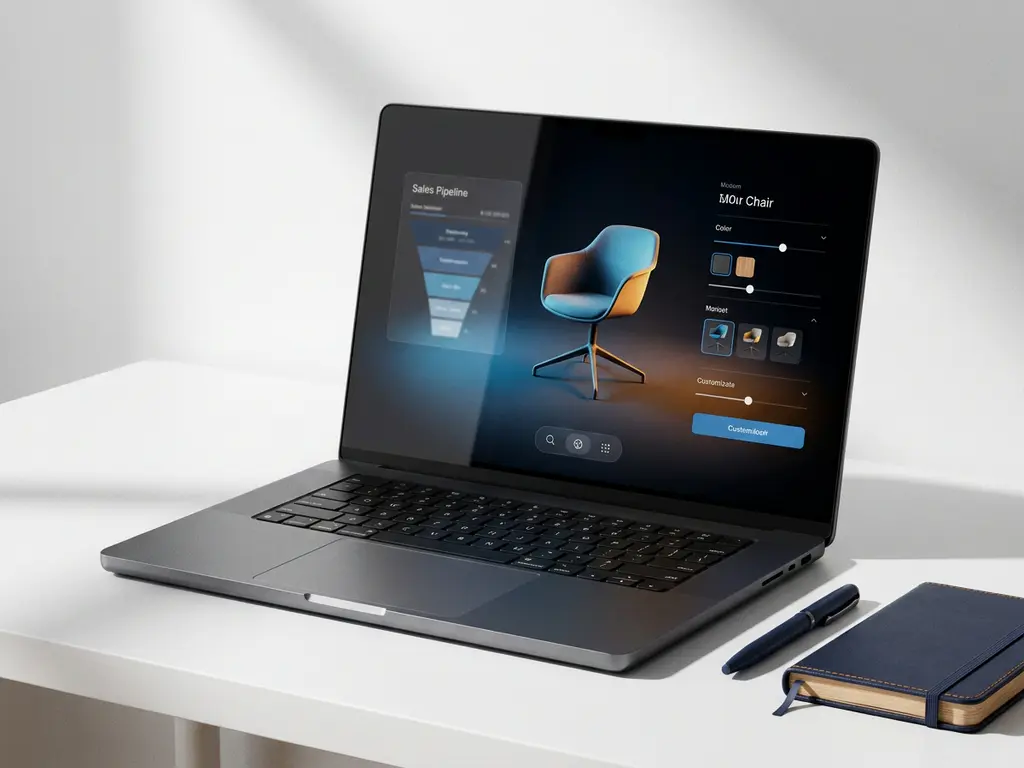
The best software for sales combines tools that help your team manage customer relationships, automate repetitive tasks, and close deals faster. For product-based businesses in particular, the right platform goes further: it brings your products to life visually and guides buyers confidently from interest to purchase. Below, we unpack the most important questions around choosing sales automation software in 2026.
What features should the best sales software have?
The best sales software should include pipeline management, contact tracking, automated follow-ups, quoting capabilities, and reporting dashboards. For product-driven businesses, visual product presentation and configuration tools are equally critical because helping a customer see and personalise what they are buying is one of the most powerful ways to move a sale forward.
At its core, strong sales automation software removes friction from the sales process. Rather than relying on manual tasks, spreadsheets, or disconnected tools, the best platforms centralise everything your team needs to act quickly and consistently. Here are the features that matter most:
- Pipeline and deal tracking — a clear visual overview of where every lead stands in the buying journey
- Automated workflows — follow-up emails, task reminders, and lead nurturing that run without manual input
- Configure, Price, Quote (CPQ) — the ability to generate accurate, professional quotes quickly, especially for products with multiple variants or custom options
- Integration capabilities — seamless connection with your webshop, ERP, or marketing tools
- Reporting and forecasting — data that helps you understand what is working and where deals are being lost
- Mobile and omnichannel access — so sales teams can work effectively both in the field and in-store
The more complex your product range, the more important it becomes that your sales software handles configuration and pricing without errors. A single quoting mistake on a high-value customised product can cost more than the software itself.
What’s the difference between CRM and sales software?
CRM (Customer Relationship Management) software focuses on managing relationships — storing contact data, tracking communication history, and nurturing leads over time. Sales software is a broader category that includes CRM functionality but also covers tools for quoting, product configuration, deal automation, and closing. Many modern platforms combine both.
Think of CRM as the foundation and sales software as the full building. A CRM tells you who your customer is and what conversations you have had. Sales software tells you what they want, what it will cost, and how to get the deal done.
For businesses selling complex or configurable products, the distinction matters. A traditional CRM alone will not help a sales rep build an accurate quote for a custom sofa in twelve fabric options and three frame sizes. That requires dedicated quoting and configuration logic layered on top of relationship data. This is where sales platform solutions that combine CPQ with visual tools become genuinely valuable.
Visual Commerce Solutions
Talk to our team about your project.
Which type of sales software is best for product-based businesses?
Product-based businesses benefit most from sales software that combines CPQ (Configure, Price, Quote) functionality with visual product tools. This combination allows sales teams and customers to configure products, see realistic representations of what they are ordering, and receive accurate pricing instantly — reducing errors, shortening sales cycles, and increasing buyer confidence.
For manufacturers and retailers selling design-led or customisable products, generic CRM tools often fall short. The real challenge is not managing contacts — it is helping customers make confident decisions about complex products. That requires:
- Visual configuration — letting buyers explore materials, colours, and dimensions in real time
- Accurate pricing logic — automatically calculating the correct price for every configuration without manual intervention
- Quote generation — producing polished, professional quotes that reflect exactly what was configured
- Omnichannel deployment — running the same experience online, in-store, and on any device
- Integration with the wider tech stack — connecting to webshops, ERP systems, and order management tools
Businesses in the furniture, interiors, and premium lifestyle sectors face this challenge acutely. Their products are inherently visual and deeply personal — and customers want to see exactly what they are getting before they commit.
How does sales software improve the customer buying experience?
Sales software improves the customer buying experience by removing uncertainty, reducing friction, and making the path from interest to purchase feel intuitive and reassuring. When customers can explore options, see accurate visuals, and receive clear pricing without waiting for a sales rep to manually prepare information, they feel more in control — and more confident in their decision.
This is especially true for high-value or customisable products. Buyers investing in premium items want to feel certain about what they are ordering. Sales automation software that includes real-time product visualisation and instant quoting addresses the two biggest sources of hesitation: “Will it look right?” and “What will it actually cost me?”
Beyond the buying moment itself, good sales software creates consistency. Whether a customer encounters your brand online, in a showroom, or through a sales representative, the experience feels coherent. Pricing is accurate. Product information is correct. The visual representation matches reality. That consistency builds trust, and trust drives conversion.
What should you look for when choosing sales software?
When choosing sales software, prioritise fit over features. The right platform is one that matches your product complexity, integrates with your existing systems, scales with your range, and delivers a buying experience that reflects your brand quality. Price matters, but total cost of ownership — including the savings on traditional photography, physical sampling, and manual quoting — is the more meaningful measure.
Start by asking these questions before evaluating any platform:
- Does it handle our product complexity — including variants, configurations, and custom options?
- Can it integrate with our webshop, ERP, and other tools without heavy custom development?
- Does it work across all our sales channels — online, in-store, and mobile?
- How quickly can we get new products live on the platform?
- What does the visual output quality look like, and does it match our brand positioning?
- What level of support and implementation guidance does the vendor provide?
For premium product brands, visual quality is non-negotiable. Sales automation software that produces mediocre product imagery undermines the very brand perception you are trying to protect. The platform you choose should make your products look as good digitally as they do in person.
How 3Dimerce helps you close more sales
We built our platform specifically for brands that take their products seriously. For manufacturers, retailers, and design-led businesses selling configurable or premium products, we combine sales automation software with the visual tools that actually move buyers to act.
Here is what that looks like in practice:
- CPQ built for complex products — our Ensemble Suite generates accurate price quotations for every configuration, every time, with no manual calculation required
- Photorealistic 3D visuals — customers see exactly what they are ordering, rendered in stunning detail across any device
- Omnichannel deployment — the same powerful experience works in your webshop, in-store on a touchscreen, or in the hands of a sales representative
- Headless integration — our platform connects cleanly with your existing e-commerce environment and tech stack
- Scalable without extra cost per variant — add products and configurations without triggering new photoshoots or manual content production
If you are ready to replace slow, expensive traditional sales tools with a platform that matches the quality of your products, get in touch with us and let us show you what is possible.
Frequently Asked Questions
How long does it typically take to implement sales automation software for a product-based business?
Implementation timelines vary depending on product complexity and integration requirements, but most businesses can expect an initial setup phase of four to twelve weeks. Platforms purpose-built for configurable products — like those with CPQ and 3D visualisation built in — tend to reduce this timeline because they are designed to handle complex product logic out of the box rather than requiring heavy custom development. The key is to prioritise getting your core product range live first, then expand from there rather than trying to migrate everything at once.
Can sales automation software integrate with the ERP or e-commerce platform we already use?
Yes — most modern sales platforms are built with integration in mind, and headless architecture has made it significantly easier to connect sales tools with existing ERP systems, webshops, and order management platforms without rebuilding your entire tech stack. Before committing to any platform, ask the vendor for specific examples of integrations they have delivered with systems similar to yours, and clarify whether those connections are maintained natively or require third-party middleware. The smoother the integration, the faster your team will see ROI.
What is the biggest mistake businesses make when choosing sales software?
The most common mistake is prioritising feature quantity over product fit — choosing a platform because it has the longest list of capabilities rather than because it solves the specific challenges your sales team actually faces. For product-based businesses in particular, this often means selecting a generic CRM that handles contact management well but cannot support visual configuration or accurate CPQ, forcing sales reps to fall back on manual workarounds. Always evaluate software against your real sales workflow, not an idealised version of it.
How does 3D product visualisation actually impact conversion rates?
Research consistently shows that interactive 3D visuals and product configurators significantly reduce buyer hesitation, particularly for high-value or customisable purchases where customers cannot physically inspect the product before buying. When shoppers can explore materials, colours, and dimensions in real time and see a photorealistic result, the two biggest barriers to conversion — uncertainty about appearance and uncertainty about price — are addressed simultaneously. For premium product categories like furniture and interiors, this translates directly into fewer abandoned quotes and higher average order values.
Is sales automation software suitable for smaller businesses, or is it mainly for large enterprises?
Sales automation software is valuable at almost any scale, but the right tier of platform depends on your product complexity and sales volume rather than company size alone. A small manufacturer selling highly configurable, high-margin products will benefit more from CPQ and visual tools than a large retailer selling simple, standardised items. The key question to ask is whether your current sales process involves manual steps — spreadsheet quoting, back-and-forth emails to confirm configurations, or inconsistent product information — because those inefficiencies cost time and deals regardless of how big your team is.
How do we keep product information and pricing accurate across all sales channels?
The most reliable way to maintain consistency across online, in-store, and field sales channels is to use a single platform that serves as the source of truth for product data, pricing logic, and visual assets. When configuration rules and pricing are centralised rather than duplicated across separate tools, updates propagate automatically — meaning a price change or new variant is reflected everywhere at once without manual intervention. This is one of the core advantages of omnichannel sales platforms over stitched-together combinations of separate tools.
What happens to our existing product photography investment if we switch to 3D visualisation?
Transitioning to 3D visualisation does not necessarily mean discarding existing photography immediately — many businesses run both in parallel during the migration period, using 3D assets for new products or configurations while legacy photography covers the existing catalogue. Over time, however, the economics shift decisively: 3D assets can render every variant, colour, and configuration without additional photoshoots, eliminating the per-variant cost that makes traditional photography unsustainable as product ranges grow. The long-term saving on photography, physical sampling, and manual content production is one of the most significant financial arguments for making the switch.