
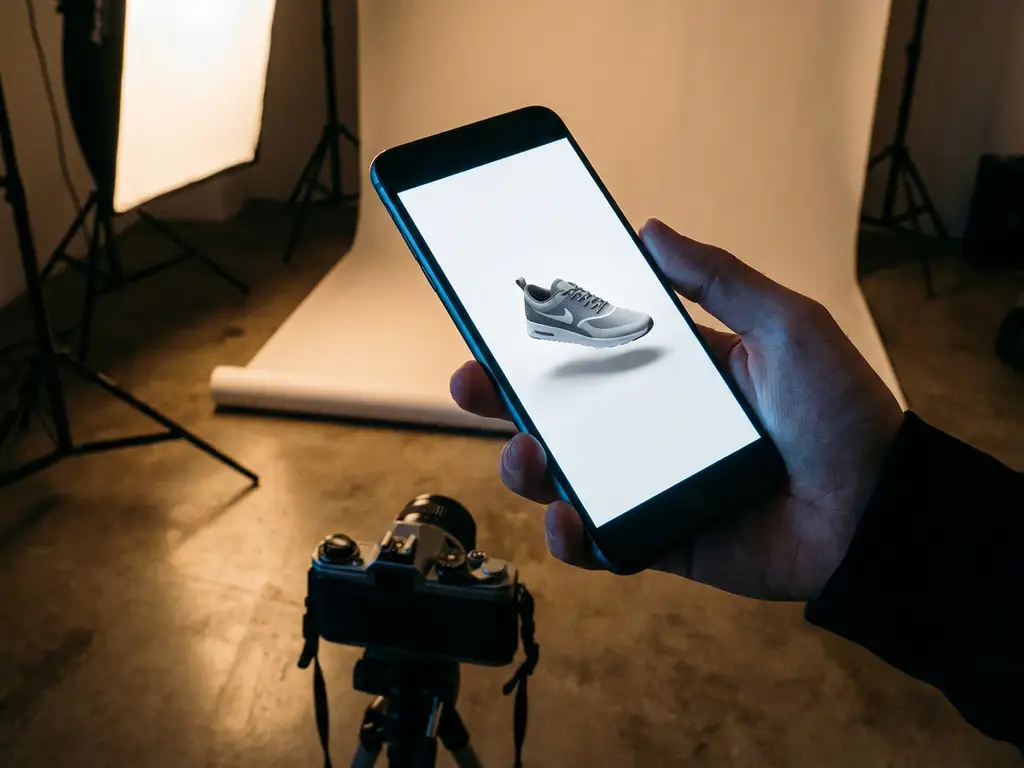
Yes, 3D modeling software can replace traditional product photography for many business applications, offering greater flexibility, cost efficiency, and creative control over product visuals. Modern 3D rendering technology produces photorealistic imagery that matches or exceeds traditional photography quality while providing unlimited customization options and faster production times.
Why are expensive photoshoots holding back your product launches?
Traditional product photography creates a bottleneck that slows down your entire product development cycle. Every new variant, color option, or configuration requires a new photoshoot, meaning weeks of coordination, studio bookings, and post-production work. For furniture and interior design brands launching seasonal collections, this delay can mean missing critical sales windows. The financial impact compounds quickly: a single photoshoot for 20 product variants can cost thousands of euros, and that’s before you factor in the opportunity cost of delayed launches. Smart brands are breaking free from this cycle by adopting 3D visualization workflows that generate stunning product imagery in days, not weeks.
What does inconsistent product imagery signal about your brand positioning?
When your webshop shows one lighting setup, your catalog uses different angles, and your retail displays feature yet another style, customers notice the disconnect. This visual inconsistency undermines the premium brand perception you’ve worked hard to build, especially in the high-end furniture and design market where quality expectations are elevated. Inconsistent imagery signals a lack of attention to detail that luxury customers associate with inferior products. The solution lies in establishing a unified 3D visualization system that maintains perfect consistency across all channels while allowing for easy updates and modifications without starting from scratch.
Visual Commerce Solutions
Talk to our team about your project.
What is 3D modeling software and how does it work for product visualization?
3D modeling software creates digital three-dimensional representations of products using mathematical algorithms and computer graphics. For product visualization, this technology builds virtual models that capture every detail of your products, from surface textures to material properties and lighting characteristics.
The process begins with creating a digital wireframe structure of your product, followed by applying materials, textures, and lighting to achieve photorealistic results. Advanced 3D modeling software uses ray tracing and global illumination techniques to simulate how light interacts with different materials, producing images that are virtually indistinguishable from traditional photography.
Modern product visualization platforms integrate directly with your existing systems, allowing real-time customization and configuration. When customers select different colors, materials, or features, the 3D model updates instantly to show the exact product they’re designing.
What’s the difference between 3D product visualization and traditional photography?
Traditional photography captures existing physical products under specific lighting conditions, while 3D product visualization creates digital representations that can be modified infinitely without physical constraints. Photography requires physical samples, studio setups, and professional equipment for each shot, limiting flexibility and increasing costs.
3D visualization offers several key advantages over traditional methods:
- Unlimited configurations: Generate imagery for any product variant without additional photoshoots
- Perfect lighting control: Adjust lighting, shadows, and reflections with precision
- Consistent quality: Maintain identical lighting and composition across all product images
- Interactive capabilities: Enable 360-degree views, zoom functionality, and real-time customization
- Environmental flexibility: Place products in any setting or context digitally
Traditional photography excels at capturing authentic textures and natural imperfections, but modern 3D rendering technology has largely closed this gap, producing imagery that rivals professional photography quality.
Can 3D modeling software match the quality of professional product photography?
Yes, advanced 3D modeling software now produces imagery that matches and often exceeds professional photography quality. Modern rendering engines use sophisticated algorithms to simulate realistic lighting, material properties, and surface details with exceptional accuracy.
The quality depends on several factors:
- Rendering technology: Ray tracing and global illumination create natural lighting effects
- Material accuracy: Advanced shader systems replicate fabric textures, wood grains, and metal finishes
- Detail resolution: High-polygon models capture intricate product features and imperfections
- Post-processing capabilities: Color correction and enhancement tools refine the final output
Leading furniture and design brands have successfully transitioned to 3D visualization for their primary product imagery, demonstrating that quality concerns are no longer a barrier to adoption. The technology has matured to the point where customers cannot distinguish between 3D renders and traditional photographs.
How much does 3D product visualization cost compared to traditional photography?
3D product visualization typically costs 60-80% less than traditional photography over time, with the savings increasing dramatically as your product catalog grows. While initial setup requires investment in 3D model creation, the long-term economics favor digital visualization significantly.
Traditional photography costs include:
- Studio rental and equipment
- Professional photographer fees
- Physical sample production and shipping
- Post-production editing
- Reshooting for new variants or updates
3D visualization costs focus on:
- Initial 3D model creation
- Software licensing or platform subscription
- Rendering and output generation
- Ongoing model updates and modifications
The break-even point typically occurs after generating imagery for 15-20 product variants, making 3D visualization especially cost-effective for brands with extensive product lines or frequent updates.
What are the main advantages of using 3D modeling for product imagery?
3D modeling offers compelling advantages that extend beyond cost savings, fundamentally transforming how brands create and manage product imagery:
- Speed to market: Generate new product imagery in hours instead of weeks
- Infinite customization: Show every possible configuration without additional production costs
- Perfect consistency: Maintain identical lighting and composition across all product variants
- Interactive experiences: Enable customer configuration, 360-degree views, and augmented reality
- Environmental flexibility: Place products in any setting or lifestyle context
- Easy updates: Modify colors, materials, or features without starting over
- Cross-channel consistency: Use the same assets for web, print, and retail applications
For premium brands, 3D visualization also enables advanced features like virtual showrooms and immersive customer experiences that differentiate your brand in competitive markets.
When should businesses choose 3D modeling over traditional product photography?
Businesses should prioritize 3D modeling when they face specific operational challenges that traditional photography cannot efficiently address. The decision often depends on your product complexity, update frequency, and channel requirements.
3D modeling is ideal when you have:
- Configurable products: Items with multiple color, material, or feature options
- Frequent product updates: Seasonal collections or regular design modifications
- Complex product lines: Large catalogs requiring consistent imagery across variants
- Omnichannel presence: Need for consistent visuals across web, print, and retail
- Interactive requirements: Customer configuration tools or virtual showroom experiences
- Limited physical samples: Products that are expensive or difficult to prototype
Traditional photography remains suitable for simple, static products with minimal variants or when authentic lifestyle imagery is the primary requirement. However, even these scenarios increasingly benefit from hybrid approaches that combine 3D product models with photographed environments.
How 3Dimerce helps with advanced product visualization
We specialize in creating sophisticated 3D product configurators and CGI imagery that transform how luxury brands present their products. Our visual product experience platform delivers stunning, photorealistic renders with blazing-fast performance across all devices, ensuring your premium brand positioning translates perfectly to digital channels.
Our comprehensive solution includes:
- High-quality 3D product configurators with unlimited customization options
- Seamless integration with existing webshops and retail environments
- Virtual showroom capabilities for immersive customer experiences
- Configure, Price, Quote integration streamlining the entire sales journey
- Omnichannel consistency across all touchpoints and devices
With over 20 years of experience serving European furniture and design brands, we understand the unique requirements of premium product visualization. Explore our solutions to see how we can elevate your product presentation and drive conversion rates. Ready to transform your product imagery? Contact us today to discuss your specific requirements and discover the possibilities of advanced 3D visualization.
Frequently Asked Questions
How long does it take to create a 3D model for a new product?
Creating a high-quality 3D model typically takes 3-5 days for standard furniture pieces, depending on complexity and detail requirements. Complex products with intricate details may require 1-2 weeks, but once created, the model can generate unlimited imagery variations instantly. This initial investment pays off quickly when you consider that traditional photography would require similar timeframes for each product variant.
What happens if I need to update my product design after the 3D model is created?
3D models are easily updatable without starting from scratch. Minor changes like color adjustments or material swaps can be implemented within hours, while structural modifications typically require 1-2 days. This flexibility is one of 3D visualization’s biggest advantages over traditional photography, where any change would require a complete new photoshoot.
Can customers actually tell the difference between 3D renders and real photographs?
Modern 3D rendering technology has reached a point where customers cannot reliably distinguish between high-quality renders and traditional photography. Studies show that photorealistic 3D imagery performs equally well in terms of customer engagement and conversion rates. The key is working with experienced 3D visualization specialists who understand material properties and lighting techniques.
What file formats do I need to provide to start creating 3D models of my products?
You can start with existing CAD files, technical drawings, or even high-quality photographs from multiple angles. CAD files (like .step, .iges, or .dwg) provide the most accurate starting point, but experienced 3D artists can work with 2D technical drawings or detailed photo references. The more reference material you provide, the faster and more accurate the modeling process becomes.
How do I ensure 3D product imagery matches my brand's visual style and quality standards?
Professional 3D visualization providers work closely with you to establish brand guidelines covering lighting, composition, and color accuracy. This includes creating custom lighting setups, defining material libraries that match your actual products, and establishing consistent camera angles and compositions. Once these standards are set, they can be applied consistently across all future renders.
Can 3D models be used for augmented reality (AR) experiences on mobile devices?
Yes, 3D models can be optimized for AR applications, allowing customers to visualize products in their own spaces using smartphones or tablets. This requires creating lightweight versions of your detailed models that maintain visual quality while ensuring smooth performance on mobile devices. AR capabilities significantly enhance the customer experience and can reduce return rates for furniture and home decor products.
What's the biggest mistake companies make when transitioning from photography to 3D visualization?
The most common mistake is trying to replicate photography exactly instead of leveraging 3D’s unique advantages. Companies often focus solely on cost savings while missing opportunities for interactive features, unlimited configurations, and enhanced customer experiences. Success comes from reimagining your entire visual strategy around 3D’s capabilities, not just replacing existing photos with renders.