
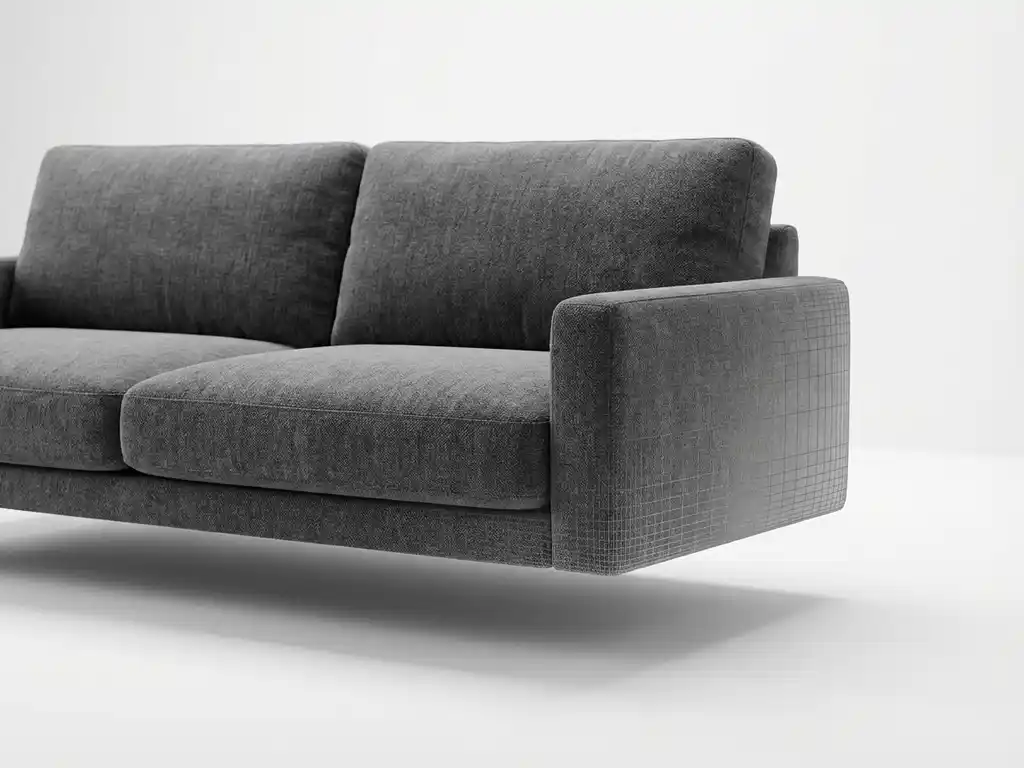
Yes, 3D product rendering can absolutely be used for furniture visualisation, offering photorealistic representations of furniture pieces before they are manufactured. This technology creates detailed digital models that showcase materials, textures, lighting, and finishes with stunning accuracy. Modern 3D rendering enables furniture brands to display countless variations and configurations while significantly reducing photography costs and production timelines.
Consumer expectations for online furniture shopping have shifted significantly. Shoppers now expect to see products from every angle, in multiple finishes, and increasingly in their own space before buying. Research consistently shows that richer product visualisation drives higher purchase confidence and lower return rates. For furniture brands, the question is no longer whether to invest in 3D furniture visualisation, but how quickly to implement it before competitors do.
How does 3D rendering add value before production begins?
3D rendering delivers value not only in marketing and sales but also during the design and development phase. A designer can upload initial CAD specifications, apply different material shaders and finishes digitally, and share photorealistic previews with stakeholders for feedback in days rather than weeks. This rapid iteration replaces expensive physical prototypes and allows product teams to explore proportions, material combinations, and finish options at a fraction of the traditional cost. For brands managing complex product development cycles, this alone makes the investment worthwhile.
For custom and bespoke furniture, where a single prototype can cost thousands before a single piece is sold, a photorealistic 3D rendering allows clients to approve the design with full confidence before any material is cut. This directly addresses one of the most common pain points in the luxury and high-end segment: the financial and reputational risk of committing to expensive custom production without a clear visual reference. We work with furniture brands at every stage of the product lifecycle, from first concept render to full e-commerce configurator launch, ensuring that 3D product visualization for furniture adds value from day one.
What is 3D furniture visualisation and how does the rendering process work?
3D product rendering for furniture is a digital production process that uses computer-generated imagery (CGI) to create photorealistic images of furniture pieces without requiring physical prototypes or a photography studio. The technology transforms detailed 3D models into lifelike visualisations that accurately represent materials, textures, lighting, and spatial relationships.
The process begins with creating detailed 3D models of furniture pieces, including precise measurements and geometric structures. Skilled artists then apply realistic materials and textures, such as wood-grain patterns, fabric weaves, metal finishes, and leather surfaces. Advanced lighting techniques simulate natural and artificial light sources, creating authentic shadows, reflections, and highlights that bring furniture to life.
For furniture visualisation specifically, rendering technology excels at showcasing intricate details such as stitching patterns on upholstery, wood-grain variations, and surface imperfections that add realism. The software can simulate different environments, from showroom settings to residential spaces, helping customers envision how pieces will look in their own homes.
Modern rendering engines produce images indistinguishable from traditional photography, often with better consistency and control over lighting conditions. This technology enables furniture brands to create extensive visual libraries without the logistical challenges of physical photo shoots.
The technical craft behind photorealistic furniture rendering
The quality of a photorealistic furniture render depends on the sophistication of the materials applied to the 3D model. Physically based rendering (PBR) materials replicate how light interacts with real surfaces at a physical level, so a rendered oak veneer, bouclé fabric, or hand-stitched leather is visually indistinguishable from a photograph. Every surface property, including reflectivity, roughness, translucency, and micro-texture, is modelled with accuracy. This is what separates a genuinely photorealistic furniture product render from a render that merely looks digital.
Studio lighting rigs are built entirely in the digital environment, giving complete control over shadow depth, highlight intensity, and ambient tone. Unlike a physical photography studio where lighting conditions shift with the time of day or equipment availability, a digital lighting setup is perfectly repeatable and infinitely adjustable. This is the consistency that photorealistic renderings for the furniture industry demand, and it is something traditional photography simply cannot guarantee at scale.
Our master 3D models are built at the highest polygon count to capture every surface detail with precision. From this single high-fidelity asset, we derive optimised versions for fast-loading web configurators and augmented reality experiences. This high-poly-first approach means that quality is never compromised downstream: the same model that produces a stunning catalogue image also powers a real-time interactive configurator and an AR room-placement experience, all without rebuilding from scratch.
Why do furniture brands choose 3D rendering over traditional photography?
3D rendering offers measurable advantages over traditional furniture photography in cost, speed, consistency, and flexibility. Once a 3D model exists, brands can generate unlimited product variations without additional photo shoot expenses, physical samples, or studio setup time.
Cost and production efficiency
Traditional furniture photography requires physical products, professional studios, lighting equipment, and multiple shoot days for different angles and configurations. 3D rendering eliminates these recurring expenses, allowing brands to create comprehensive visual content at a fraction of the cost. The savings compound as product ranges grow: each new variation requires only a model update, not a new shoot.
Speed to market
Traditional photo shoots can take weeks to organise and execute, especially for multiple product variations. 3D rendering produces high-quality images within days, enabling faster time-to-market for new collections and seasonal updates.
Consistency across channels
Every 3D-rendered image maintains identical lighting, colour accuracy, and quality standards, whether used for websites, catalogues, or retail displays. Traditional photography often suffers from variations in lighting conditions, camera settings, and post-processing approaches, making visual consistency difficult to sustain at scale.
Pre-production visualisation
3D rendering allows brands to showcase products before manufacturing begins. This capability enables pre-orders, market testing, and customer feedback collection without investing in physical prototypes or inventory, a significant advantage for brands launching new collections or entering new markets.
What ROI can furniture brands expect from 3D rendering?
The business case for 3D furniture visualisation is backed by measurable results across the industry. Decision-makers evaluating this investment can point to consistent, documented performance improvements that span the full commercial funnel, from first click to completed purchase.
- Conversion rate uplift: Furniture e-commerce implementations with interactive 3D configurators and photorealistic product renders consistently report conversion rate increases in the range of 30 to 120 percent compared to static photography, depending on product complexity and configurability.
- Return rate reduction: Richer product visualisation reduces purchase uncertainty. Industry experience shows return rates falling by up to 40 percent when customers can explore materials, configurations, and proportions in detail before buying.
- Photography cost savings: Brands that transition from traditional photography to 3D rendering for their core product range typically reduce visualisation costs by 50 to 70 percent over a two-year period, as the same 3D assets continue generating new outputs without additional shoot investment.
- Time-to-market acceleration: New product variations and collection launches that previously required weeks of shoot coordination can go live within days using existing 3D model assets, giving brands a meaningful competitive advantage in fast-moving market windows.
Our clients in the luxury and high-end furniture segment consistently report results at the upper end of these benchmarks, driven by our photorealistic rendering quality and seamless configurator integration. The investment in high-fidelity 3D assets pays back not once, but across every product launch, every new variation, and every channel where those assets are deployed.
Which furniture products benefit most from 3D product visualisation?
Furniture categories with high configurability, extensive customisation options, or complex material combinations gain the most value from 3D visualisation. These are product types where traditional photography cannot practically cover every variation, making photorealistic CGI the only scalable solution.
Modular seating systems are ideal candidates for 3D visualisation. These products often feature dozens of fabric options, multiple configurations, and various component combinations. Traditional photography would require hundreds of individual shots to cover all possibilities, making it financially impractical. Product configuration solutions are specifically designed to handle this level of variation.
Custom furniture pieces, including bespoke wardrobes, kitchen units, and built-in storage solutions, benefit enormously from 3D rendering. Customers can visualise their specific requirements and modifications before committing to a purchase, reducing uncertainty and returns.
Upholstered furniture with extensive fabric and colour options is showcased effectively through 3D rendering. The technology accurately represents different textures, patterns, and finishes, allowing customers to explore combinations that might not exist as physical samples.
High-end and luxury furniture collections, where visual quality directly impacts brand perception, leverage 3D rendering to maintain a consistent premium presentation across all channels. The technology ensures every image reflects the attention to detail and positioning that luxury customers expect.
How does one 3D model serve your entire marketing ecosystem?
Every 3D model we build is a long-term content asset, not a one-time image. A single high-fidelity 3D model can generate unlimited visual outputs across every channel and use case your brand requires, all from one master asset. Contrast this with traditional photography, where each channel, angle, and product variation demands a separate shoot with its own cost and scheduling overhead.
From a single 3D model, your brand can produce:
- Website product images in any angle or configuration
- Lifestyle renders in multiple room settings and interior styles
- Print-ready catalogue imagery at any resolution
- Social media visuals in platform-optimised formats
- In-store digital display content
- AR-ready assets for mobile shopping experiences
The cost logic is straightforward: the investment in a high-quality 3D model is made once, and every subsequent visual output, whether the tenth variation or the hundredth, costs a fraction of a traditional photo shoot. For luxury furniture brands managing broad product ranges across multiple markets and channels, this scalability is transformative. We build 3D asset libraries designed for long-term scalability, giving premium furniture brands a content infrastructure that grows with their range and works harder with every passing season.
How do customers use 3D furniture configurators to personalise their purchase?
A 3D furniture configurator is an interactive digital tool that allows customers to customise a furniture piece in real time, selecting materials, colours, dimensions, and configurations, while seeing their choices rendered instantly in photorealistic quality. The experience is designed to replicate the confidence of seeing a product in person, without requiring a showroom visit.
The typical user experience begins with selecting a base furniture piece, then progressing through customisation options systematically. Customers can change upholstery fabrics, wood finishes, hardware styles, and dimensional specifications using simple drop-down menus or visual selection tools.
Advanced configurators include room visualisation features that place configured furniture within realistic interior settings. Customers can see how their customised pieces will look in different room styles, lighting conditions, and alongside other furnishings.
Material selection becomes engaging through detailed close-up views and texture samples. Users can examine fabric weaves, wood-grain patterns, and metal finishes at high magnification, providing confidence in their choices without physical samples.
Integration with e-commerce platforms allows seamless progression from configuration to purchase. Customers can save their designs, share them with others for feedback, and complete transactions without leaving the configurator environment. Pricing updates automatically as customers make changes, providing transparent cost visibility throughout the customisation process.
How does Augmented Reality extend 3D furniture visualisation?
Augmented reality is the natural next step beyond on-screen 3D configuration. Web-native AR allows shoppers to place photorealistic 3D furniture models in their own living space using a smartphone camera, with no app download required. The experience runs directly in the mobile browser: a customer points their phone at a corner of their room, selects the sofa or dining table they have been configuring, and sees it appear at full scale in their actual space. This is augmented reality furniture visualisation at its most practical and accessible.
The consumer benefit is immediate and measurable. When shoppers can check scale, proportions, and material fit in their actual environment before buying, purchase hesitation drops significantly and confidence rises. This translates directly into higher conversion rates and fewer returns, the two metrics that matter most to furniture e-commerce decision-makers. Because our 3D models are built to the highest fidelity standards from the outset, the same asset that powers your online configurator is ready to deliver an immersive AR product visualisation experience with no additional modelling required. One investment, multiple high-impact applications.
What should furniture brands consider when implementing 3D rendering?
Adopting 3D furniture visualisation is a strategic decision that benefits from a structured approach. The brands that see the strongest results are those that plan the implementation carefully rather than treating it as a single technical project. The following five-step roadmap reflects how we guide luxury and premium furniture brands through the process.
- Identify priority products. Start with your most configurable or highest-margin lines. These are the products where 3D visualisation delivers the fastest and most visible return, and where traditional photography is already failing to cover all variations. A focused starting point builds internal confidence and delivers early wins.
- Develop high-fidelity 3D models. Invest in accurate geometry, material shaders, and lighting from the start. The quality of the master 3D asset determines the quality of every output it generates, from e-commerce images to AR experiences. Cutting corners at this stage creates compounding problems downstream. Our photorealistic renderings for the furniture industry are built to the highest standard precisely because this foundation matters.
- Integrate with your e-commerce stack. Connect the configurator to your product catalogue, pricing engine, and checkout flow. A configurator that exists outside the purchase journey creates friction rather than removing it. Seamless integration ensures that every customisation choice flows naturally into a completed transaction.
- Launch and communicate the experience. Train sales staff to use the configurator during customer consultations, both online and in physical showrooms. Highlight the tool prominently to customers across your digital channels. The technology only delivers its full value when customers and staff alike know it exists and understand how to use it.
- Measure and optimise. Track conversion rates, return rates, time-on-configurator, and customer engagement to understand what is working and where to improve. Use this data to refine the experience, expand the product range covered, and build the internal case for further investment in 3D product visualization for furniture.
Long-term strategic benefits of 3D visualisation investment
Beyond the immediate gains in cost and conversion, 3D visualisation delivers three long-term strategic advantages that senior decision-makers should factor into their evaluation:
- Configurator analytics: Every interaction with your 3D configurator generates data. Which fabrics customers select most, where they drop off in the customisation flow, which configurations convert at the highest rate. This insight is invisible with static photography and invaluable for product development and merchandising decisions.
- Future-proof asset reuse: A high-fidelity 3D model built to our standards today is the same asset that will power AR experiences, virtual showrooms, and whatever visual commerce channel emerges next. The investment does not depreciate; it appreciates as new channels open up.
- AI shopping readiness: As AI-powered shopping tools become mainstream, brands with structured, high-quality 3D product data will be better positioned to appear accurately in AI-generated recommendations and next-generation product searches. Machine-readable 3D assets are a competitive advantage that static image libraries cannot replicate.
We guide furniture brands through every step of this process, from initial 3D model creation to full configurator deployment, with a focus on the quality standards that luxury and premium brands demand.
How We Deliver Premium 3D Furniture Visualisation at 3Dimerce
We specialise in creating sophisticated 3D furniture configurators for the luxury and high-end furniture market, brands where visual quality, configurability, and premium presentation are non-negotiable. Our platform combines advanced CGI technology with intuitive user interfaces, enabling furniture brands to offer comprehensive customisation experiences that drive engagement and conversions.
Our furniture visualisation solutions include:
- Advanced 3D configurators with real-time rendering capabilities for unlimited product variations
- Photorealistic CGI imagery that accurately represents materials, textures, and lighting effects
- Seamless integration with existing e-commerce platforms and sales systems
- Mobile-optimised interfaces that perform consistently across all devices
- Room visualisation tools that place configured furniture in realistic interior settings
- Comprehensive material libraries covering fabrics, woods, metals, and finishes
Our work with luxury and high-end furniture brands consistently delivers measurable results. Brands in the premium seating category have seen conversion rates increase significantly after launching their configurator, while custom furniture clients report a meaningful reduction in pre-production revision cycles once photorealistic 3D rendering replaces physical prototypes in their approval process. Brands working with us across the high-end upholstery segment have also reported stronger average order values, driven by customers confidently selecting premium material upgrades they can see and evaluate in detail before buying. Contact us to learn how we have helped brands like yours transform their product visualisation and sales performance through 3D rendering luxury furniture solutions.
Our platform delivers stunning visuals with blazing-fast performance, ensuring customers enjoy smooth, engaging experiences whether shopping online or in retail environments. We focus exclusively on the luxury and high-end furniture market, providing the sophisticated presentation quality that premium brands require. Learn more about our expertise in delivering cutting-edge visualisation solutions.
Ready to transform your furniture visualisation capabilities? Contact our team to discover how our 3D rendering solutions can enhance your product presentation, reduce photography costs, and increase customer engagement across all sales channels.