
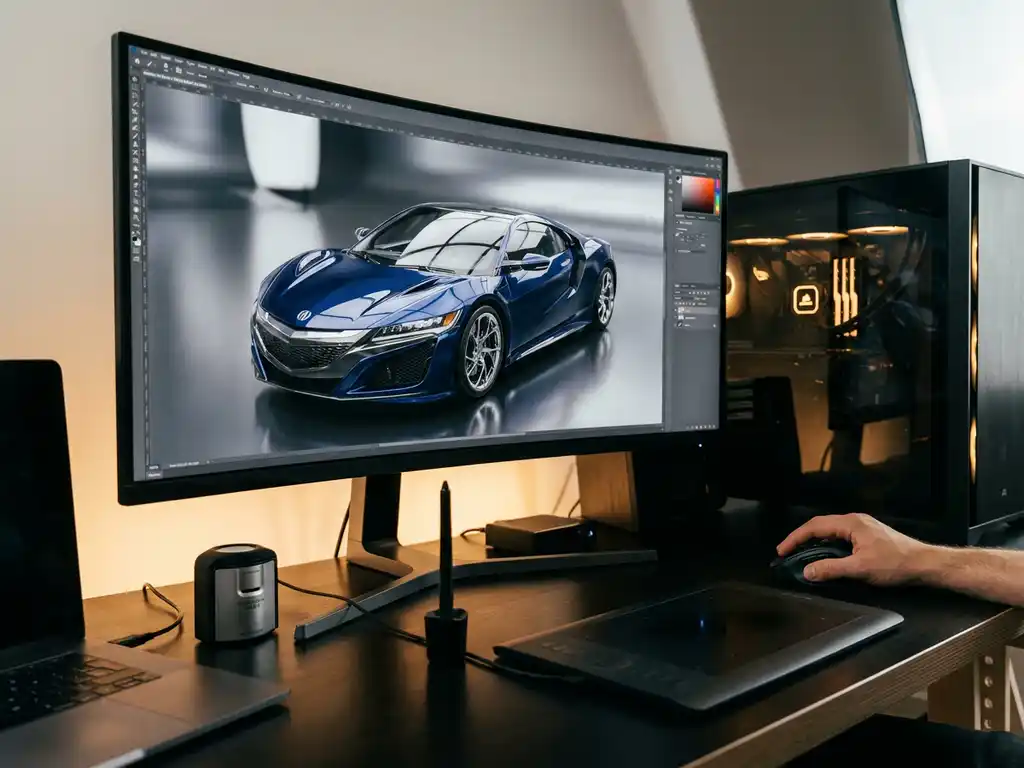
Photorealistic rendering has become the gold standard for creating digital imagery that’s virtually indistinguishable from real photographs. The most realistic renderers today combine advanced ray tracing algorithms, physically based materials, and sophisticated lighting models to achieve stunning visual fidelity. Industry leaders like V-Ray, Arnold, and Octane consistently deliver exceptional results, while real-time engines such as Unreal Engine and Unity have dramatically improved their photorealistic capabilities for interactive applications.
Why is poor rendering quality costing you customer trust?
When your product visuals look artificial or unconvincing, potential customers immediately question the quality of your actual products. Low-quality renders create a disconnect between your brand’s premium positioning and its digital presentation, leading to reduced conversion rates and lost sales opportunities. Customers expect flawless product imagery that matches the sophistication of your offerings, and subpar rendering undermines their confidence in making purchase decisions. The solution lies in investing in photorealistic rendering technology that delivers consistent, high-quality visuals across all your product configurations and marketing channels.
What does inconsistent visual quality signal about your brand standards?
Inconsistent rendering quality across your product lineup sends mixed messages about your brand’s attention to detail and professional standards. When some products appear photorealistic while others look obviously computer-generated, customers perceive a lack of cohesion and quality control in your brand presentation. This inconsistency particularly damages premium brands, where visual excellence is expected at every touchpoint. Establishing standardized rendering workflows and quality benchmarks ensures every product visualization meets your brand’s exacting standards, reinforcing customer confidence in your commitment to excellence.
Visual Commerce Solutions
Talk to our team about your project.
What is a realistic renderer and why does it matter?
A realistic renderer is software that creates computer-generated images indistinguishable from photographs by simulating how light behaves in the real world. These sophisticated tools calculate complex interactions between light, materials, and surfaces to produce images with accurate reflections, shadows, and textures that mirror physical reality.
Realistic rendering matters because it bridges the gap between digital and physical product experiences. For businesses showcasing configurable products, photorealistic rendering enables customers to visualize exactly how their customized items will look without requiring expensive photography for every possible variation. This technology has revolutionized industries from furniture and automotive to fashion and architecture, where visual accuracy directly impacts purchasing decisions.
The quality of your renders affects customer confidence, brand perception, and ultimately sales conversion. When potential buyers can see products with lifelike detail and accuracy, they’re more likely to make purchase decisions and feel satisfied with their choices.
What’s the difference between real-time and offline rendering?
Real-time rendering generates images instantly as you interact with them, typically running at 30-60 frames per second for smooth user experiences. This approach prioritizes speed over absolute visual fidelity, making it ideal for interactive product configurators where customers need immediate visual feedback while customizing products.
Offline rendering, also called pre-rendering, takes significantly longer to produce each image but delivers superior visual quality. These renders can take minutes or hours to complete but achieve photorealistic results with accurate lighting, reflections, and material properties. Offline rendering excels for marketing imagery, product catalogs, and any application where visual perfection outweighs speed requirements.
The choice between real-time and offline rendering depends on your specific needs. Interactive applications benefit from real-time rendering’s responsiveness, while marketing materials and final product presentations often require offline rendering’s superior quality.
Which rendering engines produce the most photorealistic results?
Several rendering engines consistently deliver exceptional photorealistic results, each with distinct strengths. V-Ray remains an industry standard for architectural and product visualization, offering robust material systems and excellent global illumination. Arnold, developed by Autodesk, excels in character rendering and complex lighting scenarios, making it popular in film and animation studios.
Octane Render leverages GPU acceleration for faster photorealistic rendering while maintaining high quality standards. Its real-time preview capabilities help artists achieve desired results more efficiently. KeyShot specializes in product rendering with an intuitive interface and outstanding material library, making it accessible for designers without extensive technical knowledge.
For real-time applications, Unreal Engine has dramatically improved its photorealistic capabilities with advanced lighting systems and material workflows. Unity’s High Definition Render Pipeline also delivers impressive real-time visuals suitable for interactive product experiences.
The “most realistic” renderer often depends on your specific requirements, workflow preferences, and technical expertise rather than the absolute superiority of one solution over others.
How does ray tracing improve rendering realism?
Ray tracing simulates the physical behavior of light by tracking individual light rays as they bounce between surfaces, creating incredibly accurate reflections, refractions, and shadows. This technique calculates how light interacts with materials at each surface contact, producing natural-looking illumination that matches real-world physics.
Traditional rendering methods use approximations and shortcuts to achieve acceptable results quickly, but ray tracing eliminates these compromises for true-to-life lighting. The technology excels at rendering complex materials like glass, metal, and translucent surfaces that require accurate light transmission and reflection calculations.
Modern hardware acceleration has made ray tracing more accessible, with real-time ray tracing now possible for interactive applications. This advancement allows product configuration tools to display materials and finishes with unprecedented accuracy while maintaining responsive user experiences.
Ray tracing particularly benefits product visualization by ensuring materials appear consistent under different lighting conditions, helping customers understand exactly how products will look in various environments.
What factors determine how realistic a 3D render looks?
Material accuracy forms the foundation of realistic rendering, requiring precise recreation of surface properties like roughness, metallic characteristics, and subsurface scattering. High-quality textures with appropriate resolution and detail levels ensure surfaces appear convincing at any viewing distance.
Lighting setup significantly impacts realism, with physically accurate light sources and environmental illumination creating natural-looking scenes. Proper shadow casting, light falloff, and color temperature all contribute to believable lighting conditions that match real-world expectations.
Geometric detail and modeling quality directly affect visual credibility. Smooth curves, appropriate polygon density, and accurate proportions prevent the artificial appearance that betrays computer-generated imagery. Even subtle imperfections and variations can enhance realism by avoiding the overly perfect look of basic 3D models.
Camera settings, including depth of field, motion blur, and lens characteristics, add photographic authenticity to renders. These elements help integrate 3D objects naturally into scenes and create the visual cues viewers expect from real photography.
How 3Dimerce helps with photorealistic rendering
We specialize in delivering stunning photorealistic rendering for premium product visualization, combining cutting-edge technology with over 20 years of expertise in virtual art and CGI. Our visual product experience platform creates blazing-fast, photorealistic renders that showcase your products with touchable textures, perfectly irregular contours, and natural lighting effects.
Our comprehensive solution includes:
- Advanced ray tracing technology for uncompromising visual quality
- Real-time rendering capabilities for interactive product configuration
- Seamless integration with your existing e-commerce and sales platforms
- Consistent photorealistic quality across all product variants and configurations
- Virtual photo studio capabilities eliminating traditional photography costs
Ready to transform your product visualization with photorealistic rendering that matches your premium brand standards? Contact our team to discover how we can elevate your customer experience with stunning, blazing-fast 3D product visualization.
Frequently Asked Questions
How long does it typically take to set up photorealistic rendering for my product catalog?
Implementation time varies based on your product complexity and catalog size, but most businesses see initial results within 2-4 weeks. Simple products with standard materials can be rendered within days, while complex items with multiple material variations may require 1-2 weeks for proper setup. The initial investment in creating accurate 3D models and material libraries pays dividends as new product variants can then be rendered quickly.
What's the cost difference between photorealistic rendering and traditional product photography?
While photorealistic rendering requires higher upfront investment, it becomes significantly more cost-effective for businesses with multiple product variants or frequent launches. Traditional photography costs multiply with each new color, material, or configuration, whereas rendering allows unlimited variations from a single 3D model. Most companies see ROI within 6-12 months, especially when factoring in the speed and flexibility advantages.
Can photorealistic rendering handle complex materials like fabric textures, wood grains, or metal finishes accurately?
Yes, modern photorealistic rendering excels at reproducing complex materials with stunning accuracy. Advanced material systems can capture subtle details like fabric weaves, wood grain patterns, brushed metal finishes, and even translucent materials like marble or glass. The key is using high-quality material scans and proper shader setup to ensure materials respond to lighting exactly as they would in real life.
How do I ensure my rendered products look consistent across different devices and screens?
Consistency across devices requires proper color management and standardized rendering workflows. Use calibrated monitors during production, implement sRGB color profiles for web delivery, and test renders on various devices during development. Professional rendering services typically include color management protocols and provide optimized outputs for different platforms, ensuring your products look consistent whether viewed on mobile phones, tablets, or desktop displays.
What happens if I need to update product designs or add new materials after the initial rendering setup?
Modern rendering workflows are designed for flexibility and updates. Changes to existing products typically require only minor adjustments to the 3D model, while new materials can be added to your material library for use across multiple products. The modular nature of professional rendering systems means updates can often be implemented within hours or days rather than requiring complete re-shoots like traditional photography.
How can I tell if my current product images are hurting my conversion rates?
Key indicators include high bounce rates on product pages, low add-to-cart ratios, frequent customer questions about product appearance, and returns due to products not matching customer expectations. A/B testing with higher-quality renders often reveals significant conversion improvements. If customers frequently ask for additional photos or seem hesitant about product appearance, upgrading to photorealistic rendering typically addresses these concerns and boosts confidence.
Do I need special technical knowledge or software to work with photorealistic rendering services?
No technical expertise is required when working with professional rendering services. You simply provide product specifications, CAD files, material samples, or reference photos, and the rendering team handles all technical implementation. Most services integrate seamlessly with existing e-commerce platforms and provide user-friendly interfaces for managing product configurations and updates without requiring specialized software knowledge.