
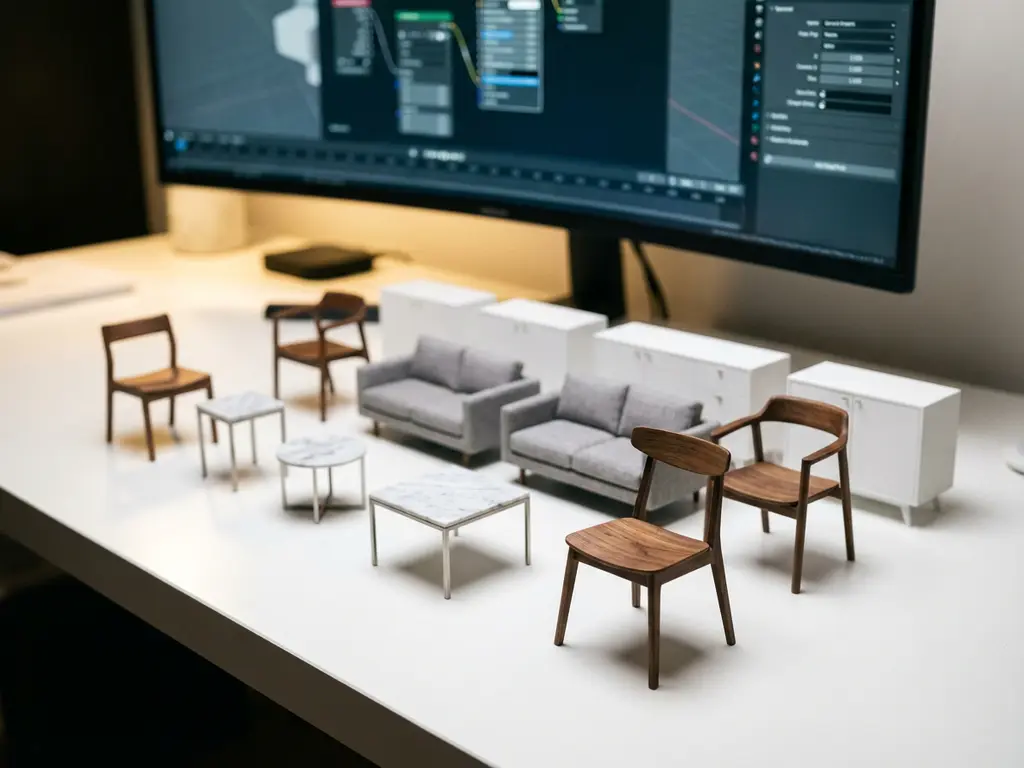
Modern 3D product rendering technology can handle volumes ranging from small catalogues with hundreds of products to enterprise-level systems managing millions of product configurations. Actual capacity depends on technical infrastructure, product complexity, and optimisation strategies. Cloud-based solutions have transformed scalability, enabling businesses to render virtually unlimited product volumes through distributed processing and automated workflows.
What volume of products can modern 3D rendering technology actually handle?
Current 3D product rendering technology can manage anywhere from 500 products for small businesses to more than 10 million configurations for enterprise retailers. Capacity depends on system architecture, hardware specifications, and rendering complexity requirements.
Small and medium-sized businesses typically work effectively with 500 to 50,000 product variations using standard rendering platforms. These systems handle furniture collections, automotive parts, or fashion accessories with multiple colour and material options without performance issues.
Enterprise-level solutions support massive catalogues. Major retailers and manufacturers successfully render millions of product combinations through advanced infrastructure. Automotive companies generate thousands of car configurations, while furniture manufacturers create extensive collections with countless material and design variations.
The key factor isn’t just raw numbers, but rendering speed and consistent quality. Modern systems balance volume capacity with visual excellence, ensuring each rendered image meets professional standards regardless of catalogue size.
How does product complexity affect 3D rendering volume capacity?
Product complexity significantly impacts rendering volume capacity. Simple products with basic geometry and few customisation options allow for higher volumes, while intricate products with detailed textures and multiple configuration possibilities require more processing resources per item.
Basic products like simple furniture pieces or standard electronics can be rendered efficiently in large quantities. These items typically feature straightforward shapes, limited material variations, and consistent lighting requirements, allowing systems to process hundreds simultaneously.
Complex products demand more computational resources. Luxury items with intricate details, multiple material layers, or sophisticated lighting effects reduce overall volume capacity. However, smart optimisation techniques help balance quality with quantity:
- Template-based rendering for product families
- Automated material application systems
- Intelligent detail scaling based on viewing requirements
- Progressive rendering for different quality levels
The goal is to find the optimal balance between visual quality and processing efficiency for your specific product range and business requirements.
What are the main bottlenecks when scaling 3D product rendering?
The primary bottlenecks in scaling 3D product rendering include processing power limitations, memory constraints, storage requirements, and workflow inefficiencies. These technical and operational challenges become more pronounced as volume increases.
Processing power is the most common limitation. Rendering high-quality 3D images requires significant computational resources, especially for complex products with detailed textures and realistic lighting. Traditional single-machine setups quickly reach capacity limits when handling large catalogues.
Memory requirements scale dramatically with volume and complexity. Each product model, texture, and rendering process consumes RAM, creating bottlenecks when system memory becomes insufficient. This particularly affects batch processing of multiple products simultaneously.
Storage needs grow exponentially with both input assets and output images. High-resolution 3D models, texture libraries, and rendered images require substantial storage capacity and fast access speeds to maintain efficient workflows.
Workflow inefficiencies often create the most significant bottlenecks. Manual processes, poor asset organisation, and a lack of automation slow down production regardless of hardware capabilities. Successful scaling requires streamlined, automated workflows that minimise human intervention.
How do cloud-based solutions change 3D rendering volume capabilities?
Cloud-based solutions transform 3D rendering volume capabilities by providing virtually unlimited scalability through distributed processing, automatic resource allocation, and on-demand infrastructure scaling. This eliminates traditional hardware constraints that limit rendering capacity.
Distributed processing allows cloud platforms to split large rendering jobs across multiple servers simultaneously. Instead of rendering products sequentially on single machines, cloud systems process hundreds or thousands of items in parallel, dramatically reducing total processing time.
Automatic resource scaling adapts to workload demands in real time. During peak rendering periods, cloud systems automatically allocate additional processing power and memory. During quieter periods, resources scale down, optimising both performance and costs.
Cloud storage eliminates capacity constraints for both input assets and output images. Businesses can store unlimited 3D models, texture libraries, and rendered images without investing in physical storage infrastructure. Fast content delivery networks ensure quick access regardless of location.
The most significant advantage is eliminating upfront hardware investments. Businesses can access enterprise-level rendering capabilities without purchasing expensive servers, graphics cards, or storage systems. This makes high-volume 3D product rendering solutions accessible to businesses of all sizes.
What strategies help optimise 3D rendering for maximum product volume?
Optimising 3D rendering for maximum volume requires template systems, automated workflows, batch processing, strategic asset reuse, and intelligent resource management. These approaches significantly increase efficiency while maintaining quality standards across large product catalogues.
Template-based systems create standardised frameworks for product families. Instead of building each product from scratch, templates provide consistent structures that can be quickly customised with different materials, colours, and configurations. This approach reduces rendering time per product while ensuring visual consistency.
Automated workflows eliminate manual bottlenecks throughout the rendering process. Automated systems can:
- Import and process 3D models automatically
- Apply materials and textures based on predefined rules
- Generate multiple camera angles and lighting setups
- Export rendered images in various formats and resolutions
Batch processing handles multiple products simultaneously rather than individually. This maximises hardware utilisation and reduces overall processing time. Smart batching groups similar products together to optimise rendering efficiency.
Asset reuse strategies minimise redundant processing. Common materials, lighting setups, and environmental elements are rendered once and applied across multiple products. This approach particularly benefits product families with shared characteristics.
Businesses can explore practical implementation examples to understand how these optimisation strategies work in real-world scenarios.
Hoe 3dimerce helpt met schaalbare productvisualisatie
Our platform addresses volume scalability challenges through advanced cloud infrastructure, automated workflows, and intelligent resource management. We enable businesses to handle massive product catalogues while maintaining exceptional visual quality and rendering speed.
Key capabilities that support large-scale rendering include:
- Unlimited cloud processing – Scale rendering capacity automatically based on demand, without hardware constraints
- Template-based efficiency – Rapid product creation using optimised frameworks for consistent quality
- Automated batch processing – Handle thousands of products simultaneously with minimal manual intervention
- Intelligent asset management – Reuse materials and components across product families for maximum efficiency
- Real-time performance monitoring – Track rendering progress and continuously optimise workflows
Our SaaS solution eliminates the complexity of managing rendering infrastructure while delivering stunning visuals at blazing speed. Whether you’re handling hundreds or millions of product configurations, our platform scales seamlessly to meet your volume requirements.
Ready to explore how scalable 3D product rendering can transform your business? Contact our team to discuss your specific volume requirements and discover the possibilities for your product catalogue. Learn more about our company and how we’ve helped businesses achieve scalable product visualisation success.