
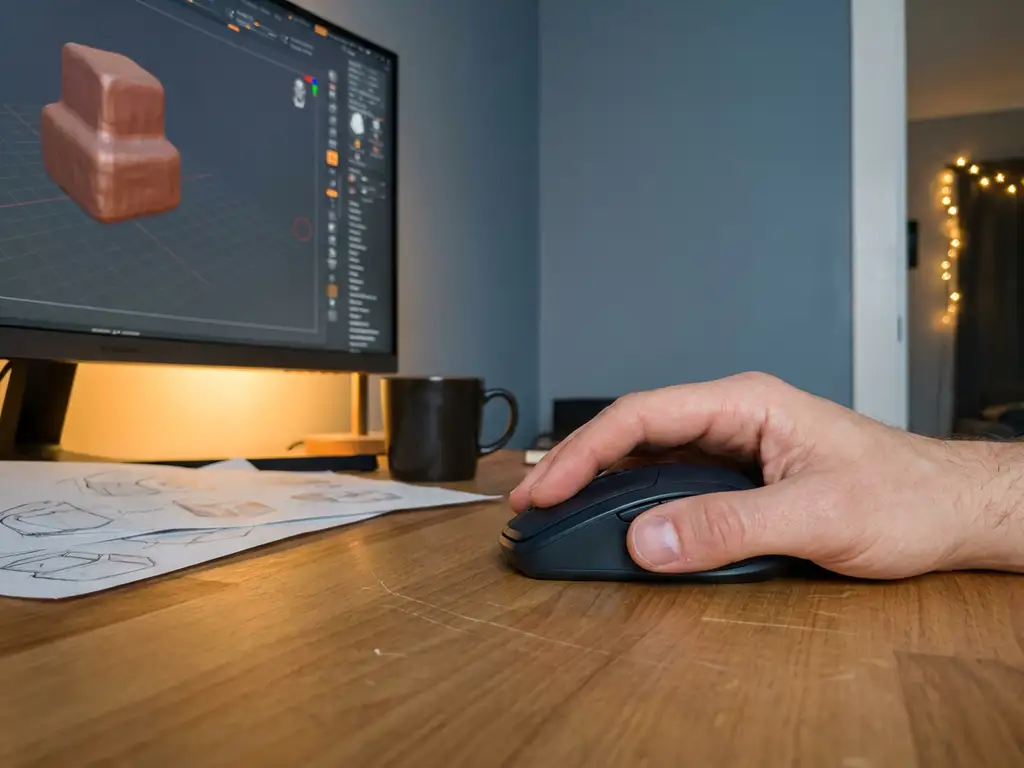
Blender 3D is good for beginners, but it comes with a learning curve that requires patience and commitment. It is a professional-grade, open-source tool that rewards those who stick with it, offering capabilities that rival expensive commercial software at no cost. This article walks through the most common questions beginners have before diving in.
How hard is Blender to learn for a complete beginner?
Blender 3D is moderately difficult for complete beginners. The interface is dense, the keyboard shortcuts are numerous, and the workflow differs significantly from most consumer software. That said, the difficulty is front-loaded: the first few weeks feel steep, but once the core concepts click, progress accelerates quickly.
The biggest challenge for most beginners is not any single feature but rather the sheer scope of what Blender can do. It covers 3D modeling, sculpting, animation, rendering, compositing, and more, all within one application. Newcomers often feel overwhelmed because they are looking at an entire professional production pipeline at once.
The good news is that you do not need to learn everything at once. Most beginners find it helpful to focus on one discipline, such as basic modeling or scene lighting, before branching out. Within a few months of consistent practice, most people can produce presentable work.
What can beginners actually make with Blender?
Beginners can make a wide range of 3D projects in Blender, even within their first few months. Starting expectations should be realistic, but the ceiling is genuinely high compared to most entry-level tools.
Here is what most beginners work toward in their first year:
- Simple 3D objects and props, such as furniture, household items, or abstract shapes
- Basic character models and sculpts
- Short animated sequences or looping motion graphics
- Product renders with lighting and materials applied
- Architectural visualizations of rooms or exteriors
- Stylized scenes for portfolios or social media
The quality of beginner output has improved significantly in recent years because of better learning resources and Blender’s own improvements to its rendering engine, Cycles and EEVEE. A motivated beginner following structured tutorials can produce portfolio-worthy renders within three to six months.
Visual Commerce Solutions
Talk to our team about your project.
What are the best free resources to learn Blender from scratch?
The best free resources to learn Blender 3D from scratch are the Blender Foundation’s official tutorials, the Blender Guru YouTube channel, and the Grant Abbitt channel. These cover everything from absolute zero to intermediate-level skills in a structured, beginner-friendly way.
Here is a suggested learning path using free resources:
- Blender Foundation’s official beginner tutorials — available on YouTube and Blender.org, these introduce the interface and core tools in a methodical way.
- Blender Guru’s Donut Tutorial — one of the most well-known beginner series online, it walks through modeling, texturing, lighting, and rendering using a simple but satisfying project.
- Grant Abbitt’s beginner series — particularly strong for character modeling and sculpting, with a calm and clear teaching style.
- Blender Artists Community forum — a free community where beginners can post work, ask questions, and receive feedback from more experienced users.
- CG Cookie and Blender Market free content — both platforms offer free tutorials and assets that supplement the core learning path.
Consistency matters more than the resource you choose. Thirty minutes of daily practice with any of these materials will produce faster results than sporadic marathon sessions.
How does Blender compare to paid 3D software for beginners?
For beginners, Blender 3D competes directly with paid tools like Cinema 4D, Maya, and 3ds Max, and in many respects outperforms them as a starting point. The most obvious advantage is cost: Blender is completely free, which removes the financial barrier that has historically made 3D a difficult field to enter.
Beyond price, Blender has closed the feature gap considerably. Its rendering quality, sculpting tools, and animation capabilities are professional-grade. The interface was overhauled significantly in version 2.8, making it considerably more accessible than the older versions many critics still reference.
The main advantage paid software holds is industry adoption. Maya and 3ds Max remain dominant in film and game studios, meaning that if a beginner’s goal is to work in a large production house, learning those tools eventually becomes necessary. However, for product visualization, freelance work, e-commerce, and personal projects, Blender is a fully capable and practical choice from day one.
What are the most common mistakes beginners make in Blender?
The most common mistakes beginners make in Blender 3D involve skipping fundamentals, ignoring mesh topology, and trying to learn too many features simultaneously. These habits slow progress and create bad practices that become harder to correct later.
Skipping the fundamentals
Many beginners jump straight into complex projects before understanding how the viewport, object mode, and edit mode interact. Without this foundation, even simple tasks become frustrating. Spending time on the basics, even if it feels slow, pays off significantly within the first month.
Ignoring mesh topology
Beginners often focus entirely on how something looks and ignore how the underlying geometry is structured. Poor topology causes problems when animating, subdividing, or exporting models for use in other applications. Learning to keep geometry clean and logical from the start saves considerable rework later.
Other frequent mistakes include not saving incremental versions of work, overlooking the importance of lighting when evaluating a render, and underestimating how much material and shader knowledge affects the final visual quality of a scene.
Should beginners use Blender or a simpler 3D tool first?
Beginners should start with Blender directly rather than using a simpler 3D tool first, provided they are willing to invest consistent time over several weeks. Simpler tools like Tinkercad are designed for specific use cases and do not build the transferable skills that Blender teaches. Starting with Blender means every skill you develop has long-term professional value.
The argument for starting simple usually comes from the assumption that Blender is too discouraging for newcomers. This was more valid before the 2.8 interface redesign, but in 2026 the software is genuinely more approachable than it once was. The learning curve is real, but it is not a wall.
If your goal is purely functional, for example creating basic geometry for 3D printing or simple game assets, a focused beginner tool may get you to that specific outcome faster. But if your goal is to develop meaningful 3D skills for visualization, design, or creative work, starting with Blender is the more efficient long-term choice.
How 3Dimerce Helps with Professional 3D Product Visualization
Learning Blender 3D is a rewarding journey, but for brands and manufacturers that need high-quality, photorealistic product visuals at scale, a dedicated professional platform delivers results that go far beyond what individual 3D learning can achieve alone. That is where we come in.
At 3Dimerce, we specialize in building premium visual product experiences for design-led brands and manufacturers across Europe. Our platform is built specifically for businesses that need stunning, consistent product visuals across every channel, without the cost and complexity of traditional photography.
Here is what we offer that Blender alone cannot:
- Real-time 3D product configurators that let customers customize and visualize products instantly, online or in-store
- Photorealistic CGI imagery produced at scale, covering every product variant without a single physical photoshoot
- Seamless integration with existing webshops and point-of-sale environments through headless architecture
- A virtual photo studio that replaces slow, expensive photography workflows with agile digital production
- Omnichannel consistency, ensuring your brand looks equally premium online, in print, and in retail
Whether you are a furniture manufacturer launching a new collection or a retailer looking to offer online product customization, we have the tools and experience to make it happen beautifully. Get in touch with us to explore what a professional 3D product experience could look like for your brand.
Frequently Asked Questions
How long does it realistically take to get good enough at Blender to produce professional-looking work?
Most dedicated beginners can produce portfolio-worthy renders within three to six months of consistent daily practice, typically 30 to 60 minutes per day. Reaching a level where you can take on freelance or commercial work usually takes between one and two years, depending on your focus area. Modeling and rendering tend to come faster than animation or rigging, so specializing early can accelerate your timeline considerably.
What computer specs do I need to run Blender as a beginner?
Blender can run on most modern computers, but for a comfortable beginner experience you should aim for at least 16GB of RAM, a dedicated GPU with 4GB or more of VRAM, and a multi-core CPU. For rendering, an NVIDIA GPU with CUDA or RTX support will dramatically speed up Cycles renders compared to CPU-only rendering. If your hardware is limited, using Blender’s EEVEE renderer instead of Cycles is a practical workaround, as it is far less resource-intensive while still producing impressive results.
Can I use Blender to create assets for game engines like Unity or Unreal Engine?
Yes, Blender exports directly to formats like FBX, OBJ, and glTF that are fully compatible with Unity, Unreal Engine, and most other game engines. However, game-ready assets require specific considerations such as low polygon counts, properly baked textures, and clean UV unwraps, which are slightly different skills from general modeling. Many game developers use Blender as their primary asset creation tool, and there are dedicated tutorials covering the Blender-to-game-engine pipeline specifically.
What is the single most important thing a beginner should focus on first in Blender?
The single most important skill to develop first is comfort with the 3D viewport: how to navigate it, understand the three-dimensional space, and switch between Object Mode and Edit Mode confidently. Without this spatial foundation, every other task in Blender becomes unnecessarily difficult. Spend your first week doing nothing but navigating, moving objects, and making simple edits before touching any advanced features.
Are there any common keyboard shortcuts every Blender beginner should memorize early on?
A small set of shortcuts will cover the majority of your early workflow: G (grab/move), R (rotate), S (scale), Tab (toggle Edit Mode), Numpad keys for viewport angles, Ctrl+Z for undo, and Shift+A to add new objects. Learning to use the middle mouse button for viewport navigation is equally important. Blender’s built-in shortcut overlay and the free Quick Favorites menu (Q key) make it easier to build muscle memory gradually without trying to memorize everything at once.
Is it worth paying for premium Blender courses, or are free resources sufficient for beginners?
Free resources are genuinely sufficient to take a complete beginner to an intermediate skill level, and paid courses are not necessary to get started. That said, premium courses from platforms like CG Cookie or dedicated instructors can offer more structured progression, project-based learning, and direct feedback, which some learners find worth the investment after exhausting the free material. A reasonable approach is to complete the major free learning paths first, then invest in a paid course once you have a clearer sense of which specialization, such as character art, product visualization, or motion graphics, you want to pursue.
What should I do when I get stuck or frustrated during the Blender learning process?
Getting stuck is a normal and expected part of learning Blender, and the most effective response is to isolate the specific problem rather than abandoning the project entirely. The Blender Artists Community forum, the official Blender Stack Exchange, and the r/blender subreddit are all active communities where beginners receive fast, helpful answers. If frustration is coming from the scope of a project, scaling it down to a simpler version of the same concept is often more productive than starting something entirely new.