
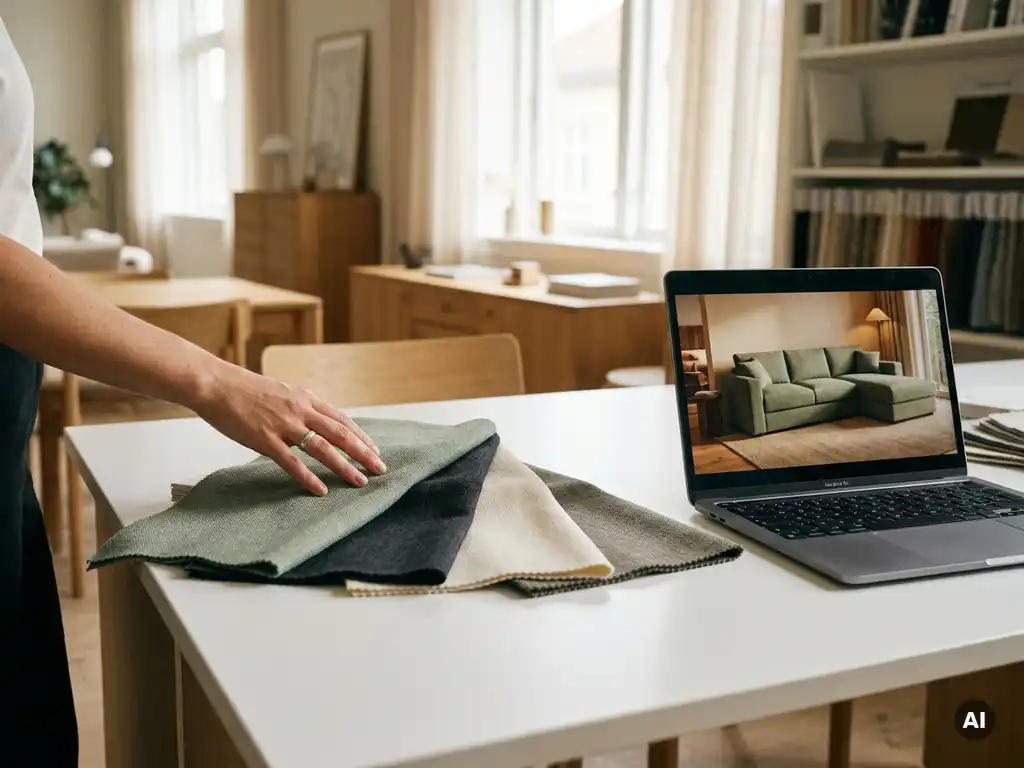
Choosing a CPQ solution for the furniture or interior design industry comes down to finding software that handles complex product configurations, accurate pricing logic, and seamless integration with your sales channels. The right CPQ tool does more than generate quotes; it becomes the engine that connects your product range, your pricing rules, and your customer experience into one smooth workflow. Below, we answer the most common questions brands ask when evaluating CPQ software for their specific needs.
What features should a CPQ solution have for furniture and interiors?
A CPQ solution for furniture and interior design must handle multi-level configuration logic, material and finish variations, dimension-based pricing, and real-time quote generation. It should support complex product rules, ensuring that only valid combinations are selectable, while producing accurate prices instantly, regardless of how many variables are involved.
Beyond the core quoting engine, the most effective CPQ tools for this industry include:
- Rule-based configuration logic: preventing invalid product combinations and guiding buyers toward feasible options
- Dynamic pricing calculation: automatically adjusting quotes based on dimensions, materials, finishes, and quantity
- Multi-channel output: generating quotes that work equally well online, in-store, and through sales teams
- Integration with product catalogs: keeping pricing and product data consistent across every touchpoint
- PDF or digital quote export: producing professional, branded quotations ready to share with clients
For premium furniture and interior brands, visual quality matters as much as functional accuracy. A CPQ tool that pairs configuration logic with photorealistic product visuals adds significant value; customers can see exactly what they are buying before they commit.
What’s the difference between a CPQ and a product configurator?
A product configurator lets customers build and customize a product by selecting options such as materials, colors, and dimensions. A CPQ (Configure, Price, Quote) tool does all of that and then goes further: it calculates an accurate price for the configured product and generates a formal quote, ready for approval or purchase.
Think of it this way: a product configurator answers “what do I want?” while CPQ software answers “what does it cost, and how do I buy it?” In practice, the two are often combined. A customer configures a sofa in their preferred fabric and size, and the CPQ tool immediately calculates the price and produces a quote, all within the same experience.
For furniture and interior design brands selling through multiple channels, the distinction matters. A standalone configurator might work well for inspiration and exploration, but a full CPQ solution is what drives the transaction. It removes the delay between interest and purchase by making pricing transparent and immediate.
How does CPQ software integrate with furniture webshops and POS systems?
CPQ software integrates with furniture webshops and point-of-sale systems through API connections or headless architecture, allowing product data, pricing rules, and configuration logic to flow seamlessly between platforms. This means a customer configuring a product online and a sales assistant guiding a customer in-store are both working from the same accurate, up-to-date pricing engine.
Headless integration is particularly valuable for furniture and interior brands because it allows the CPQ logic to sit behind the scenes while the front-end experience (your webshop, your in-store kiosk, or your sales tool) remains fully branded and tailored to your audience. You are not locked into a rigid interface; the CPQ engine powers whichever touchpoint the customer is using.
Practical integration points typically include:
- E-commerce platforms: connecting the CPQ tool to your webshop so configuration and pricing happen in real time during the shopping journey
- ERP systems: syncing product and pricing data so quotes always reflect current costs and availability
- CRM platforms: logging quotes and customer interactions to support follow-up and sales pipeline management
- In-store POS tools: giving sales staff a guided configuration and quoting tool that works on tablets or touchscreens on the showroom floor
The result is a consistent customer experience across every channel, whether someone is browsing your webshop at midnight or sitting with a sales consultant in your flagship store.
What should you look for in a CPQ vendor for the furniture industry?
When evaluating CPQ vendors for furniture or interior design, prioritize proven experience in the industry, the ability to handle complex configuration logic, and a track record of integrating with the platforms you already use. A vendor who understands the specific challenges of configurable, design-led products will save you significant time and cost during implementation.
Key criteria to assess include:
- Industry references: has the vendor worked with furniture manufacturers, interior brands, or premium product companies before?
- Configuration depth: can the platform handle your most complex products, including dimensional pricing and multi-level option dependencies?
- Visual output quality: does the CPQ tool support photorealistic product visualization, or does it produce flat, uninspiring representations?
- Integration capability: how easily does it connect with your existing webshop, ERP, and in-store tools?
- Scalability: can the platform grow with your product range without significant cost increases per variant?
- Support and onboarding: does the vendor offer genuine implementation support, or does it hand you a manual and walk away?
For high-end and design-led brands, the visual quality of the CPQ output is not a secondary consideration; it is central to the brand experience. A quote that looks as premium as your products builds confidence and reinforces your positioning at every stage of the sales journey. Explore our full platform solutions to see how configuration, visualization, and quoting can work together.
How much does a CPQ solution cost for a furniture or interior design brand?
CPQ solution costs for furniture and interior design brands vary widely depending on the complexity of your product range, the level of integration required, and whether the platform includes visual configuration capabilities. Entry-level tools may start at a few hundred euros per month, while enterprise-grade CPQ software with full integration and photorealistic visualization is typically priced as a tailored SaaS subscription.
Rather than focusing on the software cost in isolation, the more meaningful question is total cost of ownership compared to your current approach. Consider what you currently spend on:
- Traditional product photography for every variant and configuration
- Physical sample libraries and prototype production
- Manual quoting processes that slow down your sales cycle
- Inconsistent visuals across channels that dilute your brand perception
For most furniture and interior brands, the savings on photography, sampling, and sales inefficiency significantly offset the investment in a quality CPQ platform. The right solution pays for itself, not just in cost reduction, but in measurable improvements to conversion rates and average order value.
When is the right time to implement a CPQ solution?
The right time to implement a CPQ solution is when your product range, configuration complexity, or sales volume has grown beyond what manual quoting and static visuals can support efficiently. Common triggers include launching a new product line, replatforming your e-commerce environment, or facing pressure to offer online customization that your current setup cannot deliver.
More specifically, it is worth acting quickly if you recognize any of the following situations:
- Your sales team is spending significant time manually calculating quotes for configured products
- Customers are abandoning the purchase journey because they cannot visualize or price their chosen configuration
- You are launching products faster than traditional photography can keep pace with
- Your in-store and online product experiences feel disconnected or inconsistent
- You are relying on physical showrooms or sample libraries that are expensive to maintain and slow to update
In 2026, the competitive bar for digital product experiences in the furniture and interior design sector has risen considerably. Brands that offer seamless, visually compelling, and instantly priced configuration are pulling ahead, both online and in-store. The longer you wait, the more ground you cede to competitors who have already made the move.
How 3Dimerce helps furniture and interior brands get CPQ right
We built our Ensemble Suite specifically for brands that cannot afford to compromise on visual quality or pricing accuracy. Our CPQ software goes beyond standard quoting tools; it combines advanced configuration logic with photorealistic product visualization, so your customers experience your products at their best while getting accurate pricing in real time.
Here is what working with us looks like in practice:
- Accurate pricing, every time: our CPQ engine handles even the most complex product rules and dimensional pricing without manual intervention
- Stunning visuals built in: configuration and photorealistic imagery work together, so every quote reflects exactly what the customer has designed
- Seamless integration: headless architecture connects our platform to your webshop, ERP, CRM, and in-store POS tools
- Scalable by design: add new products, variants, and markets without proportional increases in cost or complexity
- Built for premium brands: our platform is designed for the high-end, design-led segment, where quality and brand experience are non-negotiable
If you are ready to replace slow, costly, and inconsistent sales processes with a CPQ solution built for the way design-led brands actually work, we would love to show you what is possible. Get in touch with our team and let’s talk about your product range, your challenges, and how we can help.
Frequently Asked Questions
Can CPQ software handle bespoke or made-to-order furniture products, not just standard configurable ranges?
Yes, a well-built CPQ solution can handle fully bespoke and made-to-order products, not just pre-defined configuration options. The key is whether the platform supports open-ended dimensional inputs, custom material specifications, and pricing logic that can calculate costs dynamically based on those unique parameters. For furniture brands that offer truly custom work, this means the CPQ engine needs to be flexible enough to accommodate one-off configurations without requiring manual pricing intervention every time.
How long does it typically take to implement a CPQ solution for a furniture brand?
Implementation timelines vary depending on the complexity of your product range, the number of integrations required, and how much of your pricing and configuration logic needs to be digitised from scratch. For a mid-sized furniture brand with a defined product catalogue, a phased implementation can go live in as little as 8 to 16 weeks. The most time-intensive part is usually mapping your product rules and pricing logic into the system, so having well-documented specifications before you start will significantly accelerate the process.
What happens to our existing product photography and sample libraries once we switch to a CPQ solution with visual configuration?
You do not need to discard existing assets immediately, but over time, photorealistic 3D visualisation within your CPQ platform will reduce your dependency on traditional photography and physical samples significantly. Many brands run both in parallel during a transition period, using CPQ visuals for new product launches and digital channels while existing photography covers legacy catalogue items. The longer-term benefit is that you can retire costly ongoing photography shoots and sample production as your 3D asset library grows to cover your full range.
How do we keep pricing accurate in the CPQ system when our supplier costs or material prices change?
This is managed through your CPQ platform’s integration with your ERP or pricing management system, which acts as the single source of truth for costs and margins. When supplier prices change, you update them in your ERP, and the CPQ engine pulls those updated values automatically, ensuring every new quote reflects current pricing without manual intervention. Establishing this integration correctly from the outset is one of the most important steps in implementation, as it is what keeps your quoting process both accurate and scalable over time.
Can our in-store sales team realistically use a CPQ tool without extensive technical training?
A well-designed CPQ solution should be intuitive enough for sales staff to use confidently after a structured onboarding session, not a prolonged technical training programme. The best platforms guide users through configuration steps with clear rules and visual feedback, so staff do not need to memorise product logic or pricing formulas. Look for vendors who offer role-specific interfaces, meaning your in-store team sees a streamlined sales tool, while back-end administrators manage the rules and pricing logic separately.
What is the biggest mistake furniture brands make when choosing a CPQ solution?
The most common mistake is selecting a generic CPQ platform built for industries like software or manufacturing, then attempting to adapt it to the specific demands of configurable, design-led furniture products. Generic tools often struggle with dimensional pricing, material and finish logic, and the visual quality standards that premium furniture brands require. Choosing a vendor with genuine furniture and interior design experience means the platform is already built around your type of complexity, which reduces implementation risk, shortens timelines, and produces a far better end result for your customers.
Can a CPQ solution support multiple sales channels simultaneously, such as B2C online, B2B trade, and in-store?
Yes, and this is one of the most valuable capabilities of a modern CPQ platform built on headless architecture. The same configuration logic and pricing engine can power different front-end experiences simultaneously, with each channel presenting the relevant interface, pricing tier, and output format for its audience. For example, a B2C webshop might show retail pricing and a polished visual configurator, while a B2B trade portal for interior designers shows net pricing and a quote request workflow, all driven by the same underlying CPQ engine.